
Total Reward Strategy Examples: A Guide for UK SMEs in 2026
- Pioneer HR
- Jul 15
- 12 min read
Updated: 6 days ago
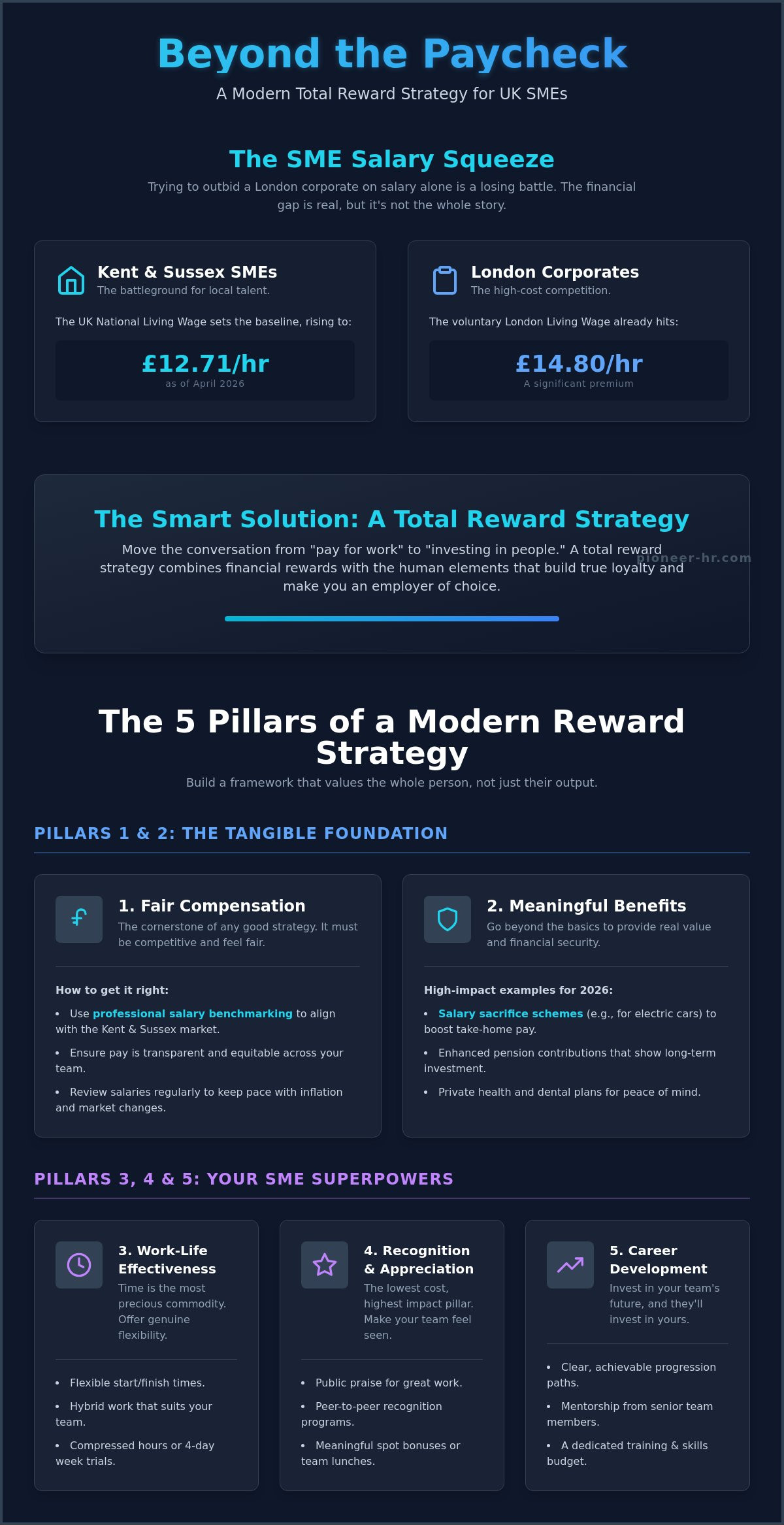
If you're an SME in Kent or Sussex, trying to outbid a London corporate on base salary alone is a race you've already lost. With the National Living Wage rising to £12.71 in April 2026 and London's voluntary Living Wage hitting £14.80, the financial pressure on smaller firms is immense. We've seen many brilliant teams struggle with turnover simply because they feel they can't compete with the deep pockets of the city. However, money is rarely the only reason people stay or go. By looking at specific total reward strategy examples, we can see that smaller businesses have a secret weapon: the ability to offer a more personal, flexible, and meaningful working life.
We understand the challenge of balancing a tight budget with the need to keep your best people happy and loyal. That's why we've created this guide to help you move beyond basic pay and pension. You'll learn how to build a framework that values the whole person, not just their output. We'll walk you through practical, cost-effective ways to enhance your offering, from salary-sacrifice schemes to career development paths that actually mean something. By the end of this article, you'll have a clear roadmap to create a workplace where talent chooses to stay, even when a recruiter comes calling.
Table of Contents
What is a Total Reward Strategy and Why Does it Matter in 2026?
In the current UK climate, simply handing over a paycheck isn't enough to keep your best people. A reward strategy in 2026 is about the entire value proposition you offer an employee. It's the sum of their base salary, the benefits package, and those "intangible" elements like company culture and professional growth. While the broader field of Reward Management covers the technicalities, for a small business in Kent or Sussex, it's really about showing your team they're more than just a line on a spreadsheet. We've found that when firms move beyond the basic pay slip, they stop being a commodity and start being a partner in their employees' lives.
The Difference Between Pay and Total Reward
If you rely solely on salary to attract talent, you're entering a bidding war against London firms with much deeper pockets. It's a transactional relationship that often ends when someone else offers a few thousand pounds more. Total reward moves the conversation from "pay for work" to "investing in people." By looking at total reward strategy examples, we see that relational rewards, such as mentorship or flexible hours, build much stronger loyalty. This shift directly strengthens your Employer Value Proposition (EVP). It makes you a destination of choice rather than just a stop on a career path. You're no longer just buying someone's time; you're earning their commitment.
Current UK Market Drivers for SMEs
The UK market has shifted significantly following the cost-of-living adjustments of 2025 and early 2026. Employees now look for financial sustainability alongside personal well-being. In the South East, where commuting costs to London remain high, the ability to work hybrid or remotely has become a high-value reward currency. Smaller firms can out-manoeuvre corporate giants by being more agile with these arrangements. Instead of rigid policies, you can offer genuine flexibility that fits a person's life in Brighton or Hove. When we examine modern total reward strategy examples, we see that successful SMEs prioritize health and financial stability over flashy, low-value perks. This personal touch is the secret to reducing high employee turnover. It ensures your business grows alongside a stable, engaged team that feels truly seen and supported.
This focus on financial stability often extends to helping employees manage rising domestic costs. For instance, some forward-thinking businesses are incorporating sustainability benefits into their packages, such as facilitating solar panel installation Hertfordshire to help staff reduce their long-term energy bills.
The 5 Essential Pillars of a Modern UK Reward Strategy
Building a reward strategy is like constructing a house. You need a solid foundation, but you also need the walls, the roof, and the interior finishes to make it a place people actually want to stay. In our experience working with SMEs across the South East, we see five distinct pillars that make up a successful framework. When you look at total reward strategy examples that actually work, they never focus on just one area. Instead, they balance the tangible financial elements with the intangible experiences that make a job feel like a career.
Pillar 1 & 2: The Tangible Rewards
Everything starts with base compensation. It's the foundation. With the National Living Wage at £12.71 as of April 2026, the baseline has shifted for everyone. If your pay isn't competitive, your employees will feel undervalued before they've even finished their first cup of coffee. This is why salary benchmarking is so vital. You need to know that your rates aren't just "okay" but are fair compared to other firms in Kent and Sussex. Beyond the base salary, your benefits package is your chance to stand out. In 2026, we're seeing a huge move towards salary sacrifice schemes for electric cars and enhanced pension contributions. These aren't just perks. They're tax-efficient ways to increase an employee's take-home value while managing your own National Insurance costs. If you aren't sure where to start, our reward strategy experts can help you design a package that fits your specific budget.
Pillar 3, 4 & 5: The Intangible Rewards
This is where smaller businesses can truly outshine the big London corporates. For many professionals in the South East, time is now the most precious commodity. Work-life effectiveness isn't just about "working from home." It's about genuine flexibility that allows a parent to attend a school play or a commuter to avoid the worst of the Southern Rail delays. Recognition and appreciation are the lowest cost but highest impact pillars. A simple, public "thank you" or a small token of gratitude can boost morale more than a generic corporate bonus ever could. Finally, you must invest in career development. Through strategic organisational development, you can show your team a clear path forward. People stay when they see they're growing. When you study successful total reward strategy examples, you'll notice they all treat learning and development as a core part of the "payback" for an employee's hard work.
Total Reward vs. Salary Benchmarking: Which Do You Need?
It's easy to get the two confused, but benchmarking and strategy serve very different purposes. Benchmarking gives you the raw data on what the market currently pays for specific roles. Total reward, on the other hand, is the strategic plan that uses that data to build a competitive package. You can't have a successful strategy without the data; data without a strategy is just a list of numbers. When we look at successful total reward strategy examples, the data is always the starting point. In a volatile UK economy, relying on one without the other is risky. You might end up overpaying for roles that don't drive value, or underpaying and losing your best talent to a competitor in Kent or London.
Using professional salary benchmarking services allows you to identify specific pay gaps before they become a crisis. It's about more than just matching a number. It's about understanding where you sit in the market and making conscious choices about where you want to lead or follow. If you don't have this baseline, your reward strategy is essentially guesswork. You might be offering expensive perks that your employees don't actually value, while missing the mark on the basic pay that provides them with financial security.
When to Benchmark Your Salaries
You'll know your pay scales are out of date when you start losing great candidates at the final interview stage. If a Hove-based SME hasn't reviewed its pay structures in the last twelve months, it's likely falling behind the fast-moving South East market. We recommend a full review at least once a year to keep pace with inflation and regional shifts. During this process, job grading is essential for maintaining internal equity. It ensures that roles with similar levels of responsibility are paid fairly relative to each other, preventing the kind of internal friction that leads to high turnover and low morale.
Moving from Data to Strategy
Once you have the numbers, you can decide where to focus your non-monetary rewards. If the data shows you're slightly below the London average for a specific role, you can bridge that gap with genuine flexibility or better well-being support. This is where a fractional CPO provides immense value, as they help translate spreadsheets into a culture people love. By studying modern total reward strategy examples, we see that the most resilient firms use data to be brave with their benefits. Benchmarking data acts as the essential sanity check for your reward ambitions, ensuring your creative perks aren't just papering over a crumbling financial foundation. When you understand both the "what" and the "why," you can build a package that truly resonates with your team.
3 Real-World Total Reward Strategy Examples for UK SMEs
While the theory of reward management is useful, most business owners we speak to in Brighton or Kent want to see how this actually works on the ground. A strategy for a 15-person marketing agency in Hove shouldn't look like a carbon copy of a global bank's policy. The beauty of being an SME is your ability to be creative without the red tape. By looking at these total reward strategy examples, you can see how different businesses balance their specific goals with their available budget.
Example 1: The "Flex-First" Tech Startup (London/Sussex)
This model is perfect for businesses competing with London tech salaries but wanting to offer a better quality of life. Instead of trying to match a six-figure corporate base, they focus on autonomy. Key features often include unlimited holiday, with a mandatory 25-day minimum to prevent burnout, home office stipends, and share options. It works because it attracts talent who are tired of the corporate grind and value the freedom to work from a garden office in Sussex. The cash outlay is moderate, but the intangible value of trust and ownership is exceptionally high.
Example 2: The "Values-Led" Professional Services Firm
For established firms in sectors like law or finance, stability is the primary currency. These total reward strategy examples typically feature enhanced maternity and paternity pay, higher-than-average pension contributions, and professional development grants. We're also seeing a rise in the 4-day work week as a key differentiator. This approach targets mid-career professionals who are looking for long-term security and work-life balance. While it requires a high operational commitment to manage workloads, it significantly reduces the cost of recruitment by keeping staff for the long haul.
Example 3: The "Community-Centric" Local Business
Smaller, local businesses in Kent or Sussex often find success by leaning into their local roots. This strategy might include discounts at other local businesses, paid volunteer days to support local charities, and quarterly profit-sharing schemes. It's about making employees feel like part of something bigger than just a workplace. This model has a low cash outlay but creates a massive cultural impact. It builds deep loyalty within the local talent pool, making it harder for national competitors to lure people away.
If you're ready to move beyond generic perks and build a framework that actually fits your business, we can help. Our team can design a bespoke reward strategy that aligns with your values and your budget.
How to Implement Your Reward Strategy with Pioneer HR
Implementing a total reward strategy is a journey that requires both hard data and genuine empathy. We've seen many Sussex businesses rush into buying flashy benefits without checking if their foundations are solid. By studying successful total reward strategy examples, we've developed a structured four-step process that ensures your investment actually pays off in higher retention and better morale. It isn't just about picking perks; it's about building a sustainable culture.
We start with a thorough HR audit to identify exactly where your current offering stands. Once we know the gaps, we move into salary benchmarking. This step is non-negotiable. It fixes your base pay foundations so you aren't trying to build a culture on top of unfair or outdated wages. After the numbers are right, we design the "Total" package by listening to your employees. Finally, we handle the roll-out. Communication is the most overlooked part of this process. If your team doesn't understand the value of their private medical insurance or flexible hours, it isn't a reward; it's just an overhead.
Avoiding Common Implementation Pitfalls
Copying total reward strategy examples from a competitor in Kent or a giant in London is a recipe for failure. Your business has a unique DNA. A perk that works for a tech startup might feel patronising to a traditional law firm. Transparency is also vital. In 2026, employees expect clarity around how pay and benefits are decided. To measure your ROI, look at your turnover rates and the results of your engagement surveys. A successful strategy should lead to a measurable drop in recruitment costs and a noticeable lift in productivity.
Partnering for Success
You don't need a full-time HR Director to get this right. Our Fractional CPO service gives you high-level strategic guidance without the executive salary. For ongoing peace of mind, many of our clients in Hove and Brighton choose retained HR support to keep their reward structures fresh and compliant. We believe that small businesses deserve big-company strategy. If you're ready to stop guessing and start building a workplace people love, contact Pioneer HR today. Let's create a strategy that keeps your best people exactly where they belong.
Start Building a Reward Strategy That Actually Works
Competing in the UK talent market in 2026 requires more than just a competitive salary. It's about creating a culture where people feel valued, supported, and challenged. By focusing on the five pillars we've discussed, from base pay to meaningful career development, you can create an offer that stands out even against London's corporate giants. Smaller firms in Kent and Sussex have a unique opportunity to lead with agility and heart. When you prioritise the whole employee experience, you stop competing on price alone and start competing on value.
Whether you're inspired by our total reward strategy examples or you're ready to fix your foundations with expert salary benchmarking, the first step is always the most important. You don't have to navigate these complex decisions alone. With over 30 years of HR expertise and specialist UK data, we're here to provide the tailored support your business needs. We specialise in helping SMEs across Hove and Brighton find the perfect balance between budget and impact. Let's work together to ensure your best talent stays with you for the long term.
Book a Reward Strategy Consultation with Pioneer HR
Frequently Asked Questions
What is the most important element of a total reward strategy?
Fair and competitive base compensation is the essential foundation. While perks and culture are vital, they won't compensate for a salary that sits below market rates. We always recommend starting with professional benchmarking to ensure your core pay is solid. Once that foundation is secure, the most important element is ensuring your rewards align with what your specific team actually values.
How can a small business with a tight budget create a total reward strategy?
You can leverage your agility to offer high-value, low-cost rewards that larger corporates often struggle to implement. Genuine flexibility, such as flexible start times or hybrid working, costs very little but is a top priority for most employees. By studying total reward strategy examples for smaller firms, we see that things like extra holiday days or enhanced autonomy can often outweigh a slightly higher salary at a rigid organisation.
Is a total reward strategy the same as an employee value proposition (EVP)?
They are related but serve different functions. Your total reward strategy is the specific package of tangible and intangible rewards you offer. Your EVP is the broader promise and identity of your brand. Think of total reward as the practical substance that proves your EVP is real. It's the "what" that backs up the "why" of working for your business in Sussex or Kent.
How often should we review our total reward strategy in the UK?
We recommend a full review at least once a year. The UK market moves quickly, particularly with annual adjustments to the National Living Wage and shifting inflation rates. If you're based in a high-competition area like Hove or near London, you may need to check your benchmarking data even more frequently. Regular reviews ensure your package remains relevant and that you aren't losing talent to more proactive competitors.
Do employees really care about non-monetary rewards in 2026?
Employees are prioritising their well-being and time more than ever before. While salary provides financial security, non-monetary rewards like health insurance, mental health support, autonomy, and personalized health technology from Cura+ provide quality of life. Many professionals in the South East are now willing to trade a higher London salary for a local role that offers a better balance and less time spent on a train.
What are some examples of low-cost recognition rewards for SMEs?
Recognition doesn't have to be expensive to be effective. Simple gestures like a public "shout-out" in a team meeting or a handwritten note from the founder can have a significant impact. Other total reward strategy examples include "early finish Fridays" during the summer months or small vouchers for local coffee shops in Brighton. These touches show your team that their hard work is genuinely noticed and appreciated.
How does a total reward strategy impact recruitment in Sussex and London?
A strong strategy allows Sussex SMEs to compete with London firms by offering a more holistic and human-centric package. Instead of trying to win a bidding war on base salary alone, you can win on culture, flexibility, and community. It helps you attract candidates who are looking for a role that fits their lifestyle and values rather than just a paycheck.
Can a total reward strategy help reduce the gender pay gap?
It's a powerful tool for improving equity across your business. By using objective job grading and transparent pay structures, you remove the unconscious bias that often leads to pay gaps. A clear strategy ensures that everyone is rewarded based on their role and contribution rather than their negotiation skills. This level of fairness is increasingly important to the modern UK workforce and helps build an inclusive culture.


Comments