
Managing Employee Grievances in the UK: A Strategic Guide for 2026
- Pioneer HR
- 3 days ago
- 13 min read
Updated: 1 day ago
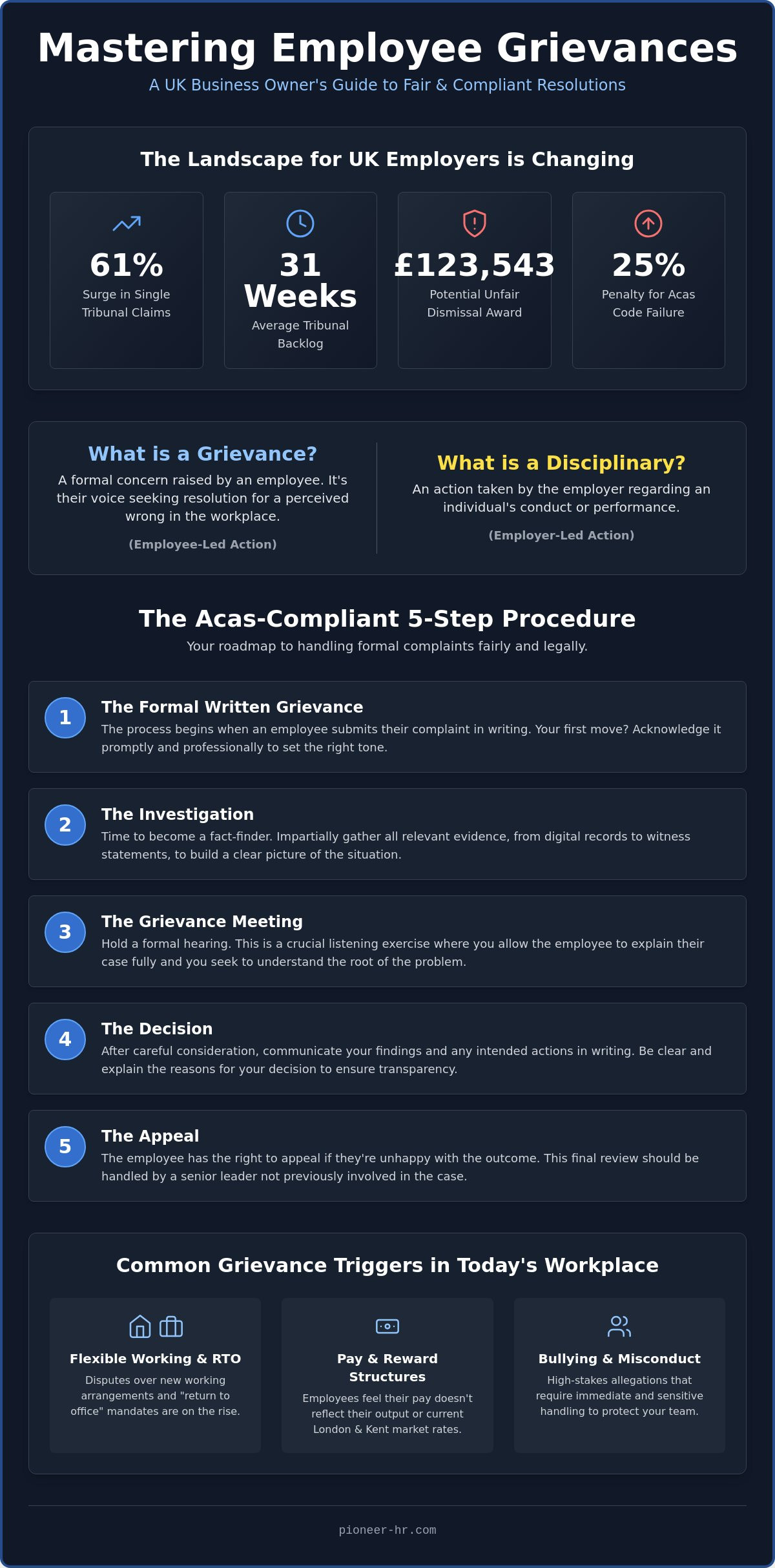
Did you know that single claims filed at employment tribunals surged by 61% in late 2025, leaving many UK business owners facing a backlog that now stretches over 31 weeks? It’s completely understandable if the thought of a formal complaint landing on your desk feels like a major setback for your company's momentum. We know how much you value your team’s harmony, and the anxiety of potential Acas non-compliance or a £123,543 unfair dismissal award is enough to keep any leader in London or Kent awake at night.
This guide is designed to help you master the art of managing employee grievances uk, turning a stressful legal hurdle into a strategic opportunity to strengthen your workplace culture. By refining your approach, you can achieve fair, legally robust resolutions with minimal disruption to your daily operations. We’ll walk through the 2026 regulatory shifts, including the new six-month tribunal claim time limits and the Fair Work Agency's enforcement powers, to ensure your business remains protected and your morale stays high.
Table of Contents
What is an Employee Grievance? Understanding the UK Framework
When we look at What is an Employee Grievance?, we define it as a formal concern, problem, or complaint raised by a staff member. It’s the vital channel through which your team communicates that something isn't right in their working environment. It’s helpful to view a grievance as the opposite of a disciplinary process; while a disciplinary is an employer-led action regarding an individual's conduct or performance, a grievance is the employee's voice seeking a resolution to a perceived wrong.
The Acas Code of Practice on Disciplinary and Grievance Procedures serves as the gold standard for these situations in the UK. While the Code isn't strictly a law, it’s a framework that employment tribunals take very seriously. If your business is found to have unreasonably failed to follow its guidance, a tribunal has the power to increase any compensation awarded against you by up to 25%. For SMEs across London and Kent, a robust written grievance policy is the best way to ensure consistency and fairness while protecting the organization from costly procedural errors.
Common Triggers for Grievances in 2026
The workplace has shifted, and the reasons people raise concerns have evolved. We've seen a sharp rise in disputes regarding flexible working arrangements and "return to office" mandates as businesses try to find their post-pandemic equilibrium. Often, these tensions are linked to pay and reward structures, where employees feel their compensation doesn't reflect their output or current market rates. Additionally, allegations of bullying or gross misconduct remain high-stakes triggers that require immediate, sensitive handling to protect your reputation and team stability.
Informal vs. Formal Resolution
Effective managing employee grievances uk often begins with a quiet, informal resolution. Many disputes can be resolved before they escalate if a line manager has the skills to listen and act. However, you must recognize the moment the formal clock starts. If an employee submits a written complaint or if the issue involves serious allegations, you must move to your formal procedure immediately. Even at the informal stage, we always recommend keeping clear documentation of conversations and outcomes. This creates a reliable audit trail that demonstrates your commitment to a fair process, which is essential for protecting your business and maintaining long-term employee retention.
The UK Formal Grievance Procedure: A 5-Step Compliance Guide
When an informal chat isn't enough to resolve a workplace issue, we must pivot to a structured formal process. Following a clear path isn't just about ticking boxes for compliance; it’s about demonstrating to your team that you treat every concern with professional rigour and respect. The Acas Code of Practice provides the essential blueprint for this, ensuring that both the business and the employee are treated fairly. Mastering these steps is the cornerstone of effectively managing employee grievances uk while protecting your company from future litigation.
We recommend following these five core steps to maintain a robust process:
Step 1: The Formal Written Grievance. The employee should submit their complaint in writing, detailing specific incidents and dates. We should acknowledge receipt promptly in writing to set a professional tone from the start.
Step 2: The Investigation. We gather all relevant evidence, including digital records and witness statements. This phase is about establishing the facts of the situation without bias.
Step 3: The Grievance Meeting. We hold a formal hearing to allow the employee to explain their case in full. This is a listening exercise where we seek to understand the root of the problem.
Step 4: The Decision. After careful deliberation, we communicate our findings in writing. This document must clearly explain the reasons for our decision and any actions we intend to take.
Step 5: The Appeal. If the employee is dissatisfied with the outcome, they have the right to appeal. This review should ideally be conducted by a senior leader who hasn't been involved in the case until now.
Conducting a Fair Investigation
Maintaining total impartiality can be difficult for smaller teams in Kent or Sussex where colleagues often share close working relationships. We must separate objective facts from subjective opinions. A witness claiming a manager was "being difficult" is an opinion; a witness stating a manager "denied three consecutive holiday requests without explanation" is a factual observation. Handling confidential data and witness statements with extreme care is non-negotiable to protect the integrity of the process and the privacy of your staff.
Managing the Grievance Meeting
The atmosphere of a grievance meeting should be objective and calm rather than adversarial. We are there to gather information, not to defend a position. It is vital to remember that the right of accompaniment is a statutory requirement in the UK. This means every worker has the legal right to bring a fellow colleague or a trade union representative into the meeting to support them. If you find these procedural steps daunting, our Retained HR Support offers the expert backing you need to ensure every conversation is handled with precision and care.
Strategic Grievance Management: Linking Conflict to Reward and Retention
While the previous sections focused on the procedural "how" of managing employee grievances uk, we must also look at the strategic "why." Grievances aren't just legal risks to be mitigated; they're often symptoms of deeper organisational friction. When an employee raises a formal concern, it's frequently a signal that your internal structures, particularly around pay and career progression, no longer align with their expectations. By treating these complaints as a diagnostic tool rather than a nuisance, we can uncover insights that drive long-term retention and cultural health, especially as talented individuals increasingly use platforms like Rezumi to keep their resumes optimized for the next opportunity.
In the competitive tech industry, where talented individuals can use QuickApply to quickly find and apply for new roles, addressing these grievances early is key to maintaining a stable workforce.
A significant portion of grievances in the UK's competitive markets, especially in London, stems from perceived unfairness in compensation. If your team feels their pay has stagnated while the market moves forward, resentment builds. This is where proactive salary benchmarking becomes essential. It moves the conversation from subjective emotion to objective data. When you combine this with transparent job grading, you provide a clear roadmap for growth that reduces the likelihood of "equal pay" or "fairness" disputes before they even begin.
We believe that a regular HR Audit is the most effective way to identify these trends early. If you notice a cluster of grievances in one specific department or regarding a particular policy, it's time to investigate the root cause. This proactive approach ensures you're adhering to the Acas Code of Practice on Disciplinary and Grievance Procedures not just in letter, but in spirit, by fostering an environment where issues are resolved through structural improvement rather than just individual mediation.
The Cost of Mismanaged Conflict
To reclaim management time and improve your bottom line, consider optimizing your vendor contracts; professional negotiation and RFP management from rightcostiq.com can help ensure your resources are used most effectively.
Unresolved conflict is expensive. Beyond the obvious threat of a £123,543 unfair dismissal award, there are hidden costs in management time and lost productivity. In the South East, where the war for talent is particularly fierce, high turnover resulting from a "blame culture" can be devastating. Engaging a reward consultancy mindset helps you design systems that prevent pay-based complaints, ensuring your leadership team spends their energy on growth rather than damage control.
When turnover does occur as a result of unresolved conflict, finding high-quality replacements is the next priority; for businesses with operations or recruitment needs in the Mediterranean, you can explore Πακέτα Δημοσίευσης Αγγελιών on Alpha.jobs to reach top-tier talent in Cyprus.
Mediation as a Strategic Tool
Sometimes, even the best structures can't prevent a personality clash or a breakdown in communication. In these cases, particularly for sensitive executive disputes in London, external mediation is a powerful alternative to the formal route. A neutral third party can help rebuild bridges that a rigid formal process might burn. This aligns perfectly with a partnership-led culture, where the goal isn't just to "win" the case, but to preserve the working relationship and maintain team stability.
Avoiding Employment Tribunals: Compliance Risks for UK Employers
The financial stakes of managing employee grievances uk have never been higher. As of April 2026, the maximum compensatory award for unfair dismissal has reached £123,543. However, the real danger lies in the "25% Uplift" rule. If an employment tribunal finds that you've unreasonably failed to comply with the Acas Code, they can increase the total compensation by a quarter. This isn't just a minor penalty; it’s a significant financial hit that can destabilise an SME in Kent or Sussex. We see many businesses fall into this trap by rushing the process or skipping the appeal stage entirely, especially now that the tribunal claim time limit has doubled to six months as of October 2026.
Ensuring your business has the financial stability to handle such risks is crucial; for organizations with international trade accounts, you can explore 商業催收服務 provided by Whole King Company Limited to efficiently manage and recover commercial debts.
Consistency is your strongest shield against legal challenges. Treating two similar complaints differently is a classic legal trap that often leads to allegations of discrimination or favouritism. If one employee in your London office receives a formal apology for a pay error while another is told to just "get over it," you're creating a clear path for a constructive dismissal claim. In these cases, the employee argues that the relationship of trust and confidence has been fundamentally broken, allowing them to resign and sue for damages. We must ensure that every decision is backed by a clear rationale that stands up to external scrutiny.
The Role of Management Training
We often find that "accidental managers", those promoted for their technical skills rather than their people skills, are the biggest compliance risk. Without proper Management Training, these leaders might accidentally ignore an initial complaint or handle it with a lack of objectivity. Investing in leadership coaching ensures your team can spot the early signs of friction before they escalate. We recommend a "lessons learned" review after every formal case to identify if a specific policy or management style is repeatedly triggering concerns.
Documentation and Data Protection
Your evidence bundle is what wins or loses a tribunal case. You must keep secure, dated records of every meeting, witness statement, and decision letter in strict accordance with UK GDPR requirements. We suggest keeping grievance records for at least six years, though access should be strictly limited to those involved in the case. Effective managing employee grievances uk relies on having a well-organised, chronological timeline of events. This demonstrates to a judge that you acted reasonably and professionally at every turn, which is often the difference between a dismissed claim and a costly settlement.
If you're worried about your current procedures or want to ensure your managers are fully equipped to handle complaints, our Retained HR Support provides the expert guidance you need to stay compliant and protected.
How Pioneer HR Supports Strategic Grievance Resolution
We understand that facing a formal complaint can feel like a heavy burden on your leadership team. It’s not just about the paperwork; it’s about the emotional energy and the potential disruption to your business's rhythm. At Pioneer HR, we bring over 30 years of deep HR experience to the table, led by Sarah-Jane (SJ) and our senior team. We don't believe in the distant, transactional approach of a call-centre. Instead, we act as your dedicated strategic partner, providing the calm, expert guidance needed for effectively managing employee grievances uk.
For particularly sensitive or high-stakes disputes, our Fractional CPO service provides a unique advantage. This isn't just basic advice; it’s executive-level strategy designed to resolve complex cases before they reach a tribunal. We look beyond the immediate conflict to see the bigger picture, often applying our "Reward First" methodology. Since many grievances are actually rooted in perceived unfairness regarding pay, we address the cause at its source, ensuring your reward structures are transparent and competitive from the outset.
Our Dedicated Retained HR Support
We pride ourselves on being a seamless extension of your management team across London, Kent, and Sussex. Our Retained HR Support is built on the foundation of partnership and trust. We don't just wait for things to go wrong; we’re proactive. This means we conduct regular policy reviews to keep your business ahead of the major 2026 legislative changes, such as the new Fair Work Agency powers and the doubled tribunal claim time limits. Having a partner who knows your culture and your people personally makes a world of difference when tensions rise.
Get Started with a People Strategy Review
If you're currently dealing with a difficult situation or simply want to ensure you're protected, we recommend starting with a People Strategy Review. This focused assessment helps us identify immediate risks in your current grievance and reward processes. It’s the first step in transitioning your business from reactive firefighting to strategic, confident people leadership. We’ll help you build a workplace where conflict is handled with a professional calibre, protecting your reputation and your bottom line.
Building a Resilient Workplace for 2026 and Beyond
Successfully managing employee grievances uk in 2026 requires more than just a passing knowledge of the Acas Code. It demands a proactive culture where conflict is viewed as a diagnostic tool for your reward structures and leadership health. By following a robust five-step procedure and ensuring your managers in London and Kent are fully trained, you can transform potential legal risks into opportunities for genuine organisational growth. We've seen how procedural errors can lead to a 25% uplift in tribunal awards; staying ahead of these risks is essential for your stability.
At Pioneer HR, we don't believe in the distant, scripted advice of a call-centre. We offer a senior-led consultancy built on 30+ years of strategic HR experience, specifically tailored to the unique business culture of the South East. We're here to help you move beyond reactive firefighting and toward a partnership that prioritises both compliance and team morale. Our goal is to ensure your business remains a high-performing environment where disputes are resolved with professional calibre.
Protect your business and your people with our Retained HR Support.
It's time to build a workplace where every voice is heard and every process is legally sound. We're ready to help you lead with confidence and protect what you've built.
Frequently Asked Questions
Do I have to follow the Acas Code if I only have two employees?
Yes, the Acas Code applies to every employer in the UK, regardless of how many people you employ. Even for a small team in Kent, failing to follow the code can lead to a 25% increase in tribunal awards if a claim is successful. We always advise smaller businesses to maintain a simple, written policy to ensure they meet these basic legal expectations from day one.
What is the typical timeframe for resolving a formal grievance in the UK?
There isn't a strict statutory deadline, but you must handle the process without unreasonable delay. We usually recommend acknowledging a written complaint within two working days and aiming to hold the initial meeting within five to ten days. If an investigation is complex and requires more time, you should keep the employee updated to maintain trust and show that you're taking their concerns seriously.
Can an employee raise a grievance after they have left the company?
Yes, former employees can still raise a grievance after their employment has ended. While you aren't legally required to follow the full formal Acas process for someone who has already left, it's often strategically wise to investigate their concerns. This can help you identify potential risks before they escalate into an employment tribunal claim, especially given the six month time limit for claims introduced in late 2026.
Managing the exit process professionally is just as important as the initial hire; for individuals concerned about how their departure might impact future job offers, they can explore Professional Reference Package to secure expert support with employment verification.
What happens if a grievance is raised during a disciplinary process?
You have the option to pause the disciplinary process to deal with the grievance, or you can handle both concurrently if the issues are related. The right path depends on whether the grievance has a direct impact on the disciplinary case. In these tricky situations, we often suggest seeking senior HR guidance to ensure neither process is compromised, which helps protect your business from claims of procedural unfairness.
Is an employer legally required to allow a lawyer in a grievance meeting?
No, there's no statutory requirement to allow an employee to be accompanied by a lawyer in an internal meeting. The legal right of accompaniment is limited to a fellow colleague or a trade union representative. While you can choose to allow a lawyer in very exceptional circumstances, it's not standard practice for managing employee grievances uk and can often make the process feel unnecessarily adversarial rather than collaborative.
How do I handle a grievance against a senior director or the business owner?
You should appoint an impartial person to lead the investigation, which often requires bringing in an external HR expert. If the grievance is against the business owner, it's vital that the person making the decision is independent to avoid a conflict of interest. Using an external partner ensures the process remains fair and objective, which is something a tribunal will look for if the case escalates.
What is the difference between an HR consultant and an employment lawyer for grievances?
An HR consultant focuses on the strategic management of the situation, helping you follow correct procedures while protecting your workplace culture. We act as a partner to resolve the issue internally and fairly. An employment lawyer typically gets involved for legal representation or when a case reaches the litigation stage. We aim to resolve conflict through leadership and policy before it ever requires a courtroom or expensive legal fees.
Can a grievance be handled entirely through mediation?
Yes, if both parties agree, mediation can be a highly effective way of managing employee grievances uk without the need for a formal hearing. It’s a voluntary process where a neutral third party helps everyone reach a mutual agreement. If mediation works, it can save significant time and preserve the working relationship. If it doesn't, the employee still has the right to move forward with the formal grievance procedure.


Comments