
How to Handle Redundancy in London: A Strategic Guide for 2026
- Pioneer HR
- 7 days ago
- 13 min read
On January 14, 2026, a tech founder in Shoreditch realized that a shifting market required a 15% reduction in headcount to keep their company viable for the coming year. It's a heavy burden to carry, and we understand the weight of these decisions. You likely feel the pressure of the 12% rise in employment tribunal claims reported by ACAS during the previous year. Perhaps you're also anxious about how a restructure might fracture the close-knit culture you've worked so hard to build in your Kent or London office.
We've designed this guide to help you master how to handle redundancy london SMEs must manage, ensuring you remain fully compliant while putting your people first. You'll find a clear roadmap covering the latest UK legislative changes for 2026, consultation best practices, and strategic ways to maintain a positive employer brand throughout the transition. Our goal is to help you move through this process with professional precision and genuine empathy, protecting both your business and your team's future.
Key Takeaways
Understand how the shifting 2026 business landscape in London, driven by hybrid working and rising City costs, impacts your organizational structure.
Master the 10-step UK compliance checklist to build a robust business case and identify fair selection pools for at-risk roles.
Learn how to handle redundancy london SMEs effectively by conducting meaningful consultation processes that protect your business from unfair dismissal claims.
Explore strategic alternatives like voluntary redundancy and suitable alternative employment to maintain team morale during difficult transitions.
Discover how a people-first HR partnership provides the professional distance and empathy required to manage sensitive changes across the capital.
Table of Contents Navigating the Redundancy Landscape in London for 2026 The 10-Step Redundancy Process: A UK Compliance Checklist Exploring Alternatives: Voluntary Redundancy vs. Compulsory Mastering the Consultation and Selection Phase Strategic HR Support: How Pioneer HR Manages London Redundancies
Navigating the Redundancy Landscape in London for 2026
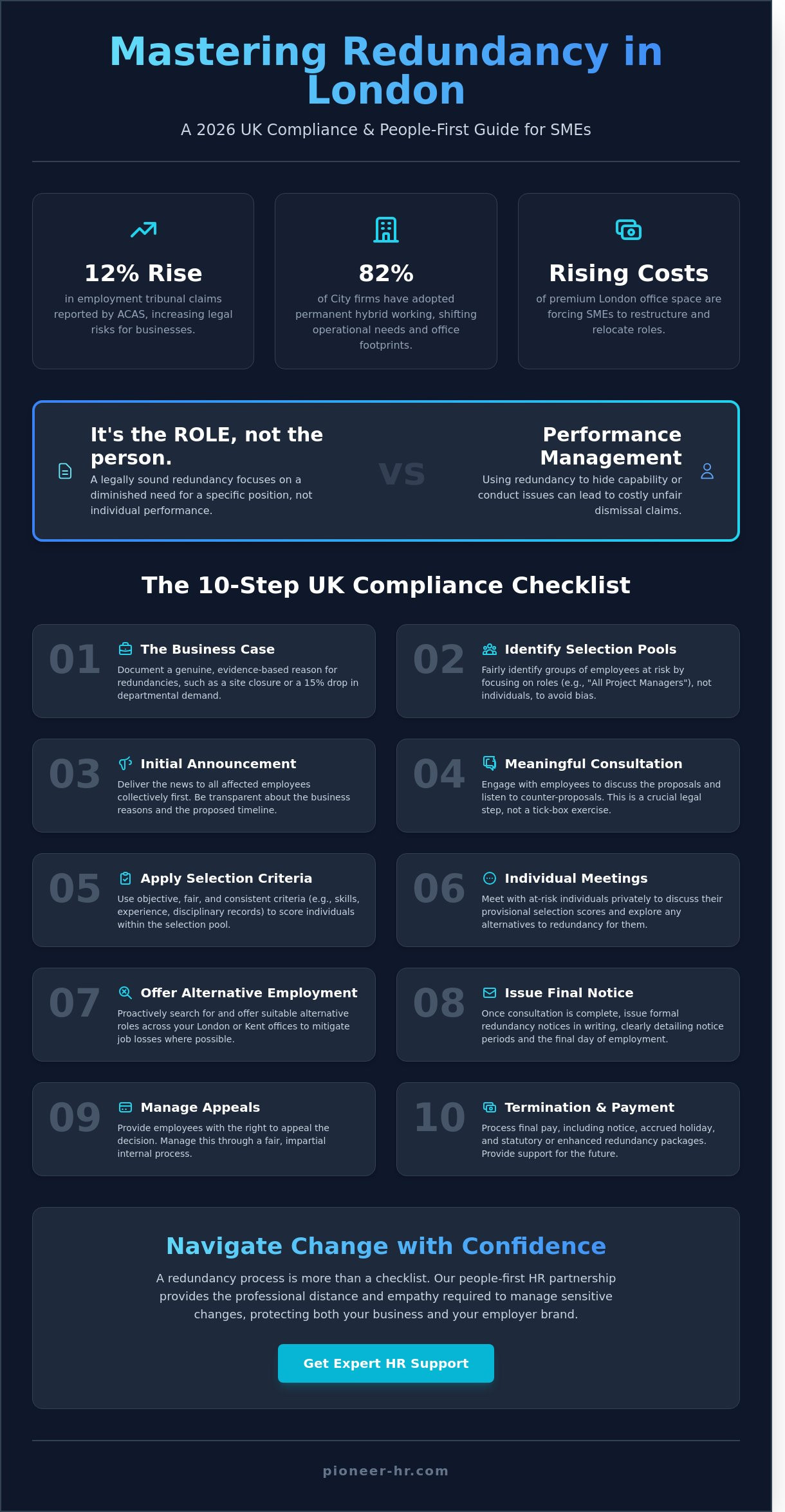
As we move into 2026, the London business environment faces a unique set of challenges that redefine how we approach structural changes. While hybrid working has become a permanent fixture for 82% of City firms, the rising costs of maintaining premium office space in the Square Mile are forcing many organizations to rethink their physical footprints. Redundancy occurs when a specific role is no longer required due to office closures, relocation to areas like Kent, or a fundamental shift in how a business operates. For leaders, knowing how to handle redundancy london requires a balance between strict legal compliance and maintaining a positive employer brand in a transparent digital age.
We've seen that SME employers who only meet the bare legal minimum often suffer long-term damage to their reputation. In a competitive talent market, how you treat people on their way out matters just as much as how you treat them on their way in. According to the foundational principles of UK redundancy law, a genuine redundancy must exist to avoid the risk of unfair dismissal claims. This means the requirement for employees to carry out work of a particular kind must have ceased or diminished within the specific context of your 2026 business goals.
Is it the Role or the Person? Avoiding Confusion
Redundancy must always focus on the position, not the individual's performance or personality. Under the Employment Rights Act 1996, redundancy is defined as a situation where a business closure, workplace closure, or a diminished requirement for employees to carry out work of a particular kind necessitates the termination of a role. A common pitfall for London businesses is trying to "hide" performance issues behind a redundancy process. This is a high-risk strategy; employment tribunals are quick to spot when a "redundancy" is actually a disguised dismissal for conduct or capability, which often leads to costly settlements and legal fees.
Local Market Pressures: From the West End to Kent
Economic shifts across the South East are driving many firms to centralize operations or move back-office functions out of the West End to reduce overheads. Before making these high-stakes decisions, we recommend looking at salary benchmarking uk data to understand which roles are vital for your 2026 growth and which can be restructured. If a role moves from London to a satellite office in Kent, the change in commute can be a significant burden for your staff. We believe in a supportive approach here, as understanding how to handle redundancy london effectively involves maintaining a compassionate dialogue with those who may face longer travel times or significant life changes due to centralisation.
The 10-Step Redundancy Process: A UK Compliance Checklist
Managing a workforce reduction requires a balance of legal precision and human empathy. If you're figuring out how to handle redundancy london businesses often face unique pressures, from high operational costs to intense talent competition. Following a structured 10-step process ensures you remain compliant with UK employment law while protecting your employer brand. We recommend a methodical approach that prioritizes transparency from day one.
Step 1: The Business Case. You must document a genuine reason for redundancies, such as a site closure or a 15% drop in departmental demand.
Step 2: Selection Pools. Identify which groups of employees are at risk. Don't target individuals; focus on roles to avoid bias.
Step 3: Initial Announcement. Deliver the news collectively first. Be transparent about why this is happening and what the timeline looks like.
Step 4: Meaningful Consultation. Listen to employee counter-proposals. This isn't just a "tick-box" exercise; it's a legal requirement.
Step 5: Selection Criteria. Use objective metrics like skills, experience, or disciplinary records.
Step 6: Individual Meetings. Discuss selection scores and explore alternatives to redundancy.
Step 7: Identifying Alternative Employment. Check for open roles across your London or Kent offices to mitigate job losses.
Step 8: Final Notice. Issue formal redundancy notices in writing, detailing the last day of work.
Step 9: Appeals. Give employees the right to challenge the decision through an internal process.
Step 10: Termination and Payment. Process final pay, including statutory or enhanced packages and any accrued holiday.
Planning and the Preliminary Announcement
You can't wing the first meeting. Preparation starts weeks before the announcement with a full audit of your documentation. Many boards find that a Fractional Chief People Officer provides the necessary strategic distance to design a fair process. When you stand in front of your team in the London office, your tone should be calm and professional. Avoid corporate jargon. Explain the economic drivers clearly. This approach minimizes anxiety and sets a respectful foundation for the consultation period ahead.
Calculating Statutory Redundancy Pay in 2026
Statutory redundancy pay is a legal right for staff with at least two years of service. In 2026, you'll need to apply the latest multipliers based on age and length of service. As of April 2024, the weekly pay cap was set at £700, but these figures are reviewed every April. You can check the current employee redundancy rights to ensure your figures are accurate. While statutory minimums are required, 65% of London firms often provide enhanced packages. We can help you align these exit terms with your broader reward consultancy strategy to maintain goodwill. Understanding how to handle redundancy london teams effectively means looking beyond the statutory minimums to protect your long term reputation. If you're unsure about your current liabilities, our team can provide a quick pay benchmarking review to see how your packages compare to the 2026 market average.
Exploring Alternatives: Voluntary Redundancy vs. Compulsory
Deciding between voluntary and compulsory routes is a pivotal moment for any London leadership team. When we look at how to handle redundancy london businesses often find that the voluntary path preserves much of the company culture. A 2023 study by the CIPD suggested that compulsory cuts can lead to a 20% drop in the productivity of remaining staff due to survivor syndrome. Voluntary schemes, by contrast, give employees a sense of agency; they choose their exit. This choice significantly reduces the risk of legal fallout and keeps the atmosphere in your London or Kent office from turning toxic.
Before you commit to any headcount reduction, you must investigate "Suitable Alternative Employment." This isn't just a best practice; it's a legal requirement. You'll find the specific criteria for what constitutes a "suitable" role, including pay, location, and status, in the official UK government redundancy guidance. Redeploying a talented individual into a different department isn't just about compliance. It’s a smart financial move. With the average cost of hiring a new professional in London reaching approximately £6,000 when factoring in agency fees and onboarding, keeping existing talent is a major cost-saving strategy.
We often discuss the "bumping" technique with our partners. This occurs when an employee whose role is redundant moves into a different role currently held by another person who isn't at risk. While it sounds counterintuitive, it allows you to retain high-value individuals with deep institutional knowledge. It's a complex maneuver that requires careful legal handling to avoid unfair dismissal claims from the "bumped" employee.
Voluntary Redundancy: The Pros and Cons
The primary benefit of a voluntary scheme is the reduced risk of litigation. People who choose to leave are far less likely to file a tribunal claim. However, the biggest risk is losing your "stars." Often, the most talented employees are the first to volunteer because they're confident they'll find work elsewhere in the UK market. To prevent this, you'll need to structure your scheme carefully. We recommend aligning any offer with established job grading standards to ensure the roles being vacated don't leave a critical gap in your operational hierarchy.
Flexible Working as a Redundancy Alternative
Sometimes, a full redundancy isn't the only answer. You might consider job-sharing or reducing hours across a department to save costs without losing people. This is particularly effective in marketing or digital teams where performance is measurable. For instance, using PPC benchmarking can help you determine if a marketing role can be restructured into a part-time position based on actual campaign output rather than a standard 40-hour week. Temporary lay-offs or short-time working are also options, though these require specific clauses in your employment contracts to be legally sound. When you're managing how to handle redundancy london markets require this kind of creative, flexible thinking to remain competitive for 2026.
Mastering the Consultation and Selection Phase
Consultation isn't just a legal hurdle; it's a strategic opportunity to retain trust within your workforce. When you're determining how to handle redundancy london based businesses often find that the consultation phase is where the most risk lies. We've seen that transparency during this phase significantly reduces post-redundancy friction. It's about showing your team that you've considered every alternative before reaching this point. Whether you're operating out of a tech hub in Shoreditch or a logistics center in Kent, the procedural integrity you maintain now will define your employer brand for years to come.
Individual vs. Collective Consultation
The scale of your restructuring dictates your legal timeline. If you're proposing to make 20 or more employees redundant at one establishment within a 90-day period, collective consultation rules apply. For 20 to 99 redundancies, you must start the consultation at least 30 days before the first dismissal. If the number reaches 100 or more, that clock extends to 45 days. Understanding how to handle redundancy london requires a firm grasp of these timelines to prevent expensive protective award claims, which can reach up to 90 days' pay per employee. In a collective process, you must allow staff to elect employee representatives if a recognized trade union isn't already in place. In the UK, a meaningful consultation is defined as a genuine exchange of views between employer and employee where the employer remains open to alternative suggestions that could potentially avoid or mitigate the redundancies.
Designing a Fair Selection Matrix
Objectivity is your best defense against unfair dismissal claims. We advise moving away from "Last In, First Out" (LIFO) because it often leads to indirect age discrimination claims, particularly affecting younger talent. Instead, we help our partners build matrices based on measurable data like documented skills, disciplinary records, and performance reviews from the last two years. Data from 2024 suggests that Employment Tribunals are increasingly critical of "subjective" criteria like "attitude" or "flexibility" unless backed by specific examples.
As you reshape your team, you must also consider the market value of the remaining positions. Using pay benchmarking ensures that the roles you retain are competitively compensated, which is vital for preventing further turnover during a period of instability. When scoring employees during selection meetings, follow these practical steps:
Use at least two managers to score each individual to minimize personal bias.
Provide clear evidence for every score, such as project completion rates or sales figures.
Ensure the criteria don't unfairly penalize those on maternity leave or with disabilities.
Share the scores with the affected individuals and allow them to challenge the findings.
By focusing on objective data, you create a process that is not only legally robust but also perceived as fair by those staying with the company. This balance is essential for maintaining morale in a post-redundancy environment.
Need expert guidance to ensure your selection process is both fair and compliant? Secure our strategic HR support to protect your business and your people.
Strategic HR Support: How Pioneer HR Manages London Redundancies
Managing a restructure is one of the most taxing responsibilities a London business leader faces. It's not just about ticking legal boxes; it's about people's lives and the future of your organization. We've found that bringing in an external partner provides the necessary distance to stay objective while keeping empathy at the forefront. When leadership is too close to the situation, emotions can cloud the commercial necessity of the change. At Pioneer HR, our "People-First" approach ensures we protect the individual’s dignity while securing the business’s long-term viability. Our team provides the clarity you need when learning how to handle redundancy london style, where the pace is fast and the legal stakes are high.
Protecting Your Brand and Remaining Team
After the final consultation meetings are over, the real work of rebuilding begins. Research shows that up to 67% of remaining employees experience "Survivor Syndrome," characterized by guilt, anxiety, and a significant drop in productivity. It's vital to re-engage them quickly to prevent further turnover. We use our HR retainer to provide post-restructuring management training, helping your leaders in Kent or the City navigate these difficult conversations and rebuild trust.
Restructuring also offers a rare moment to evaluate your internal structures. We often work with clients to redesign their reward strategy, ensuring that those who stay feel valued and motivated to drive the company toward its new goals. Understanding how to handle redundancy london effectively means balancing the needs of those leaving with the psychological safety of those staying. A refreshed benefits package or a clearer career path can be the catalyst for a successful recovery.
Why Pioneer HR is Your Strategic Partner
With over 30 years of experience navigating the UK’s complex labour laws, we've seen every scenario imaginable across the South East. We're committed to solutions that are logistically sound, legally compliant, and deeply human. Our experts handle the heavy lifting of documentation and process, allowing you to focus on the strategic direction of your firm. We pride ourselves on being hiders of conflict and builders of bridges. If you're facing a restructure, don't go it alone. Book a consultation with our London HR experts today to ensure your process is handled with the care and precision it deserves.
Securing Your Business Future Through Strategic Transition
Managing a workforce transition in 2026 requires more than just following a checklist. It demands a blend of legal precision and human empathy. We've explored the essential 10-step UK compliance process and the strategic differences between voluntary and compulsory routes. Understanding these nuances ensures your business remains resilient while treating your people with the respect they deserve. Many London and Kent SMEs find that the consultation phase is where the most significant risks lie. This makes expert guidance vital for a smooth transition.
You don't have to navigate these complexities alone. With the right partnership, you can transform a challenging period into a structured path forward for everyone involved.
Frequently Asked Questions
How much is statutory redundancy pay in the UK for 2026?
Statutory redundancy pay in 2026 depends on an employee's age and length of service, with new weekly caps typically implemented on April 6, 2026. Employees with at least 2 years of service receive half a week's pay for each full year worked under age 22; one week's pay for each year aged 22 to 40; and one and a half weeks' pay for each year aged 41 or older. We recommend checking the updated government limits each April, as the maximum weekly amount usually rises to reflect inflation.
Can I make a pregnant employee redundant in London?
You can make a pregnant employee redundant, but the legal protections are extremely strict to prevent discrimination. Under the Protection from Redundancy (Pregnancy and Family Leave) Act, pregnant staff and those returning from maternity leave have priority for any suitable alternative vacancies. If we don't offer an available alternative role to a protected employee first, the dismissal is likely automatically unfair. We must prove the redundancy is a genuine business necessity and entirely unrelated to the pregnancy.
What is the minimum consultation period for making 5 people redundant?
There's no statutory minimum consultation period when you're making fewer than 20 people redundant at one establishment. For a group of 5 employees, we suggest a period of at least 14 days to ensure the process is meaningful and fair. While the 30 day collective consultation rule doesn't apply here, rushing the timeline increases the risk of unfair dismissal claims. We find that a two week window allows for proper individual meetings and consideration of alternative options.
Do I have to offer a right of appeal after a redundancy dismissal?
You aren't legally required by statute to offer a right of appeal, but the ACAS Code of Practice strongly recommends it. We always advise London employers to include an appeal stage to demonstrate a robust and transparent process. Skipping this step can lead an employment tribunal to decide the dismissal was procedurally unfair. This often results in a 25 percent increase in compensation awards if the employee wins their case, so it's a vital safeguard for your business.
Can I hire someone new after making a role redundant?
How do I handle redundancy for remote workers based in Kent but tied to a London office?
We treat remote workers based in Kent the same as London office staff if they're assigned to the same establishment or selection pool. Their physical home address doesn't change their statutory rights or your legal consultation obligations. We must ensure they're included in the selection process if their work is similar to the tasks performed by the office based team. This ensures our redundancy procedure remains consistent and defensible across the entire South East region.
What happens if an employee refuses a suitable alternative job offer?
If an employee refuses a suitable alternative job offer without a valid reason, they usually lose their right to a statutory redundancy payment. Suitability is based on objective factors like pay, location, and seniority compared to their previous role. We provide a 4 week trial period for any new position to help the employee assess the fit. If they resign after the trial for unreasonable reasons, the redundancy pay is forfeited because they effectively turned down continued employment.
Is voluntary redundancy pay tax-free in the UK?
The first £30,000 of a redundancy payment is tax-free in the UK, and this includes voluntary redundancy packages. This tax exemption applies to the statutory redundancy pay and any non-contractual ex-gratia payments we might offer as part of a settlement. You'll still need to deduct tax and National Insurance on other elements like accrued holiday pay or pay in lieu of notice. We always ensure these calculations are clear so the departing team member understands their final take-home amount.


Comments