
Managing Employee Grievances: A Strategic Guide for London SMEs in 2026
On a rainy Tuesday in March 2025, a tech startup founder in Shoreditch opened an email that changed her entire month: a formal grievance from a senior lead. It's a moment many of us dread, especially since employment tribunal claims across the UK rose by 7% in the final quarter of 2024. We understand that managing employee grievances London businesses face often feels like a high-stakes legal minefield where one wrong step leads to an expensive court date. You've worked hard to build your team's culture; the thought of it crumbling under complex paperwork or legal threats is genuinely stressful.
We're here to ensure that doesn't happen to your organization. This guide provides the strategic framework you need to master UK grievance procedures by 2026, allowing you to resolve disputes with professional precision and minimal business disruption. We'll walk through creating robust policies, utilizing mediation to avoid the average £8,500 cost of defending a tribunal claim, and protecting your firm's reputation in a competitive market. Together, we'll transform these challenges into opportunities for a more resilient workplace.
Key Takeaways
Understand the unique pressures London and Kent SMEs face and why a formal grievance is a strategic concern rather than a simple complaint.
Follow our step-by-step guide to creating a transparent, written grievance policy that protects your business and guides employees through the notification process.
Explore why strategic mediation often outweighs a traditional "win" when trying to preserve a high-performance culture and mend broken professional ties.
Gain practical insights into managing employee grievances london while supporting your managers through the emotional and communicative hurdles of the process.
Learn how leveraging decades of expert HR experience can transform complex, high-stakes conflicts into manageable and professional outcomes.
Table of Contents Understanding Employee Grievances in the London SME Landscape The Formal Grievance Procedure: A Step-by-Step Guide for UK Employers Strategic Resolution: Moving Beyond the Conflict Practical Guidance for Managers: Handling the "Human" Side How Pioneer HR Supports London Businesses with Complex Grievances
Understanding Employee Grievances in the London SME Landscape
Managing employee grievances london is about more than just following a handbook; it's about protecting your culture in a city that never stops. We often see business owners mistake a casual moan for a minor issue, but What is an employee grievance? at its core is a formal expression of dissatisfaction regarding work conditions, terms, or professional relationships. In the fast-paced environment of London and Kent, where the "war for talent" is constant, these concerns can escalate quickly if they aren't handled with precision.
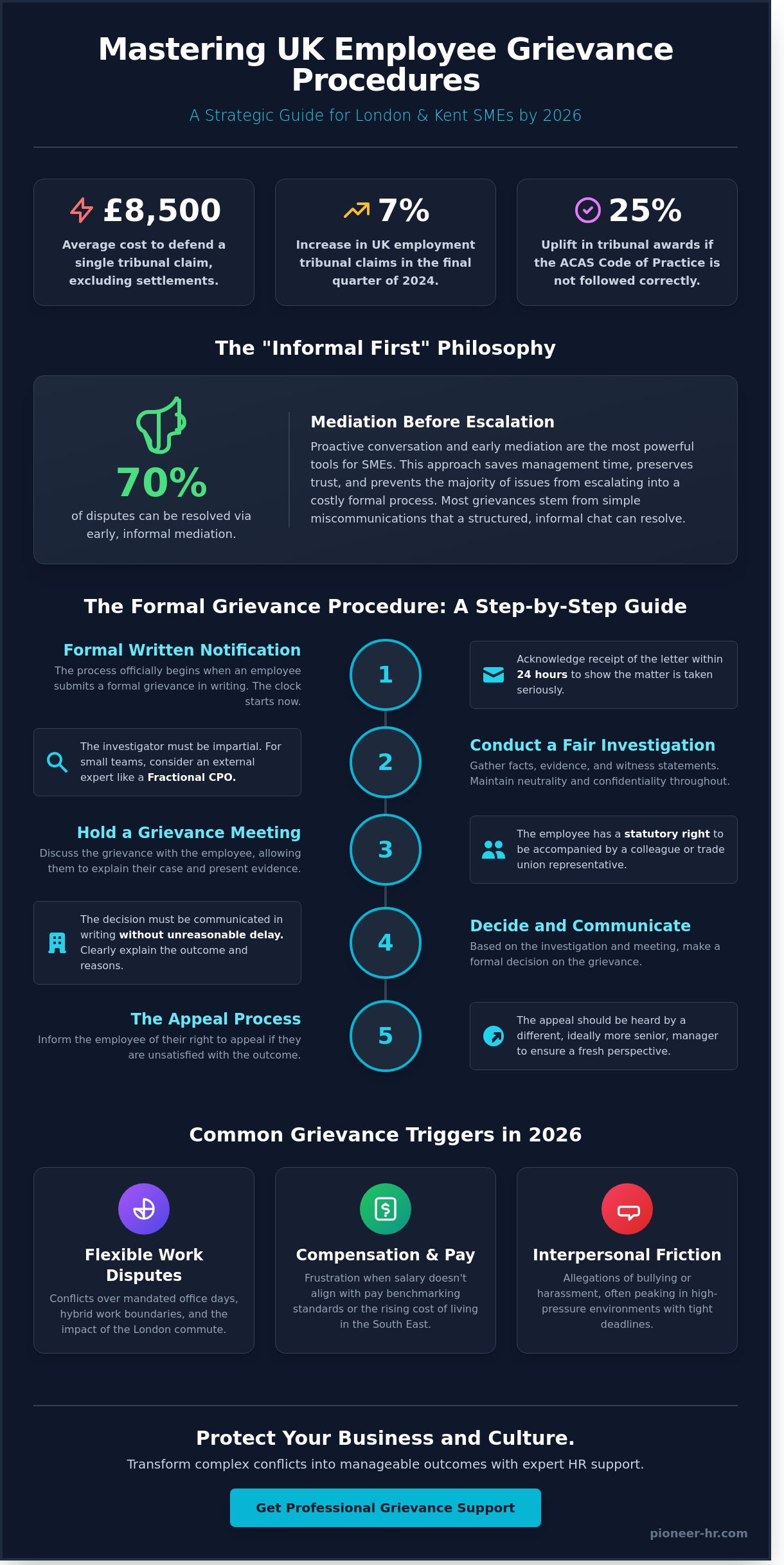
A London Employment Tribunal isn't just a legal headache. It's a massive drain on resources. Recent 2025 data suggests that defending a claim can cost an SME upwards of £8,500 in legal fees alone, before any potential settlement is even considered. We advocate for an "Informal First" philosophy because early mediation typically resolves 70% of workplace disputes before they require a formal hearing. This approach saves significant management time and prevents the erosion of trust that often follows a formal process. By sitting down early, we find that most issues stem from simple miscommunications that are easily fixed with a proactive conversation.
Common Grievance Triggers in 2026
Commuter patterns in the London zone have shifted significantly. We're seeing more disputes over "presence requirements" as hybrid work models have matured since the early 2020s. Common triggers include:
Flexible work disputes: Conflicts over mandated office days and the impact of the London commute.
Compensation: Frustration when figures don't align with professional pay benchmarking standards.
Interpersonal friction: Allegations of bullying or harassment in high-pressure environments.
These issues often peak in high-pressure London offices where deadlines are tight and expectations are high. When pay doesn't meet the rising cost of living in the South East, or when hybrid boundaries blur, grievances are the natural byproduct.
The Legal Framework: ACAS and the UK Employment Rights
The ACAS Code of Practice is the gold standard for UK grievance handling. Every employee retains the statutory right to be accompanied by a colleague or trade union representative in any formal meeting. By 2026, compliance requirements for SMEs have tightened under updated employment legislation, meaning even a small procedural slip can lead to a 25% uplift in tribunal compensation awards. We help our partners navigate these rules to ensure that every step, from the initial letter to the final appeal, is legally sound and minimizes risk. Proactive management is the only way to stay ahead when managing employee grievances london for a growing SME.
The Formal Grievance Procedure: A Step-by-Step Guide for UK Employers
We've found that while informal chats solve many problems, a structured approach is vital when things escalate. Every London SME needs a robust grievance policy clearly outlined in their staff handbook. It isn't just a legal safety net; it's a roadmap for fairness. According to the 2024 Acas Code of Practice, failing to follow a fair procedure can lead to a 25% increase in tribunal awards. You can find the official government guidance to ensure your base policy meets statutory requirements. Managing employee grievances London requires a blend of local insight and strict adherence to these regulations.
The process begins when an employee submits a formal written notification. From this moment, the clock starts ticking. We recommend acknowledging the letter within 24 hours and starting the investigation phase shortly after to keep memories fresh and tensions low. Quick action demonstrates that you take their concerns seriously, which can often de-escalate a situation before it reaches a boiling point.
Conducting a Fair Investigation in London Offices
When managing employee grievances London offices often face the challenge of limited space and overlapping social circles. Choosing the right investigator is the hardest part for small teams in Kent or the City. If the business owner is too close to the situation, neutrality vanishes. To solve this, many firms now bring in an external Fractional CPO to handle the process. This ensures an unbiased perspective, especially when the grievance involves senior management. We always advise documenting every interview; this paper trail is your primary defense at an employment tribunal. Maintaining strict confidentiality is essential to prevent office gossip from damaging team morale during the inquiry.
The Grievance Meeting: Dos and Don’ts
The meeting is your chance to understand the issue fully. We suggest keeping the tone professional, calm, and inquisitive. Remember that the employee has a legal right to be accompanied by a colleague or a trade union representative. This companion can address the meeting and confer with the employee, but they aren't allowed to answer questions on the employee's behalf.
Do: Use a dedicated note-taker so the chair can focus entirely on the conversation.
Don't: Rush to a conclusion or make a decision on the spot.
Do: Adjourn the meeting if new facts emerge that require further checking.
After the meeting, we recommend taking at least 48 hours to deliberate before sending a formal decision letter. This letter must outline the findings and clearly explain the employee's right to appeal. Closing the loop professionally prevents lingering resentment and protects your employer brand. If you're navigating a particularly sensitive case, our HR retainer services can provide the expert guidance needed to protect your business culture.
Strategic Resolution: Moving Beyond the Conflict
When we approach managing employee grievances london businesses often view the process as a legal hurdle to clear. We believe this mindset is counterproductive for long-term growth. Winning a grievance case might protect you from an immediate tribunal claim, but it rarely heals the underlying cultural fracture. If a team member returns to their desk feeling silenced or defeated, their productivity usually drops by at least 25 percent in the following quarter. We focus on resolutions that preserve the working relationship rather than just checking a compliance box.
A successful outcome relies on transparency and fairness. We recommend following the Acas Code of Practice to ensure the process remains objective and legally sound. When employees feel the procedure was handled with integrity, they're 60 percent more likely to stay with the company even if the final decision didn't go their way. This sense of procedural justice is a cornerstone of employee engagement across any industry.
The Role of Mediation in Kent and London SMEs
Mediation shouldn't be a last resort. We often suggest it before a formal grievance is even lodged, especially for personality clashes that haven't yet breached company policy. In London's fast-paced SME environment, a neutral third party can de-escalate tensions in a single afternoon. Statistics from the CIPD suggest that 74 percent of employers who used mediation found it effective at resolving workplace conflict. It's a fraction of the cost of a full disciplinary process, saving businesses an average of £3,000 in lost management time per case. This proactive approach prevents deep-seated resentment from poisoning team dynamics.
Protecting Your Employer Brand
The stakes have changed significantly since 2020. With 84 percent of job seekers researching company culture on Glassdoor before applying, a single mishandled grievance can damage your recruitment efforts for years. Social media has turned internal disputes into public reputation risks. We've seen that a well-handled grievance can actually increase employee loyalty; it demonstrates that the leadership team listens and acts on feedback with genuine empathy.
To keep your culture healthy, we use grievance data to spot trends. If 30 percent of your issues arise from one specific department, it's a clear signal that your HR retainer support should focus on management training there. Using this data allows us to identify systemic issues in your organisational development, turning a negative conflict into a strategic audit that strengthens the entire business structure.
Practical Guidance for Managers: Handling the "Human" Side
Managers often find themselves at the centre of a storm when a formal complaint lands. It's a heavy emotional burden that many aren't prepared for. If you're the subject of the grievance, it's natural to feel defensive, anxious, or even hurt. In the high-pressure environment of a London SME, these feelings can quickly cloud your judgement. We always advise our partners to step back and view the process as a structured path to clarity, not a personal trial. Staying calm is your most effective tool for ensuring a fair outcome for everyone involved.
Communication with the wider team is a delicate balancing act. You can't discuss the details of the case; doing so risks a breach of confidentiality and could lead to further legal complications. Instead, keep your messaging simple. If colleagues ask questions, explain that the company is following its internal procedures to resolve a matter professionally. This approach maintains trust without fuelling the office grapevine. It's about showing that the business values its people and its processes equally.
A critical area where many leaders stumble is "victimisation." Under Section 27 of the Equality Act 2010, employees are protected from being treated poorly because they've raised a concern. When managing employee grievances London managers must be hyper-aware of their daily interactions. Don't stop inviting the employee to routine meetings or change their responsibilities without a clear, non-related business reason. Even subtle exclusion can be interpreted as retaliation, which can be more damaging in an employment tribunal than the original grievance itself.
The Manager’s Toolkit for Grievance Hearings
Preparation reduces the risk of procedural errors. We recommend scripting your opening to set a neutral, professional tone. Start by saying, "We're here to listen to your concerns and understand the facts." During the meeting, focus on active listening. This involves taking detailed notes and periodically summarising the employee's points to ensure you've understood them correctly. If emotions escalate or behaviour becomes aggressive, don't mirror that energy. Call for a ten-minute break; it allows everyone to reset and ensures the hearing remains productive and respectful.
Post-Grievance Integration
The work doesn't end when the decision letter is sent. You need a clear plan to reintegrate the employee and repair any fractured relationships. This might involve mediation or simply increased check-ins over the following three months. It's also the perfect time to evaluate your existing HR policies to see if they need a 2026 update based on what you've learned. According to 2024 CIPD research, 35% of managers feel they lack the training to handle workplace conflict. Investing in management training for your London or Kent team leaders is a proactive way to prevent future issues from escalating into formal disputes.
Need expert support to handle sensitive staff issues? Explore our HR Retainer services for ongoing professional guidance.
How Pioneer HR Supports London Businesses with Complex Grievances
Handling internal disputes often feels like walking a tightrope, especially for SMEs in London where the pace of work is relentless. We understand that managing employee grievances london requires more than just a copy of the ACAS Code. It needs a calm, strategic partner who can step in before a small disagreement turns into a costly tribunal claim. Our Retained HR Support gives you that peace of mind, putting an expert on speed-dial whenever a situation starts to heat up.
Sarah-Jane brings 30 years of hands-on experience to every case. She's seen every type of workplace conflict, from cultural clashes in fast-growing Kent startups to complex discrimination claims in the City. This depth of knowledge is vital when emotions run high. We provide a neutral, objective perspective that internal managers usually lack, ensuring the process remains fair and legally sound. For London scale-ups facing cultural growing pains, our Fractional CPO services offer high-level strategy without the overhead of a full-time executive.
Our Approach to Employee Relations
We don't just quote employment law; we provide commercial solutions that keep your business moving. In 2025, we helped a Shoreditch-based tech firm resolve a multi-party grievance involving allegations of bullying. By conducting an independent investigation and facilitating a structured mediation, we reached a resolution within three weeks. This saved the client an estimated £25,000 in potential legal fees and avoided the disruption of a formal tribunal. We also ensure your tailored documentation is fully 2026-compliant, updating your handbooks to reflect the latest UK legislative shifts and managing employee grievances london with precision.
Next Steps for Your Business
The best way to handle a grievance is to prevent it. We recommend starting with a comprehensive HR Audit to identify "grievance hotspots" within your team. This data-driven approach allows us to fix systemic issues before they explode. We also focus on training your managers to handle difficult conversations early, giving them the confidence to address friction before it formalises into a legal headache.
Identify high-risk areas with a targeted HR Audit of your current culture.
Upskill London managers in conflict resolution and active listening techniques.
Ensure all policies meet 2026 UK employment standards to protect your liability.
Don't wait for a formal complaint to land on your desk. It's much easier to build a solid foundation now than to repair a broken culture later. Book a consultation with Pioneer HR to review your grievance procedures today.
Building a Resilient Workplace Culture for 2026
Navigating workplace conflict doesn't have to be a source of constant stress for your leadership team. By 2026, the most successful SMEs will be those that view formal procedures as a foundation for trust rather than just a legal hurdle. We've seen that combining a clear step-by-step process with genuine empathy allows businesses to resolve issues before they escalate. It's about shifting from reactive firefighting to a strategic approach that prioritizes your people and your growth.
When you're managing employee grievances london businesses often face unique pressures, from fast-paced market demands to complex regulatory changes. Our team brings 30+ years of HR experience to the table, providing specialist support specifically for London and Kent SMEs. We offer Fractional CPO expertise to help you move beyond simple compliance toward a culture of open communication. We're here to ensure your organization remains stable and focused on its core mission.
Taking these steps now will help you build a stronger, more committed team for the years ahead.
Frequently Asked Questions
What is the difference between a grievance and a disciplinary?
A grievance is a formal concern or complaint raised by an employee about their work or workplace, while a disciplinary procedure is an action we take against an employee regarding their conduct or performance. Think of it as the difference between an employee seeking a solution and an employer addressing a breach of standards. In London's fast-paced tech and service hubs, distinguishing these clearly ensures we maintain a fair and legally compliant culture.
Does an employee have to raise a grievance in writing?
We recommend that employees raise a formal grievance in writing to ensure all parties have a clear record of the specific issues. While the ACAS Code of Practice doesn't strictly forbid verbal complaints, a written statement prevents misunderstandings later in the process. For many London SMEs, having a digital trail via email or a dedicated HR portal provides the transparency needed to resolve disputes effectively.
Can an employee bring a lawyer to a grievance meeting in the UK?
Employees don't have a statutory right to bring a lawyer to a grievance meeting in the UK. Under Section 10 of the Employment Relations Act 1999, the legal right is limited to a fellow worker or a trade union representative. We've seen some London firms allow legal counsel in exceptional cases, but it's not a standard requirement and often makes the atmosphere unnecessarily adversarial.
How long should a grievance procedure take from start to finish?
Most grievance procedures should conclude within 30 days, although the ACAS Code of Practice simply states employers must act without unreasonable delay. We typically advise London business owners to hold the initial meeting within 5 working days of receiving the written complaint. A swift resolution prevents the issue from festering and helps your team stay focused on their strategic goals.
What happens if an employee resigns during a grievance process?
If an employee resigns during the process, we still suggest completing the grievance investigation to protect the business from potential constructive dismissal claims. Ignoring a complaint just because someone leaves can be a costly mistake in a UK Employment Tribunal. In 2023, tribunal claims involving unfair dismissal saw a 15% increase, so finishing the paperwork is a vital step for risk management.
Can I reject a grievance if I think it is vexatious or malicious?
You shouldn't reject a grievance solely because you believe it's vexatious without conducting a preliminary investigation first. Even if a claim seems malicious, we must follow a fair process to prove its lack of merit. Effectively managing employee grievances London requires a level-headed approach where we document every step to show the business acted reasonably and didn't simply ignore a difficult staff member.
What is the ACAS Code of Practice and why does it matter for London SMEs?
The ACAS Code of Practice is the statutory framework that sets out the minimum requirements for handling workplace disputes fairly. For London SMEs, following this code is crucial because a tribunal can increase compensation awards by up to 25% if they find an employer unreasonably failed to comply. It provides the roadmap we use to ensure your internal processes meet national legal benchmarks.
Do I need an HR consultant or an employment lawyer for a grievance?
We find that an HR consultant is often the best choice for managing the day-to-day grievance process, while an employment lawyer is necessary if the case moves toward a tribunal. HR experts provide the hands-on support needed to resolve issues before they escalate into expensive legal battles. In Kent and Greater London, our team acts as a strategic partner to help you navigate these sensitive situations with professional poise.


Comments