
Disciplinary Process Advice for London Employers: A 2026 Guide to Compliance and Fairness
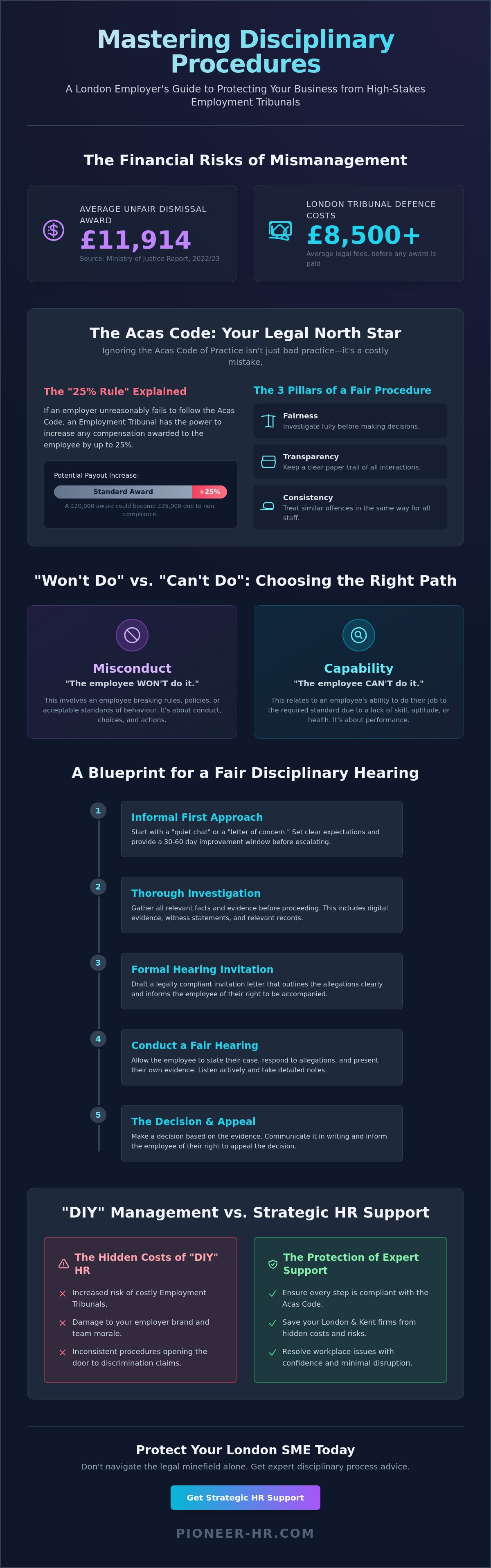
What if the biggest threat to your London business isn't a competitor, but a single mismanaged disciplinary hearing? With the average unfair dismissal award in the UK recorded at £11,914 in the 2022/23 Ministry of Justice reports, the financial stakes for business owners in Kent and the capital have never been higher. We understand that providing disciplinary process advice for london employers requires more than just quoting law; it requires a practical, human approach that protects your reputation and your bottom line.
You likely believe that being fair to your staff shouldn't feel like walking through a legal minefield, yet the distinction between poor performance and gross misconduct often feels blurred when you're managing a team without a full-time HR department. We're here to bridge that gap. This guide provides a clear, legally compliant roadmap to help you master the 2026 UK employment law updates and resolve workplace issues with minimal disruption. We'll walk you through the essential paperwork, the legal thresholds for dismissal, and the specific steps needed to keep your business out of the tribunal courts.
Key Takeaways
Protect your London SME from high-stakes Employment Tribunals by establishing a robust formal framework for addressing employee misconduct and capability issues.
Gain expert disciplinary process advice for london employers to ensure your procedures align with the Acas Code and avoid the "25% Rule" that can increase Tribunal payouts.
Learn to distinguish between "won’t do" and "can’t do" scenarios to ensure you apply the correct legal path for every performance or conduct challenge.
Follow a step-by-step blueprint for fair hearings, from gathering digital evidence in a London office environment to drafting compliant invitation letters.
Discover how strategic HR support can save your Kent or London firm from the hidden costs and risks of "DIY" disciplinary management.
Table of Contents Understanding the Disciplinary Landscape for London Businesses The Acas Code of Practice: Your Legal North Star Misconduct vs. Capability: Navigating Performance Challenges A Step-by-Step Blueprint for a Fair Disciplinary Hearing Strategic HR Support: Protecting Your London SME from Tribunal Risks
Understanding the Disciplinary Landscape for London Businesses
Managing a team in a high-pressure environment like London requires more than just intuition. A disciplinary process is the formal framework UK employers use to handle misconduct or performance issues. It provides a structured path to resolve problems while protecting the business from legal fallout. For SMEs in the capital, the stakes are exceptionally high. Data from 2025 shows that defending a claim at a London Employment Tribunal costs businesses an average of £8,500 in legal fees alone, even before any potential settlement or award is considered. In a city where talent moves fast and reputation is everything, a poorly managed process doesn't just risk a lawsuit; it damages your employer brand across the local market.
Your written policy is your first line of defence. It shouldn't be a generic template found online. A "London-proof" procedure accounts for the specific pace and regulatory scrutiny of the capital's business environment. It clearly distinguishes between a "quiet chat" for minor slip-ups and the official trigger for formal action. Knowing when to transition from informal coaching to a formal procedure is the hallmark of a mature leadership team. This section provides the foundational disciplinary process advice for london employers who want to maintain a high-performance culture without falling foul of evolving regulations.
The Legal Framework for UK Employers in 2026
Under the Employment Rights Act and the latest April 2026 legislative updates, the "reasonableness" test remains your most critical benchmark. A tribunal will look at whether a "reasonable employer" would have acted the same way under similar circumstances. We've found that consistency across Kent and London offices is vital for compliance. If you treat a junior staff member in Maidstone differently than a senior executive in Canary Wharf for the same offence, you're opening the door to discrimination claims. Understanding UK unfair dismissal law is essential to ensure every step you take, from the initial investigation to the final decision, is legally sound and procedurally fair.
Why "Informal First" is Often the Best Advice
Jumping straight into formal proceedings can often alienate a team and escalate a minor issue into a major conflict. We often suggest an "informal first" approach. This starts with a verbal warning or a "letter of concern" that outlines the issue without the weight of a permanent disciplinary record. You should set clear expectations and "improvement windows," typically lasting 30 to 60 days, to allow the employee to course-correct. If you're unsure whether a specific situation warrants this approach or an immediate formal hearing, using Pioneer HR’s retained support helps you gauge the severity of the situation with expert backing. This ensures you're providing disciplinary process advice for london employers that balances human empathy with commercial reality.
The Acas Code of Practice: Your Legal North Star
We often tell our partners that the Acas Code of Practice is the most critical document in their HR toolkit. It isn't a law passed by Parliament, but it carries immense weight in an Employment Tribunal. Judges treat the Code as the gold standard for workplace conduct. If you ignore it, you're taking a significant financial risk that can impact your bottom line. Under Section 207A of the Trade Union and Labour Relations (Consolidation) Act 1992, tribunals have the power to increase compensation by up to 25% if an employer unreasonably fails to follow the Code. For a London firm facing a high-value claim in 2026, that 25% uplift could represent tens of thousands of pounds in additional costs.
Providing effective disciplinary process advice for London employers requires a focus on three pillars: fairness, transparency, and consistency. In a fast-paced city environment, it's tempting to cut corners to save time, but Acas standards demand that we document every single interaction. Whether it's a brief check-in or a formal warning, a clear paper trail is your best defense. If a case reaches a tribunal, your notes will be the evidence that proves you acted reasonably and followed a predictable, transparent path.
The Core Principles of a Fair Procedure
Fairness starts with a clear head and a commitment to facts. We see many businesses rush into hearings before they've fully understood the situation. You must investigate issues thoroughly before jumping to conclusions. This means gathering witness statements and reviewing digital records before any formal action is taken. Once you've established there's a case to answer, you must inform the employee in writing. They need to see the evidence against them to prepare properly. This alignment with the official government guidance on disciplinary procedures ensures that the employee isn't blindsided. Finally, always allow the employee to state their case in a formal hearing where they can respond to every allegation made against them.
The Right to be Accompanied
Every worker has a statutory right to bring a companion to a disciplinary hearing if the meeting could result in a formal warning or other action. This companion is usually a colleague or a trade union representative. In London's high-stakes sectors, like fintech or law, employees sometimes request a solicitor. While there's generally no legal right to have a lawyer present in a standard internal meeting, you should handle these requests with care to avoid claims of procedural unfairness. The companion's role is specific; they can sum up the employee's case and confer with them, but they can't answer questions on the worker's behalf. If you're looking for consistent support to manage these complex interactions, our HR retainer service offers the strategic partnership your leadership team needs to stay compliant.
Misconduct vs. Capability: Navigating Performance Challenges
Understanding the distinction between misconduct and capability is the first step in providing sound disciplinary process advice for london employers. Misconduct is essentially a "won't do" issue. It occurs when an employee chooses to break workplace rules, such as through persistent lateness, insubordination, or minor policy breaches. Capability, however, is a "can't do" situation. This happens when an employee wants to perform but lacks the necessary skills, aptitude, or physical health to meet the requirements of their role. Treating a capability issue as a disciplinary matter is a common mistake that often leads to avoidable employment tribunals. We always suggest using the Acas Code of Practice as your legal north star to ensure you're categorising these challenges correctly from the start.
Gross misconduct is the "nuclear option" of the disciplinary world. It covers acts so serious they destroy the trust between employer and employee, potentially justifying summary dismissal. In a fast-paced London office, this might involve theft, physical violence, serious negligence, or significant data breaches. When these incidents occur, immediate action is vital. We recommend a prompt suspension while you investigate. It's vital to remember that suspension isn't a punishment; it's a protective measure designed to maintain the integrity of the investigation and protect your business interests. For employees who go AWOL within the London commuting zone, don't assume they've resigned. Check for major TfL disruptions or health emergencies before moving to formal proceedings.
Identifying Gross Misconduct in a Modern London Workplace
Modern gross misconduct often looks different than it did a decade ago. While theft and violence remain clear-cut, 2026 brings new challenges like sophisticated internal data breaches or severe harassment in hybrid working environments. If you find yourself in this position, follow these steps:
Immediate Suspension: Keep the employee away from the office and company systems, ensuring they receive full pay during this period.
Secure Evidence: Collect digital logs, witness statements, and CCTV footage immediately.
Clear Communication: State clearly in writing why they're being suspended and what the next steps of the investigation will be.
Is it a Performance Issue or a Reward Issue?
Sometimes, what looks like a lack of effort is actually a structural misalignment. We often find that using job grading helps clarify whether the expectations placed on an employee actually match their pay grade and experience level. If a staff member is struggling, consider if a Performance Improvement Plan (PIP) is more appropriate than a formal warning. A PIP provides a structured window for improvement, usually between 30 and 90 days, with clear milestones.
You should also evaluate your reward strategy to ensure it incentivises the right behaviours. If your 2026 salary benchmarking UK data shows your team is significantly underpaid compared to the London market average, "performance issues" might actually be a symptom of low morale and disengagement. Solving a reward discrepancy is often more cost-effective than a full disciplinary cycle and the subsequent recruitment costs of replacing a departing employee.
A Step-by-Step Blueprint for a Fair Disciplinary Hearing
We believe that clarity is the foundation of any successful HR procedure. Our team provides bespoke disciplinary process advice for London employers to ensure every step aligns with current UK employment law and the Acas Code of Practice. A single misstep during the hearing stage often leads to costly Employment Tribunal claims, which averaged over £14,000 for unfair dismissal cases in recent years. To protect your business, you must treat the process as a structured search for the truth rather than a formality to confirm a decision you've already made.
The hearing itself requires a logical flow. You'll start by introducing those present and explaining the purpose of the meeting. We suggest following this structure:
The Presentation: State the allegations clearly and present the evidence gathered.
The Response: Allow the employee to set out their case and answer the allegations.
The Discussion: Ask probing questions to clarify discrepancies in witness statements or digital logs.
The Right to Accompaniment: Ensure the employee knows they can bring a colleague or trade union representative. This is a statutory right under the Employment Relations Act 1999.
After the discussion, you must adjourn. We always advise a cooling-off period of at least 24 to 48 hours. Decisions made in the heat of the moment are rarely objective and frequently fail the "fairness" test in court. If the employee raises new facts, you'll need to pause and investigate those before reaching a conclusion.
Conducting the Investigation Correcty
We recommend appointing an investigator who isn't the person who'll eventually chair the hearing. For many London SMEs, using an external HR retainer service ensures total impartiality and avoids internal bias. In modern office environments, you'll need to collect Slack logs, email archives, and door entry records to build a factual timeline. Managing confidentiality is vital; we've seen office gossip escalate into separate grievance claims when sensitive details leak during a London disciplinary process.
The Outcome: From Verbal Warnings to Dismissal
Your decision must be proportionate to the offense. A first written warning usually stays live for 6 months, while a final written warning typically remains on the record for 12 months. Summary dismissal, or dismissal without notice, is reserved for gross misconduct like theft or physical violence. If you decide on dismissal, the appeal must be heard by a different, more senior manager to ensure a fresh perspective. Statistics show that 85% of successful tribunal appeals stem from procedural flaws during these final stages.
If you need expert guidance to manage a sensitive staff issue, our specialists offer tailored disciplinary process advice for London employers to keep your business compliant.
Strategic HR Support: Protecting Your London SME from Tribunal Risks
Many London SME owners try to handle disciplinaries alone to save on overheads. This usually ends up costing more than professional support. By 2026, the complexity of UK employment law means a single procedural slip-up can lead to a costly tribunal. Acas reports suggest that the average cost of defending a claim is now over £8,500, excluding any potential settlement. You're also losing your most valuable asset: time. A director spending thirty hours on a grievance is a director not focused on growth. Finding reliable disciplinary process advice for london employers is the first step toward long-term stability.
Choosing between retained HR and an employment lawyer is a common dilemma for Kent and London firms. Lawyers are vital for courtrooms, but they're often too clinical for day-to-day management. Retained HR support provides a human-centric partnership. We don't just tell you what the law says; we help you implement it without destroying team morale. It's a proactive approach rather than a reactive legal defense.
A Fractional CPO takes this further by building a culture that prevents issues before they escalate. They integrate feedback loops and performance frameworks so that a formal disciplinary never comes as a surprise. It's a strategic shift from punishment to development. When you turn a negative disciplinary into a positive culture shift, you reduce turnover and improve your employer brand in a competitive city.
How Pioneer HR Supports London Employers
We bring 30 years of experience to the table, providing the calm head you need during high-stakes terminations. Our team drafts bespoke, legally compliant documentation specifically for your London industry. We also act as an impartial third party for hearings or appeals. This ensures total compliance and removes the "bias" argument that often sinks an employer's case at tribunal.
Next Steps for Your Business
Start with a handbook audit. Most policies from 2023 won't meet the compliance standards of 2026. You should also train your managers. They are your first line of defense. Knowing how to handle a difficult conversation in a fast-paced London context is a skill, not an instinct. If your leadership team feels out of their depth, it's time to seek external expertise.
Contact Pioneer HR today for expert disciplinary process advice for london employers.
Securing Your Company’s Future Through Fair Practice
Navigating the complexities of UK employment law requires more than just a template; it demands a strategic approach that balances legal compliance with human empathy. By strictly following the Acas Code of Practice, you mitigate the risk of costly Employment Tribunal claims where compensation awards can increase by 25% for procedural failures. It's vital to distinguish clearly between conduct and capability to ensure your internal processes remain robust and defensible. We've seen that clarity at the start of a process prevents expensive litigation at the end.
Our team provides essential disciplinary process advice for london employers who want to maintain high standards without the constant fear of tribunal risks. With 30+ years of HR expertise and strategic fractional CPO leadership, we specialise in protecting London SMEs from the unique regulatory pressures of the capital. We don't just solve immediate problems; we build the professional frameworks that help your business thrive long-term.
We're ready to partner with you to turn these challenging management moments into opportunities for organisational growth and stability.
Frequently Asked Questions
Can I dismiss a London employee without a disciplinary process if they have under 2 years of service?
You can generally dismiss an employee with less than two years of service without a full formal process, as they haven't yet earned the right to claim unfair dismissal under the Employment Rights Act 1996. However, we always recommend following a shortened procedure to ensure the decision doesn't stem from discrimination or whistleblowing. Even in London's fast-paced market, skipping steps entirely can lead to "automatically unfair" claims that don't require any length of service.
What is the 2026 Acas Code of Practice and does it apply to small London businesses?
The 2026 Acas Code of Practice provides the minimum standard for fairness that every UK employer must follow, regardless of company size. It applies to all London businesses, including small startups with only a few staff members. If an Employment Tribunal finds you've unreasonably failed to follow this code, they can increase compensation awards by up to 25%. We help small businesses implement these standards to maintain professional integrity and protect their reputation.
How much notice do I need to give an employee for a disciplinary hearing in the UK?
You should provide at least 48 hours of notice for a disciplinary hearing, though giving three to five working days is the standard for professional London firms. This timeframe allows the employee to prepare their case and arrange for a companion to attend. Providing this window is a core part of the disciplinary process advice for london employers we provide to ensure your procedures remain legally defensible if they're ever challenged.
Can an employee bring a lawyer to a disciplinary meeting in a London office?
Employees don't have a statutory right to bring a lawyer to a disciplinary meeting; they're legally entitled to be accompanied by a colleague or a trade union representative. While some London contracts might offer more flexibility, most private sector employers stick to the statutory limit to keep the process internal. If the case could result in a professional ban, legal representation might become a consideration under specific human rights legislation.
What happens if a London employee goes on sick leave during a disciplinary process?
You should pause the proceedings and assess the employee's fitness to participate if they go on sick leave during a disciplinary. We suggest requesting a medical report or an Occupational Health assessment to see if adjustments can make the meeting possible. If the absence lasts longer than four weeks, you might eventually proceed by asking for written submissions or holding the meeting in their absence as a last resort.
Is suspension with pay required for gross misconduct investigations in Kent?
You must almost always provide full pay if you suspend an employee during a gross misconduct investigation in Kent or elsewhere in the UK. Suspension is a neutral act designed to protect the investigation, not a sanction or a sign of guilt. Failing to pay an employee during this period usually breaches the employment contract and can lead to a constructive dismissal claim in an Employment Tribunal, even before a final decision is made.
How do I handle a disciplinary for a remote employee based outside of London?
You must follow the same legal standards and Acas guidelines for remote staff as you would for those in your London office. We recommend conducting the hearing via a secure video platform like Microsoft Teams or Zoom while ensuring the employee still has their right to a companion. This ensures your disciplinary process advice for london employers stays consistent across your entire workforce, regardless of where individual team members are physically located.
What is the difference between a grievance and a disciplinary procedure?
A grievance is a formal complaint raised by an employee about their work or a colleague, while a disciplinary is a process initiated by the employer to address conduct or performance issues. Think of a grievance as "bottom-up" communication and a disciplinary as "top-down" management action. Both require a structured, fair approach to comply with the 2026 Acas Code and maintain a healthy, transparent working environment for your entire team.



Comments