
Employee Relations Support for London Businesses
A gap in employee relations capacity doesn’t have to leave a difficult workplace issue on hold. Employee relations support in London can include HR advice, case management for disciplinary or grievance matters, temporary cover and guidance through dismissal processes.
When a case is sensitive, managers need support or your team is stretched, practical help can make the next steps clearer. The right support depends on the issue and the capacity your business needs, whether that means advice on a specific case or ongoing help with employee relations work.
This article explains what employee relations support can involve, how case management and temporary support work, and when businesses may seek help with dismissals. It also sets out what to consider when choosing an approach, so you can identify a sensible next step for your London business.
Table of Contents
HR advice and employee relations management
HR advice helps London employers respond consistently to workplace concerns, changes and employee queries. Start by defining the issue, identifying who needs to act and keeping a clear record of decisions.
The UK Government stated that the National Living Wage increase on 1 April 2024 applied to adults aged 21 and over, with the rate due to rise to £11.44 per hour. Pay questions can therefore be part of employee relations advice, alongside communication and consistent workplace practice.
Investigations and Case Management
For an investigation, first define the allegation or concern, then identify relevant records and people to speak with. A case manager can organise interviews, keep notes, track outstanding actions and help managers distinguish evidence from assumptions. For example, a grievance about team communication may involve reviewing relevant messages and hearing each person’s account before deciding what to do next.
Outsourced employee relations support can include advice on case handling, investigation planning, documentation and manager guidance. Look for a clear process that sets out responsibilities and decision points, rather than a one-size-fits-all response.
Choosing an Employee Relations Provider
Choose support that matches your London business’s needs: advice on an individual case, ongoing case management, change support or additional capacity. Consider how the provider will communicate with managers, organise records and adapt its approach to your workplace. HR consultants offer practical people-management support; employment solicitors advise on legal issues and representation, while mediation services facilitate discussion between people in conflict.
Before proceeding, clarify the scope, who leads each task and how progress will be reported. This helps you compare focused case-management support with an ongoing arrangement, and decide whether legal advice or mediation is also relevant.
Costs depend on the case’s complexity, the work involved and whether support is ongoing or interim. A provider can set out the fee after a quote request, based on the agreed scope and level of input.
For organisational change or redundancies, plan communications and manager responsibilities before discussions begin. Map the proposed change, identify affected roles, prepare consistent messages and record feedback. This helps managers explain decisions clearly and respond to employee questions in an organised way.
Leadership Coaching can help managers prepare for difficult conversations, such as addressing repeated conduct concerns or responding to a grievance. During a change in working arrangements, HR advice can help coordinate employee communications, records and internal processes, while managers focus on clear, consistent updates.
Without structured support, managers may handle similar cases differently, overlook relevant evidence or leave decisions poorly documented. A clear process, named case owner and timely escalation route can help reduce these avoidable risks.
Managing disciplinary and grievance cases
Disciplinary and grievance cases need clear communication, consistent records and a defined decision-making process. For London employers, the approach should reflect the concern, the people involved and the evidence available.
Employee Communication and Grievances
Employees need to know how to raise a concern, who will receive it and what happens next. For example, if someone reports repeated interruptions during team meetings, acknowledge the issue, clarify what behaviour they want addressed and record their account accurately. Keep updates factual and discreet, sharing information only with people involved in handling the case.
If a grievance points to a wider workplace pattern, distinguish the individual complaint from the broader issue. An employee engagement survey can help identify recurring themes across a team, but it doesn’t replace investigating a specific person’s complaint.
Disciplinary and Grievance Processes
Employee relations support from Pioneer HR can help with complex disciplinary, grievance and absence cases, as well as consultation and organisational change. It may also involve working with trade unions and employee forums. Employers should clarify the concern, identify relevant documents and accounts, and decide who will handle each part of the process.
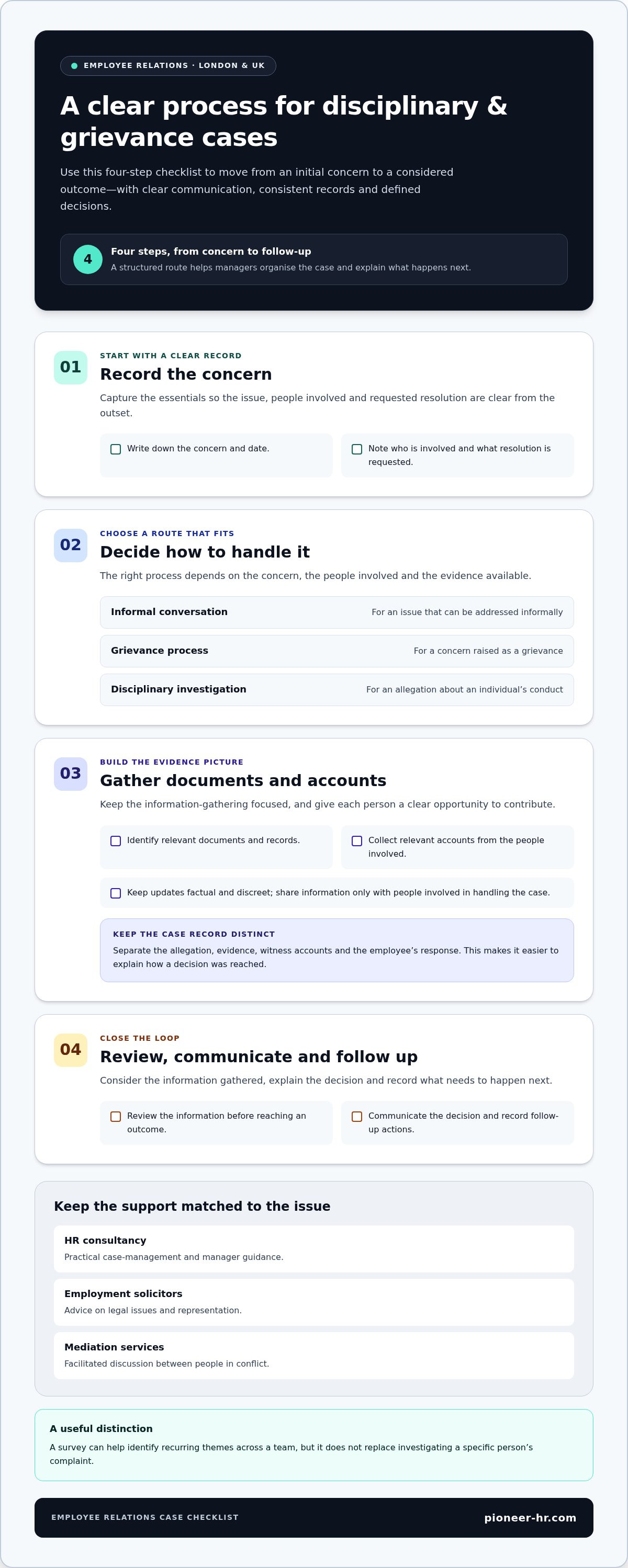
Keep a case record that separates allegations, evidence and findings. In a conduct case, for instance, record the reported incident separately from witness accounts and the employee’s response. This makes it easier to explain how a decision was reached and what action follows.
Steps to Resolve Employee Relations Issues
A structured process helps managers move from an initial concern to a considered outcome:
Record the concern, date, people involved and requested resolution.
Decide whether it needs an informal conversation, a grievance process or a disciplinary investigation.
Gather relevant documents and accounts, giving each person a clear opportunity to contribute.
Review the information, communicate the decision and record any follow-up actions.
For example, a disagreement over shift handovers may call for clearer responsibilities, while an allegation about an individual’s conduct may need a separate investigation.
London employers can seek practical case-management and manager guidance from an HR consultancy like Pioneer HR. Employment solicitors advise on legal issues, while mediation services facilitate discussion between people in conflict. The right route depends on the issue and the support required.
Managers can also benefit from coaching before difficult meetings. Preparing a neutral opening, specific questions and a plan for recording responses helps keep conversations focused. If the same concern arises across several teams, review communication and management practices alongside the individual case, rather than treating each report as unrelated.
An interim HR Assistant Manager role covering multiple London locations is advertised at £45,000 to £50,000 per year for 12 months. A permanent HR Operations Manager role based in central London is advertised at £46,000 to £48,000 per year.
Workplace statistics often highlight that a small fraction of employee relations issues account for the majority of management time and friction. These broader trends can sit alongside case records and careful assessment, but they do not determine how an individual concern should be handled.
Interim employee relations support
Temporary HR support can help a London business manage a defined project, staff absence or increase in casework. It can keep work moving while the organisation considers its longer-term needs. Agree priorities and responsibilities before the assignment begins, so the support is focused on the workload at hand.
Small businesses can use temporary support for a specific task without creating a permanent role. For example, an adviser could help organise a backlog of employee queries, prepare managers for meetings or coordinate records during workplace change. The scope should identify which work the adviser handles and which decisions remain with the employer.
An adviser can begin by reviewing open work, noting key actions and agreeing priorities with managers. They can then help coordinate case updates, prepare meeting materials and track follow-up tasks. A clear handover records open matters, decisions, pending actions and the internal owner for each case, giving the business a practical record when the assignment ends.
Advertised London roles show the range of interim assignments, although salaries for employed roles are not consultancy fees.
Before work starts, agree a brief that sets out:
The project or cases requiring attention, such as consultation, grievance work or employee queries.
The manager responsible for decisions and the adviser’s role in supporting the process.
How records, progress updates and outstanding actions will be managed.
What information must be handed back when the assignment finishes.
This clarity supports continuity without transferring accountability. For example, during a restructure, an interim adviser can coordinate work and help managers maintain consistent communication, while business leaders retain responsibility for decisions. Employee relations support in London can also help small employers manage a temporary workload without treating interim cover as a substitute for clear internal ownership.
Choose an arrangement by considering the work involved, your existing HR capacity and the continuity your team needs. A defined project may need focused temporary support; recurring people-management questions may call for ongoing guidance instead. A precise brief helps managers prioritise urgent cases while keeping routine employee relations work visible.
Recurring people-management needs may call for a different arrangement from a short project, so compare the assignment’s duration, location and required on-site presence before confirming interim cover. An HR Advisor /ER Advisor interim vacancy closes on 30 Oct 2026. An HR Business Partner role in Kew is offered for a 6-month period. These examples underline the value of checking practical terms alongside the work itself: confirm expected availability, where support will be delivered and how the adviser will coordinate with managers. A well-defined arrangement helps maintain service while keeping employer decisions with the business.
Dismissals
A dismissal affects the employee, the remaining team and the business’s ability to explain its decision. Before acting, clarify the reason, review the evidence and consider whether the process has been consistent. For example, a conduct concern requires a careful account of what happened, the employee’s response and the manager’s reasoning.
Different situations need different handling. A capability concern may involve reviewing expectations, support already offered and relevant performance records. A role change or restructure requires a separate assessment of the business rationale and its impact on affected employees. Keeping these issues distinct helps managers avoid treating different cases as though they were the same.
Practical HR support can help managers organise decision-making without taking ownership away from the employer. Before a dismissal meeting, prepare a concise case summary, relevant documents and clear questions. During the meeting, listen carefully and record the employee’s response. Afterwards, document the decision, its reasoning and any follow-up communication.
Clarify the reason: identify the concern or business change behind the proposed decision.
Review the record: compare relevant evidence, earlier conversations and the employee’s account.
Plan the conversation: decide who will attend, what information to explain and how responses will be recorded.
Communicate the outcome: explain the decision clearly and record the next actions.
If a manager is considering dismissal after repeated performance concerns, for instance, they should gather relevant records and review what expectations and support were communicated. If the employee raises new information during discussion, record it and consider its relevance before finalising the decision. This can help prevent a rushed conclusion based on an incomplete account.
Where both parties want to resolve an employment dispute by agreement, a settlement agreement can provide a route to mutual agreement and may reduce the risk of disputes or tribunal claims. It is different from an employer simply announcing a dismissal: its purpose is to record agreed terms. Whether it is appropriate depends on the circumstances and proposed terms.
Employee relations advisers can help organise cases, prepare managers and support consistent communication, while an employment solicitor can advise on legal questions. Keep that distinction clear when assigning work. HR input can help make the process orderly, but managers remain responsible for the business decision and how they communicate it.
After the decision, plan a respectful handover of work and communicate necessary team arrangements without disclosing private case details. Record outstanding tasks, access changes and the internal contact for follow-up. A measured close helps managers protect confidentiality and maintain continuity across the London workplace.
Which London consultancies provide employee relations support for businesses?
London businesses can consider HR consultancies, retained HR support and specialist employee relations advice. Support may cover ongoing people-management guidance, complex casework or temporary capacity. The right fit depends on whether you need help with a particular issue or an ongoing relationship across several workplace matters.
An HR consultancy can advise managers on employee relations processes and help organise casework. Retained HR support offers an ongoing point of contact for recurring questions, while temporary support can help with a defined project or a period of reduced internal capacity. These approaches differ in continuity, scope and how closely the support connects with managers’ day-to-day work.
Some situations call for a different specialist. Employment solicitors focus on legal advice and representation; mediation services facilitate discussion between people in conflict. An HR consultancy can support people-management practice, but it isn’t a substitute for legal representation or mediation when those are needed.
To compare London HR support, start with the work you need handled. A business with several active employee cases may prioritise case coordination, while a growing team may need ongoing manager advice and consistent policies. Ask how the proposed support would address your actual situation, such as a grievance involving several colleagues or a change affecting multiple roles.
Scope: identify whether support covers advice, casework, manager guidance or temporary project capacity.
Working arrangement: clarify who leads each task and how managers share updates and records.
Continuity: consider whether your team needs a regular adviser or focused input for a defined issue.
Boundaries: distinguish HR support from legal representation and mediation.
If an operations manager faces a rise in employee queries during a restructure, for example, assess how the support would prioritise work, guide managers and maintain clear records. If a specific dispute needs legal advice, identify that requirement separately rather than expecting an HR adviser to perform a solicitor’s role.
Before agreeing a service, request a written outline of responsibilities, reporting arrangements and fees. The cost depends on the scope, complexity and level of input, and is provided after a quote request. This makes comparisons more meaningful than judging providers by a headline price alone.
A considered choice matches the consultancy’s expertise to your business’s needs. Define the immediate issue, decide whether support should be ongoing or temporary, and set out what good communication and case ownership look like. These steps help London employers choose a practical arrangement without confusing HR advice with other specialist services.
Pioneer HR: Retained HR Support
Pioneer HR’s Retained HR Services can suit London businesses that need ongoing practical HR advice rather than help with one isolated issue. It gives managers a route to discuss employee matters as they arise and helps businesses develop a consistent approach to people management.
For wider organisational priorities, Salary Benchmarking and Reward Strategy can inform pay and reward decisions. A Fractional Chief People Officer may be relevant when a business needs senior people leadership as part of its wider plans. The right starting point depends on whether your priority is regular HR guidance, reward decisions or strategic leadership.
If you’re considering ongoing HR support for your business, contact Pioneer HR to discuss your needs.
Build a steadier approach to people decisions
Employee relations support in London can be most useful when it helps equip managers before a difficult situation escalates. Consider where people decisions currently depend on individual judgement, then identify how clearer guidance could help your team act consistently and communicate with care.
Pioneer HR provides Retained HR Services for businesses seeking ongoing HR guidance. Salary Benchmarking and Reward Strategy can also inform considered decisions about pay and reward. These services may support your developing people priorities alongside the day-to-day need to handle workplace matters thoughtfully.
To discuss the support that fits your organisation, contact Pioneer HR. A considered next step can help you build a more confident, consistent approach for managers and employees alike.
Frequently Asked Questions
What employee relations support services are available in London?
London businesses can seek HR advice, case management, investigation support and guidance for managers handling employee concerns. Temporary support can provide capacity for a defined project, while retained support offers ongoing HR guidance. Pioneer HR provides Retained HR Services for employers seeking practical, continuing advice. A business facing recurring employee queries, for example, may benefit from a regular HR contact rather than help with one case alone.
What UK employment laws and ACAS rules apply to employee relations cases?
Requirements depend on the issue. Disciplinary or grievance cases should be handled in line with applicable UK employment legislation and the ACAS Code of Practice on disciplinary and grievance procedures. In practice, employers should identify the concern, follow a fair and consistent process, keep clear records and communicate decisions. A case involving dismissal or a proposed settlement may raise different legal questions, so seek advice appropriate to that situation.



Comments