
Gender Pay Gap Reporting Service UK: Compliance & Strategy in 2026
Updated: Jul 17
In 2026, your gender pay gap report is no longer just a legal checkbox; it's a public statement about your company's values. We know that for many HR leaders in London and across Kent, the April 4 deadline often feels like a looming reputational risk rather than a strategic opportunity. The recent June 2026 guidance requiring reporting based on biological sex, combined with the evolving requirements of the Employment Rights Act 2025, has added layers of complexity that manual calculations simply can't handle with precision.
That's why choosing the right gender pay gap reporting service uk is essential for moving beyond data entry and into meaningful strategy. We agree that compliance shouldn't be a source of stress, but a foundation for building a more inclusive employer brand. In this article, we'll show you exactly how to manage the latest reporting standards while crafting a narrative that resonates with your people. We'll preview the transition toward mandatory action plans and provide a clear roadmap to help you close the gap and attract the best talent in the UK.
Table of Contents
What is Gender Pay Gap Reporting in the UK for 2026?
For employers across London, Kent, and the wider UK with 250 or more employees, gender pay gap reporting is a statutory requirement that demands both precision and transparency. It's often confused with equal pay, but the two concepts are distinct. While equal pay is a legal obligation to pay men and women the same for performing the same or similar work, the gender pay gap is a statistical measure of the difference in average earnings across an entire organization. To understand the broader context of these figures, you can explore What is the Gender Pay Gap? to see how these disparities are tracked globally.
2026 is a landmark year for this legislation. Since the mandatory reporting began in 2017, we've seen nearly a decade of data maturity. Stakeholders, from employees to investors, are no longer just looking at the numbers; they're looking for trends. They want to see if your gap is shrinking and what you're doing to drive that change. If your figures suggest a lack of progress, it might indicate that your current reward strategy isn't as inclusive as it needs to be to stay competitive in today's market.
Who Must Report and When?
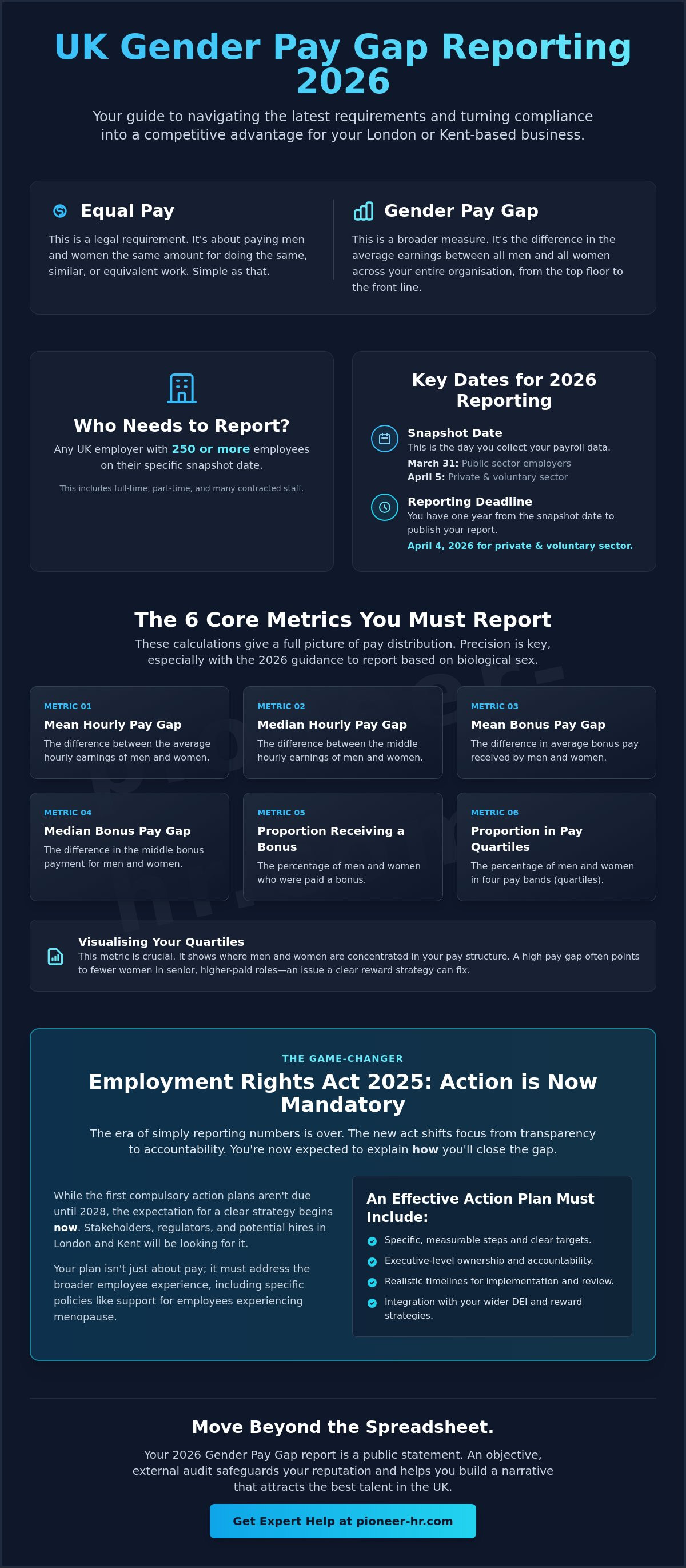
If your headcount reaches 250 on your specific snapshot date, you're legally required to report. This headcount includes full-time and part-time staff, as well as many contractors who are personally contracted to do work. The snapshot dates remain fixed: March 31 for most public authority employers and April 5 for private and voluntary organizations. You have exactly one year from these dates to publish your findings. For the current cycle, private firms must publish by April 4, 2026. Failing to comply isn't just a legal oversight; the EHRC has the power to enforce compliance, and the resulting reputational damage can make it much harder to attract top talent in the UK.
The 6 Core Metrics You Need to Calculate
To meet the standard, you must publish six specific metrics. These provide a comprehensive view of how pay is distributed across your workforce. Accuracy is paramount here, especially with the June 2026 guidance update requiring all reporting to be based on biological sex. The metrics include:
The mean gender pay gap in hourly pay.
The median gender pay gap in hourly pay.
The mean bonus gender pay gap.
The median bonus gender pay gap.
The proportion of male and female employees who received a bonus.
The proportion of male and female employees in each of four pay quartiles.
Calculating these figures manually is time-consuming and prone to error. Utilizing a professional gender pay gap reporting service uk ensures these calculations are audited for accuracy, allowing you to focus on the narrative behind the numbers rather than the spreadsheets. For companies that value this level of data-driven precision, Nodal Marketing offers AI-powered marketing technology to help optimize digital performance and brand strategy.
The Employment Rights Act 2025: New Mandatory Action Plans
The Employment Rights Act 2025 represents a landmark change for businesses across the UK. For years, gender pay gap reporting was primarily a disclosure exercise, focused on publishing numbers and moving on. That era is ending. The new legislation introduces a requirement for mandatory action plans, shifting the focus from simple transparency to active accountability. While the first compulsory plans aren't due until April 2028 based on 2027 data, the expectation for strategic clarity starts now. Organizations are now expected to explain exactly how they intend to close their gaps, rather than just acknowledging they exist.
A significant part of this shift involves a more holistic view of equality. The Act specifies that these plans must address not only the pay gap itself but also how the company supports employees experiencing menopause. This level of detail ensures that businesses aren't just looking at payroll data in isolation; they're looking at the lived experience of their workforce. Aligning your internal data with the UK Government Reporting Requirements is the first step, but building a narrative that satisfies both regulators and employees requires a deeper touch.
What Must Your Action Plan Include?
An effective action plan needs more than vague promises. It should outline specific, measurable steps, such as reviewing your reward strategy or implementing targeted leadership development programs. These plans require clear ownership at the executive level and realistic timelines for implementation. If your plan isn't integrated with your broader DEI objectives, it's likely to fail. We often see that the most successful organizations in London and Kent are those that treat these plans as living documents, regularly audited and updated to reflect real-world progress.
Why 'Voluntary' Reporting is Becoming the UK Standard
We're seeing an increasing number of smaller firms in Kent and London choosing to report voluntarily. Even if you don't meet the 250-employee threshold, there's a strong case for proactive disclosure. In competitive sectors like tech and finance, transparency is a powerful tool for recruiting top talent. Candidates want to see that a company is forward-thinking and committed to fairness. Starting now also prepares your team for future requirements, such as potential ethnicity or disability pay gap reporting. If you're looking for ongoing support to stay ahead of these legislative curves, our retained HR support can provide the long-term guidance your leadership team needs.
Utilizing a professional gender pay gap reporting service uk can help you bridge the gap between raw data and a compelling action plan. It's about moving away from manual calculations and toward a strategic roadmap that actually delivers results for your people and your brand.
Closing the Gap: Integrating Reward Strategy and Benchmarking
Reporting your figures is a necessary first step, but data without action is just a diagnostic tool. We believe that reporting is effectively useless if it isn't backed by a robust reward strategy. When we partner with organizations as a gender pay gap reporting service uk, our goal is to look past the surface level. A wide gap often acts as a mirror, reflecting deeper structural issues within your recruitment or promotion cycles. It might reveal that women are underrepresented in your highest-paid departments or that your starting salaries lack consistency across different regions like London and Kent.
By identifying the "why" behind your numbers, we can help you build a workplace where fairness is built into the framework. This shift in perspective moves your organization away from a defensive compliance posture and toward a proactive, talent-first culture. It's about ensuring that your pay practices don't just meet the legal minimum but actually drive your business forward.
Benchmarking vs. Reporting: What's the Difference?
It's easy to see these two processes as the same thing, but they serve very different strategic purposes. Reporting is an essential look in the rearview mirror, while benchmarking is your roadmap for the journey ahead. Using external market data allows you to justify pay decisions with confidence, ensuring you don't inadvertently widen the gap during your next hiring round.
For specialized or niche roles where talent is scarce, a PPC benchmarking approach is particularly valuable. It provides the granular detail needed to make competitive offers that are also internally equitable. This prevents "pay creep," where new starters are brought in on higher rates than existing employees, a common cause of pay disparities.
Fixing Structural Gaps through Job Grading
Inconsistent job titles are often the hidden culprits behind a widening gender pay gap. When two roles involve work of equal value but carry different titles, it creates room for bias to creep into pay rises and bonus allocations. Establishing a clear job grading system provides a transparent structure that removes the guesswork from compensation. This ensures that every employee understands how their pay is determined, which is the absolute foundation of "equal pay for work of equal value." Utilizing a professional gender pay gap reporting service uk helps you audit these structures, ensuring your reporting is built on a foundation of genuine equity.
When your salary benchmarking is integrated with a solid grading system, you create a defensive shield against equal pay claims while simultaneously making your brand more attractive to elite talent across the UK.
How to Prepare Your 2026 Gender Pay Gap Report
Preparing for the 2026 reporting cycle requires more than just pulling a standard report from your payroll software. It's a multi-stage process that should start months before your snapshot date to ensure total accuracy. By following a structured approach, we can help you transform a compliance burden into a clear strategic advantage for your London or Kent based business. A well-prepared report doesn't just satisfy the regulator; it builds trust with your employees and the wider market.
Step 1: Cleanse your payroll data. Start this well ahead of your April snapshot date. You'll need to ensure your records accurately reflect employee status and biological sex as per the latest June 2026 guidance.
Step 2: Perform the 6 statutory calculations. Once the snapshot date passes, calculate your mean and median gaps. At this stage, it's vital to audit for equal pay risks to ensure you aren't facing hidden legal liabilities.
Step 3: Draft a compelling narrative report. This is your opportunity to provide the context behind your figures and explain the "why" to your stakeholders.
Step 4: Gain Board-level approval. Your report must be signed off by a director or equivalent senior leader to confirm its accuracy.
Step 5: Upload and publish. Finally, upload your data to the government portal and ensure the report is easily accessible on your company website.
Data Cleanliness: The Hidden Reporting Hurdle
Many organizations stumble because their underlying data is messy or incomplete. Common pitfalls we see include misclassified contractors who should be in the headcount or missing bonus data from the previous 12 months. Accuracy is non-negotiable. According to UK government guidelines, ordinary pay includes basic pay, allowances, pay for piecework, pay for leave, and shift premium pay, but excludes overtime, redundancy pay, and non-monetary benefits. We strongly recommend running a "dry run" in January. This gives your team enough time to spot anomalies and correct payroll errors before the official April snapshot date arrives.
Writing a Narrative That Protects Your Brand
Your narrative is your chance to tell the story behind the numbers. If you have a significant gap, don't make excuses. Instead, provide honest context. For example, rather than simply stating you have a recruitment problem, explain that a higher proportion of men in senior technical roles is being addressed through new diverse hiring initiatives. Link this narrative directly to your new Mandatory Action Plan required under the Employment Rights Act 2025. This shows stakeholders that you aren't just reporting a problem; you're actively solving it with a clear roadmap. If you're looking for expert guidance to ensure your data is audited and your narrative is bulletproof, our gender pay gap reporting service uk can provide the strategic oversight you need to succeed.
Why Choose Pioneer HR for Your Pay Gap Reporting?
Choosing the right partner for your gender pay gap reporting service uk is a decision that affects both your legal standing and your reputation as an employer. At Pioneer HR, we bring over 30 years of experience in UK reward and HR strategy to every client engagement. We don't treat reporting as a simple data entry task; we see it as a critical strategic exercise. An external, objective audit of your pay data is vital for identifying the subtle biases that internal teams might naturally overlook. This independent perspective provides the professional distance needed to ensure your final report is accurate, defensible, and transparent.
The shift toward mandatory action plans under the Employment Rights Act 2025 requires a high level of leadership and foresight. Our Fractional Chief People Officer service is specifically designed for organizations that need executive-level expertise to lead the action planning process. We work closely with your leadership team to ensure the commitments you make are both impactful for your people and sustainable for your business. We act as a bridge between your raw payroll data and the strategic roadmap required to close your gap for good.
Beyond the Spreadsheet: Strategic Insight
We believe that numbers alone don't tell the whole story. While we ensure your six statutory calculations are precise, we focus heavily on telling you what those figures mean for your long-term growth. By integrating our reporting with retained HR support, we help you implement the cultural changes necessary to address the root causes of pay inequality. Our team has extensive experience in managing the sensitivities of pay discussions with employees and stakeholders. We help you communicate your findings in a way that maintains trust, even when the data reveals difficult truths that need to be addressed.
A Local Partner for London and Kent Businesses
Navigating the nuances of a gender pay gap reporting service uk requires an advisor who understands your specific talent market. For businesses in London and Kent, the pressures of the South East market are unique; high living costs and intense competition for elite talent mean that fair pay is a primary driver for retention. We have a proven track record of helping SMEs in these regions navigate complex UK employment law changes with confidence. We aren't just a distant service provider; we are a local partner invested in the health and success of your organization.
Building a Fairer Future Through Strategic Reporting
The standards for gender pay gap reporting are fundamentally shifting from simple disclosure to active accountability. By 2026, your organization's success will be measured by the clarity of your mandatory action plans and the precision of your data. We've explored how a robust reward strategy and proactive benchmarking can turn a legal requirement into a powerful tool for talent attraction. Whether you're based in London, Kent, or Sussex, the key is to move beyond manual spreadsheets and embrace a narrative that reflects your commitment to genuine equity.
Partnering with a specialized gender pay gap reporting service uk ensures your calculations are audited and your strategic roadmap is bulletproof. Led by SJ with over 30 years of HR experience, our team specializes in UK-specific reward and benchmarking solutions tailored for SMEs. We act as your strategic partners to navigate these complexities with confidence and professional discretion. Ready to move from reporting numbers to driving real change? Book a Reward Strategy Consultation with Pioneer HR to start building a fairer future for your workforce. We're here to support you every step of the way.
Frequently Asked Questions
Do I need to report if I have exactly 250 employees?
Yes, you're legally required to report if you have exactly 250 employees on your snapshot date. The threshold applies to any employer with 250 or more relevant employees. This includes anyone on your payroll in London, Kent, or anywhere else in the UK, provided they meet the headcount criteria. Counting correctly is the first step toward ensuring your organization remains fully compliant with the latest regulations.
What happens if our gender pay gap has increased since last year?
An increased gap isn't a legal violation, but it does carry significant reputational risk. It's essential to use your narrative report to explain the specific reasons, such as a large intake of junior female staff or a change in senior leadership. A professional gender pay gap reporting service uk can help you frame this increase positively by focusing on your long term strategy and future goals.
Is it mandatory to publish an action plan in 2026?
Publishing an action plan isn't strictly mandatory for the 2026 reporting cycle, but the legislative landscape is changing quickly. The Employment Rights Act 2025 has set the stage for these plans to become compulsory from spring 2027. We recommend starting now to stay ahead of the curve and demonstrate your commitment to transparency to your stakeholders. It shows that you're proactive about your organizational development.
Can we report our ethnicity pay gap at the same time?
You certainly can report your ethnicity pay gap alongside your gender data, though it's currently a voluntary choice in the UK. Many forward thinking businesses in competitive regions like London choose to do this to show a broader commitment to diversity. It's a great way to build a more comprehensive picture of your organizational culture and attract talent that values transparency and inclusion.
What is the difference between the mean and median pay gap?
The mean pay gap is the difference between the average hourly rate for men and women. The median is the difference between the middle person in each group's pay range. While the mean can be skewed by a few very high earners, the median is often considered a more accurate reflection of the typical pay experience within your company. Both metrics provide valuable insights into your structure.
How do we handle salary sacrifice schemes in our calculations?
For hourly pay calculations, you must use the employee's gross pay after any salary sacrifice has been deducted. This means the figure should reflect the actual amount paid to the employee on the snapshot date. It's a common area for confusion during calculations. We always suggest a thorough audit of your payroll data to ensure these deductions are handled correctly and don't skew your final results.
Who is responsible for signing off the gender pay gap report?
A director or a senior officer of equivalent standing must sign a written statement to confirm the accuracy of the report. This isn't just a formality; it places the responsibility for data integrity at the highest level of your business. It ensures that your leadership team in London or Kent is fully engaged with the findings and the resulting action plan. Accountability starts at the very top.
Does the gender pay gap report include partners or business owners?
Generally, the report doesn't include partners or business owners who aren't also employees under a contract of service. If your organization is a traditional partnership, those partners are usually excluded from the headcount and the calculations. However, if you're unsure about specific roles, it's always best to check the latest UK government guidance for your specific structure. Clarity on your headcount is vital for accurate compliance.



Comments