
Equal Pay Audit UK: The 2026 Employer’s Guide to Fair Reward
- Pioneer HR
- Jun 22
- 12 min read
Did you know that your annual gender pay gap report might be hiding significant legal risks that only a formal equal pay audit uk can uncover? Whether you're managing a team in the heart of London or a growing business in Kent, the pressure to move beyond simple data reporting is mounting. We understand that the distinction between mandatory reporting and a full audit often feels blurry. Many leaders we partner with worry that digging too deep might expose liabilities they aren't ready to handle, especially with the new voluntary Equality Action Plans introduced in April 2026.
It's completely natural to feel a bit of trepidation when looking at your reward structures. We've seen how a lack of internal expertise can make a formal review feel like a daunting mountain to climb. However, we believe that clarity is the foundation of trust. This guide will help you conduct a robust audit that ensures legal compliance and boosts employee retention through transparent reward. We'll give you a clear roadmap to navigate these changes, providing the peace of mind that your business is protected and your workplace is truly fair.
Key Takeaways
Understand why the Equality Act 2010 makes a systematic comparison of "equal work" essential for every UK employer to avoid sex-based discrimination.
Learn the 5-step process to conduct a robust equal pay audit uk, from defining the scope of job evaluations to cleaning your payroll data.
Discover why SMEs in London and Kent are increasingly vulnerable to group litigation and how pay transparency can become a competitive edge in the talent market.
See how to transition to a future-proof reward strategy by integrating your audit results into your salary benchmarking for 2026.
Explore how professional HR support can bridge the gap between technical data analysis and strategic leadership to ensure your workplace is both compliant and fair.
Table of Contents
What is an Equal Pay Audit in the UK?
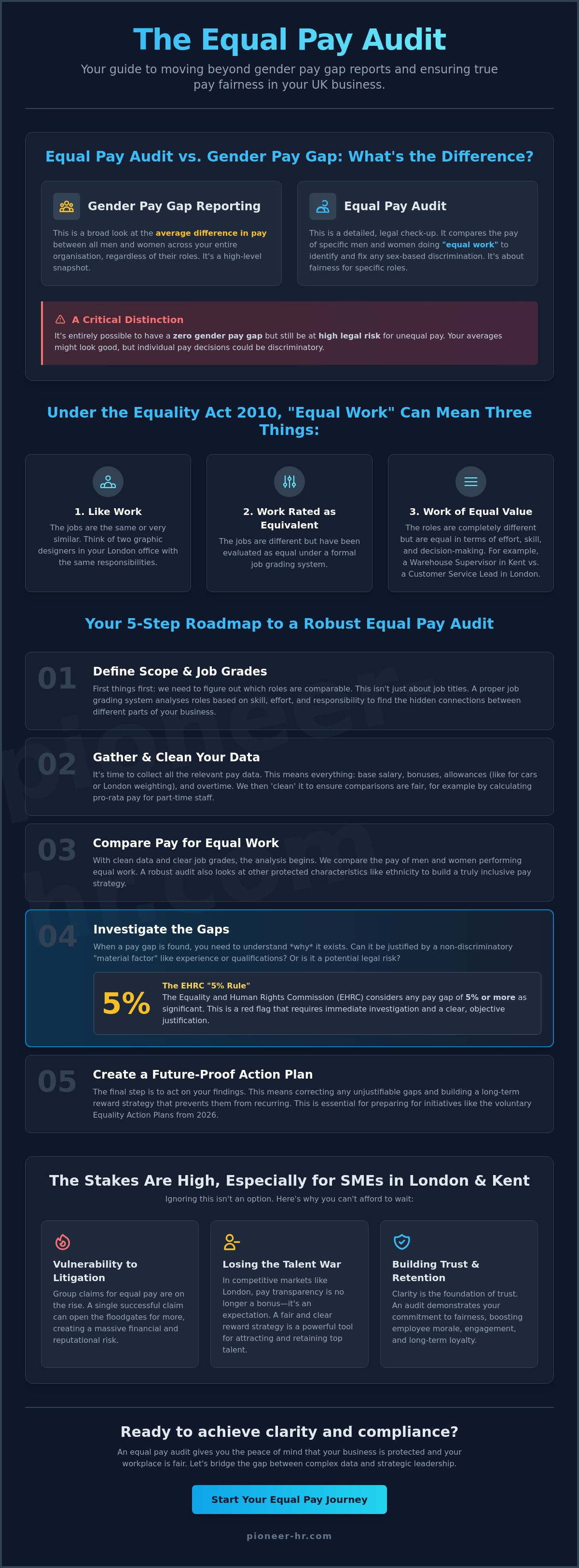
An equal pay audit uk is a proactive health check for your reward strategy, ensuring your pay structures are both fair and legally sound. At its core, this process involves a systematic comparison of pay for employees who are performing "equal work" to identify any potential sex-based discrimination. While many leaders focus on annual reporting, an audit goes much deeper by examining why specific individuals are paid what they are, rather than just looking at broad averages across the firm.
The legal foundation for this process is the Equality Act 2010, which consolidated previous legislation to protect employees from being paid less than someone of the opposite sex for doing the same or equivalent work. The journey toward these protections began decades ago with the Equal Pay Act 1970, and today, it's a non-negotiable part of responsible business management. We believe that understanding these roots helps us build more transparent and equitable organisations for the future.
One area where we often see confusion is the concept of "equal value." Different job titles don't necessarily mean the work isn't equal in the eyes of the law. For example, a Warehouse Supervisor in Kent and a Customer Service Lead in London might have entirely different daily tasks, yet their roles could be deemed equivalent in terms of effort, skill, and responsibility. This is why robust job grading is so important; it allows us to strip away the labels and look at the actual demands of each position.
Equal Pay vs. Gender Pay Gap: Clearing the Confusion
It's easy to mistake gender pay gap reporting for an equal pay audit, but they serve different purposes. A gender pay gap report measures the difference between the average earnings of men and women across your entire organisation, regardless of their roles. In contrast, an equal pay audit uk looks at specific individuals or groups doing the same work to ensure they're paid fairly. Paradoxically, your business could report a zero gender pay gap while still failing an equal pay audit if specific women are being paid less than men for work of equal value.
The 5% Rule: When Should You Worry?
The Equality and Human Rights Commission (EHRC) highlights that any pay discrepancy of 5% or more is considered significant and requires immediate investigation. Throughout 2026, we've noticed that market volatility in competitive hubs like London and Kent has made salary benchmarking more challenging. While a gap might sometimes be justified by a "material factor", such as a genuine difference in qualifications or a specific recruitment premium, you must be able to prove these factors aren't influenced by discrimination. Without a formal review, these small discrepancies can quickly grow into substantial liabilities.
The 5-Step Process for a Robust Equal Pay Audit
Conducting an equal pay audit uk isn't just a box-ticking exercise; it's a strategic journey that requires a structured approach to ensure nothing is missed. We've found that breaking this down into five logical steps allows leadership teams to handle the data with confidence while maintaining the human-centric focus that makes a business thrive. By following this roadmap, you'll move from uncertainty to a place of professional clarity and legal security.
Step 1: Identifying Equal Work and Job Grading
Before we can compare pay, we must establish which roles are actually comparable. This is where job grading becomes the essential foundation of your audit. We look at "like work", which is straightforward, but also "work rated as equivalent" and "work of equal value". Many SMEs in London and Kent fall into the trap of using vague job descriptions that mask pay inequality. For instance, an "Operations Lead" and a "Finance Manager" might have different titles but require identical levels of responsibility and skill. If your job descriptions haven't been updated in years, they might be hiding discrepancies you aren't even aware of yet.
Step 2: Collecting and cleaning your data. Once the roles are grouped, we gather comprehensive payroll and HR data. This includes base pay, bonuses, car allowances, and any regional weightings. It's vital to "clean" this data to ensure we're comparing apples with apples, especially when accounting for part-time pro-rata calculations.
Step 3: Comparing pay across characteristics. While gender is the primary focus for many, a truly robust equal pay audit uk also considers other protected characteristics like ethnicity or disability. This holistic view ensures your reward strategy is inclusive across the board.
Step 4: The "Material Factor" Defence
If you find a pay gap, the next step is to determine if there's a legal justification for it. According to the Acas guidance on equal pay, a "material factor" must be a genuine reason that isn't based on the employee's sex. Valid reasons might include geographical location, such as a London-specific allowance, or premiums for working unsociable night shifts. However, we often have to remind clients that "he negotiated a better starting salary" is never a valid legal defence in the UK. Documenting these findings thoroughly is what protects you from potential tribunal claims down the line.
Step 5: Creating an action plan. The final step is about progress. If inequities are found, we help you build a plan to rectify them. This might involve phased pay adjustments or updating your internal policies to ensure future hires enter on a fair footing. If you're unsure where to start with your data, our retained HR support can provide the ongoing expertise needed to manage these complex reviews smoothly.
Why UK SMEs in London and Kent Can’t Afford to Wait
Small and medium businesses often assume that equal pay issues are only a concern for retail giants or global tech behemoths. However, we're seeing a sharp rise in group litigation across the UK, moving from the High Street into smaller, specialized sectors. For a business owner in London or Kent, an equal pay audit uk isn't just about compliance; it's a strategic insurance policy against the devastating costs of an employment tribunal. By the time a claim is filed, the financial and reputational damage is often already done.
The Equality and Human Rights Commission's Statutory Code of Practice provides the framework that tribunals use to judge these cases. If you wait for a claim to arrive before looking at your data, you've already lost the opportunity to correct issues quietly and professionally. Proactive reviews allow us to identify discrepancies before they become legal liabilities, ensuring your business remains stable in an increasingly litigious environment.
The Recruitment Advantage of Pay Transparency
Candidates in 2026 are more informed than ever before. In the competitive talent hubs of the South East, prospective employees aren't just looking at the headline figure on a job advert. They're asking deep questions about pay equity and how a company ensures fairness over the long term. By implementing a transparent reward strategy, you aren't just following the law; you're building a brand that top talent actually wants to join. Trust is a currency that's hard to earn but easy to lose, and fair pay is its most stable foundation. We've seen that businesses leading with transparency often experience significantly lower turnover rates, saving thousands in recruitment costs.
Legal Professional Privilege: Protecting Your Data
There's a "disclosable" risk that many leaders overlook when they start digging into their payroll. If you conduct an internal audit without expert guidance and discover a significant gap, that document could potentially be used against you in court if you don't act on it immediately. This is where professional oversight becomes vital. Our Fractional Chief People Officer service allows you to manage this sensitive process with the necessary discretion and strategic foresight. We help you navigate the "discovering and ignoring" trap by ensuring that every finding is met with a clear, actionable solution that protects both your people and your bottom line.
Integrating Your Audit into a Broader Reward Strategy
Once you've completed the heavy lifting of your equal pay audit uk, the real value emerges when you shift your focus from fixing past errors to building a sustainable future. We view the audit not as a one-off compliance event, but as the vital baseline for a modern, high-performance culture. This data shouldn't just sit in a secure folder; it should be the primary driver for your salary benchmarking efforts throughout 2026. By aligning your internal equity with external market rates, you create a reward structure that is both fair and fiercely competitive.
Communicating the results is where many leaders feel most vulnerable. You don't need to publish every individual salary to build trust with your team. Instead, we encourage you to focus on the methodology and your ongoing commitment to fairness. Explain that we've reviewed every role to ensure that work of equal value is rewarded equally. This level of transparency turns a potentially awkward conversation into a powerful retention tool. It shows your people in London, Kent, and beyond that their contribution is valued based on objective criteria rather than subjective bias.
Market Alignment and Benchmarking
Ensuring your pay is fair internally is vital, but it also needs to be competitive externally. In high-demand regions like the South East, "fair" pay that's significantly below market rates won't help you keep your best people. We recommend using PPC benchmarking to ensure your reward packages stay aligned with industry standards while maintaining the equity you've established. Regular annual reviews are then needed to prevent "pay drift," where new hires or ad-hoc raises slowly erode the balance you've worked so hard to achieve.
The Role of Leadership in Fair Pay
Managers often have the most influence over pay through discretionary bonuses or starting salary offers. Without proper management training, these individual decisions can slowly recreate the very gaps you've just closed. We've seen how setting clear, objective criteria for bonuses and pay rises ensures consistency across different departments. Linking pay equity directly to your company’s core values helps your leaders understand that fairness isn't just an HR policy; it's a fundamental part of how you do business. If you're ready to turn your audit findings into a long-term competitive advantage, our team can help you design a bespoke reward strategy that protects your business and empowers your people.
How Pioneer HR Supports Your Equal Pay Journey
Undertaking a comprehensive equal pay audit uk can feel like a significant administrative burden, especially for SME leaders who are already balancing growth with complex people management. We believe that professional support should simplify your life, not add another layer of jargon. Our approach is designed specifically for smaller and mid-sized businesses that need the technical rigour of a large-scale audit but delivered with the personal touch and agility of a dedicated partner. We don't just hand over a list of numbers; we provide the strategic context needed to make sense of them.
Our team combines deep technical data analysis with high-level strategic advice to ensure your reward structures are fit for purpose. Whether you need a one-off review or ongoing guidance, our retained HR services provide the stability and expertise to keep your business compliant year after year. For organisations undergoing significant change or those requiring executive-level oversight, our Fractional CPO service offers the leadership needed to manage pay equity projects at the highest level. We act as your strategic bridge, connecting your business goals with a fair, transparent reward culture.
Our Practical Approach to Pay Equity
We don't believe in giving our clients a static spreadsheet and leaving them to figure out the rest. Instead, we provide a clear, actionable roadmap for change. We've supported businesses across London, Kent, and the wider UK in navigating these sensitive waters with discretion and care. Our partnership is built on conversational, jargon-free communication that respects the unique culture you've built. We understand that every business is different, so we tailor our job evaluations and data cleaning processes to reflect your specific operational reality rather than applying a rigid, corporate template.
Ready to Secure Your Business’s Future?
The landscape of 2026 is moving quickly, and waiting for a grievance or a tribunal claim to surface is a high-risk strategy. Now is the ideal time to review your pay structures and ensure they align with both the law and your company values. There is an immense sense of peace of mind that comes from having professional, third-party validation of your reward strategy. It allows you to stand behind your pay decisions with total confidence during recruitment and annual reviews alike. If you're ready to build a fairer workplace and protect your bottom line, contact Pioneer HR today for a confidential discussion about your equal pay audit uk and wider reward journey.
Building a Future-Proof Reward Strategy
The landscape for UK employers is shifting, and staying ahead of compliance isn't just about avoiding risk; it's about building a workplace where talent chooses to stay. We've explored how a systematic equal pay audit uk serves as the foundation for this fairness, moving your business beyond simple reporting toward genuine equity. By identifying work of equal value and grounding your decisions in robust job grading, you protect your organisation from the rising tide of litigation seen across London and the South East.
With over 30 years of HR experience, we specialize in helping UK SMEs navigate these complexities with clarity and discretion. Our team provides the strategic oversight of a Fractional CPO combined with practical, technical analysis to ensure your reward strategy is both competitive and legally sound. Whether you're based in Kent or operating in the heart of the capital, we're here to act as your partner in creating a transparent, high-performance culture.
Book your 2026 Equal Pay Audit with Pioneer HR
Taking this step today ensures your business is ready for whatever 2026 brings. We look forward to helping you build a fairer future for your team.
Frequently Asked Questions
Is an equal pay audit a legal requirement for UK SMEs?
No, an equal pay audit is not a routine legal requirement for most small and medium businesses unless it is ordered by an employment tribunal after a lost claim. However, the landscape is changing with the introduction of voluntary Equality Action Plans in April 2026. For businesses in London and Kent, conducting an audit is a strategic choice to prevent the £5,000 penalties associated with non-compliance of tribunal orders.
What is the difference between an equal pay audit and gender pay gap reporting?
Gender pay gap reporting measures the broad difference in average earnings between men and women across your entire firm. In contrast, an equal pay audit uk focuses on specific roles to ensure individuals are paid fairly for doing the same or equivalent work. You can have a narrow gender pay gap but still face significant legal risks if specific employees aren't receiving equal pay for equal work.
How often should a UK business conduct an equal pay audit?
We generally recommend that businesses conduct a full audit every three years, supplemented by lighter annual reviews of their reward structures. This frequency aligns with the three year exemption period for tribunal ordered audits. Regular checks are especially important in fast moving markets like London, where shifting salary benchmarks can unintentionally create new pay discrepancies as you hire new talent or promote existing staff.
Can an employee request to see the results of an equal pay audit?
Employees do not have a specific statutory right to see the full, confidential audit report. However, they can request information about how their pay is determined if they suspect a discrepancy. While you aren't forced to share the entire document, we believe that sharing high level findings and your action plan is a powerful way to build trust and demonstrate your commitment to fairness.
What happens if we find a pay gap during the audit?
If a gap is identified, you must first determine if it is justified by a legitimate "material factor", such as a recruitment premium for a specific location or a difference in qualifications. If no legal justification exists, you should develop a plan to rectify the inequity. It's important to remember that you cannot legally lower someone's pay to close a gap; you must instead bring the lower paid group up.
What is work of "equal value" under the Equality Act 2010?
Work of equal value refers to jobs that are entirely different in their daily tasks but are equivalent in terms of the demands made on the worker. This includes looking at factors like effort, skill, and decision making responsibility. For example, a firm in Kent might find that a clerical role and a manual role are of equal value once the underlying job demands are professionally evaluated.
How long does a typical equal pay audit take to complete?
A typical equal pay audit uk for an SME usually takes between three and six months to complete from start to finish. The timeline depends heavily on the complexity of your current job grading and the quality of your payroll data. We spend a significant portion of this time on the data cleaning phase to ensure that the final comparisons are accurate and can withstand professional scrutiny.
Do I need a lawyer to conduct an equal pay audit?
You don't strictly need a lawyer to perform the audit, but you do need expert HR guidance to handle the technical data analysis and job evaluations. Our team provides the strategic oversight required to identify risks without the high costs of a law firm. If our review uncovers significant liabilities, we'll guide you on when it might be prudent to seek legal advice to protect your data.


Comments