
When to Hire a Fractional CPO: A Strategic Guide for UK Business Leaders
- Pioneer HR
- May 1
- 12 min read
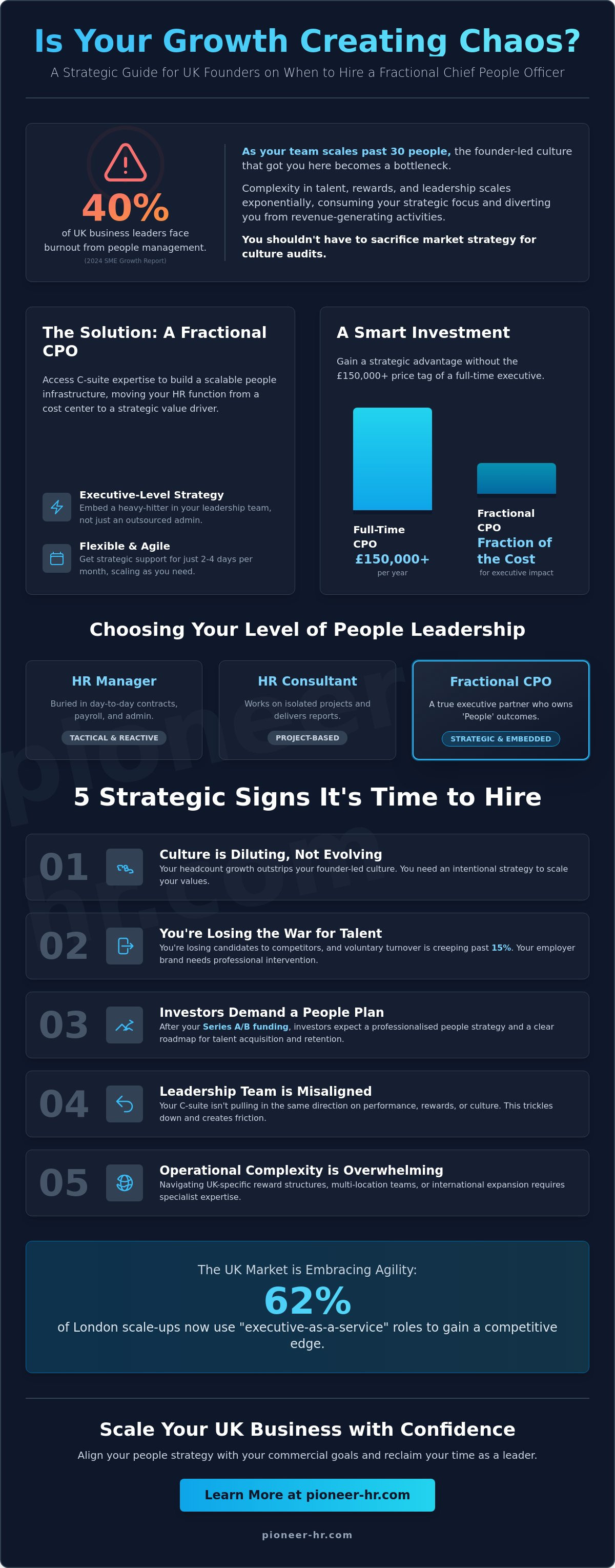
What if the culture that built your London startup is currently the biggest bottleneck to your next £5m in revenue? We understand that as a team expands beyond the 30-person mark, the complexity of managing talent, reward structures, and leadership coaching scales exponentially. You likely agree that your people are your most valuable asset, but you shouldn't have to sacrifice your own strategic focus to handle pay reviews or culture audits. According to the 2024 SME Growth Report, 40% of UK business leaders are currently facing burnout due to administrative people management.
This guide will help you identify the exact triggers for when to hire a fractional cpo, ensuring you get high-level expertise at a fraction of the £150,000 annual executive salary. We'll walk you through a clear roadmap to professionalise your people operations, reduce turnover, and reclaim your time as a leader, whether you're scaling in Kent or the heart of the City. We've mapped out the specific milestones that signal it's time to move from reactive HR to strategic leadership.
Key Takeaways
Understand how high-level strategic leadership can be integrated into your business for just a few days a month, providing executive expertise without the full-time cost.
Recognise the critical milestones, such as when headcount growth begins to dilute your original culture, to identify exactly when to hire a fractional cpo.
Distinguish between tactical HR compliance and the strategic organisational design required to attract and retain top-tier talent in the competitive London and South East markets.
Learn how to secure a high return on investment by establishing clear 90-day KPIs and ensuring your people strategy is aligned with your broader business objectives.
Discover how a collaborative, partnership-led approach can help you scale your UK business with the confidence that comes from three decades of professional HR expertise.
Table of Contents Understanding the Fractional Chief People Officer Role in the UK 5 Strategic Signs It is Time to Hire a Fractional CPO Fractional CPO vs. HR Consultant: Choosing the Right Level Maximising ROI: Preparing Your Business for Executive People Leadership Scaling with Confidence: The Pioneer HR Approach
Understanding the Fractional Chief People Officer Role in the UK
The UK business environment has shifted rapidly leading into 2026. We've seen a significant rise in "agile leadership" across London and the South East, where scale-ups need high-level strategy without the £150,000+ price tag of a full-time executive. This is where the fractional model becomes a game-changer. By Understanding the Fractional Executive Model, leaders can access C-suite wisdom for just 2 to 4 days per month. It's not about outsourcing admin; it's about embedding a heavy-hitter into your leadership team to drive growth through people.
Deciding when to hire a fractional cpo usually happens when a founder realizes their HR Manager is buried in contracts and payroll, leaving no room for culture or talent strategy. We see this often in Kent-based tech firms reaching the 30-employee mark. They need a partner who can build a scalable people infrastructure, not just someone to manage the holiday calendar. Our team at Pioneer HR focuses on these high-impact interventions that bridge the gap between basic compliance and world-class culture.
Unlike traditional HR consultants who might work on a project-by-project basis, a fractional CPO is a true member of your executive board. They don't just deliver a report; they own the "People" outcomes. This distinction is vital because it moves the HR function from a cost centre to a value driver. In 2026, the ability to pivot your workforce strategy quickly is what separates thriving companies from those that stagnate.
The Distinction Between People and Product CPOs
A common hurdle in search results is the "CPO" acronym. In the tech-heavy corridors of London, "Chief Product Officer" is a common title. However, a People CPO focuses on your most valuable asset: your staff. While a Product CPO builds software, a People CPO builds the culture, reward systems, and leadership pipelines that make the software possible. Businesses in transition often mix these needs up, but we've found that clarity here is vital for success. A fractional CPO ensures your talent strategy aligns with your commercial goals from day one.
Why the Fractional Model is Exploding in 2026
The 2026 economic landscape in the UK rewards flexibility. With 62% of London scale-ups now opting for "executive-as-a-service" roles, the fractional model offers a competitive edge. You get "big company" experience from someone who has scaled teams at global firms, but on a startup budget. This flexibility allows you to scale support up during a recruitment surge or down during a period of consolidation. It's a pragmatic, cost-effective way to ensure your business remains human-centric while maintaining the lean operations required in today's market.
5 Strategic Signs It is Time to Hire a Fractional CPO
Deciding when to hire a fractional cpo often comes down to a shift in complexity rather than just a total headcount number. We see many UK businesses reach a point where the people-related tasks that once took five hours a week now consume the CEO’s entire calendar. If you're spending more time resolving team friction than driving market strategy, you've likely crossed that threshold. Here are five milestones that signal it's time to bring in strategic HR leadership.
Headcount growth outstrips founder-led culture: When you can no longer have a 1:1 relationship with every employee, your culture starts to evolve on its own. A fractional CPO ensures this evolution is intentional.
Difficulty attracting or retaining top-tier UK talent: If you're losing candidates to London-based competitors or seeing a 15% increase in turnover, your employer brand and recruitment process need professional intervention.
Post-funding requirements (Series A/B): Investors expect a professionalised people strategy. They want to see a roadmap for talent, not just a list of hires.
Leadership team misalignment: When your C-suite isn't pulling in the same direction, it trickles down. Strategic HR leadership focuses on elevating the role of HR leadership to align executive goals with team performance.
Operational complexity: Managing international expansion or navigating UK-specific reward structures requires a level of expertise that a generalist HR manager might lack.
Navigating the 30-50 Employee Growth Chasm
The 30-50 employee range is often called the "danger zone" for UK scale-ups. At this size, the "family feel" that defined your early days starts to fray. You need to transition into a high-performance organisation without losing your soul. We've found that without clear structures, productivity often dips by 20% during this phase because roles become blurred. The growth chasm represents the critical transition point where informal founder-led interactions no longer suffice to sustain a productive organisational culture.
Preparing for Investment or Exit
If you're eyeing an exit or a major funding round in the next 12 to 18 months, your people data must be impeccable. A fractional CPO cleans up your HR tech stack and ensures your due diligence reports are ready for scrutiny. Proving fiscal responsibility is vital; this involves using accurate salary benchmarking to show that your compensation strategy is both competitive and sustainable. This level of preparation builds a scalable leadership structure that investors trust.
If you're unsure if your current team structure is ready for the next level, our fractional CPO services can help you bridge the gap between where you are and where you need to be.
Fractional CPO vs. HR Consultant: Choosing the Right Level
Deciding between a consultant and a CPO isn't just about the job title. It's about the depth of the problems you're trying to solve. In the London market, where competition for talent is fierce, mistaking a tactical fix for a strategic need can be a costly error. We often see business leaders struggle to identify exactly where the line is drawn between administrative support and leadership. Understanding this distinction is the first step in determining when to hire a fractional cpo versus when to stick with a standard consultancy model.
The Strategic vs. Tactical Divide
A tactical HR consultant typically focuses on the "how." They'll draft a contract, handle a specific grievance, or ensure you're compliant with the latest UK employment law updates. This is vital work, but it doesn't build a company. A CPO looks at the "why." If your staff turnover has hit 20% in the last 12 months, a consultant might help you exit those people legally. A CPO will diagnose why they're leaving and fix the underlying culture. We believe organisational development is the bridge between simply having employees and building a high-performing team. You'll know your current HR lead is out of their depth when they can't link people initiatives to your 2025 revenue targets or growth milestones.
Integrating with Retained HR Support
For many maturing businesses in Kent or Sussex, the ideal setup isn't an "either/or" choice. It's often a combination. The CPO sets the vision and the reward strategy, while the retained HR support handles the day-to-day documentation and compliance. This synergy ensures that high-level advice doesn't just sit in a slide deck but actually gets executed on the ground. It provides a safety net of compliance with the driving force of a strategic roadmap, allowing the business to scale without the wheels falling off the cultural bus.
Managing an existing team is another area where the Fractional CPO shines. They don't replace your HR Manager; they mentor them. In London, hiring a full-time CPO can easily exceed £160,000 per year plus benefits. A fractional model provides that same boardroom-level experience for a few days a month, making it a much more efficient investment for a scaling SME. It allows you to keep your overheads lean while ensuring your people strategy is robust enough to support rapid growth. We've seen this approach transform businesses that have outgrown their initial HR setups but aren't quite ready for a permanent C-suite salary.
Tactical: "How do we fire X?"
Strategic: "How do we build a performance culture where X wouldn't have failed?"
Tactical: Updating a handbook.
Strategic: Designing a long-term reward structure that retains top 5% talent.
Maximising ROI: Preparing Your Business for Executive People Leadership
Deciding when to hire a fractional cpo is a significant milestone for any growing UK business, but the success of this partnership depends on the groundwork you lay before they start. We've found that the highest returns on investment happen when founders treat the CPO as a true strategic peer. This means ensuring they have a permanent "seat at the table" where they can influence commercial decisions rather than just reacting to them. If your people leader is excluded from board-level discussions, you're essentially paying for executive expertise that you aren't fully using.
Before the engagement begins, we recommend gathering your existing people data to save time and money. You can't fix what you can't measure. Pull together your current turnover rates, total payroll costs, and any recent engagement survey results from your London or Kent based teams. If your employee turnover is approaching the 34% mark seen in recent UK industry reports from 2023, having this data ready allows your fractional leader to move from diagnosis to action on day one. It's also vital to communicate the new role to your wider team. Framing this hire as an investment in their growth and wellbeing helps build trust and prevents any unnecessary anxiety about corporate changes.
The First 90 Days: What a Fractional CPO Should Deliver
The initial three months are about stabilization and alignment. Your CPO will start with a comprehensive HR audit to ensure your business remains compliant with evolving UK employment laws and right-to-work regulations. They'll also begin developing a Reward Strategy that goes beyond simple salary figures to include benefits that actually matter to your specific workforce. Finally, they should conduct initial coaching sessions with your senior management team. This ensures every leader is pulling in the same direction and understands how to manage their teams effectively during periods of rapid scale.
Establishing the People Strategy Framework
We believe your people strategy must be a direct reflection of your 2026 commercial business plan. Your fractional leader will help you bridge this gap by setting up professional pay benchmarking. This ensures you don't lose your best talent to competitors in the London market because of outdated salary brackets. They'll also create a clear roadmap for your future hiring needs. This includes identifying the exact moment you'll need to transition from a fractional model to a full-time Head of People or HR Director, ensuring your infrastructure always stays one step ahead of your growth.
Ready to align your people strategy with your commercial goals? Explore how our fractional CPO services can transform your leadership team and drive sustainable growth.
Scaling with Confidence: The Pioneer HR Approach
At Pioneer HR, we've spent more than 30 years supporting the UK business community. We aren't interested in cold, transactional relationships. We believe in a conversational, partnership-led approach that puts your people first. Our deep roots in London, Sussex, and the South East mean we understand local market pressures better than most. Knowing when to hire a fractional cpo is about recognising the point where people management becomes a strategic bottleneck rather than an administrative task. We help you identify that moment before it impacts your bottom line.
We've guided over 450 leadership teams through periods of rapid change since our inception. Our goal is to provide the stability you need to scale without the overhead of a full-time executive. We don't just hand over a strategy document and walk away. We stay by your side to ensure those plans actually work in the real world. This blend of high-level thinking and practical execution is what sets us apart in the South East business landscape. Deciding when to hire a fractional cpo often comes at a critical juncture where you need expert leadership to protect your culture during growth.
Why Pioneer HR for Fractional Leadership?
Our team bridges the gap between strategic vision and daily HR operations. We've worked across diverse UK sectors, supporting everything from fast-paced tech scale-ups in Shoreditch to established SMEs in Kent. We understand the specific nuances of the London talent market and the operational needs of businesses across the South East. You get a partner who knows the local regulations and the cultural expectations of UK employees. We focus on building a sustainable people strategy that aligns with your long-term commercial goals, ensuring your HR functions are a driver of growth, not a cost centre.
Next Steps for Your People Strategy
The best way to move forward is through a direct conversation. You can book a discovery call with Sarah-Jane (SJ) to discuss your current challenges and growth plans. We'll start with a comprehensive people health check to identify gaps in your current structure. This initial strategic review provides a clear roadmap for your growth over the next 12 to 18 months. It's a no-pressure way to see if our approach fits your company culture. Ready to transform your leadership team? Explore our Fractional CPO services and take the next step today.
Elevate Your People Strategy with Strategic HR Leadership
Deciding when to hire a fractional cpo is a pivotal moment for any growing UK business. It's the point where you move beyond simple compliance and start building a culture that drives sustainable growth. We've seen how London and Sussex scale-ups thrive when they have access to executive-level expertise without the heavy financial burden of a full-time C-suite salary. By integrating 30+ years of strategic HR experience, we ensure your people operations are as sophisticated as your product or service.
Our approach focuses on high-impact areas like specialist UK salary benchmarking and reward systems that keep you competitive in a tight labour market. You don't have to navigate these complexities alone. We're here to act as your strategic partners, helping you scale with confidence while keeping your team's well-being at the heart of every decision. Let's work together to create a workplace where both your business and your people can truly flourish.
Frequently Asked Questions
What is the typical cost of a fractional CPO in the UK?
A fractional CPO in the UK typically costs between £1,200 and £2,500 per day. This rate depends on their level of experience and the complexity of your business needs. We find that companies often save up to 60% compared to the total cost of a full-time executive hire, which includes salary, bonuses, and expensive benefits packages.
How many days a month does a fractional CPO usually work?
Most fractional CPOs work between 2 and 8 days per month. The exact duration depends on the scale of your people strategy and your current workforce size. For instance, a scaling tech firm in London might require 4 days a month to manage rapid growth, while a more stable business in Kent might only need 2 days for high-level oversight.
Can a fractional CPO help with UK employment law and tribunals?
Yes, a fractional CPO provides essential guidance on UK employment law to mitigate the risk of industrial tribunals. They ensure your policies align with the Employment Rights Act 1996 and more recent 2024 legislative updates. While they aren't solicitors, their strategic oversight helps you handle sensitive grievances or redundancies correctly, which protects your reputation and your bottom line.
What is the difference between an interim CPO and a fractional CPO?
An interim CPO works full-time for a fixed period to bridge a specific gap, whereas a fractional CPO provides long-term, part-time strategic support. You should know when to hire a fractional cpo if you need consistent executive leadership without the overhead of a full-time role. Interims usually focus on short-term transitions, while fractional leaders become a permanent part of your leadership team.
Do we need to be based in London to hire a fractional CPO?
You don't need to be based in London to hire a fractional CPO. While many of our partners operate in the capital, we regularly support businesses across Kent and the wider UK through hybrid working models. Modern communication tools allow these experts to provide the same level of strategic value regardless of your office's physical location.
How does a fractional CPO interact with our existing HR manager?
A fractional CPO acts as a mentor and strategic lead for your existing HR manager. They focus on the high-level "why" of your people strategy, while the HR manager handles day-to-day operations. This partnership elevates the HR function. It allows your manager to grow professionally while ensuring the business meets its long-term commercial objectives through expert guidance.
Can a fractional CPO help us with salary benchmarking in the UK?
Yes, they use industry-specific data to ensure your compensation packages remain competitive within the UK market. By analyzing 2024 market trends and regional variations between London and the South East, they help you attract top talent without overspending. This data-driven approach ensures your payroll remains sustainable while reducing the risk of losing key staff to competitors.
Will a fractional CPO help with our recruitment strategy?
A fractional CPO is vital for building a robust recruitment strategy that moves beyond simply filling seats. Knowing when to hire a fractional cpo is often linked to high churn or difficulty attracting specialists in a competitive market. They design end-to-end talent acquisition frameworks and improve your employer brand, which can reduce your average time-to-hire by 30%.


Comments