
How to Conduct an Employee Engagement Survey: A Strategic Guide for UK SMEs
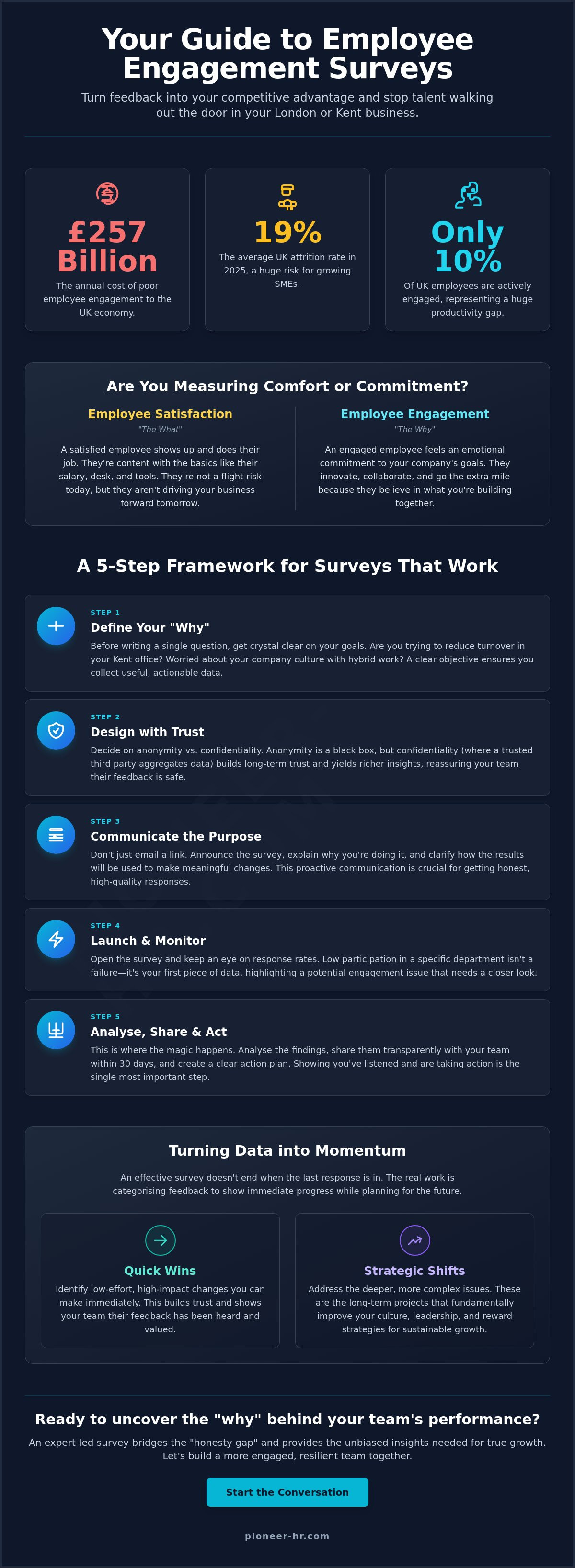
Did you know that poor employee engagement costs the UK economy an estimated £257 billion every year in lost productivity? In a competitive landscape where the average UK attrition rate hit 19% in 2025, many business owners from London to Kent feel they're fighting a losing battle against "quiet quitting." We know it's exhausting to wonder if your hard-earned rewards are actually motivating your team or if you're just watching talent walk out the door. Learning how to conduct an employee engagement survey effectively is the first step toward securing the future of your business through data-driven insights.
We agree that a survey shouldn't just be a box-ticking exercise that creates more work for your leadership. You need a process that provides clarity on whether your salary benchmarking is competitive and whether your people feel truly heard. In this guide, we promise to show you the exact steps to design, launch, and act on surveys that foster genuine loyalty and drive growth. We'll preview a clear roadmap for building a feedback culture, covering everything from initial design to making the strategic changes that improve morale and retention across your entire organisation.
Key Takeaways
Master our five-step framework on how to conduct an employee engagement survey to ensure your data leads to meaningful organisational development rather than just a pile of spreadsheets.
Identify the "Big Five" engagement drivers for your team, allowing you to pinpoint exactly where your reward strategy or leadership support needs adjustment.
Implement the 30-day transparency rule to share feedback openly with your staff, proving that their voices are heard and valued in your business.
Learn how to categorise survey findings into "Quick Wins" and "Strategic Shifts" to maintain momentum and show immediate progress to your employees.
Explore why an external strategic lens can bridge the "honesty gap" and provide the unbiased insights needed for true growth and better retention.
Table of Contents
Understanding Employee Engagement in the 2026 UK Workplace
The UK employment market in 2026 is unrecognisable compared to just a few years ago. With Statutory Sick Pay becoming a day-one right and the Fair Work Agency stepping up enforcement on holiday pay, the "social contract" between employer and employee has fundamentally shifted. While overall engagement has reached 65% across the country, active engagement remains a serious challenge at just 10%. For a business owner in Kent or London, this gap represents a massive hidden cost that doesn't show up on a balance sheet until people start leaving. Learning how to conduct an employee engagement survey is no longer a "nice to have" HR project; it is a survival strategy for growing firms. When you're figuring out how to measure your team's pulse, you're actually looking for the foundation of your future productivity.
Disengagement isn't just a quiet office or a few missed deadlines. It's a financial leak that drains resources every single day. Poor engagement costs the UK economy an estimated £257 billion annually. With the average UK attrition rate jumping to 19% in 2025, the stakes for SMEs are incredibly high. If you don't know why your people are staying, you won't know why they're leaving until you receive their resignation email. We believe that Understanding Employee Engagement is the first step toward plugging that leak and building a resilient organisation.
Engagement vs. Satisfaction: Why the Distinction Matters
A satisfied employee shows up, does the work, and takes the paycheque. They're content enough to stay, but they aren't necessarily the ones driving innovation or going the extra mile during a busy period. Engagement is the emotional commitment an employee has to the organisation and its goals. While satisfaction targets the "what", such as having a decent desk or the right tools, engagement targets the "why". An engaged team member doesn't just work for a salary; they work because they believe in what we're building together. This distinction is vital because many DIY surveys fail by measuring comfort instead of commitment.
The Strategic Role of Feedback for Sussex and Kent SMEs
SMEs in Sussex and Kent face a unique challenge: the "London Magnet." Local firms often struggle to match the inflated salaries of the capital, making your internal culture your primary competitive advantage. Using regular surveys allows you to identify "flight risks" months before they actually resign. It's about building a culture of transparency that attracts top talent who are tired of the faceless corporate grind. If you're unsure how to interpret the feedback you collect, a fractional Chief People Officer can provide the strategic lens needed to turn raw data into a retention roadmap. Mastering how to conduct an employee engagement survey properly gives you the evidence needed to make bold changes that keep your best people from commuting to the city.
A 5-Step Framework: How to Conduct an Employee Engagement Survey
Running a survey without a structured plan is just noise. To get results that actually mean something for your business, you need a method that prioritises both data integrity and the human experience. We've developed a five-step approach to help you navigate how to conduct an employee engagement survey while maintaining the trust of your team in London, Kent, or anywhere across the UK.
Step 1: Define your "Why". Before you write a single question, decide what you're trying to solve. Are you seeing high turnover in your Kent office? Are you worried that hybrid work is diluting your culture? Setting clear objectives ensures the data you collect is actually useful.
Step 2: Design the structure. Decide between anonymity and confidentiality. Anonymity means no one knows who said what; confidentiality means a third party knows, but the leadership team only sees aggregated data. For most SMEs, confidentiality often yields better long-term insights.
Step 3: Communicate the purpose. Don't just drop a link in an inbox. Explain why you're doing this, what you hope to learn, and how the results will be used. This step is where you build the trust necessary for honest feedback.
Step 4: Launch and monitor. Open the survey and watch the response rates in real-time. If participation is low in specific departments, it might indicate a lack of trust or simply a busy week that requires a gentle nudge.
Step 5: Close the loop. As soon as the survey closes, send a "thank you" note. Acknowledge the time your team spent and give them a timeline for when they can expect to hear the results.
If you're worried about the "Honesty Gap" or don't have the internal capacity to manage this, a fractional Chief People Officer can provide the strategic oversight needed to ensure employees feel safe being truly candid.
Designing for Maximum Participation
Engagement fatigue is real. We've found that 10-15 minutes is the "sweet spot" for survey length. Anything longer and you'll see a sharp drop-off in the quality of open-ended answers. It's also vital that your survey is mobile-friendly, especially for diverse UK workforces where many staff might not be desk-bound. Finally, ensure your process is fully GDPR compliant to protect your employees' data privacy.
Choosing the Right Distribution Channel
Don't rely solely on email if your team uses Slack or Teams. For deskless workers in warehouses or on-site in Sussex, QR codes on posters in breakrooms work brilliantly. We recommend setting a clear deadline, usually between 10 and 14 days, to create a sense of urgency without causing stress. A couple of well-timed reminders can boost participation without feeling intrusive.
Drafting Actionable Questions and Benchmarking Results
The quality of your data depends entirely on the quality of your questions. When you're looking at how to conduct an employee engagement survey, it's tempting to ask fifty different things to cover every base. We've seen that this often leads to "survey fatigue," where employees just click through to finish. Instead, focus on the "Big Five" drivers: Leadership, Growth, Alignment, Support, and Reward. By structuring your survey around these pillars, you create a clear narrative of what it's really like to work in your business.
We recommend using a mix of three question types to get a full picture. Likert scale questions (1-5 or "Strongly Disagree" to "Strongly Agree") provide the quantitative data needed for tracking trends over time. Multiple choice questions help with segmentation, such as identifying if certain issues are specific to your London office or your remote team. Finally, open-ended questions provide the depth that numbers alone cannot reach. Numbers tell you "what" is happening, but comments tell you "why".
Linking Engagement to Reward and Pay
In the current UK economy, ignoring pay in your survey is a mistake. With the National Living Wage rising to £12.71 in April 2026, employees are more aware of their market value than ever. You can ask about pay without "opening a can of worms" by focusing on the perceived fairness and transparency of your system. For example, ask if they understand how their pay is determined or if they feel their total reward package meets their needs. This data is invaluable for your salary benchmarking uk efforts. If the results show a disconnect, it's a clear signal that your reward strategy might need a strategic adjustment to remain competitive in the South East job market.
Qualitative vs. Quantitative Data
While the percentages and charts look great in a board meeting, the "comments" section is often the most valuable part of the survey. This is where the real "gold" lies. To avoid getting overwhelmed, look for recurring keywords or themes. Are multiple people mentioning a lack of career progression? Is there a specific bottleneck in your Kent warehouse? Spotting these patterns allows you to address the root cause of disengagement rather than just treating the symptoms. Benchmarking these results against industry standards in the South East helps you understand if your challenges are unique to your business or part of a wider regional trend.
The Post-Survey Action Plan: Turning Data into Change
Data collection is only half the battle. The real value of learning how to conduct an employee engagement survey is found in the action that follows the closing date. We recommend adopting a strict 30-day transparency rule. This means sharing the "good, the bad, and the ugly" with your entire organisation within four weeks of the survey closing. If you wait longer, your team in London or Kent might assume the results were disappointing or, worse, that the leadership team is ignoring them. Silence is the fastest way to breed cynicism and ensure that future participation rates plummet.
Once the results are out, we suggest categorising the feedback into two distinct buckets: "Quick Wins" and "Strategic Shifts." Quick Wins are visible, low-cost changes that can be implemented almost immediately. This might include clarifying a specific policy or improving the equipment in your Sussex warehouse. These small victories prove to your staff that you've actually listened. Strategic Shifts are the deeper, long-term projects like a full overhaul of your organisational structure or implementing a new leadership training programme. If you've been wondering how to conduct an employee engagement survey that drives genuine growth, the answer lies in this visible follow-up.
Communicating the Results Honestly
When presenting this data to your Board or leadership team in Hove or London, focus on the commercial reality of the findings. Use the data to justify necessary investments in your people. For the "all-hands" announcement to the wider company, we suggest a tone of partnership rather than defense. Acknowledge where the company has fallen short of expectations. Honesty builds more respect than a polished corporate spin ever could. If you need help navigating these sensitive conversations, our retained HR support provides the ongoing expertise to turn raw feedback into a professional action plan.
Building the Continuous Feedback Loop
To avoid "survey fatigue," you must demonstrate that change is happening. If employees see no progress, they won't participate next time. We recommend moving away from a single annual event toward quarterly "pulse" checks. These shorter surveys allow you to monitor the impact of your changes in real-time. Assigning "Engagement Champions" from different departments in your Kent or Sussex offices can also help. These individuals act as a bridge between the leadership team and the workforce, ensuring that the employee voice remains central. Setting up small focus groups can also help you dig deeper into specific problem areas identified in the initial data.
Why a Managed HR Approach Beats a DIY Survey
While free online tools make it look easy, the technical aspect of how to conduct an employee engagement survey is actually the simplest part. The real challenge lies in the psychology of the process. We've seen that when a survey is managed internally, a "Honesty Gap" inevitably forms. Employees are often hesitant to be 100% candid if they suspect their direct manager or the internal HR team might see their raw responses. This fear of repercussion, even if unfounded, leads to skewed data that paints a rosier picture than reality. By the time you realise the data was wrong, your best talent might already be browsing jobs in London.
At Pioneer HR, we bring 30 years of experience to the table, helping UK businesses move beyond basic data collection. We don't just hand you a report; we provide a fractional Chief People Officer to help you interpret the "why" behind the numbers. This strategic oversight ensures that the feedback you receive is integrated into your wider HR retainer support, turning a one-off survey into a continuous engine for organisational development. It's about moving from a reactive stance to a proactive culture where people feel truly valued.
The Benefits of Third-Party Objectivity
Using an external partner removes the natural internal bias that can creep into data analysis. It's difficult for a leadership team to remain objective when reading criticism of their own policies. We act as a neutral bridge, filtering out the noise to focus on actionable insights. This level of psychological safety is crucial; knowing an external firm handles the data encourages the kind of radical honesty that drives change. We also provide professional reporting that's ready for board or investor review, giving you the evidence needed to justify strategic shifts in your reward or leadership structure.
Strategic Implementation with Pioneer HR
We believe that a survey is only as good as the action it inspires. Our team helps you bridge the gap between "feedback" and "fixed" by creating a tailored roadmap that fits your specific Sussex or Kent business context. We understand the local market dynamics and the unique pressures facing SMEs in the South East. We'll help you identify the "Quick Wins" mentioned earlier and manage the long-term "Strategic Shifts" that lead to a high-performing culture. If you're ready to stop guessing and start growing, contact us for a discovery call to build your 2026 engagement roadmap together.
Building a Resilient Future for Your Team
Creating a culture where your people feel heard is the most effective way to protect your business against the high attrition rates currently seen across London and Kent. We've seen how a structured 5-step framework and the 30-day transparency rule can transform a simple questionnaire into a powerful engine for change. The real value lies in the action you take once the data is in. By focusing on the "Big Five" drivers and linking your findings to your reward and retention strategy, you build a workplace that top talent won't want to leave.
We've explored the nuances of how to conduct an employee engagement survey that actually delivers measurable results rather than just more admin. At Pioneer HR, we bring over 30 years of HR expertise to help UK SMEs navigate these complexities. As specialists in SME reward and retention, we provide the UK-based strategic support you need to turn feedback into a high-performing culture.
Ready to design a survey that drives growth? Book a consultation with Pioneer HR to design your strategic engagement survey and start building your 2026 roadmap today. Your team's future is waiting to be heard.
Frequently Asked Questions
How often should a UK SME conduct an employee engagement survey?
UK SMEs should aim for one comprehensive annual survey supported by shorter quarterly "pulse" checks. This rhythm allows you to track long term organisational development while remaining agile enough to address immediate issues in your Kent or London office. Consistency is more important than frequency; don't start a cycle you can't realistically follow up on with concrete actions.
Can we run an engagement survey if we are a very small team of under 10?
You certainly can, but you must be mindful that true anonymity is difficult to maintain in teams this small. Instead of promising total anonymity, focus on building a culture of psychological safety where staff feel comfortable sharing their views openly. For teams under 10, a structured conversation facilitated by an external partner can often be more effective than a digital form.
What is a good response rate for an employee engagement survey?
A response rate between 70% and 80% is considered excellent for most UK businesses. While 100% is the dream, it's rarely achievable without coercion, which often ruins the data quality. If your rate falls below 60%, it's usually a sign of "survey fatigue" or a deeper lack of trust in the leadership team's willingness to act on the feedback provided.
How do we ensure our survey is GDPR compliant for UK employees?
Ensure your survey platform is GDPR compliant and that you've provided a clear privacy notice to all staff before they begin. You must explain what data is being collected, how it's stored, and who has access to the raw results. When learning how to conduct an employee engagement survey, ensure a Data Processing Agreement is in place if you are using an external consultant to handle staff emails.
What are the best questions to ask about management and leadership?
Focus on the "Big Five" drivers, specifically looking at support and clarity of vision. Questions like "Does my manager provide the support I need to succeed?" or "Do I understand how my work contributes to the company's goals?" are highly effective. These provide actionable data that can lead directly into targeted leadership coaching or management training programmes.
How do we handle negative or toxic feedback in survey comments?
Treat negative feedback as a diagnostic tool rather than a personal attack on the business. Look for clusters of similar complaints; if five people in your London team mention the same issue, it's a systemic problem rather than a "toxic" individual. Acknowledge the feedback openly in your summary report to show that you aren't cherry-picking only the positive responses.
Should we offer incentives or prizes for completing the survey?
We generally advise against using prizes as they can lead to "junk data" where people rush through the questions just to enter a draw. The best incentive is proving that the process leads to real change. If employees see that their feedback results in a better reward strategy or improved office culture, they'll participate because they value having a voice.
How long should we wait between the survey closing and sharing results?
Adhere to the 30-day transparency rule to maintain momentum and trust within the team. Sharing a high-level summary of the results within four weeks shows that you've prioritised their feedback. You don't need a full solution for every problem by day 30, but you must show that you've listened and have a clear plan for the next steps.


Comments