
How to Justify Salary Decisions to Your Board: A Strategic Guide for UK Leaders
- Pioneer HR
- 1 day ago
- 13 min read
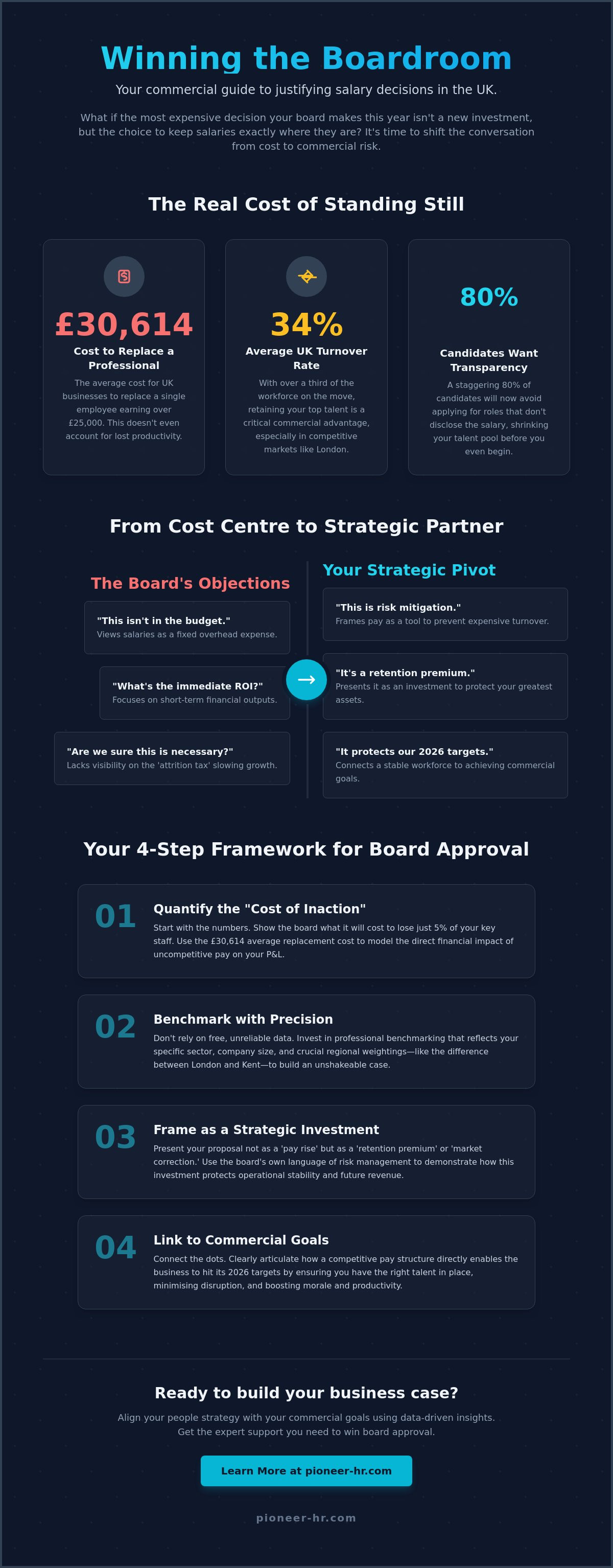
What if the most expensive decision your board makes this year isn't a capital investment, but the choice to keep salaries exactly where they are? We understand the pressure of walking into a boardroom in London or Kent and being viewed as a cost centre rather than a value driver. It's a difficult position to be in, especially when you know that replacing a single professional now costs an average of £30,614. When turnover rates across the UK sit at 34%, the risk of losing top talent is a commercial threat that cannot be ignored.
You’re likely searching for how to justify salary decisions to my board in a way that feels commercial rather than just emotional. We agree that the old ways of asking for budget no longer work in a market where 80% of candidates now avoid roles without pay transparency. This article will teach you how to transform raw benchmarking data into a compelling business case that wins board approval and aligns your people strategy with your commercial goals. We'll explore how to use 2026 market trends and the "cost of inaction" to move your directors from a mindset of expense to one of strategic investment.
Key Takeaways
Learn how to pivot the conversation from "overhead costs" to "risk mitigation" by quantifying the financial impact of employee turnover and lost productivity.
Discover exactly how to justify salary decisions to my board using precise UK benchmarking data that reflects the 2026 market landscape.
Apply a strategic four-step framework designed to align your remuneration proposals with the board's fiduciary duties and commercial goals.
Understand the tactical advantage of using a Fractional Chief People Officer as a neutral, expert voice to secure approval for complex reward strategies.
Table of Contents
Why Boards Push Back on Salary Increases (And How to Pivot)
Stepping into a boardroom in London or Kent to request a budget increase for salaries can feel like an uphill battle. We've seen many leaders fall into the 'Cost Centre' trap, where HR requests are viewed as pure overheads that eat into the bottom line. To change the outcome, we must first respect the board's fiduciary duty. Their primary focus is financial stability and shareholder value, which is why they often approach pay with caution. Understanding the broader Executive Compensation Overview provides a useful perspective on how governance and financial scrutiny shape their worldview. When pay is viewed through this lens, any increase must be tied to a clear commercial return.
Learning how to justify salary decisions to my board requires shifting the narrative from 'spending more' to 'protecting assets.' Your people are your most valuable assets, and in the 2026 UK climate, a 'wait and see' approach is a dangerous strategy. With the National Living Wage rising to £12.71 per hour and median pay awards stabilising at 3%, standing still actually means falling behind. If we don't act proactively, we risk a talent drain that will cost far more than the initial salary adjustment.
The Disconnect Between HR Strategy and Boardroom Finances
The disconnect often stems from a lack of shared data. While the board reviews P&L statements, they might not see the hidden 'attrition tax' slowing down the business. In competitive hubs like London, the pressure is even higher. We must show them that 80% of candidates now avoid roles that don't disclose pay. Boards often lack visibility into the true cost of employee turnover, which currently averages £30,614 for professionals earning over £25,000. For a growing SME, short-termism in salary budgeting can be fatal. We help leaders bridge this gap by connecting people metrics to financial KPIs. If you don't show the board the direct link between uncompetitive pay and the 34% average UK turnover rate, they'll continue to see salary as a cost rather than a lever for growth.
Identifying the Core Objections: Cost vs. Investment
Common board refrains like 'Is this in the budget?' or 'What is the ROI?' are risk management questions in disguise. Instead of defending a number, we recommend framing the increase as a 'retention premium.' This is a proactive Reward Strategy that prevents the much higher costs of recruitment and lost productivity. By using the board's own language regarding risk management, you can justify pay as a necessary investment to maintain operational stability. We don't just want to pay people more; we want to ensure the business has the talent required to meet its 2026 commercial targets without constant, expensive disruptions to the workforce.
Building Your Case with Robust Salary Benchmarking Data
To succeed in the boardroom, we must define salary benchmarking accurately. It's the technical process of comparing your internal pay structures against verified external market rates. Beyond the mechanics, it's a strategic tool for maintaining market competitiveness. When you're considering how to justify salary decisions to my board, anecdotal evidence simply won't suffice. Free tools and casual Google searches often fail under boardroom scrutiny because they lack the rigour required for fiduciary oversight. Directors expect data that accounts for 'market drift', which occurs when internal pay increments fail to keep pace with the wider UK economy over several cycles.
Regional weighting is another critical factor that can make or break your business case. A software engineer role in central London naturally commands a different premium than the same position in Kent. Boards understand geographic cost-of-living differences and local competition levels, so your data must reflect these nuances. If you're using generic UK-wide averages, you're likely either overpaying in some areas or, more dangerously, underpaying in talent hotspots where recruitment is already a challenge.
The Limitations of Free Data vs. Professional Benchmarking
Free, self-reported salary sites are often skewed by extreme outliers and outdated entries. For UK SMEs, this data is often too broad to be useful. We believe the value lies in 'clean' data that's filtered by sector, company size, and specific UK regions. Professional salary benchmarking provides the 'hard' evidence boards require to feel confident in their approvals. It moves the discussion from subjective opinions to what the market actually dictates. This level of precision helps you avoid setting expensive precedents for uncontrolled wage growth while ensuring you aren't losing your best people to competitors.
2026 Market Trends: Navigating the Post-Inflation Landscape
The 2026 labour market is transitioning, yet talent shortages remain acute in specialised sectors. We're seeing a return to stability with a 3% median pay increase forecast, but the debate between 'cost of living' and 'market rate' still persists in the boardroom. With 80% of candidates now avoiding roles without disclosed pay, transparency is no longer optional. It's a requirement for effective recruitment. If you're unsure where your current packages sit against these new expectations, conducting a professional benchmarking exercise can provide the clarity needed for your next board presentation.
Quantifying the 'Cost of No': Turnover, Recruitment, and Morale
When we discuss how to justify salary decisions to my board, the conversation often centres on what the company might spend. We believe the more powerful argument lies in what the company stands to lose. This is the 'Cost of No'. It represents the total financial impact of losing a talented employee because their pay has fallen behind the market. While a salary increase is a visible line item, the costs of a resignation are often buried across multiple budgets. We must help the board see that the "New Hire Premium" is a real financial burden; it often costs 20% more to hire a replacement from the open market than it does to retain a proven expert who already understands your business.
The direct costs of turnover are easier to track but no less damaging. Recruitment fees, job board advertising, and the significant amount of management time spent interviewing all add up quickly. In our experience, these expenses are just the tip of the iceberg. The indirect costs, such as lost productivity during the vacancy and the subsequent 'knowledge drain', can stall projects for months. When a key person leaves a team in London or Kent, the remaining members often face increased workloads, which can trigger a domino effect of further resignations.
Calculating the Financial Impact of Employee Turnover
To win board approval, we need to present a clear formula: (Recruitment Cost + Onboarding Cost + Lost Productivity). Let's look at the numbers. Replacing a mid-level professional in the UK now carries an average cost of £30,614. When you compare a 5% pay rise to a potential £15,000 recruitment fee plus several months of reduced output, the business case for retention becomes undeniable. Replacing a specialist in Sussex can take up to 6 months of lost revenue. By presenting these figures, you move the board away from a simple 'spend' mindset and toward a sophisticated risk-mitigation strategy.
The Hidden Costs of 'Quiet Quitting' and Disengagement
Uncompetitive pay doesn't always lead to an immediate exit. Sometimes, it results in 'quiet quitting' or presenteeism, where employees remain in their roles but significantly reduce their effort. This disengagement is a silent profit killer. Pay-related stress also takes a heavy toll on employee wellbeing and mental health, leading to higher rates of absenteeism. We've found that a fair and transparent reward strategy is a fundamental prerequisite for high performance. It provides the stability employees need to focus on their work rather than their bank balances. When people feel valued, they're more likely to go the extra mile, creating a culture of proactivity that benefits the entire organisation.
The 4-Step Framework for Justifying Pay Decisions
Having the data is one thing; presenting it in a way that secures a 'yes' is another. We've developed a repeatable structure that moves the conversation from a request for money to a strategic business proposal. Knowing how to justify salary decisions to my board involves a logical progression that first addresses their financial concerns and then highlights the opportunities for growth. By following this four-step framework, you can lead the boardroom narrative with confidence and clarity.
Step 1 & 2: Leading with Data and Risk
We recommend opening your presentation by validating the board's primary concern: financial stability. Acknowledge that every pound spent must be accounted for. Once you've built that rapport, present the market reality through benchmarking evidence. Use job grading to demonstrate that your internal structures are consistent and fair. This prevents the board from worrying that one increase will trigger a chaotic chain reaction across the entire company. It shows you've looked at the organisation as a whole rather than just reacting to individual requests.
Visualising the gap is essential. Use clear charts to show where your current packages sit against competitors in Hove, London, or Kent. This isn't about being the highest payer; it's about being within a safe 'market zone' to prevent the 34% turnover rate we discussed earlier. Quantifying the risk through a 'Cost of No' analysis allows you to show that the cost of inaction is far higher than the proposed investment. You're not asking for a favour; you're presenting a risk-management solution that protects the company's bottom line.
Step 3 & 4: Commercial Alignment and Feasibility
Step three is where you connect pay to specific business milestones. Frame the proposal around growth enablement. For example, explain that to hit your 2026 revenue targets, you must keep the core engineering or sales team intact. When you master how to justify salary decisions to my board in this way, you become a strategic partner in the company's success. If a full immediate increase isn't feasible, propose a phased implementation. A clear roadmap for pay adjustments helps the board manage cash flow while still sending a positive signal to the workforce.
We often suggest exploring a mix of solutions. If the budget is tight, consider performance-linked bonuses or non-monetary rewards alongside a more modest base increase. This flexibility shows you're thinking like a business owner, not just an HR manager. It demonstrates that you're committed to the company's long-term health. If you need support building this commercial narrative, our Fractional Chief People Officer service can help you design a pitch that resonates at the director level.
Leveraging Fractional Leadership to Secure Board Approval
Boards often approach internal salary requests with a degree of healthy skepticism, sometimes fearing that the HR function is too closely aligned with employee sentiment to remain purely objective. This is exactly where external validation becomes a powerful asset. When you are looking for how to justify salary decisions to my board, bringing in a "Neutral Expert" can fundamentally shift the dynamic of the conversation. An external perspective removes the emotional weight often associated with pay discussions and replaces it with the objective market mechanics that directors find much easier to digest and approve.
We've seen that boards in London and Kent tend to lean into recommendations that come with a broader market context. By using a third party to validate your internal findings, you demonstrate a commitment to rigour and financial discipline. This doesn't just help you win the immediate budget; it builds your long-term credibility as a leader who understands the delicate balance between talent retention and fiscal responsibility. Our role is to act as that strategic partner, helping you build a case that is as commercially sound as it is fair.
The Role of a Fractional CPO in Boardroom Negotiations
A Fractional Chief People Officer brings executive-level gravitas to your pitch. Because these experts operate across various organisations and sectors in the UK, they possess a breadth of market knowledge that internal teams might naturally lack. They don't just advocate for higher pay; they validate your internal recommendations against real-world 2026 data and commercial trends. This presence helps bridge the communication gap between the "People" function and the "Finance" function. It ensures that your proposal is viewed as a strategic business move designed to protect the company's assets rather than just another departmental expense.
How Pioneer HR Streamlines the Justification Process
We act as your strategic partner to ensure your business case is bulletproof before you even step into the meeting. Through our salary benchmarking services, we provide bespoke reports that go far beyond generic national averages. These reports offer the granular, sector-specific detail required to satisfy even the most detail-oriented CFO. We focus on delivering "clean" data that accounts for regional nuances, ensuring your London-based roles are as accurately priced as those in the home counties.
Our support doesn't end with a single presentation. With ongoing retained HR support, we help you maintain pay structures that remain compliant and competitive as the UK market shifts throughout the year. If you're preparing for a high-stakes remuneration discussion and need to know how to justify salary decisions to my board with absolute confidence, contact us today. We'll help you build a board-ready business case that aligns your 2026 reward strategy with your long-term commercial goals.
Securing Your Organisation's Future Through Strategic Reward
Winning boardroom approval for salary adjustments doesn't have to be a battle of opinions. By shifting the narrative from departmental spending to commercial risk mitigation, you position yourself as a strategic partner in the company's growth. We've explored how professional benchmarking and the "Cost of No" analysis provide the hard evidence needed to move directors from a cost-mindset to an investment-mindset. Whether you're operating in London, Kent, or across the UK, mastering how to justify salary decisions to my board is the key to protecting your most valuable assets in a shifting 2026 market.
At Pioneer HR, we bring over 30 years of HR leadership experience to help you navigate these high-stakes discussions. Our specialist UK salary benchmarking data ensures your proposals are rooted in reality, helping our clients reduce recruitment costs by up to 30% through improved retention. Don't leave your talent strategy to chance. Book a consultation with Pioneer HR to build your board-ready reward strategy and lead your next board meeting with absolute confidence. We're here to help you turn people metrics into commercial results.
Frequently Asked Questions
What is the best way to present salary benchmarking data to a board?
Visualise the 'Market Zone' rather than just presenting a single data point. Showing where your organisation sits against competitors in London or Kent helps the board see the risk of being an outlier. We recommend using a traffic light system: green for competitive, amber for at-risk, and red for critical. This turns a complex spreadsheet into a strategic decision-making tool that directors can easily digest.
How do I justify a pay rise for an employee when the company isn't hitting all its targets?
Focus on the 'Critical Asset' argument. If the business is currently struggling, losing a top performer will only accelerate that decline. Explain that the cost of a modest increase is significantly lower than the disruption of a vacancy in a key department. It's about protecting the talent needed to lead the organisation back toward its commercial targets and ensuring you have the right people to drive recovery.
Should I use national or local UK data when benchmarking salaries in Kent or Sussex?
Use local data for roles that are office-based in Kent or Sussex, but use London data for specialised roles where you're competing for the same talent pool. Boards appreciate this nuance because it prevents overpaying for local roles while ensuring you don't lose technical experts to London firms. It's about being geographically precise rather than just using broad national averages that might not reflect local competition.
How can a Fractional CPO help with board-level salary negotiations?
They act as a neutral bridge between the People function and the Finance function. A Fractional CPO brings an objective, executive-level voice that validates your recommendations without the perceived bias of an internal manager. This external authority often gives the board the confidence they need to approve budgets, especially when the expert can cite broader UK market trends and 2026 data from across various sectors.
What are the legal risks of denying a pay rise request in the UK?
The primary risk involves potential equal pay claims under the Equality Act 2010. While pay rises are usually discretionary, you must be able to prove that the decision was based on objective, non-discriminatory factors like market rates or performance. Inconsistent decisions can also damage trust and lead to formal grievances, which creates a significant administrative and financial burden for any leadership team.
How do I handle a situation where a new hire is paid more than a long-serving employee?
Address this through a transparent job grading system that values skills and market demand. If a new hire's market rate is higher, you should look to adjust the long-serving employee's pay over a set period to maintain internal equity. Ignoring this gap often leads to resentment and turnover, which ultimately costs the business more than the salary adjustment would have in the first place.
What non-monetary rewards are most effective if the board refuses a salary increase?
Flexibility and professional development are often top priorities for UK workers. If base pay is frozen, consider offering enhanced leave, private medical insurance, or leadership coaching. We've found that tools like Insights Discovery can also be incredibly effective; they show a commitment to personal growth and improve team dynamics without increasing the permanent fixed-cost base of the organisation.
How often should our company conduct a full salary benchmarking review?
We suggest a comprehensive review once a year, ideally three to four months before your new financial year begins. This gives you ample time to prepare your evidence and calculate the potential 'Cost of No' for your budget proposal. Having a regular cycle means you're never scrambling for data when you're looking for how to justify salary decisions to my board during the annual budgeting process.


Comments