
Pay and Reward Strategy Design: A Strategic Guide for UK Employers in 2026
- Pioneer HR
- 7 hours ago
- 12 min read
What if your current approach to pay is actually driving your best people straight into the arms of your London competitors? We understand the pressure you're under. With the National Living Wage rising to £12.71 this April and employer National Insurance now at 15 percent, balancing a sustainable budget while keeping your team motivated feels like a constant challenge. Whether you're based in Kent or the heart of the city, the struggle to stay competitive against inflation and salary pressure is a reality we face together.
We're here to help you move beyond the spreadsheet. This guide explains how effective pay and reward strategy design can transform your business into a talent magnet that values fairness and transparency. You'll learn how to create a competitive, future-proof strategy that rewards performance and ensures compliance with the latest UK standards. We'll explore a clear roadmap for reward design, covering everything from salary benchmarking to the non-financial perks that truly drive employee engagement in 2026.
Key Takeaways
Understand why traditional compensation models are failing in the 2026 UK market and how to navigate the shift from an employee-led to an employer-led landscape.
Discover how a modern pay and reward strategy design balances competitive salaries with intangible benefits like autonomy to secure top talent in London and beyond.
Learn why relying solely on market averages can be a cultural trap and how to use professional benchmarking as a foundation for a unique employer brand.
Gain a practical five-step roadmap to auditing your current recognition framework and defining a reward philosophy that truly reflects your company values.
Explore how SMEs in regions like Kent and Hove can access executive-level expertise through fractional support to implement sustainable, high-impact reward frameworks.
Table of Contents
What is Pay and Reward Strategy Design and Why Does it Matter in 2026?
At its heart, pay and reward strategy design is the deliberate framework you use to compensate and recognise your people for the value they bring to your business. It isn't just a list of salaries in a spreadsheet. It's a cohesive plan that aligns your financial goals with the needs of your workforce. To understand the broader academic context, you might look at What is Reward Management?, which highlights how financial and non-financial incentives work together to drive performance. We see it as a partnership between the organisation and the individual.
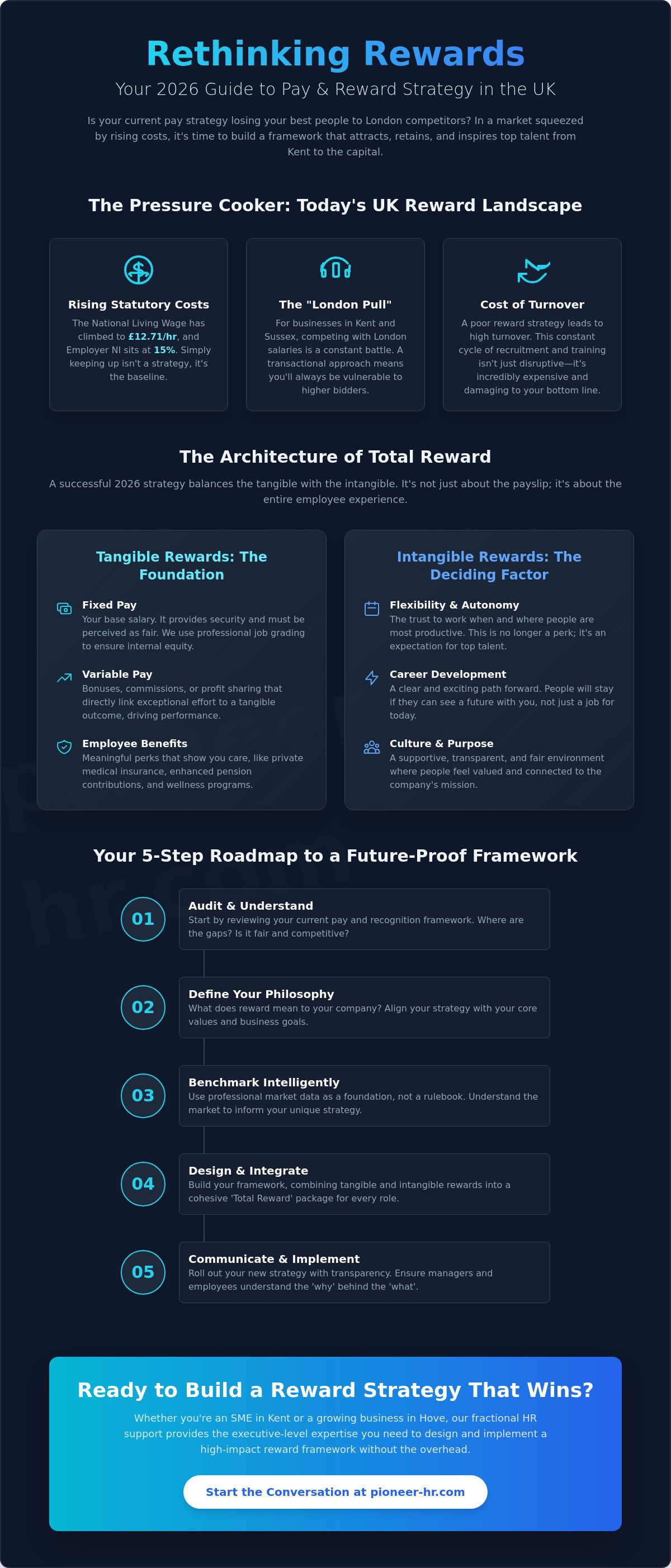
As we move through 2026, the stakes have never been higher for UK employers. With the National Living Wage reaching £12.71 per hour and employer National Insurance contributions sitting at 15 percent, your overheads are facing unprecedented pressure. Simply "paying people" is a survival tactic; having a proper pay and reward strategy design is a growth tactic. A well-constructed plan protects your bottom line by reducing the eye-watering costs of high turnover and constant recruitment cycles. When you get this right, you aren't just filling roles; you're building a sustainable community.
The "great reshuffle" of the mid-2020s has taught us that employees are no longer just looking for the highest bidder. They're looking for clarity, fairness, and a sense of value. If your approach is purely transactional, you'll always be vulnerable to competitors with deeper pockets. A strategic approach allows you to compete on more than just the base salary figure, ensuring you attract people who believe in your mission as much as their paycheck.
The Core Elements of a Modern UK Reward Framework
We often break down a strategy into three distinct layers. First, there's fixed pay, which is the baseline salary that provides security. Then, you have variable pay, such as bonuses or commissions, which links effort to outcome. Alongside these, we look at employee benefits. This includes everything from private medical insurance to enhanced pension contributions that go beyond the legal minimums.
We also can't ignore "hidden" rewards. These are the elements that don't always show up on a payslip but carry immense weight. Flexible working arrangements, clear career development paths, and a supportive company culture are often the deciding factors when a candidate chooses you over a rival in Kent or London. If you're looking to refine these elements, our Reward Strategy support can help you map these out effectively.
Why Hove and Sussex Businesses Face Unique Reward Challenges
Employers in Hove and across Sussex deal with a specific geographic tension. You're close enough to London to feel the pull of capital city salaries, yet you're operating in a local market with its own distinct cost-of-living realities. In Kent and Brighton, attracting top-tier professionals requires more than just matching a "London Weighting" figure. You need a strategy that leverages your unique culture and flexibility to stay competitive without overstretching your budget.
A reward strategy is the DNA of employee motivation for 2026.
The Architecture of Total Reward: Balancing Tangible and Intangible Value
Total reward is more than a buzzword; it's the full spectrum of what you offer in exchange for your team's time, energy, and expertise. By 2026, the market has shifted significantly. While a competitive salary remains the entry ticket, employees now weigh autonomy and purpose just as heavily as their monthly deposit. We believe a successful pay and reward strategy design must balance these tangible figures with the intangible value that makes someone choose to stay in Kent or London rather than looking elsewhere.
Tangible Rewards: Getting the Basics Right
Your tangible offer is the anchor. It starts with base pay structures that aren't just plucked from thin air. Implementing job grading ensures that roles are evaluated fairly against one another, creating a sense of internal equity that's vital for morale. With the National Living Wage reaching £12.71 this year, staying ahead of statutory requirements is a baseline, not a strategy. We help you look beyond these minimums to build benefits that actually resonate, like enhanced pension contributions or private medical insurance that supports a hybrid workforce. These elements provide the financial security your people need to perform at their best.
Intangible Rewards: The Secret Sauce of Retention
Intangible rewards are the high-value, low-cost pillars of your framework. Many 2026 professionals would trade a minor pay increase for genuine autonomy or better work-life balance. Recognition shouldn't be a generic "employee of the month" plaque. It needs to be authentic and tied to your specific culture. Investing in professional growth is another heavy hitter. A dedicated training budget often acts as a better retention tool than a one-off Christmas bonus because it signals that you're invested in their future. This is where transparency in pay and rewards becomes essential; people want to see the path ahead of them clearly.
To keep your strategy grounded in reality, you can use salary benchmarking to ensure your tangible offers are competitive. However, don't fall into the trap of simply copying a competitor's homework. Your rewards should reflect your specific brand values. If you're struggling to find that balance, a Fractional Chief People Officer can provide the executive-level insight needed to design a framework that fits your unique culture and long-term goals.
Benchmarking vs. Strategy: Why Data Alone Isn't Enough
Data can be a seductive trap. It's easy to look at a spreadsheet of "market rates" and assume your work is done. However, blindly following these averages can lead to a generic culture that fails to inspire your best people. While salary benchmarking services UK provide the essential foundation, they don't represent the whole house. Effective pay and reward strategy design requires you to interpret that data through the lens of your specific business goals and values. You aren't just buying labour; you're investing in a partnership.
The "London vs. Local" debate has become a central challenge for hybrid teams in 2026. If you're based in Kent but your lead developer lives in a London borough, your pay structure must be defensible. Paying purely by geography can inadvertently create pay gaps that hurt your culture. We suggest using data to proactively close gender and ethnicity pay disparities. Addressing these gaps isn't just about compliance; it's about proving to your team that your pay and reward strategy design is rooted in genuine fairness. This proactive stance prevents small discrepancies from turning into significant legal headaches later on.
When to Use Professional Salary Benchmarking
Free salary checkers often rely on skewed or outdated information that doesn't reflect the nuances of the 2026 UK market. These tools often pull from broad datasets that miss the specific pressures of local hubs. To make informed decisions, you need sector-specific insights that understand the difference between a tech role in Brighton and a traditional manufacturing role in Kent. Professional Salary Benchmarking provides the precision needed to stay competitive without wasting budget. Data is the "map," but strategy is the "destination" for HR leaders who want to build lasting teams.
Handling Objections: 'We Can't Afford to Pay Market Rate'
We often hear from SMEs who worry they simply can't afford the "market rate." This is where strategic positioning becomes your greatest tool. You don't always have to be a "market leader" in base salary to win the talent war. By choosing to be a "market follower" on cash but a "leader" on high-impact, low-cost benefits, you can still create an irresistible offer. Consider things like flexible work-from-anywhere weeks or robust leadership coaching. Being honest about your pay scales and the logic behind them builds far more trust than a secret, discretionary bonus ever could. This level of transparency is a cornerstone of modern pay and reward strategy design that keeps people engaged.
5 Steps to Designing a Future-Proof Reward Framework
Designing a future-proof framework doesn't have to be an overwhelming academic exercise. We've refined the process into five practical steps that help you build a pay and reward strategy design that actually works for your business. By focusing on these high-impact phases, you can move from reactive pay hikes to a proactive, strategic approach that supports your long-term growth.
Phase 1: Discovery and Benchmarking
The first step is a thorough audit of your current state. You need to know what you're actually paying and, more importantly, if it's working. Start with an internal equity check. Are people in the same role being paid differently for no objective reason? These discrepancies are often where cultural friction begins. Next, perform an external market check to identify high-risk flight areas. If you're losing talent in Kent to London firms for a specific salary gap, you need to quantify that risk. Finally, set a realistic budget. Your strategy must be something the business can sustain over the next three years, especially with the 15 percent employer National Insurance rate in mind.
Once you have the data, you must define your "Reward Philosophy." This is simply deciding what you want to be known for as an employer. Do you aim to be the highest payer in the South East, or do you want to be the firm known for the best professional development and work-life balance? This philosophy acts as your North Star for every decision that follows.
Phase 2: Design and Implementation
With your philosophy in place, you can begin building your pay structures and benefit tiers. We recommend using job grading and reward tools to create clear pay bands. This structure allows for career progression without "title inflation," where roles are renamed just to justify a salary increase. It provides a transparent ladder that employees can actually see and climb. When selecting benefits, don't guess what your team wants. Ask them. A demographic in Brighton might value a learning allowance or enhanced mental health support far more than a traditional corporate perk.
The final, and perhaps most critical, step is the communication and rollout. How you tell your team about these changes matters as much as the changes themselves. Transparency is your greatest ally here. Explain the logic behind the tiers and the "why" behind the benefits. If you're ready to stop guessing and start building a structured framework, our Salary Benchmarking service provides the exact data points you need to begin this process with confidence.
Compliance is the final check. Ensure your new design meets all UK employment law requirements, particularly around the National Living Wage and gender pay reporting. A strategy that isn't compliant isn't just a risk; it's a liability that can undo all your hard work in building trust.
Implementing Your Strategy: From Paper to People with Pioneer HR
A brilliant plan on paper only creates value when it's felt by your employees. Moving from the design phase to actual implementation requires a delicate touch and a clear communication plan. We've seen many businesses in London and Kent spend months on pay and reward strategy design, only to see the impact fizzle out because the rollout lacked clarity. This is where Pioneer HR Reward Consultancy steps in. We partner with you to ensure your new framework is understood, respected, and embraced by your team.
The 2026 UK market doesn't stand still. With inflation forecasts hovering around 2.3 percent and the recent rise in employer National Insurance to 15 percent, your strategy needs to be agile. A "set and forget" approach is the fastest way to lose your best people to more proactive competitors. We help you take a long-term view, reviewing and evolving your rewards as the economic landscape shifts. This ensures you're always offering a package that is both affordable for the business and irresistible to your talent.
How a Fractional Chief People Officer Executes Your Vision
Taking the load off the CEO is one of the primary benefits of our Fractional CPO services. Strategy design shouldn't be another item on your already overflowing to-do list. By bringing in executive-level expertise on a fractional basis, you get the strategic depth of a full-time People Director without the associated salary costs. We provide the objective expertise needed to handle sensitive pay conversations and technical job grading. Having a trusted third party manage these elements often builds more trust with employees, as they see the process is being handled with professional rigour and fairness.
Next Steps for Your Business
You don't have to overhaul everything at once. Many of the Hove and Sussex SMEs we work with find success by starting small and scaling their efforts. If you're ready to move forward, we recommend these immediate actions:
Book a comprehensive pay and reward audit to see exactly where you stand against 2026 standards.
Start with a targeted project, such as Salary Benchmarking for your core or highest-risk roles.
Review your non-financial perks to ensure they align with what your specific demographic actually values.
Ready to build a reward strategy that actually works? Let’s talk. We can help you turn your pay and reward strategy design into a powerful engine for business growth and employee loyalty.
Building a Sustainable Future for Your Team
Navigating the complexities of the 2026 UK labour market requires more than just reactive pay increases. We've explored how a balanced "Total Reward" approach, combining competitive benchmarking with meaningful intangible benefits, creates a culture where people actually want to stay. Whether you're competing with London salaries or building a local powerhouse in Kent, your pay and reward strategy design should be a reflection of your unique values and long-term business goals.
At Pioneer HR, we bring over 30 years of HR expertise to help you bridge the gap between data and culture. As specialists in UK SME salary benchmarking and Fractional CPO leadership, we provide the strategic depth needed to drive growth without the overhead of a full-time executive. It's time to move from surviving salary pressure to thriving through strategic recognition. Book your Pay and Reward Strategy consultation with Pioneer HR today and let's build a framework that supports your people and your bottom line. We look forward to partnering with you on this journey.
Frequently Asked Questions
What is the difference between a pay structure and a reward strategy?
A pay structure is the technical framework of salary bands and grades that dictates what each role is paid. In contrast, a reward strategy is the broader philosophy that explains why you compensate people in a certain way. While the structure provides the "how," the strategy ensures your financial and non-financial rewards align with your company culture and long-term business goals.
How often should a UK business review its pay and reward strategy?
We recommend a full review of your pay and reward strategy design at least once a year, typically before your annual budget cycle. You should also monitor specific market shifts more frequently, such as the April 2026 National Living Wage increase to £12.71. Staying ahead of these changes prevents you from losing your best talent to more agile competitors in London or Kent.
Is it better to offer higher salaries or better benefits in 2026?
A balance is essential because employees in 2026 value security and flexibility equally. While inflation makes a competitive base salary a priority, many professionals now choose autonomy and professional growth over a minor pay bump. We suggest using professional benchmarking to ensure your base pay is fair, then layering in benefits that offer genuine lifestyle value to your specific team.
How do we handle pay rises during a period of high inflation in the UK?
Focus on sustainable, measured increases rather than reactive jumps that might damage your long-term financial stability. You can bridge the gap by highlighting your total reward package, including non-cash benefits like flexible working. Transparency is vital here; explaining the business logic behind a 3 percent increase often builds more trust than staying silent while staff feel the pressure of rising costs.
What are the legal requirements for pay transparency in the UK?
UK employers with 250 or more staff must comply with mandatory gender pay gap reporting. Beyond this, the influence of international regulations is pushing many UK firms to be more open about pay scales during the recruitment process. Proactively sharing your pay bands helps you build an employer brand rooted in fairness and equality, which is a major draw for talent in 2026.
Can a small business in Hove really compete with London salaries?
Yes, by leveraging your unique local advantages that large capital city firms struggle to match. While you might not match a global bank on base salary, you can win on work-life balance, shorter commutes, and a more supportive, human-centric culture. Small businesses in Hove often attract top talent by offering the autonomy and sense of purpose that many professionals crave after years in the city.
What is 'Total Reward' and why is it important for retention?
Total Reward encompasses everything an employee receives, from their base salary and bonuses to flexible working and career development opportunities. It's crucial for retention because it shifts the focus away from just the monthly paycheck. When people feel valued through a comprehensive pay and reward strategy design, they're far less likely to leave for a slightly higher offer from a competitor.
How do I know if my current pay rates are competitive?
The most reliable method is through professional salary benchmarking that uses verified, sector-specific data. Free online tools often provide skewed results that don't account for the specific pressures of the Kent or Brighton markets. We help you compare your rates against real-time data to identify exactly where you might be at risk of losing key staff to other local or London-based firms.


Comments