
Salary Review Process for Small Business: A Strategic 2026 UK Guide
Updated: Jun 23
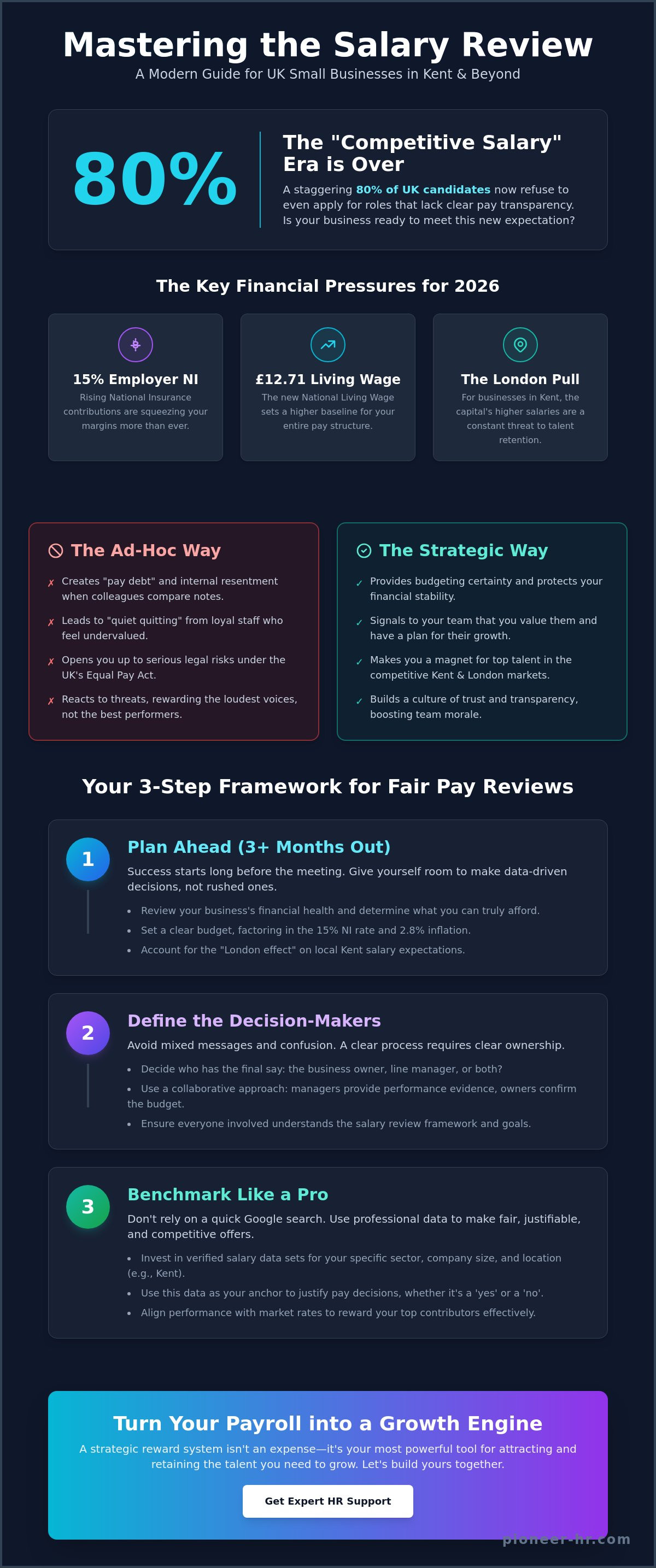
With 80% of UK candidates now refusing to even apply for roles that lack clear pay transparency, the days of "competitive salary" being a vague placeholder are officially over. We understand the quiet anxiety that sets in when a star performer in Kent mentions a recruiter from London reached out, or when you're calculating the impact of the 15% employer National Insurance rate on your 2026 margins. It's a difficult tightrope to walk, especially when you want to reward hard work without compromising your company's financial stability.
The good news is that a well-structured salary review process for small business doesn't have to be a source of dread. We've designed this guide to help you master pay discussions so you can retain your best talent while keeping your staff costs sustainable. We'll explore a repeatable framework that covers benchmarking against the £12.71 National Living Wage, navigating the 2.8% inflation rate, and turning those awkward "no" conversations into opportunities for deeper employee trust.
Table of Contents
Why a Formal Salary Review Process is Vital for UK Small Businesses
A formal salary review process for small business is far more than an annual administrative chore; it's a structured evaluation where we look at how much you're paying each team member compared to their individual performance and current market rates. In 2026, this isn't just good practice. It's a survival strategy. With employer National Insurance contributions rising to 15% and the National Living Wage hitting £12.71 per hour, your margins are under more pressure than ever. If you're running a business in Kent or Sussex, you're likely feeling the pull of London salaries too. This is where a solid Reward Strategy comes in. It provides the foundation you need to make decisions based on data, not just on who asks the loudest.
The Risks of Ad-Hoc Pay Rises
Individual negotiations often feel like the path of least resistance, but they create what we call "pay debt." This is the hidden cost of internal resentment that builds when one person gets a bump because they threatened to leave, while a loyal high performer stays at the same rate. These arbitrary decisions can lead to "quiet quitting" or serious legal risks under the Equal Pay Act. If two people are doing the same job but have vastly different salaries because of separate, private negotiations, you're on thin ice. Transparency and a clear framework are your best defenses against turnover in a market where 80% of candidates expect clear pay information from the start.
Strategic Benefits for Your Bottom Line
When you formalize your reviews, you gain budgeting certainty. You'll know exactly how much your staff costs will increase before the new tax year starts, which is vital when navigating the 2.8% inflation rate. You can also implement performance-related pay to ensure that your most productive people are the ones seeing the biggest rewards. This aligns their personal goals with your business growth. Beyond the numbers, being known as a fair and professional employer in the London or Sussex regions makes you a magnet for talent. It builds a culture of trust that no "emergency" pay rise can ever replicate.
Step-by-Step: Preparing Your Small Business for a Salary Review
Success in the salary review process for small business depends entirely on the groundwork you lay before you ever sit down with an employee. We recommend starting your preparation at least three months before your effective pay date. This lead time allows you to review your financial health without the pressure of an immediate deadline. You'll need to determine what the business can actually afford for 2026, keeping in mind that the employer National Insurance rate is now 15% and the National Living Wage has risen to £12.71. These aren't just numbers; they're the boundaries of your budget. If you're based in Kent or Sussex, your budget also needs to account for the local "London effect," where proximity to the capital's higher pay scales can tempt your best people away.
Identifying who makes the final call is equally vital. In many small firms, the business owner holds the purse strings, but line managers often have the best view of day to day performance. We suggest a collaborative approach. Managers should provide the evidence of impact, while the owner ensures the total increase remains within the 2.8% inflation-linked growth targets or specific merit-based pots. This clarity prevents mixed messages during the actual review meetings.
The Power of Professional Salary Benchmarking
Many owners fall into the trap of "Google searching" salaries, which often leads to inaccurate or inflated data that doesn't reflect the nuances of your specific sector. Real salary benchmarking involves looking at verified data sets that account for company size, location, and specific responsibilities. This data is your best tool for justifying decisions. If an employee asks for a rise that exceeds the market rate, having professional data allows you to have a calm, evidence-based conversation rather than a defensive one. Our team provides detailed Salary Benchmarking support to help you find that "sweet spot" where pay is competitive but sustainable.
Establishing Your Evaluation Criteria
To keep the process fair, you must move beyond rewarding "tenure" alone. Just because someone has been with you for five years doesn't automatically mean their value to the business has increased at the same rate as the market. Instead, focus on "value added" and specific achievements. We often help growing SMEs implement Job Grading structures to ensure that everyone is being compared on a like-for-like basis. This structure makes the salary review process for small business much easier to manage as you scale, as it removes the guesswork from pay decisions. If you're feeling unsure about how to categorize roles, a quick HR Audit can often reveal where your current pay structure might be out of alignment.
Benchmarking vs. Performance: How to Make Fair Pay Decisions
When you're finalizing your salary review process for small business, you'll find that pay decisions usually fall into two distinct categories: market adjustments and performance rewards. In 2026, the total cost of employment has jumped significantly. With employer National Insurance now at 15% on earnings above £5,000 and mandatory pension contributions to consider, a 3% pay rise actually costs your business much more in total reward. We recommend using a "Pay Matrix" to stay objective. This is a simple grid that plots an employee's performance score against where their current pay sits compared to the market median. It helps you prioritize your budget for those who are both high performing and currently underpaid.
For businesses in Kent and Sussex, the "London weighting" debate is a constant challenge. You don't necessarily have to match London's peak salaries to retain your team, but you must offer a package that respects the local cost of living and the convenience of a shorter commute. Balancing a Cost of Living Adjustment (COLA) with merit-based increases allows you to support everyone through the 2.8% inflation rate while specifically rewarding those who drive your business forward.
Performance-Linked Rises
Merit increases should always be tied to clear KPIs and your company values. If your budget is tight because of the recent NI increases, look beyond the monthly paycheck. High performers often value non-monetary rewards like additional holiday days, professional development, or more flexible working arrangements. These elements can be just as effective for retention as a small cash bump. Our Reward Strategy services can help you design a holistic package that recognizes excellence without breaking your 2026 margins.
Market Alignment: Avoiding the "Poaching" Trap
Salary benchmarking is the process of comparing internal pay against external market data for similar roles. This is your primary tool for identifying "flight risk" roles. If a key employee is significantly under the market rate, they're an easy target for recruiters. In these cases, you might need to prioritize a market adjustment over a performance rise just to save the business from the high cost of a sudden vacancy. It's about being proactive rather than reactive. If you're unsure where your team stands, a professional Salary Benchmarking exercise provides the clarity you need to make these tough calls with confidence.
Navigating the Conversation: Communicating Pay Decisions Transparently
Communicating the results of your salary review process for small business is often the most stressful part for owners. We've seen many leaders in Kent and London delay these meetings because they fear a negative reaction. But transparency is your best tool. We always advocate for the "No-Surprises" Rule. An employee shouldn't learn about performance issues for the first time during a pay discussion. If you've been having regular 1-2-1s throughout the year, the pay meeting becomes a logical conclusion rather than a shock. It's a time to sit down and have a mature, data-led conversation about value.
When you structure the meeting, start with genuine appreciation for their specific contributions. Move quickly to the data we discussed in the benchmarking phase. Ending with future goals ensures the conversation stays forward-looking. If someone says "I expected more," use your professional benchmarking data as a neutral shield. It shifts the focus from your personal opinion to an objective market reality. Once the meeting is over, a formal follow-up letter is a must. It's not just professional; it's a vital part of your record-keeping to ensure clarity for both parties. If you find these conversations daunting, our Retained HR Support provides the coaching and templates you need to lead them with confidence.
The "Yes" Conversation
When the answer is yes, don't just state the new figure and move on. Reinforce the specific behaviours and achievements that led to this investment. It's also the perfect time to remind them of their "Total Reward" package. Mention the 15% employer NI and pension contributions you're making, alongside perks like flex-working or extra leave. This helps them see the full value of their employment beyond just the gross salary. You're showing them that they have a long-term future with the business.
The "Not This Time" Conversation
If you can't offer a rise, be honest about the reasons. Whether it's business constraints like the rising cost of the £12.71 National Living Wage or specific performance gaps, clarity is kinder than vagueness. We suggest creating a "Roadmap to Raise." Define exactly what they need to achieve or what skills they need to gain to reach the next level by the next review. This keeps morale high because they still see a path forward. It turns a "no" into a "not yet," which is far better for retention than leaving them in the dark.
Strategic Reward: How Pioneer HR Supports Your Growth
Managing a salary review process for small business in 2026 involves much more than picking a percentage out of the air. With the Fair Work Agency now active and statutory sick pay becoming a day-one right, the legal and financial stakes have never been higher. We've seen how easily a well-meaning business owner can fall into compliance traps or accidentally trigger a talent exodus by mismanaging pay expectations. This is where strategic, outsourced leadership becomes a genuine competitive advantage for firms in Kent and Sussex.
Our approach goes beyond basic administration. We don't just give you a spreadsheet; we provide the strategic oversight usually reserved for global corporations. By bringing in a Fractional Chief People Officer, you gain access to high-level reward strategy and organisational development expertise without the overhead of a full-time executive. It's about building a sustainable future where your pay structure supports your growth rather than draining your resources. We help you balance the 15% employer National Insurance costs with the need to keep your best people happy and productive.
Tailored HR for Kent and Sussex SMEs
At Pioneer HR, we pride ourselves on being a partner rather than just a service provider. Sarah-Jane brings over 30 years of experience in the local UK market, giving her a deep understanding of the unique challenges faced by businesses in the South East. Whether you're competing with London salaries or trying to maintain a close-knit culture in a rural office, we provide the local context that generic software simply can't offer. Our Retained HR Support ensures that your policies aren't just compliant with 2026 laws, but are actually working to improve employee engagement and trust every single day.
Ready to Professionalise Your Pay?
Moving from guesswork to data-driven pay is one of the most significant steps you can take to mature your business. It removes the emotion from difficult conversations and replaces it with professional standards. If you're ready to master the salary review process for small business, we're here to guide you through every step, from the initial audit to the final follow-up letter. You can find even more depth on this topic in our Salary Benchmarking UK pillar guide. When you're ready to get ahead of the curve, contact us to book a consultation and let's ensure your reward strategy is fit for 2026 and beyond.
Securing Your Team's Future for 2026
Taking control of your pay structure is one of the most proactive steps you can take to protect your business margins. We've explored how moving away from arbitrary, ad-hoc raises prevents internal resentment and how professional data helps you navigate the "London effect" often felt by employers in Kent and Sussex. By formalizing your salary review process for small business, you aren't just managing overheads; you're building a culture of transparency and mutual respect that keeps your best people from looking elsewhere. For businesses looking to further optimize their operational efficiency, you can learn more about specialized payment processing tools.
With 30+ years of HR expertise, we specialize in helping London and Sussex SMEs design reward strategies that actually work. We'll help you balance the 15% employer National Insurance rate against the need for competitive pay using our data-driven benchmarking insights. It's time to stop second-guessing your payroll and start making strategic decisions with total confidence. Book your 2026 Salary Benchmarking project with Pioneer HR today. We're ready to help you grow a loyal, high-performing team that feels truly valued and motivated for the long term.
Frequently Asked Questions
How often should a small business conduct salary reviews?
Small businesses should typically conduct salary reviews once a year. This provides a predictable rhythm for your team and allows you to align increases with your annual budget or the start of the UK tax year in April. While some high-growth firms in London might review pay every six months, a yearly cycle is usually more sustainable for most Kent-based SMEs.
Is a pay review the same as a performance appraisal?
No, they are distinct processes with different goals. An appraisal focuses on feedback, skill development, and setting future objectives. A salary review is the financial decision that follows that evaluation. We often suggest keeping these meetings separate by a few weeks so the employee can focus on their professional growth without being distracted by the final pay figure.
Do I have to give a pay rise every year in the UK?
There's no legal requirement to increase pay annually unless it's specifically written into an employment contract or necessary to meet the National Living Wage. However, with the April 2026 inflation rate at 2.8%, failing to adjust pay can lead to your best talent being poached. If a rise isn't possible, you'll need to be transparent about your business constraints to maintain trust.
What is a typical salary increase percentage for 2026?
Most UK employers are planning for average pay increases of around 3% in 2026. This figure is a helpful benchmark for businesses trying to remain competitive while managing the new 15% employer National Insurance rate. While specialized roles might see higher growth, a 3% merit-based increase is a balanced target for many small businesses in the current economic climate.
How do I handle employees asking for a cost-of-living raise?
Handle these requests by acknowledging the 2.8% inflation rate while explaining that pay is tied to a combination of market rates and individual performance. It's helpful to use professional benchmarking data to show how their current salary compares to similar roles in Sussex or London. This shifts the conversation from a personal plea to a factual discussion about market alignment.
What should be included in a formal pay review letter?
A formal letter must clearly state the new gross salary, the date it takes effect, and any changes to benefits or pension contributions. It's also good practice to briefly summarize the performance achievements that led to the rise. This document serves as a vital record for UK employment compliance and ensures there's no confusion about the new terms of their contract.
Can I conduct pay reviews if my business is currently making a loss?
Yes, and you should still hold the meetings even if you're implementing a pay freeze. Transparency is far better for morale than silence. Explain the financial situation honestly and focus on non-monetary rewards or "Day One" rights like flexible working. This approach shows you still value the team's contribution even when the budget is temporarily restricted.
How does the UK National Living Wage impact my salary review process?
The rise to £12.71 per hour is a major factor in the salary review process for small business as it can cause "pay compression." This happens when the gap between your lowest-paid staff and their supervisors narrows. You'll likely need to review the pay of your mid-level managers to ensure they still feel their higher level of responsibility is being fairly rewarded.


Comments