
What Does a Chief People Officer Do? A Guide for UK Business Leaders in 2026
Is your business scaling so fast that the culture you worked so hard to build is starting to feel like a distant memory? In competitive hubs like London and Kent, many leaders find themselves asking, what does a chief people officer do that a standard HR Director cannot? It's a valid question, especially as we navigate the massive shifts of 2026, from the abolition of SSP waiting periods to the new Fair Work Agency. A CPO isn't an administrator; they're a commercial architect who builds the human infrastructure required for sustainable scaling.
We understand the pressure of trying to align people strategy with aggressive commercial goals while managing high turnover. It's a difficult balance to strike. This guide explores the strategic impact of the role and how it transforms company culture into a genuine engine for growth. You'll learn the key differences between HR levels and how your business can access executive expertise affordably through a fractional model. We'll show you how to turn the latest 2026 employment protections into a competitive advantage that keeps your best talent exactly where they belong.
Key Takeaways
Move beyond basic HR compliance and discover how a CPO acts as a strategic architect for your company's commercial growth and culture.
Clarify the confusion around executive job titles and understand exactly what does a chief people officer do compared to a traditional HR Director.
Navigate the 2026 UK employment law landscape, including new day-one rights, with a focus on maintaining stability during rapid scaling.
Tackle regional challenges like London weighting and remote pay parity to keep your high-performers engaged across Kent and the South East.
Learn how the fractional CPO model provides SMEs with high-level organisational development and leadership coaching on a flexible, affordable basis.
Table of Contents
What is a Chief People Officer? Defining the Strategic HR Leader
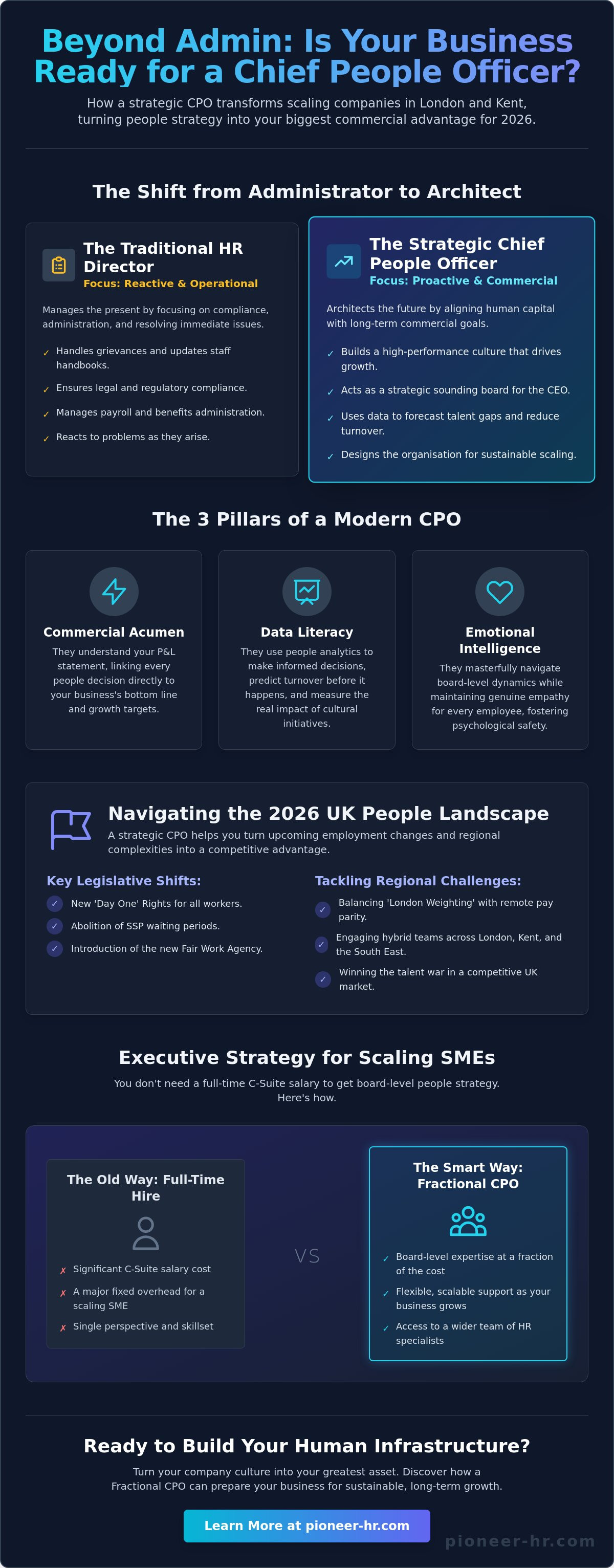
The title "Chief People Officer" isn't just a modern rebrand of the traditional HR Director role. While the legacy HR function often focuses on compliance and administration, a CPO acts as the "Guardian of Culture" and the "Architect of Talent." They ensure that every individual in the building aligns with the company's long-term commercial goals. When people ask Chief People Officer, they are essentially looking for the bridge between human potential and business performance. They don't just manage people; they design the environment where those people can actually succeed.
In the UK, this distinction is becoming sharper and more necessary. An HR Manager might handle a specific grievance or update a staff handbook. A CPO, however, earns a seat at the board table alongside the CEO and CFO. They treat human capital with the same rigour that a CFO treats financial capital. This executive presence is vital for businesses in London and Kent that are scaling rapidly. These companies can't afford to lose their unique "secret sauce" or cultural identity as they expand their headcount.
The Evolution of HR in the UK (2021-2026)
The journey from 2021 to 2026 has been transformative for the British workplace. We've seen the role shift from a "nice-to-have" support function to an essential strategic pillar. The post-pandemic world demanded more than just remote work policies; it required a total rethink of the employee value proposition. In the 2026 talent market, professionals across the South East are looking for purpose-led work. They want to know their employer cares about more than just the quarterly report. This shift explains why we've seen such a surge in businesses seeking a fractional Chief People Officer to guide them through these complex cultural waters without the cost of a full-time executive hire.
Core Competencies of a Modern CPO
To understand what does a chief people officer do to stay ahead, you have to look at their specific skill set. They rely on three core pillars. First is commercial acumen. They understand the profit and loss statement as well as any other director. Second is data literacy. They use people analytics to predict turnover before it happens and measure productivity accurately. Finally, they possess high emotional intelligence. Navigating board-level dynamics while maintaining empathy for a team member in a satellite office requires a delicate touch. It is about building a sustainable professional relationship where everyone feels valued and heard.
What Does a Chief People Officer Do? Key Responsibilities
A CPO doesn't just manage the present; they architect the future. When we look at what does a chief people officer do on a daily basis, it's rarely about processing paperwork or managing payroll. Instead, it's about the strategic role of a Chief People Officer as a commercial partner. They look at your 3-5 year business plan and ask whether you've got the right leadership and skills in place to actually get there. If you're a scaling firm in London, this might mean identifying talent gaps two years before they become a recruitment crisis.
They also act as a vital sounding board for the CEO. Leadership can be isolating, and having an executive peer who understands the human nuances of every board decision is invaluable. This extends to employer branding. In a competitive UK market, your reputation as an employer is just as important as your product. The CPO ensures you're positioned as an employer of choice, making it easier to attract the best talent without relying solely on inflated salaries. They build the systems that allow your business to grow without losing its soul.
Building a High-Performance Culture
True engagement goes deeper than office perks or Friday drinks. It's built on psychological safety and clear communication. We've seen that businesses using robust retained HR support can better manage the shift to hybrid work. This is especially true for teams split between the fast pace of London and the lifestyle benefits of Kent or Sussex. A CPO designs policies that ensure productivity remains high, regardless of where the team is sitting.
Talent Architecture and Reward Strategy
Attracting high-performers in 2026 requires a sophisticated approach to compensation. A CPO develops a Reward Strategy that balances financial incentives with professional growth. They use Salary Benchmarking to ensure your offers are competitive within the specific UK sectors you operate in. By implementing structured job grading, they create transparent career paths that show employees exactly how they can grow. If you're unsure if your current structure is working, our fractional Chief People Officer services can help you build this foundation.
CPO vs. CHRO vs. HR Director: Understanding the Differences
In the UK executive landscape, titles like HR Director, CHRO, and CPO are often used interchangeably. However, for a growing business, the nuance matters. While an HR Director typically focuses on operational excellence and compliance, the CPO role is fundamentally more "people-centric" than "resource-centric." If you are trying to understand what does a chief people officer do differently, think of it as the shift from managing a function to architecting a culture. An HR Director ensures the rules are followed; a CPO ensures the culture is strong enough that people want to follow them.
The Chief Human Resources Officer (CHRO) often appears in large-scale corporate environments where risk management and complex industrial relations are the priority. In contrast, the CPO title is favoured by modern, agile businesses in London and the South East that view talent as their primary competitive advantage. They aren't just looking for someone to run a department. They need a leader who can align human potential with a 3-5 year commercial roadmap. To help clarify these distinctions, we can look at the strategic depth versus operational breadth of each role.
When Does an SME Need a CPO?
Most UK businesses reach what we call the "50-employee hurdle." This is the stage where informal culture begins to break down. You can no longer rely on everyone sitting in the same room to maintain alignment. For tech startups in Sussex or scaling firms in London, this rapid growth often leaves the HR Director overwhelmed by tactical fires. If your leadership team is spending more time on individual disputes than on long-term organisational development, it's a clear sign you need a CPO mindset to regain control of the big picture.
Executive Partnership: The CEO and CPO Dynamic
The most successful UK leaders treat their CPO as a "Chief of Staff" for the human element of the business. This partnership allows the CEO to focus on external markets while the CPO manages internal stability and succession planning. They navigate the complexities of board-level conflict and ensure that the company’s values aren't just posters on a wall. The CPO serves as the indispensable bridge between the boardroom and the breakroom, ensuring executive decisions resonate with the frontline reality. This level of leadership coaching and strategic guidance ensures that as the business scales, the people scale with it.
The UK Context: Why the CPO Role is Vital for 2026 Scale-Ups
Navigating the UK employment landscape in 2026 requires more than just a compliance checklist. With the abolition of the three day waiting period for Statutory Sick Pay (SSP) and the removal of the Lower Earnings Limit as of April 6, 2026, businesses face immediate operational shifts. When you ask what does a chief people officer do in this specific climate, the answer is simple: they protect your bottom line while ensuring you stay on the right side of the new Fair Work Agency. They don't just read the regulations; they translate them into a people strategy that keeps your business agile.
The "London Weighting" challenge has also evolved. As more professionals move to Kent or Sussex while keeping their London expectations, managing pay parity has become a complex puzzle. A CPO helps you design a Fractional Chief People Officer strategy that balances these regional nuances. They ensure your reward packages are attractive enough to stop your best talent from being headhunted by firms in the capital, without overextending your budget. This is particularly vital for scale-ups where every hire represents a significant investment in your future growth.
Managing People in the London-Sussex Corridor
Brighton and Hove have become significant hubs for modern, people-first businesses, especially in the creative and tech sectors. However, the proximity to London creates a constant "talent drain" risk. A CPO acts as a shield here. They build a culture that offers something a large corporate firm cannot: genuine purpose and high-impact work. By focusing on Hove's unique community feel and professional lifestyle, they help local businesses retain high-performers who are looking for more than just a commute to the city. We can help you benchmark these roles to ensure you remain competitive. If you're ready to secure your team's future, explore our salary benchmarking services to see where you stand.
2026 Trends: AI, Well-being, and the 4-Day Week
In 2026, the strategic integration of AI is no longer optional. A CPO ensures that technology serves the people, not the other way around. They identify which tasks can be automated to reduce burnout and which require the "human" touch that defines your brand. This feeds directly into holistic well-being, which has moved from a perk to a core business KPI. We're also seeing more UK service businesses evaluating the 4-day working week. A CPO conducts the feasibility studies needed to see if this model can drive productivity without sacrificing client service. They look at the data, listen to the team, and make a commercial recommendation that fits your specific goals.
The Rise of the Fractional CPO: Executive Strategy for SMEs
For many mid-market businesses in London and Kent, the jump from a standard HR function to a full-time executive hire feels like a massive financial leap. While the national average salary for a CPO in the UK has reached £148,554 in 2026, many scale-ups simply don't need that level of support forty hours a week. This is where the fractional model has transformed the landscape. If you're still asking what does a chief people officer do on a part-time basis, it's about providing the same strategic depth and board-level experience as a full-time hire, but on a flexible schedule that fits your current growth stage.
The demand for this model is backed by clear trends. Projections from early 2026 suggest that one in three UK businesses now engage some form of fractional leadership. It allows founders to access top-tier talent for high-stakes decisions without the long-term commitment of a six-figure salary. We've seen this work exceptionally well for firms in the South East that are navigating rapid scaling or preparing for an exit. You get the commercial architect we discussed earlier, focused entirely on your human infrastructure and long-term stability.
How Our Fractional CPO Service Works
Our approach is built on partnership, not just transactions. We offer tailored strategic support that scales with you, whether that's one day a month or one day a week. We focus on high-impact projects that move the needle. This often includes implementing structured job grading to ensure your internal hierarchy is fair and transparent. We also provide a steady hand for founders during funding rounds or complex M&A activity. Having an experienced professional to manage the people side of a merger ensures that culture isn't diluted when the stakes are highest.
Taking the Next Step with Pioneer HR
With over 30 years of experience, we've seen every type of organisational challenge. We understand that your needs change as you grow. Many of our clients start with retained HR support to get their compliance and day-to-day operations in order. As they scale toward that 50-employee hurdle, they transition into strategic CPO leadership to protect their culture. We act as the bridge, ensuring your people strategy always stays one step ahead of your commercial goals.
If you're ready to bring executive-level clarity to your leadership team, you can book a consultation to discuss a Fractional CPO for your business today. Let's build the human infrastructure your growth deserves.
Building a Sustainable Future for Your UK Team
Scaling a business in competitive hubs like London or Kent is as much about human capital as it is about financial growth. We've explored what does a chief people officer do to bridge that gap, from designing high-performance cultures to navigating the complex employment law changes of 2026. A CPO isn't a luxury reserved for global corporations; it's a vital necessity for any SME that wants to scale without losing its cultural identity. By moving beyond tactical HR and embracing strategic leadership, you ensure your business remains agile in an ever-shifting market.
At Pioneer HR, we bring over 30 years of experience as specialists in UK SME growth. We understand the specific challenges of the South East market and how to align your people strategy with your commercial ambitions. We're here to provide the steady hand and executive insight your leadership team needs to succeed. Ready to elevate your people strategy? Explore our Fractional CPO services today. Your team is the engine of your commercial success. With the right strategic partner by your side, you can build a workplace where both your people and your profits can thrive together.
Frequently Asked Questions
Is a Chief People Officer the same as an HR Director?
While the roles overlap, they aren't identical. An HR Director typically manages the operational and tactical side of human resources, such as compliance and policy implementation. A Chief People Officer sits at the board level to align the entire people strategy with your long-term commercial goals. If you're asking what does a chief people officer do differently, it's their focus on being a business architect rather than a departmental manager.
Does a small business with 20 employees need a CPO?
A business of this size usually doesn't require a full-time CPO, but it does need strategic direction. At 20 employees, your focus should be on building a solid foundation through retained HR support. However, it's the perfect time to start thinking about organisational development. Laying the right cultural groundwork now prevents the common growing pains that many London and Kent firms face when they double in size.
What is the average salary for a CPO in London vs. the rest of the UK?
As of May 2026, the national average salary for a CPO in the UK is £148,554 per year. In Greater London, the median salary rises significantly to £195,500 for those with average experience. Leaders in the South East often see a range between £146,750 and £244,500. These figures reflect the high demand for executive talent who can navigate the complex 2026 employment landscape.
What qualifications does a Chief People Officer need?
Most CPOs in the UK hold a CIPD Level 7 qualification, which is equivalent to a postgraduate degree. Beyond formal certifications, a modern CPO needs high data literacy and deep commercial experience. They should be comfortable discussing profit and loss statements as easily as employee engagement. Many also pursue leadership coaching credentials to better support the rest of the executive team.
How does a CPO improve company profitability?
A CPO impacts the bottom line by reducing the high costs associated with employee turnover and disengagement. By creating a high-performance culture, they ensure that your most expensive asset, your people, are as productive as possible. They also use salary benchmarking to ensure you aren't overpaying for talent while still remaining competitive in hubs like London and Brighton.
Can I hire a Chief People Officer on a part-time or fractional basis?
Yes, the fractional model has become a standard solution for UK SMEs in 2026. This allows you to access executive level strategy for a few days a month or week. It's an ideal way to get the strategic impact of a seasoned leader without the financial commitment of a full-time six-figure salary. Many businesses find this is the most effective way to manage rapid scaling.
What is the first thing a CPO should do in a new role?
The first priority for any CPO is to conduct a thorough HR audit and listen to the team. They need to understand the current cultural health and identify where the people strategy is out of sync with commercial goals. This initial discovery phase allows them to build a roadmap that addresses immediate risks, like compliance with the latest 2026 SSP changes, while planning for future growth.
How does a CPO handle remote and hybrid work cultures?
In 2026, a CPO focuses on maintaining cultural cohesion regardless of where a team is based. They design communication frameworks that ensure a remote worker in Kent feels just as connected as someone in a London office. This involves using people analytics to monitor well-being and ensuring that hybrid policies are fair, transparent, and built on a foundation of mutual trust and psychological safety.


Comments