
Reward Strategy Consultant UK: Building Competitive Pay Frameworks for 2026
Updated: Mar 17
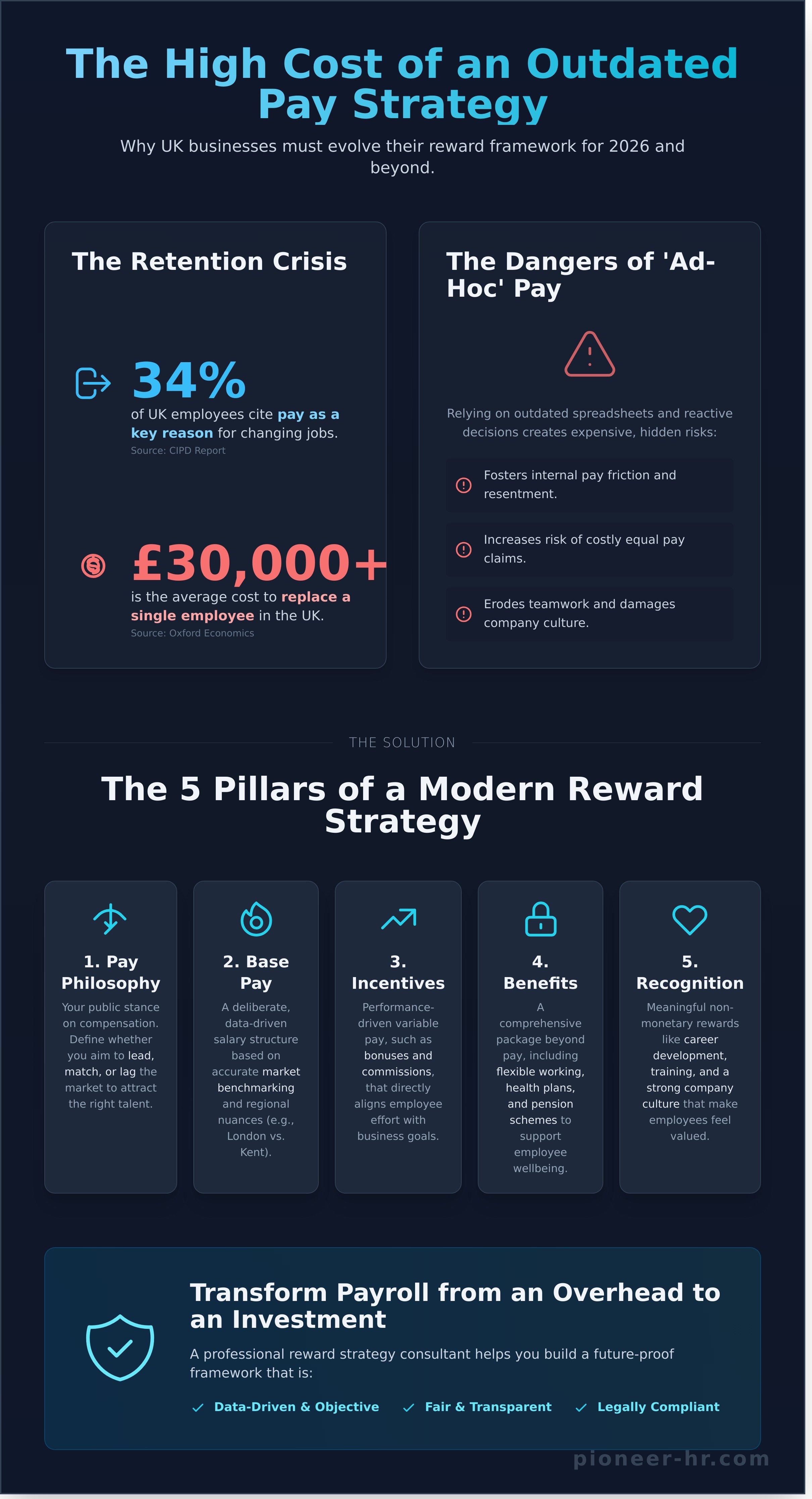
What if the biggest threat to your 2026 growth isn't market volatility, but the outdated salary spreadsheet saved on your server? It’s a familiar story across the UK. With a recent CIPD report showing that 34% of employees who changed jobs cited pay as a key reason, the risk of losing top talent to a competitor in London or Manchester is higher than ever. You feel the pressure of internal pay friction and the constant worry that your offers are no longer competitive.
This is where a forward-thinking pay framework becomes your most powerful retention tool. In this article, we'll explore how a specialist reward strategy consultant UK businesses trust can help you build a competitive, fair, and transparent structure that attracts premier talent and drives growth. We will guide you through the process of creating a defensible salary framework that aligns with future market rates and fosters a culture where every employee understands their true value to your organisation.
Key Takeaways
Discover the five essential pillars of a modern reward framework and learn how to define a clear 'Pay Philosophy' to attract the right talent.
Learn why generic salary data is insufficient and how to correctly benchmark pay by considering regional UK nuances, from London to Kent.
Understand how a reward strategy consultant uk can help you conduct a comprehensive audit to identify gaps and build a proactive pay structure for 2026.
Get a clear, step-by-step guide to implementing your strategy, including how to define effective pay bands and transparent progression criteria.
Table of Contents Why Your UK Business Needs a Reward Strategy Consultant in 2026 The Core Pillars of a Modern Reward Strategy Beyond the Spreadsheet: Salary Benchmarking and Job Grading in the UK Implementing Your Strategy: From Paper to Practice Partnering with Pioneer HR: Strategic Reward for UK Growth
Why Your UK Business Needs a Reward Strategy Consultant in 2026
As we move towards 2026, the UK talent market is defined by a profound shift in employee expectations. The "Great Resignation" has settled into a "Great Re-evaluation," where top performers are no longer motivated solely by salary. The outdated strategy of simply "paying more" than competitors is not only unsustainable; it's ineffective. Today's workforce seeks value alignment, career progression, and a sense of being genuinely valued beyond their monthly paycheque.
This is where the expertise of a specialist becomes invaluable. A reward strategy consultant helps a modern UK business move from a reactive, transactional approach to a proactive, holistic one. Their role is to architect a comprehensive "Total Reward" framework. This framework intelligently combines financial elements like base pay and bonuses with crucial non-financial benefits, including flexible working, professional development opportunities, and a supportive company culture. It’s about creating a compelling employee value proposition that attracts and, more importantly, retains the right people to drive your business forward.
The economic climate adds another layer of complexity. The high inflation rates of the early 2020s have permanently altered salary expectations across the UK. An annual pay review that doesn't account for the real-world impact of the cost of living can feel like a step backwards for employees, directly impacting their engagement and loyalty. A forward-thinking reward strategy must be both competitive and sustainable, balancing employee needs with your organisation's financial health.
The High Cost of Having No Strategy
Failing to implement a coherent reward strategy isn't a neutral choice; it's an expensive one. Research from Oxford Economics found that the average cost to replace a UK employee is over £30,000, factoring in recruitment fees and lost productivity. For a small business in Kent losing just a handful of staff, this quickly becomes a significant financial drain. Furthermore, making "ad-hoc" pay decisions to keep individuals happy creates dangerous internal inequalities, increasing the risk of equal pay claims and fostering a culture of resentment that erodes teamwork.
The Strategic Advantage of Professional Reward Consulting
Engaging an external consultant introduces objective, data-driven analysis into what can be an emotionally charged process. By benchmarking against the market and understanding the foundational principles of reward management, a specialist helps build a pay and reward structure that is transparent, fair, and legally compliant. A skilled reward strategy consultant uk works with you to ensure every pound spent on compensation actively supports your 2026 business goals, whether that's fostering innovation or improving customer retention.
A professional reward strategy transforms your biggest overhead-payroll-into your most effective investment tool.
The Core Pillars of a Modern Reward Strategy
A truly effective reward strategy is far more than a simple salary scale. It’s a powerful communication tool that tells your employees what you value, how you define success, and what it means to be part of your organisation. To build a framework that attracts and retains top talent in the competitive UK market, you must move beyond the payslip and consider the entire employee experience. A robust strategy is built on five interconnected pillars: a clear pay philosophy, competitive base pay, performance-driven incentives, comprehensive benefits, and meaningful non-monetary recognition.
The foundation is your Pay Philosophy. This is your organisation's public stance on compensation. Do you aim to be a market leader in pay to attract the absolute best, or do you prefer to match the market and compete on culture and flexibility? Defining this is the critical first step. From there, you must strike a careful balance between fixed pay (the salary that provides security) and variable pay (bonuses and incentives that drive performance). Increasingly, UK businesses are finding that non-monetary rewards, such as career development opportunities and a strong wellbeing programme, are becoming powerful differentiators in a crowded talent market. A skilled reward strategy consultant uk can help you articulate this philosophy and build a structure that aligns with your business goals.
Base Pay and Market Alignment
Your approach to base salary must be deliberate and data-driven. First, you need to define your "market." Are you competing for talent with other businesses in Kent, or are you in a national battle for specialist skills against firms in London and Manchester? The answer dictates your data pool. Your pay philosophy then determines whether you aim to "lead" (e.g., pay in the 75th percentile), "match" (50th percentile), or "lag" the market (often compensating with equity or other benefits). Integrating professional salary benchmarking into your annual review cycle is essential for maintaining fairness and competitiveness. This isn't just best practice; it's a strategic necessity, as evidenced by the detailed guidance within the UK government pay framework, which ensures consistency across a vast organisation.
Benefits and the Employee Value Proposition (EVP)
By 2026, certain benefits are simply "table stakes." According to a 2023 CIPD survey, flexible working options are a key driver for over 60% of UK job seekers, while private medical insurance remains a highly valued component of any competitive package. A one-size-fits-all approach no longer works. Your benefits must be tailored to your workforce demographics; a Gen Z employee might value a cycle-to-work scheme and enhanced training budget, whereas an employee with a young family may prioritise enhanced parental leave and life insurance. The key is communicating the full value. An employee's "Total Reward" isn't just their net pay; it includes the company's pension contribution, the value of health benefits, and other perks, which can often add another 20-30% to their base salary. Articulating this complete picture is vital for employees to truly understand and appreciate their overall package.
Beyond the Spreadsheet: Salary Benchmarking and Job Grading in the UK
Securing the right salary data is the first step, but raw numbers on a spreadsheet don’t create a competitive reward strategy. The real value comes from interpretation, context, and a deep understanding of the UK market. This is where many businesses falter, relying on incomplete data and overlooking the nuances that define fair and attractive pay.
The most common objection we hear is, "Why can’t I just use a free online salary checker?" The answer is simple: reliability. These tools often rely on self-reported, unverified, and outdated figures. They can’t distinguish between a tech startup in Shoreditch and a manufacturing firm in Kent, yet they might group both under a generic "UK average." This approach creates a distorted picture that can lead you to either overpay, straining your budget, or underpay, losing top talent to competitors who have done their homework.
A salary for a role in Central London, for example, can be 20-30% higher than for the exact same role in the South East, reflecting different living costs and talent pool dynamics. A generic national average is, therefore, practically useless for precise, strategic decision-making.
The Mechanics of Salary Benchmarking
Professional salary benchmarking moves beyond crowdsourced noise. A specialist reward strategy consultant uk utilises robust, verified data sets from established industry surveys. These sources provide granular detail, filtering by company size, sector, and specific UK regions. For today's increasingly complex roles, we often benchmark "hybrid" positions that don't fit a standard job description. This involves deconstructing the role into its core competencies, such as "data analysis," "project management," and "client relations," and benchmarking those skills individually to build an accurate market rate. Effective benchmarking in 2026 requires looking at the specific skills required, not just the job title on a LinkedIn profile.
Job Architecture and Career Levelling
While benchmarking ensures you are competitive externally, a solid internal structure is vital for retention. This is achieved through a formal process of job grading, which evaluates and ranks roles based on factors like complexity, responsibility, and impact. This creates a clear and logical job architecture, preventing "title inflation" where job titles become disconnected from actual responsibility. Failing to build this framework is one of the most common reward strategy mistakes, leading to perceived unfairness and employee churn.
By establishing this framework, we can link each job level to a transparent pay range. This doesn't just ensure internal equity; it creates a visible "map" for career progression. When your team members can see a clear path forward within your company-and understand how their growth translates into tangible rewards-their engagement and loyalty increase significantly.
Implementing Your Strategy: From Paper to Practice
A meticulously designed reward strategy remains purely theoretical until it's brought to life within your organisation. The transition from planning to practice is where a clear, structured approach becomes critical for success. This implementation phase is often where the expertise of a reward strategy consultant UK businesses rely on proves invaluable, ensuring a smooth and effective rollout. We guide our partners through a proven four-step process.
The journey begins with a deep, objective analysis of your current state. From there, we build the structures that ensure fairness and clarity, empower your leaders to communicate effectively, and launch the new framework with confidence.
Step 1: Conduct a Comprehensive Reward Audit. The first practical step is a thorough reward audit. This diagnostic process goes beyond surface-level salary checks to identify critical gaps. We analyse internal equity, external market competitiveness against UK benchmarks, and the perceived value of your benefits package to reveal where your current approach may be falling short and contributing to staff turnover.
Step 2: Define Your Pay Bands and Progression Criteria. Using data from the audit, we work with you to establish clear, logical pay bands for every role. This creates a transparent structure that employees can understand. Crucially, we also define the criteria for progression within and between bands, linking pay directly to skills, performance, and responsibility.
Step 3: Train Your Managers. Your managers are the key communicators of your reward strategy. We equip them with the training and tools needed to have confident, constructive conversations about compensation. This isn't just about explaining a salary; it's about articulating the 'why' behind the new structure and linking an individual's pay to their value and career path.
Step 4: Launch with Transparent Communication. A successful launch is built on trust. We help you craft a clear communication plan that explains the changes, the benefits for employees, and the company's commitment to fair and competitive pay. This proactive approach preempts confusion and fosters buy-in from day one.
Navigating Pay Transparency in the UK
The landscape of pay is shifting. With the EU Pay Transparency Directive setting a precedent, UK businesses must prepare for similar legislation expected by 2026. This involves addressing historical "legacy pay issues" - where long-serving employees have salaries inconsistent with new structures - and ensuring your framework stands up to scrutiny for gender and ethnicity pay gap reporting, a requirement for UK firms with over 250 employees.
The Role of Communication in Reward Success
Even the most equitable strategy will fail if employees don't understand it. We help clients develop tools like Total Reward Statements, which visualize the full value of an employee's package. Seeing a £60,000 salary presented as a £75,000+ total package, including pension, private health, and bonus potential, fundamentally changes an employee's perception of their compensation. Continuous feedback loops, such as annual surveys and market reviews, ensure the strategy remains relevant as the UK market shifts.
Implementing a new reward framework is a significant undertaking, but it's one of the most powerful levers you have for retaining top talent. Let us help you translate your reward strategy from a document into a powerful retention tool.
Partnering with Pioneer HR: Strategic Reward for UK Growth
For over 30 years, Pioneer HR has been embedded in the UK's SME community, delivering expert people strategies that fuel growth. From our base in Hove, we provide hands-on support to ambitious businesses across London, Kent, and Sussex. We understand the unique pressures and opportunities you face because we've been your strategic partner on the ground, navigating the same economic currents.
Many of our most successful partnerships begin with our foundational retained HR support, handling the essential day-to-day people management. But as your business scales, the conversation naturally shifts. It moves from reactive problem-solving to proactive, strategic planning. This is where we step in as your dedicated reward strategy consultant uk, helping you build a compensation and benefits framework that doesn't just fill roles, but retains the talent that will define your future.
Why a Fractional CPO is the Secret Weapon for SMEs
Growing businesses need board-level people leadership, but often can't justify the £120,000+ annual cost of a full-time Chief People Officer. Our fractional CPO model bridges this critical gap. We provide the high-level strategic ownership your reward strategy needs, bringing an objective, expert voice to your leadership meetings. We help you move beyond administrative HR to build a people function that directly drives commercial results, ensuring every pound spent on reward delivers a measurable return on investment.
Getting Started with Pioneer HR
We take a no-nonsense approach. You won't receive a 50-page PDF filled with theory; you'll get practical, usable advice designed for immediate implementation. Our process is built on clarity and action, starting with an initial audit of your current reward landscape. We follow this with a robust benchmarking review, comparing your packages against real-time market data for your specific sector and region. This gives us the data-driven foundation needed to build a competitive and sustainable strategy.
An effective reward strategy isn't a quick fix; it's a long-term investment in your people and your company's future. The decisions you make now will directly impact your ability to attract and retain top talent in the years to come. Planning ahead is essential.
Contact Pioneer HR today to book your 2026 reward strategy consultation.
Build Your 2026 Reward Strategy for Lasting UK Success
Looking ahead to 2026, a reactive approach to compensation simply won't be enough to thrive in the UK's demanding talent market. The crucial takeaway is this: a well-designed reward strategy is your most powerful tool for attracting top performers and driving sustainable growth. It moves beyond salary benchmarks to create a holistic framework that reflects your company's values and goals, a task that requires specialist insight, particularly for SMEs.
This is where partnering with an expert reward strategy consultant uk provides a decisive advantage. From our base in Hove, the Pioneer HR team applies 30+ years of dedicated HR expertise to support businesses across the UK. We specialise in SME pay benchmarking, ensuring your framework is both competitive and fair. Let's work together to build a compensation structure that not only attracts but also retains your most valuable people.
Take the first step towards securing your future talent. Book your Reward Strategy Consultation with Pioneer HR and build a framework for success.
Frequently Asked Questions
What is the difference between a salary survey and a reward strategy?
A salary survey is a data-gathering tool, while a reward strategy is the comprehensive plan for how you use that data to compensate employees. A survey provides market benchmarks for specific roles, telling you what competitors are paying. Your reward strategy defines why and how you pay, aligning compensation, benefits, and recognition with your specific business goals. It’s the difference between having raw ingredients and having a complete, bespoke recipe for success.
How much does a reward strategy consultant cost in the UK?
The cost for a reward strategy consultant in the UK typically ranges from £800 to £2,000 per day, depending on the project's complexity. A full strategy review for a small or medium-sized business might cost between £5,000 and £15,000. This investment covers in-depth analysis, market benchmarking, and pay structure design. We provide a tailored proposal after an initial consultation to ensure the scope perfectly matches your needs and budget.
Does my small business really need a formal pay structure?
Yes, a small business with even 10-15 employees benefits immensely from a formal pay structure to ensure fairness, transparency, and legal compliance. Without a defined structure, pay decisions can become subjective, leading to inconsistencies and potential equal pay claims. A formal structure provides a clear, defensible framework for salary decisions, supports career progression, and demonstrates to your team that compensation is managed equitably. It's a foundational element for scalable growth.
How often should we benchmark our salaries against the UK market?
We recommend a comprehensive salary benchmarking exercise annually to remain competitive in the fast-moving UK talent market. For high-demand roles, such as in tech, a lighter "sense check" every six months is also prudent. An annual review ensures your pay scales haven't fallen behind the market median, which, according to 2023 data from the ONS, saw regular pay grow by 7.8%. This protects you against losing key talent to competitors.
What are the legal risks of an inconsistent pay structure in the UK?
The primary legal risk of an inconsistent pay structure in the UK is facing an equal pay claim under the Equality Act 2010. If an employee can show they are paid less than a colleague of the opposite sex for 'like work' without a valid, non-discriminatory reason, a tribunal can award back pay for up to six years. A structured, transparent system is your best defence, proving that pay differences are based on objective factors.
Can a reward strategy help with employee retention during a recruitment crisis?
Absolutely, a well-designed reward strategy is one of your most powerful tools for improving employee retention, especially when hiring is difficult. A holistic strategy goes beyond just competitive pay; it incorporates meaningful benefits, clear career development pathways, and recognition programs. This creates a compelling reason for your existing team to stay, reducing turnover costs which can be as high as £30,000 per employee according to a 2022 Oxford Economics report.
How do we handle "London Weighting" for staff based in Kent or Sussex?
You should create a zoned pay structure that reflects varied living costs, rather than applying a blanket "London Weighting" to all surrounding areas. We often advise creating two or three geographic pay zones. For example, Zone 1 for Central London, Zone 2 for key commuter towns in Kent or Sussex with high property values like Sevenoaks or Brighton, and Zone 3 for the rest of the region. This tiered approach ensures compensation is both fair and geographically relevant.
What non-financial rewards are most effective for UK SMEs in 2026?
Looking ahead to 2026, the most effective non-financial rewards for UK SMEs will be enhanced flexibility, personalised learning budgets, and robust wellbeing support. Employees increasingly value autonomy, so options like a four-day week or hybrid models will be key differentiators. Providing an annual training budget of £1,000 per person for professional development shows investment in their growth. Finally, comprehensive mental health support through apps like Spill is now an expectation, not a perk. Some companies also find that offering unique cultural benefits can foster creativity; for example, you can read more on how contemporary art can inspire new perspectives, while for travel-based incentives, you can check out NCC Bardi for premium transport options in Italy. For truly memorable team-building or high-performance rewards, experiences offered by companies like UK Skydiving can also create a lasting impact.


Comments