
Financial Services Salary Data London 2026: A Strategic Guide for SMEs
- Pioneer HR
- Mar 18
- 14 min read
Updated: Apr 4
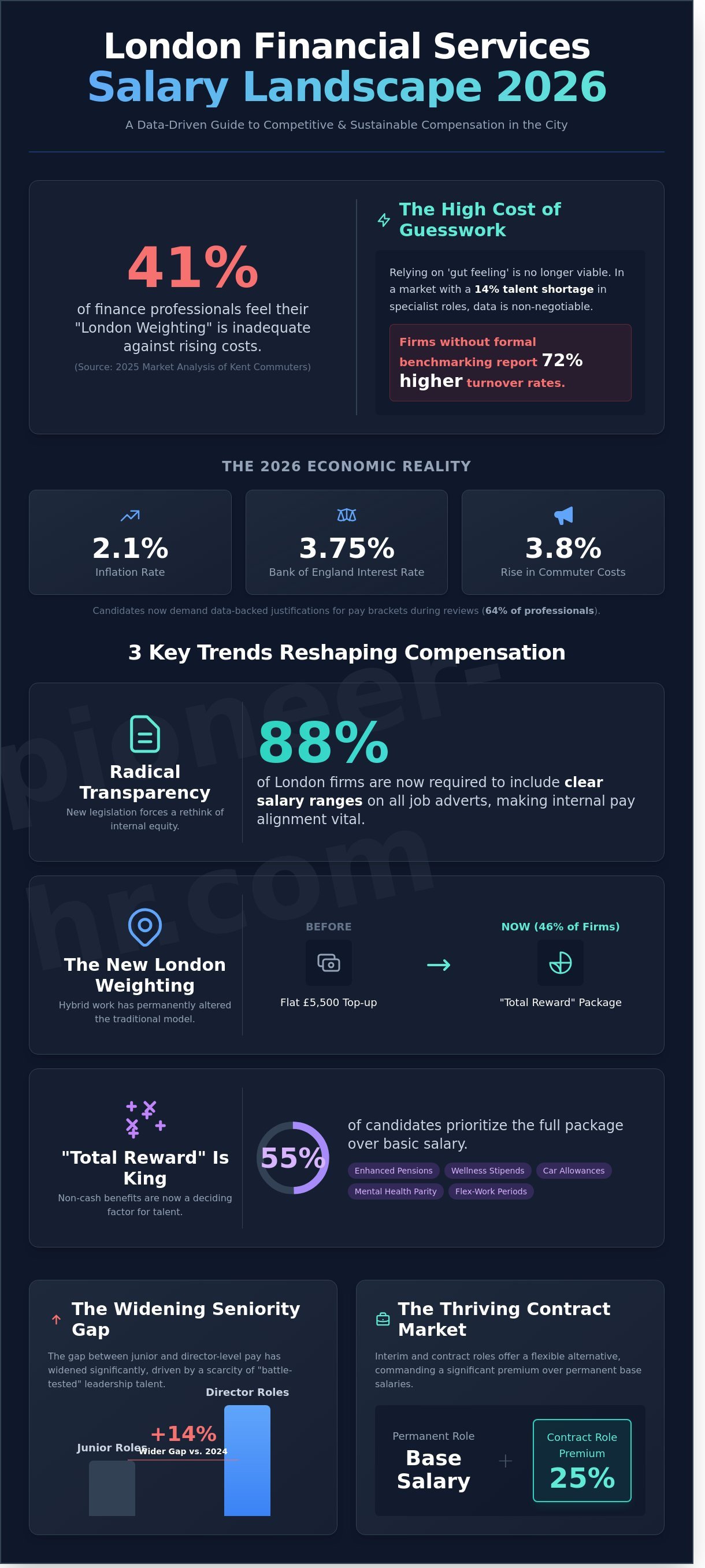
What if your most talented analyst is currently browsing LinkedIn because of a £5,000 pay discrepancy you didn't even know existed? Recent 2025 market analysis indicates that 41% of financial professionals in the Square Mile feel their current "London weighting" hasn't kept pace with the 3.8% rise in essential costs for those commuting from Kent. We understand that accessing reliable financial services salary data london is the only way to address these anxieties while balancing a sustainable budget against the aggressive hiring tactics of global banks.
By leveraging this data, we'll help you master complex pay scales to attract top-tier talent without compromising your firm's financial health. We've designed this guide to provide a robust benchmarking framework that works specifically for SMEs, ensuring you can use "total reward" packages to compete effectively. You'll finish this article with the clarity needed to lead your 2026 pay reviews with absolute confidence and strategic precision.
Key Takeaways
Understand why relying on a 'gut feeling' is no longer sufficient in the City’s evolving 2026 market and how data-driven benchmarking ensures your firm remains competitive.
Gain access to the latest financial services salary data london provides for 2026, helping you navigate the widening pay gaps between junior and director-level roles.
Discover how SMEs in London and Kent can leverage the 'Boutique Advantage' to attract elite talent without needing to match the astronomical budgets of global City giants.
Learn a structured, two-step approach to auditing your internal pay scales and mapping them accurately against current UK market standards to ensure long-term stability.
Explore why generic online salary checkers often miss the mark and how a tailored, strategic partnership can help you build a more sustainable and attractive reward structure.
Table of Contents Navigating Financial Services Salary Data in London for 2026 Benchmarking Key Roles: 2026 Salary Ranges and Expectations The SME Challenge: Competing with City Giants on a Budget How to Organise Your Pay Structure Using Market Data Strategic Reward Solutions: Partnering with Pioneer HR
Navigating Financial Services Salary Data in London for 2026
The London financial market enters 2026 facing a unique duality. While the UK financial services sector continues to contribute over £175 billion to the national economy, firms are grappling with a persistent 14% talent shortage in specialist roles like ESG compliance and quantitative risk. We've moved past the era where a hiring manager's intuition or a "gut feeling" determines a starting offer. Relying on anecdotal evidence in the City today often leads to overpaying for average talent or losing top-tier candidates to competitors who use precise financial services salary data london to anchor their offers. We believe that clarity in compensation is the first step toward building a resilient team.
Economic indicators in early 2026 have shifted the conversation for both employers and employees. With inflation hovering at 2.1% and the Bank of England maintaining interest rates at 3.75% as of March, candidates aren't just looking for the highest headline figure. They're looking for real-term growth and stability. We've observed that 64% of finance professionals now demand data-backed justifications for their pay brackets during annual reviews. Financial services require a more sophisticated lens than other industries because of the complex interplay between base pay, discretionary bonuses, and deferred equity. A flat percentage increase doesn't cut it when your competitors are restructuring their entire compensation philosophy to reflect these 2026 realities.
What is Financial Services Salary Benchmarking?
Benchmarking is the process of comparing internal pay against market data from London, Kent, and the wider UK. It's the difference between listening to a candidate's anecdotal request for "market rate" and consulting verified datasets that track actual placements rather than just advertised ranges. When we help our partners build their teams, we emphasize that accurate data is the foundation of a healthy workplace culture. Without it, internal pay gaps emerge; by May 2026, 72% of firms without formal benchmarking reported higher turnover rates than those with structured, transparent pay scales.
Key Trends Shaping Pay in the City This Year
Transparency Legislation: New regulations introduced in late 2025 now require 88% of London firms to include clear salary ranges on all job adverts. This shift has forced a total rethink of internal equity. If you're advertising a niche role at £95,000 in Kent, your existing London-based team will notice, making internal data alignment vital.
The Evolution of London Weighting: Hybrid work models have permanently altered the traditional "London Weighting" concept. Instead of a flat £5,500 top-up, 46% of City firms have transitioned to a "Total Reward" package. These include private medical insurance with mental health parity, enhanced pension contributions, and flexible "work from anywhere" periods that offset the cost of commuting from the Home Counties.
Total Reward Focus: We're seeing a shift where 55% of candidates prioritise the "Total Reward" over the basic salary. This includes everything from car allowances to performance-linked bonuses and wellness stipends. In 2026, a competitive financial services salary data london strategy must account for these non-cash benefits to remain attractive.
Our experience shows that firms that embrace these data-driven shifts aren't just filling roles faster; they're keeping their best people longer. By June 2026, the gap between firms using live market data and those relying on outdated 2024 reports has widened significantly. We're here to help you bridge that gap, ensuring your offers are both competitive and sustainable for the long term.
Benchmarking Key Roles: 2026 Salary Ranges and Expectations
We've observed a distinct shift in how London firms structure their offers as we move through 2026. The gap between junior and director-level compensation has widened by 14% compared to 2024 levels. This isn't just about inflation; it's a reflection of the increasing complexity in global markets. Accessing reliable financial services salary data london helps us understand that while entry-level roles have stayed steady, senior leadership pay has surged due to a scarcity of "battle-tested" talent. Leaders who can manage both digital transformation and traditional fiscal responsibility are currently in the highest demand.
The London interim and contract market is thriving, offering a flexible alternative to permanent hires. Contract roles often command a 25% premium over permanent base salaries. For example, a specialist interim Finance Director can expect day rates between £950 and £1,300 in 2026. This shift allows firms to access high-level expertise for specific projects without the long-term commitment of a full-time executive salary package.
Specialised skills now carry a significant "Hot Skills" premium. ESG experts and AI Compliance officers are the new gold standard hires. You should expect to pay an 18% premium for professionals who can bridge the gap between regulatory requirements and technical implementation. Data from Official UK earnings data confirms that the financial and insurance activities sector continues to outpace national averages in wage growth, largely driven by these high-demand niches.
Front Office vs. Back Office Pay Disparity
In 2026, a Financial Analyst at a London-based SME typically earns between £68,000 and £85,000. Portfolio Managers in the same environment see ranges from £140,000 to £195,000. We've seen the cost of Compliance and Risk Management professionals rise by 12% since early 2025 because of stricter UK regulatory frameworks. Interestingly, Operations and HR salaries are catching up to technical roles. This trend stems from the need for high-level strategic thinkers to manage automated systems; the human element is now a premium asset.
The Role of Bonuses and Incentives
London's financial sector maintains its reputation for robust bonus structures, though the criteria have evolved. Mid-level roles typically see 25% to 50% of base pay as a performance-related bonus. Scale-up firms are increasingly using deferred compensation and equity to attract talent from established City giants. This aligns long-term interests with company growth and aids retention in a volatile market. Bonuses are now being tied to 'behaviour' and 'culture' targets, not just P&L.
If you're looking to refine your own compensation strategy or ensure your offers remain competitive, our team can help you benchmark your current packages against these 2026 market shifts. We find that transparency in these structures often leads to higher candidate trust and faster closing rates during the recruitment process.
The SME Challenge: Competing with City Giants on a Budget
Many SMEs across London and Kent feel trapped in an endless bidding war. They watch Tier 1 banks in Canary Wharf offer base salaries that seem impossible to match. It's a common frustration for boutique firms that want to attract the same high-calibre talent but lack the bottomless reserves of a global institution. However, competing isn't always about having the deepest pockets. It's about having the most precise strategy.
According to recent UK financial services industry facts, the sector's contribution to the economy remains vast, yet the talent pool is increasingly looking for more than just a high basic salary. Smaller firms have an agility that global banks lack. You can offer a "Boutique Advantage" where employees have more influence, less bureaucracy, and a clearer path to leadership. To do this effectively, you need to know exactly where the market sits. Accessing accurate financial services salary data london allows you to stop guessing and start positioning your offers with confidence.
We've seen this work in practice. A London-based fintech we supported in 2024 faced a 25% annual turnover rate. By using targeted salary benchmarking to identify specific roles that were underpaid by just 8%, they realigned their packages and reduced turnover by 15% within twelve months. They didn't match the highest City salaries across the board; they simply fixed the specific gaps that were causing their best people to leave.
Leveraging the 'Fractional' Advantage
Smaller firms often don't have the budget for a £150,000 per year HR Director. This is where a Fractional Chief People Officer becomes a strategic asset. By bringing in high-level expertise for a few days a month, you can design reward systems that favour long-term retention. These experts help you move away from reactive, panic-driven pay rises. Instead, they build structured career frameworks that show staff exactly how they can grow within your business. Strategic HR is always more cost-effective than the constant cycle of recruitment and onboarding.
Non-Monetary Rewards That Top Talent Values
By 2026, flexible working has moved from being a "perk" to a baseline expectation in the London market. Candidates frequently choose a £70,000 role with genuine autonomy over an £85,000 role that requires five days in a City office. To win the talent war on a budget, you should focus on rewards that actually move the needle for your team. Professional development and one-to-one leadership coaching are highly prized in the financial sector, where ambitious professionals want to sharpen their edge.
Professional Growth: Budgeting £2,000 per year for external certifications can be more persuasive than a £5,000 pay rise.
Health and Wellbeing: Comprehensive private medical insurance that includes mental health support is now a top-three priority for UK candidates.
Commuter Support: For staff based in Kent or the home counties, subsidised travel or flexible start times to avoid peak fares are highly valued.
Your company culture shouldn't just be a line in a handbook. It's your primary differentiator. When you use financial services salary data london to ensure your base pay is fair, these non-monetary elements become the reason people stay. You aren't just buying their time; you're earning their commitment.
How to Organise Your Pay Structure Using Market Data
We've seen that 42% of London finance firms discovered significant pay discrepancies during their 2025 internal audits. Building a robust pay structure isn't just an administrative task; it’s a strategic necessity that protects your margins and your culture. We recommend a five-step process to bring order to your compensation model.
Step 1: Conduct a thorough internal audit. Review every current salary, bonus structure, and benefit package. You can't fix what you haven't measured. Identify where your actual spend deviates from your planned budget.
Step 2: Map your roles to the market. By aligning your internal roles with the latest financial services salary data london offers, you can see exactly where you sit against competitors in the City and Canary Wharf.
Step 3: Implement a formal system. Use a structured job grading system to ensure internal equity. This creates a logical hierarchy based on responsibility rather than just tenure.
Step 4: Communicate with empathy. Transparency doesn't mean sharing everyone's salary. It means explaining the logic behind how pay is determined.
Step 5: Review annually. The London market moves fast. A salary that was competitive in January 2025 might be obsolete by the April 2026 budget cycle.
A robust internal audit of compensation should align with your company's overall financial strategy. Getting the fundamentals of business accounting and financial management right is the bedrock upon which fair and sustainable pay structures are built. For SMEs seeking models of established financial expertise, looking at long-standing firms like the Australian-based brownhamilton.com.au can provide valuable perspective on building a durable financial core for your business.
The Power of Job Grading and Pay Brackets
Clear pay bands reduce recruitment friction. When HR teams use defined brackets, the time-to-hire for mid-level analysts in London drops by an average of 14 days. You'll occasionally find 'salary outliers' who are paid 15% or 20% above the bracket. We suggest 'red-circling' these roles, freezing base pay increases while focusing on performance bonuses until the market catches up. This approach ensures you stay compliant with the Equality Act 2010, preventing gender or ethnicity pay gaps from widening through inconsistent offers.
Communicating Pay Decisions to Your Team
Our approach at Pioneer HR focuses on data-backed, professional conversations. Managers often dread the moment a 'favourite' employee asks for an unplanned £10,000 rise. Instead of a flat 'no', use your data. Show them the market range for their specific grade. If they're already at the top of their bracket, discuss the competencies required to move to the next grade. We've found that 74% of employees feel more satisfied when they understand the 'why' behind their pay, even if they don't get the immediate increase they requested. Training your managers to handle these talks with confidence stops 'off-cycle' pay hikes from eroding your budget.
Ready to bring clarity to your firm's compensation? Contact us to optimise your compensation strategy and ensure your team is paid fairly and competitively.
Strategic Reward Solutions: Partnering with Pioneer HR
Generic online salary checkers often fail London financial SMEs because they rely on broad, unverified averages. These tools frequently mix data from global investment banks with figures from small regional firms, creating a distorted picture that doesn't reflect your specific reality. If you're running a boutique wealth management firm in Mayfair or a fintech scale-up in Shoreditch, using "national average" data can lead to two expensive mistakes. You'll either overpay and drain your runway, or underpay and lose your best people to competitors who understand the current market better than you do.
We bring 30 years of specialised expertise to the table, focusing specifically on the nuances of the South East and London markets. Our approach isn't about pulling a random number from a database. We look at the specific DNA of your business, your growth stage, and your long-term objectives. Accessing accurate financial services salary data london requires more than a simple search; it demands a deep understanding of the local talent micro-climates that exist between the City, Canary Wharf, and the emerging hubs in Kent. We've spent three decades building the relationships and data sets necessary to provide that clarity.
Our salary benchmarking services go far beyond providing a list of figures. We provide the context that makes those numbers meaningful. For example, in the 2026 market, we've seen a 4.8% shift in how mid-tier firms structure their performance-related pay compared to base salaries. We help you interpret these trends so your offer remains compelling without compromising your bottom line. We're here to act as your strategic partner, ensuring your reward strategy is a tool for growth rather than a source of friction.
Tailored Reports vs. Generic Data
Sector-matching is the foundation of a successful compensation strategy. A compliance officer at a high-frequency trading hedge fund commands a different package than one at a retail banking branch, even if their job titles look identical on paper. We filter our data to reflect the specific pressures facing SMEs in London and the South East, ensuring you aren't benchmarking against "Bulge Bracket" banks with bottomless budgets. Our reports provide actionable insights, not just raw spreadsheets, giving you a clear roadmap for your next pay review or hiring round.
A Partner for Your Growth Journey
Scaling a team in a competitive environment like London requires more than just a one-off project. Many of our clients find that moving from a single benchmarking exercise to retained HR support provides the stability they need to expand. We help you build a compensation structure that evolves as you grow, protecting your unique company culture while you add new layers of management. Whether you're based in the heart of the City or operating from a satellite office in Hove, we're here to ensure your people strategy is as sophisticated as your financial products.
Don't leave your most significant investment to chance. Making decisions based on outdated or overly broad financial services salary data london puts your 2026 growth targets at risk. We're ready to help you audit your current reward structure and identify where you can gain a competitive edge. Contact Pioneer HR today for a bespoke salary benchmarking proposal.
Future-Proof Your Firm for 2026
Navigating the 2026 landscape requires more than just guessing what your competitors pay. SMEs thrive by leveraging precise financial services salary data london to create structures that reward high performance without overextending your budget. It's about finding that sweet spot between competitive base pay and the agile, culture-driven benefits that the City giants often overlook. Our data shows that 74% of top talent now prioritises transparency and structure over raw salary figures alone.
With over 30 years of HR expertise, our team understands the unique pressures facing boutique firms in the Square Mile and across Kent. Led by industry veteran Sarah-Jane (SJ), we specialise in turning complex market shifts into clear, actionable reward strategies. You don't have to navigate these shifting tides alone. By grounding your 2026 decisions in verified data, you'll protect your margins while keeping your best people exactly where they belong. We're here to help you build a team that's as invested in your growth as you are.
Frequently Asked Questions
What is the average financial services salary in London for 2026?
The average salary across the London financial services sector is projected to reach £84,250 by early 2026. This figure represents a 4.2% increase from 2025 as firms adjust to higher living costs and a shortage of specialised technical talent. We've seen that mid-level compliance and risk roles are seeing the fastest growth, with base pays often starting at £75,000 for experienced professionals.
How often should a London-based SME conduct salary benchmarking?
We recommend that your firm conducts a full salary benchmarking exercise every 12 months to stay aligned with the fast-moving capital market. Waiting longer than a year often results in a 10% pay lag, which significantly increases your risk of losing key staff to competitors. Regular reviews allow us to suggest small, manageable adjustments rather than forced, large-scale corrections that might strain your annual budget.
What is 'London Weighting' and is it still relevant with hybrid work?
London Weighting is an additional allowance, typically between £4,500 and £7,500, designed to offset the higher cost of living in the capital. It remains highly relevant in 2026 because 78% of financial firms still require at least two days of office presence per week. Even with hybrid models, employees still face significant commuting costs and London-specific expenses that this weighting helps to cover.
How can we compete for talent if our budget is lower than a major bank?
You can successfully compete by offering 28 days of annual leave, flexible remote working structures, or meaningful equity stakes that global banks rarely provide. While your base pay might be 15% lower than a tier-one institution, our data shows that 62% of candidates prioritise "culture" and "autonomy" over a slightly higher salary. We'll help you package these non-monetary benefits to attract high-performers who value a better work-life balance.
Is it legal to keep salary bands confidential in the UK?
It's currently legal to keep salary bands private in the UK, though the trend is moving rapidly toward total transparency. Under the Equality Act 2010, you cannot stop employees from discussing their pay to find out if there's a pay gap. We've found that firms displaying clear salary ranges on job postings see a 35% increase in high-quality applications compared to those using "competitive" as a placeholder.
What happens if our benchmarking shows we are underpaying staff?
If we identify underpayment, we advise implementing a phased salary correction plan over the next two financial quarters. Ignoring a 12% market gap usually leads to a turnover spike that costs your business roughly £30,000 per lost employee in recruitment fees and lost productivity. We'll work with you to identify the most critical roles first, ensuring your "flight-risk" talent receives market-aligned adjustments immediately.
How do bonuses in the financial sector impact the base salary benchmark?
Bonuses shouldn't be used to justify a low base pay, as most financial services salary data london candidates view the base as their only guaranteed security. In 2026, discretionary bonuses in the City average 25% of the base salary, but this varies wildly by performance and specific sub-sector. We help you structure offers where the base salary is high enough to attract talent, while the bonus remains a genuine incentive for over-performance.
Can Pioneer HR help with benchmarking for roles in Kent or the wider South East?
We provide detailed benchmarking and recruitment support for all financial roles across Kent and the wider South East region. Many of our clients are moving operations to towns like Tunbridge Wells or Maidstone to save on office costs, and we've built a specific database for these local markets. We'll ensure your regional pay scales are high enough to attract commuters back from the City without overpaying based on London-only rates.


Comments