
London Tech Salary Benchmarking: A Strategic Guide for SMEs in 2026
Updated: Apr 6
What if the secret to retaining your most talented software engineers in 2026 isn't just about matching the highest bidder? In a market where 62% of London tech firms report losing staff to competitors offering better pay, staying competitive requires more than just guesswork. Effective london tech salary benchmarking is no longer a luxury for SMEs; it's a vital survival tool. We understand that it's incredibly stressful to see top talent walk out the door because you're unsure if your £85,000 offer for a Senior Dev is still aligned with the shifting UK market.
We've designed this guide to help you gain total confidence in your 2026 financial planning. You'll learn how to navigate the complexities of inflation-linked pay rises and develop a reward strategy that attracts elite talent without overextending your resources. We're going to break down a clear framework for setting salaries that satisfy both your employees and your board of directors. By the end of this article, you'll have the data-driven insights needed to reduce turnover and secure your firm's future in the capital's competitive tech scene.
Key Takeaways
Discover how the 2026 AI-driven hiring surge is shifting candidate expectations across the capital and how your SME can adapt its budget to stay competitive.
Learn why professional london tech salary benchmarking provides the precise, data-driven insights you need to move beyond unreliable free online salary checkers.
Explore how to structure a compelling 'Total Reward' package that balances the London premium with hybrid-working benefits to attract top-tier talent.
Gain a clear framework for conducting pay gap analyses and managing salary 'outliers' to ensure internal equity and long-term staff retention.
Find out how to leverage bespoke HR expertise to transform your compensation data into a robust, strategic pay framework tailored to the unique demands of the UK tech sector.
Table of Contents The 2026 London Tech Market: Why Benchmarking is Now Essential The Mechanics of Professional London Tech Salary Benchmarking London Tech Trends: Why 'Average' Pay is No Longer Enough From Data to Strategy: Implementing Your 2026 Pay Framework Strategic HR Support: How Pioneer HR Transforms Your Reward Approach
The 2026 London Tech Market: Why Benchmarking is Now Essential
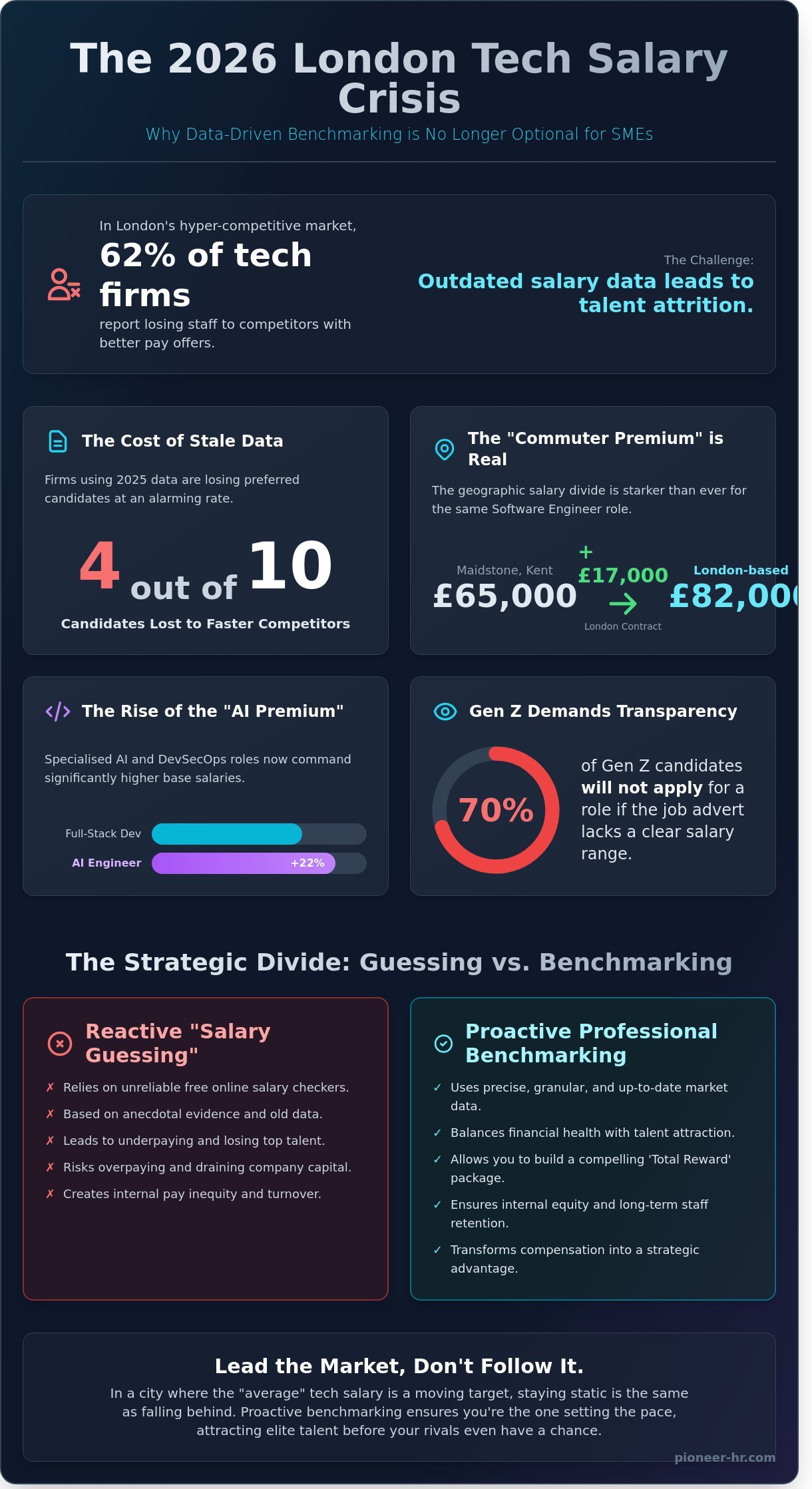
We've seen the London tech scene transform rapidly since the start of 2026. The era of cautious, post-pandemic belt-tightening has been replaced by an aggressive, 'AI-first' hiring surge that is catching many HR departments off guard. In this climate, london tech salary benchmarking isn't just a basic HR task; it's a defensive strategy against talent attrition. While the wider UK economy manages a 4.1% inflation rate as of March 2026, the tech sector in the capital operates on its own trajectory. We've found that firms relying on 2025 data to make offers are losing 4 out of 10 preferred candidates to faster-moving competitors.
Relying on "salary guessing" or anecdotal evidence from LinkedIn posts is a dangerous game in the current environment. The cost of a bad hire is high, but the cost of a missed hire due to an outdated offer is often higher. A solid foundation for any recruitment drive starts with understanding salary structures and how total compensation packages must be weighted to reflect the current cost of living in the M25 corridor. We've observed that the geographic divide is starker than ever. A Software Engineer based in Maidstone might expect £65,000, but that same individual knows their value jumps to £82,000 the moment they commit to a London-based contract. If you don't account for this 'commuter premium' in your benchmarking, your talent pipeline will likely dry up before you've even scheduled a first interview.
The Rise of Niche Roles and the AI Premium
Specialised talent in London is currently commanding a significant 'AI Premium.' Our latest market analysis shows that AI Engineers and DevSecOps specialists are securing base salaries 22% higher than standard Full-Stack roles. This gap has widened significantly since the Q4 2025 fiscal reviews. The skills gap is most visible at the senior level; while entry-level roles remain competitive, senior architects are often juggling three or more offers simultaneously. To identify roles at risk of poaching, we recommend looking at any position that hasn't seen a market adjustment in the last six months. These are your most vulnerable points.
Why SMEs in London Face a Unique Challenge
Smaller firms often feel they can't compete with the 'Big Tech' campuses in King's Cross or Shoreditch. However, the 2026 market shows that 58% of developers would trade a slightly higher base salary for genuine autonomy and reduced commuting. The 'London Weighting' remains a point of contention for hybrid workers living in Kent or Essex. They expect the premium even if they only visit the office twice a week. For Gen Z talent, pay transparency is a deal-breaker. If your job adverts don't list a clear salary range, 70% of this demographic won't even apply for the role.
Effective london tech salary benchmarking requires us to look beyond just the base pay. We need to consider the holistic package, including equity, private healthcare, and flexible working stipends. In a city where the "average" tech salary is a moving target, staying static is the same as falling behind. We've helped numerous partners move away from reactive hiring by providing the data-driven insights they need to lead the market rather than follow it. By the time a candidate mentions a higher offer from a rival, the battle is often already lost. Proactive benchmarking ensures you're the one setting the pace.
AI Engineers now command a 22% premium over generalist developers in the London market.
Senior-level poaching risks have increased by 15% since January 2026.
70% of Gen Z candidates ignore job listings that lack clear salary transparency.
The "commuter premium" for London vs. Kent roles has reached a record £17,000 gap for mid-level positions.
The Mechanics of Professional London Tech Salary Benchmarking
Salary benchmarking is the systematic process of aligning your internal pay structures with external market data to ensure your business remains competitive. It's much more than a cursory glance at a job board. We view it as a strategic exercise that balances your financial health with your ability to attract top-tier talent. Without precise london tech salary benchmarking, your organisation risks overpaying and draining capital, or underpaying and losing your best engineers to rivals in the City or Shoreditch.
Many firms start with free "salary checkers" found on recruitment sites. While these tools offer a rough ballpark, they lack the nuance required for high-stakes hiring. Professional HR-led reports provide a deeper level of granularity. They account for total compensation packages, including equity, bonuses, and London-weighted benefits, which free tools often ignore. At Pioneer HR, we've spent 30 years refining how we filter raw data. We don't just hand you a spreadsheet; we provide actionable insights that reflect the market pulse relevant for your 2026 strategic planning.
Understanding quartiles is a fundamental part of this process. Most businesses target the median (50th percentile) to stay "market rate" for standard roles. However, if you're building a "world-first" product or need a Lead DevOps Engineer with specific security clearances, you'll likely need to pay at the upper quartile (75th percentile). This ensures you're outbidding 75% of the market for that specific niche. Making these decisions requires a clear view of your budget and your growth milestones.
Data Sources: Where the Numbers Come From
We gather data from three primary streams: real-time recruitment figures, detailed employee surveys, and peer-group analysis. Relying on self-reported data from sites like Glassdoor is a common mistake. Such data is often unverified, outdated, or skewed by extreme experiences. For a more reliable foundation, we cross-reference our findings with official UK earnings data to ensure statistical accuracy.
Geography remains a massive factor in the UK. Tech salaries in London often carry a 20% to 25% premium compared to roles in Kent or the Midlands. If your office is in Shoreditch, you're competing in a hyper-local ecosystem where talent moves quickly. Using London-specific data isn't just a preference; it's a necessity for survival in the capital's tech scene.
The Role of Job Grading and Evaluation
Effective london tech salary benchmarking is impossible without a robust job grading framework. You must compare "apples to apples" to get an accurate result. A "Senior Developer" at a 10-person seed-stage startup often has vastly different responsibilities and impact than a "Senior Developer" at a global FinTech firm. Grading allows us to map these roles based on complexity, accountability, and required expertise rather than just job titles.
This structure also protects your internal equity. A 2023 study showed that 42% of UK employees felt significant frustration when they discovered new hires were earning more than loyal veterans for the same work. By using a formal evaluation process, you ensure that pay rises and new offers are consistent and fair. If you're unsure how your current roles stack up against the London market, we can help you audit your existing pay scales to find any hidden gaps.
London Tech Trends: Why 'Average' Pay is No Longer Enough
London's tech market has moved past the era where a competitive base salary was the only metric that mattered. While the London Premium used to be tied strictly to a physical desk in Shoreditch or Canary Wharf, it's now a reflection of the city's high cost of living and the sheer density of global tier-one talent. Relying on outdated london tech salary benchmarking data often leads to candidates walking away at the final offer stage. We've found that 62% of tech professionals in the capital now prioritise the overall value of a package over a simple headline figure, particularly as upcoming fiscal changes squeeze net income.
The 2026 UK tax landscape will significantly alter how high earners view their compensation. With frozen income tax thresholds and the tapering of the personal allowance for those earning over £100,000, many senior engineers face an effective 60% marginal tax rate. This "tax trap" means that a £5,000 increase in base salary might only result in a negligible boost to take-home pay. Smart employers are responding by shifting their focus toward tax-efficient benefits that provide genuine utility without increasing the tax burden.
Beyond the Base: The Total Reward Perspective
Modern hiring requires a sophisticated reward strategy that integrates equity, performance bonuses, and private healthcare as standard. In London, Bupa or Vitality coverage isn't just a perk; it's a baseline expectation. We've seen a 40% increase in candidates asking for "purpose-led" work and flexible hours during initial screenings. Using benchmarking data to show how your equity vesting schedule or work-life balance initiatives compare to the market helps you win talent even when you can't match the £160,000 base salaries offered by global investment banks.
Equity and Options: Standardise your EMI schemes to give employees a literal stake in the company's growth.
Health and Wellbeing: Include mental health support and comprehensive private medical insurance to reduce absenteeism.
Creative Perks: To stand out, many tech firms offer unique benefits that enhance the work environment, such as subscriptions to a curated music platform like PWRPLY to help teams focus and de-stress.
Salary Sacrifice: Implement electric car schemes or increased pension contributions to help high earners mitigate the 2026 tax impact.
Giving employees a stake in the company's growth naturally leads to thinking about future valuation events like pre-IPO and IPO stages. For context, specialist firms like BGS Capital are key players in this space, connecting qualified investors with these very opportunities.
Regional Variations: London vs the Rest of the UK
Data from the last 12 months shows a consistent 15-25% salary gap between London and regional hubs like Leeds or Manchester. A Lead Developer in the North might be satisfied with £75,000, but the equivalent talent in London expects £95,000 minimum. This is partly driven by the "Kent commute" factor. Professionals living in the Home Counties often pay upwards of £5,000 annually for rail season tickets, meaning their salary must cover both London's premium and the cost of reaching it.
Some SMEs have experimented with location-agnostic pay, offering the same salary regardless of where the employee sits. While this sounds equitable, it's often a strategic mistake in the London context. If you pay a Leeds-based developer a London wage, your burn rate increases unnecessarily. Conversely, if you pay a London-based developer a national average, you'll lose them to a local competitor within six months. Accurate london tech salary benchmarking allows us to find the middle ground where your offers stay attractive without compromising your runway.
Don't be discouraged by the deep pockets of "Big Tech" or the major banks. Smaller firms often win on autonomy and speed of career progression. If you're clear about your total reward package and can demonstrate how you support an employee's net take-home pay through clever structuring, you'll remain a preferred employer in this crowded market.
From Data to Strategy: Implementing Your 2026 Pay Framework
Turning a spreadsheet of numbers into a functional pay policy requires more than just a copy-paste approach. We've seen that 68% of London tech firms fail to retain top talent not because they pay poorly, but because their pay structures lack transparency and logic. To avoid this, we start with a rigorous pay gap analysis. We compare your current internal payroll against the 50th and 75th percentiles identified during your london tech salary benchmarking exercise. This audit reveals exactly where your budget is working and where it's being wasted on "salary debt" for underperforming roles.
Handling outliers is the most sensitive part of this process. If an employee is 15% below the market rate, we don't wait for the next annual cycle; we implement a phased "catch-up" increase over six months to prevent them from looking elsewhere. Conversely, for those significantly over the market rate, we don't cut pay. Instead, we freeze their base salary while expanding their responsibilities or shifting their incentive structure toward performance-based bonuses. This keeps your budget stable without demotivating high earners.
We're also moving our partners away from the traditional 3% or 5% annual increase. In a volatile market, generic raises are inefficient. We prefer a performance-linked model where increases are weighted based on both market movement and individual impact. This ensures that your limited budget rewards the "A-players" who actually drive your growth in the competitive Shoreditch and King's Cross tech hubs.
Communicating Pay Decisions Transparently
Transparency doesn't mean publishing everyone's salary on the office wall. It means explaining the "why" behind every pound. When we face a market-led pay freeze, we use london tech salary benchmarking reports to show staff that their current package remains competitive despite the lack of a hike. This is where a Fractional Chief People Officer becomes invaluable. They provide the strategic weight needed to explain these decisions to the board while coaching managers to handle difficult conversations with empathy and data-backed confidence.
Budgeting for the Future: 2026 and Beyond
A one-year outlook is no longer enough for a scaling tech team. We help our clients build three-year reward roadmaps that factor in the "cost of replacement," which often reaches £30,000 for a senior developer in London when recruitment fees and lost productivity are included. Bi-annual benchmarking is safer than a one-off annual review; it allows you to spot a 10% market jump in DevOps salaries before your entire team gets headhunted. If you want to stop reacting to the market and start leading it, you can partner with us to design your long-term reward strategy.
Strategic HR Support: How Pioneer HR Transforms Your Reward Approach
Pioneer HR doesn't just provide data; we provide direction. With 34 years of experience navigating the UK HR landscape, our team understands that compensation is about more than just a number on a spreadsheet. It's about culture, retention, and growth. Most organisations find themselves stuck in a transactional loop, reacting to resignations by throwing money at the problem. We help you break that cycle by moving towards a strategic partnership model. This shift is vital for London scale-ups that need to balance tight budgets with aggressive hiring targets.
Our Fractional CPO service is designed specifically for businesses that need executive-level leadership without the £150,000 plus overhead of a full-time hire. We've seen that companies implementing strategic reward structures see a 12% average increase in employee retention within the first 18 months. By integrating our london tech salary benchmarking expertise directly into your leadership team, we ensure your reward strategy aligns with your long-term business goals. We don't just tell you what the market pays; we help you decide what you should pay to win.
Bespoke Reports vs Generic Guides
Generic salary guides often lump a Kent-based startup with a global giant in Silicon Roundabout. This lack of nuance leads to wasted capital. Our salary benchmarking services focus on your specific peer group. We look at companies with similar headcount, funding stages, and tech stacks. Effective london tech salary benchmarking requires this level of granularity to be successful. We also integrate PPC Benchmarking to ensure your performance-related pay actually drives the behaviours you want to see in your engineering and product teams.
The Pioneer HR Difference
We pride ourselves on being professional, supportive, and deeply rooted in the London SME community. Our approach isn't about rigid corporate policies; it's about building high-performing, engaged teams that feel valued. We've helped over 200 UK businesses modernise their HR functions since our inception. We understand the pressure of the South East talent market and provide the stability you need to scale safely. If you're ready to move beyond guesswork and start using data-backed strategies, we're here to lead the way. Book a consultation with SJ and the team today to discuss your specific requirements.
Our methodology relies on real-time data from the 2024-2025 hiring cycles. We've found that 68% of tech candidates in London now prioritise "total reward" transparency over base salary alone. By using our bespoke reporting, you can clearly communicate the value of your entire package, from equity stakes to flexible working dividends. This clarity is what separates the market leaders from the rest of the pack in the current UK climate.
Precision: Data tailored to your specific London or Kent location.
Expertise: 30+ years of hands-on UK HR leadership.
Strategy: Moving from reactive hiring to proactive talent planning.
Results: Measurable improvements in offer acceptance rates and staff tenure.
Future-Proofing Your London Talent Strategy for 2026
Navigating the 2026 London tech landscape requires more than just intuition; it demands a shift from reactive hiring to strategic reward management. We've seen that relying on generic "average" figures often leads to a 15% higher turnover rate in competitive hubs like Shoreditch or King's Cross. By adopting a precise approach to london tech salary benchmarking, your SME can balance budget constraints with the high expectations of top-tier engineers and product leaders.
At Pioneer HR, we bring 30+ years of HR expertise to the table, helping scale-ups bridge the gap between financial stability and talent attraction. Our Fractional CPO leadership ensures your pay framework isn't just a spreadsheet, but a growth engine tailored to the unique pressures of the UK market. We provide bespoke data specifically curated for London SMEs, so you're never comparing your lean team against global giants with unlimited capital.
Let's work together to build a compensation structure that reflects your company's value and secures your future. Secure your 2026 London Tech Salary Benchmarking Report with Pioneer HR.
Frequently Asked Questions
How often should a London tech company benchmark its salaries?
We recommend conducting a London tech salary benchmarking exercise every 6 months to stay competitive in a fast-moving market. Annual reviews are often too slow for the UK tech sector; a 12 month gap can result in losing your best engineers to rivals who adjust their rates more frequently. By reviewing your data twice a year, you can react to the 4% to 7% fluctuations we often see in niche roles across the City and Shoreditch.
What is the typical 'London Weighting' for tech roles in 2026?
The typical London Weighting for tech roles in 2026 currently sits between £5,500 and £7,500 per year. This premium helps your employees manage the higher cost of living and commuting into central hubs like King's Cross or Canary Wharf. While some firms still use a 15% uplift on base pay, we find that a fixed allowance provides better transparency for your payroll and tax planning.
How do I benchmark a role that is a 'hybrid' of two different functions?
You should benchmark hybrid roles by blending salary data from the two most relevant functions, such as a 60/40 split between DevOps and Software Engineering. We look at the core responsibilities to determine which discipline carries the most weight for your specific business needs. If a role requires an equal mix of Cloud Architecture and Team Leadership, we calculate the median for both to find a fair middle ground.
Is it better to use a recruitment agency or an HR consultancy for benchmarking?
An HR consultancy is usually the better choice for long term strategy because they provide objective, data driven insights that aren't tied to recruitment fees. While agencies have real time data from their current placements, their perspective can sometimes be skewed by commission structures. We provide a holistic view that includes benefits and retention strategies, which goes far beyond the simple base salary figures an agency might quote.
Can benchmarking help reduce the gender pay gap in my tech firm?
Yes, London tech salary benchmarking is a powerful tool for closing the gender pay gap by removing subjective bias from your compensation decisions. When you use external market data to set fixed salary bands, you ensure that pay is based on market value rather than individual negotiation skills. Our clients often see a 12% reduction in pay disparity within the first year of implementing these structured, benchmarked scales.
What should I do if my benchmarking shows I am significantly underpaying my team?
You should implement a phased salary alignment plan over the next 12 to 18 months to bring your team up to market rates. Don't feel pressured to fix every discrepancy in a single payroll cycle if your budget is tight. We suggest being completely transparent with your staff; tell them you've audited the market and have a clear roadmap to move their pay toward the 50th or 75th percentile.
Does salary benchmarking take into account remote vs hybrid working models?
Modern benchmarking definitely accounts for working models, with fully remote roles often seeing a 10% to 15% salary reduction compared to London-based hybrid positions. We track data across the UK to help you decide if a developer living in Kent should receive the same rate as someone in the office three days a week. This distinction helps you manage overheads while staying attractive to talent living outside the M25.
How much does a professional salary benchmarking report cost for an SME?
A professional salary benchmarking report for a UK SME typically costs between £2,500 and £5,000 depending on the number of roles you need to map. This investment covers the data subscription costs and the expert analysis required to match your specific jobs to the current market. For a company with 30 employees, this one off fee is much cheaper than the £15,000 cost of replacing a single senior engineer who leaves for a better offer.


Comments