
Performance Related Pay UK: 2026 Guide for Employers
- Pioneer HR
- 6 minutes ago
- 12 min read
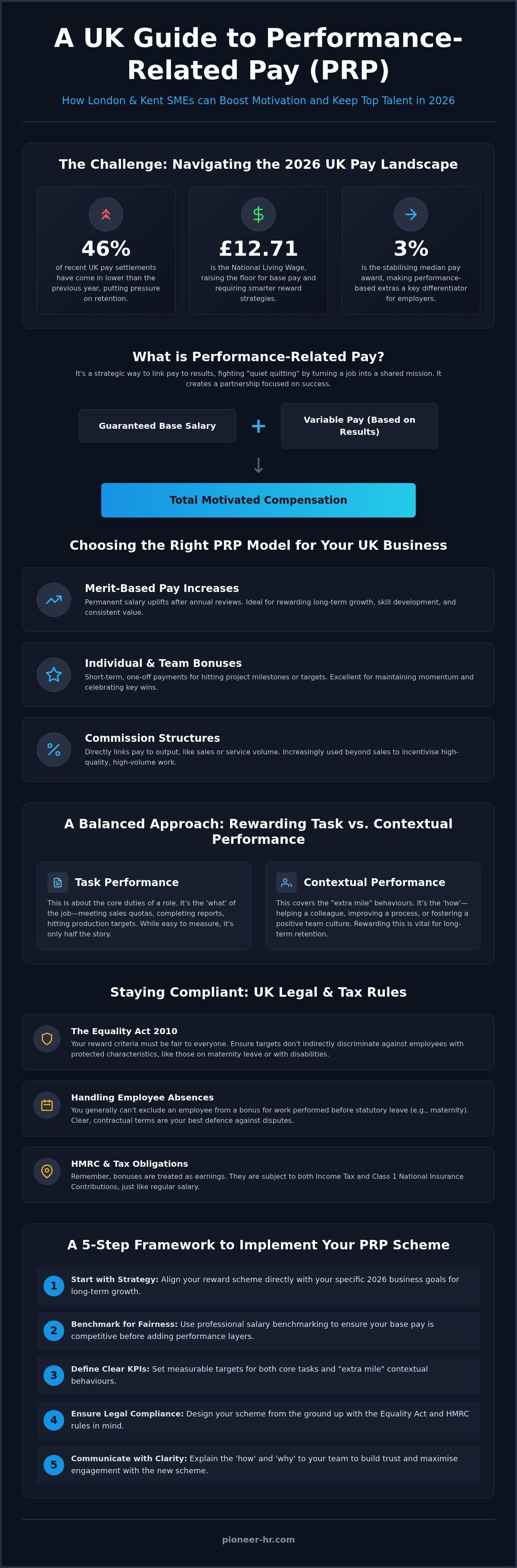
With nearly 46% of UK pay settlements in early 2026 coming in lower than the previous year, many business owners from London to Kent are searching for smarter ways to keep their best people. We understand the pressure you're under; with the National Living Wage now at £12.71 per hour and median pay awards stabilising at 3%, the margin for error when implementing a Performance-Related Pay scheme has never been smaller. It's a delicate balance to strike, especially when you're worried about high staff turnover or the potential pitfalls of complex HMRC rules and employment law.
We believe that rewarding your team shouldn't feel like a legal minefield or a guessing game. You deserve a clear, fair way to recognise individual contributions that actually drives results. In this guide, we'll show you how to design and implement a framework that motivates your team while staying strictly compliant and cost-effective. We'll provide a strategic roadmap for rewarding your top performers, ensuring your pay structure is perfectly aligned with your 2026 business goals and long-term organisational growth.
Table of Contents
What is Performance Related Pay (PRP) in the UK?
Performance Related Pay (PRP) is a strategic compensation method that links an employee’s financial rewards directly to their measurable output or the achievement of pre-agreed targets. In essence, What is Performance-Related Pay? works by dividing remuneration into a guaranteed base salary and a variable component that fluctuates based on results. For many SMEs, implementing performance related pay uk structures has become a standard response to the 2026 trend of "quiet quitting," as it provides a tangible reason for staff to remain fully engaged with their roles.
We see this model as a bridge between an individual's daily efforts and your organisation's overarching mission. When employees understand that their personal success contributes to the company's growth, and that this contribution is reflected in their pay packet, their sense of ownership increases. It moves the conversation away from a purely transactional "time for money" exchange toward a partnership focused on shared success.
The Different Models of PRP for UK Businesses
Choosing the right structure is critical for your budget and culture. Many organisations we partner with to design performance related pay uk schemes use a combination of these three approaches:
Merit-based pay increases: These involve permanent salary uplifts following a positive annual review. They reward long-term growth in an employee's skill set and value.
Individual and team bonuses: These are short-term, one-off payments for hitting specific project milestones or quarterly targets. They're excellent for maintaining momentum during busy periods.
Commission structures: While traditionally found in sales, these are increasingly common in broader service sectors across London and the South East to incentivise high-volume, high-quality work.
To ensure these models remain sustainable, we always recommend starting with professional salary benchmarking. This ensures your base pay is competitive before you even consider the performance-based layer.
Task vs. Contextual Performance: What are you rewarding?
A common mistake is focusing solely on "Task Performance." This refers to the core requirements of a job, such as meeting sales quotas or completing reports on time. While these KPIs are easy to measure, they don't tell the whole story. We encourage our clients in Kent and London to also reward "Contextual Performance." This includes "extra mile" behaviours, such as helping a struggling colleague, contributing to a positive office culture, or suggesting process improvements.
Rewarding both is vital for long-term employee retention. If you only incentivise task-based metrics, you might hit your short-term numbers but damage your team's morale. A balanced approach ensures that your top performers aren't just productive, but are also positive influences who help your business thrive. We often find that a well-rounded reward strategy is the difference between a high-turnover environment and a stable, high-performing team.
UK Legal and Tax Considerations for Performance Pay
Compliance needs to be at the heart of your design when you introduce a performance related pay uk scheme. While the goal is to drive productivity, ignoring the legal framework can lead to costly disputes or tribunal claims. Under the Equality Act 2010, you must ensure your reward criteria don't lead to indirect discrimination. For instance, if your targets are only achievable by those working full-time without interruptions, you might be unfairly disadvantaging employees on maternity leave or those with disabilities. A fair system balances ambition with inclusivity.
Handling periods of absence is a common sticking point for employers in London and Kent. Generally, you can't exclude an employee from a bonus scheme during their "protected period" of maternity leave if the reward relates to work performed before they went on leave. Similarly, UK government guidance on performance pay clarifies that while you can withhold pay for missed targets, you must be careful not to penalise staff for absences related to statutory rights. Clear contractual terms are your best defence here, helping you avoid the "discretionary" pay trap where vague wording leads to unmet expectations and legal friction.
HMRC and the "Bonus vs. Salary" Debate
From a tax perspective, bonuses are treated as earnings. This means they're subject to Income Tax and Class 1 National Insurance. For the 2026/27 tax year, Employer National Insurance contributions remain at 15%, so you must factor this additional cost into your budget. Unlike a permanent salary uplift, a one-off performance bonus doesn't indefinitely increase your NI or pension liabilities, but it does count as "pensionable earnings" under auto-enrolment rules. We always recommend ensuring your payroll team is briefed on Real Time Information (RTI) reporting requirements to avoid HMRC penalties for late or inaccurate submissions.
Drafting Enforceable PRP Policies
Your employee handbook needs a dedicated section that defines exactly how rewards are calculated. To stay fair and defensible, stick to "measurable" criteria rather than subjective opinions. Vague goals like "displaying a positive attitude" are difficult to measure and can be seen as biased. Instead, use data-driven KPIs that reflect your business mission. If you're looking to professionalise your documentation, our Retained HR Support provides the strategic oversight needed to draft robust policies that protect your business while rewarding your team's hard work. By setting clear boundaries now, you prevent "discretionary" pay from becoming a source of internal conflict later.
The Pros and Cons: Is PRP Right for Your Organisation?
Implementing a performance related pay uk scheme is a significant strategic move that requires more than just a spreadsheet of targets. While it offers a clear path to increased productivity and rewards your "A-players," it's not without its complexities. For many SMEs in London and the South East, the promise of clearer goal setting is often weighed against the fear of creating internal friction or an overwhelming administrative burden. We've seen that a "one size fits all" approach often fails because it ignores the unique culture of a business.
The primary benefit is the shift in focus. By rewarding specific outcomes, you give your team a roadmap for success. However, we must consider the psychological impact. Relying solely on extrinsic rewards, like money, can sometimes dampen intrinsic motivation, which is the internal drive to do a good job for its own sake. If employees feel they're only working for the next bonus, you risk a culture of short-termism. In this scenario, long-term business health might be ignored in favour of hitting immediate, narrow milestones.
When PRP Succeeds: Real-World UK Examples
A successful scheme never exists in a vacuum. It must be part of a broader, cohesive Reward Strategy. We've seen this work exceptionally well with a Kent-based client who struggled with high staff turnover. By introducing a transparent PRP structure backed by real-time data, they improved employee retention by 20% within eighteen months. The key wasn't just the money. It was the transparency. When people understand why pay decisions are made, they're far more likely to stay engaged and feel valued by the leadership team.
Common Pitfalls and How to Avoid Them
The most frequent error we encounter is the "Unattainable Target" trap. If your KPIs are unrealistic, they won't motivate your team; they'll demoralise them. Targets should be challenging but achievable within the standard working week. Another critical mistake is using performance related pay uk to paper over the cracks of uncompetitive pay. PRP cannot fix the issues caused by an under-market basic rate. Before you build a bonus structure, you must ensure your foundation is solid. Using professional Salary Benchmarking is the only way to set a baseline that attracts talent while remaining cost-effective. Without that starting point, even the most generous bonus scheme will fail to keep your best people from looking elsewhere.
How to Implement a PRP Scheme: A 5-Step Framework
Moving from a traditional fixed-pay model to a performance related pay uk structure requires a methodical approach. It's not just about adding a bonus line to a contract; it's about shifting your company culture toward high performance. We recommend a five-step framework to ensure your scheme is robust, fair, and legally sound.
Conduct a thorough salary benchmark: You can't build a variable reward system on a shaky foundation. Use professional salary benchmarking to ensure your base pay is competitive within the London and Kent markets before adding performance layers.
Define clear, measurable KPIs: Your targets should reflect your 2026 business goals. These must be objective and data-driven to avoid any perception of bias.
Consult with your team: Transparency builds trust. Explain the "why" behind the scheme and gather feedback before it goes live to ensure employee buy-in.
Pilot the scheme: Test the framework with a specific department or for a three-month trial period. This helps you identify unintended consequences before a full roll-out.
Review and refine: Use performance data and employee feedback to tweak the system. A reward scheme should be a living document that evolves alongside your business.
Setting the Right KPIs
Finding the balance between quantitative and qualitative measures is essential for long-term success. For a professional services role in Hove or London, a SMART KPI might look like this: "Achieve a minimum billable utilisation rate of 75% while maintaining an average client satisfaction score of at least 8.5/10 over the next six months." To ensure fairness across different seniority levels, we often use Job Grading. This process ensures that the complexity of targets remains proportionate to the individual's role and salary bracket, preventing "A-players" from feeling unfairly burdened compared to their peers.
Communication and Roll-out
The success of your performance related pay uk strategy depends heavily on how your line managers deliver it. They're the ones having the difficult conversations, so they need to be trained to deliver feedback that is constructive and linked directly to reward. We often use Insights Discovery during this phase to help managers tailor their communication styles to different personality types within the team. This ensures the message is received as a positive opportunity for growth rather than a source of pressure. If you're ready to design a bespoke framework that truly motivates your team, our Fractional Chief People Officer service provides the high-level strategy you need to get it right the first time.
Strategic HR Support for Performance and Reward
Navigating the intricacies of a performance related pay uk scheme requires more than just a standard template. At Pioneer HR, we've spent decades helping businesses across London and Sussex turn their reward systems into engines for growth. We understand that as an SME, you might not need a full-time HR Director, yet you still require high-level strategic input to remain competitive. This is where our Fractional Chief People Officer service becomes invaluable. We partner with you to design bespoke reward systems that don't just tick a compliance box but actually resonate with your specific culture and team dynamics.
While financial incentives are powerful, they're only one piece of the puzzle. To truly win the war for talent in 2026, we help you look beyond the pay packet to create a holistic Employee Value Proposition (EVP). This involves integrating your PRP with wider organisational development and professional growth opportunities. If you're unsure if your current system is working, we can provide a tailored HR audit of your existing pay structures to identify gaps and opportunities for improvement. We're here to ensure your investment in your people yields the best possible return for the business.
Why Local Expertise Matters in Hove, Kent, and London
The South East corridor faces unique market pressures that businesses in other parts of the UK might not experience. Competition for skilled staff is exceptionally fierce, and the cost of living remains a primary concern for employees. Our PPC Benchmarking service gives you access to precise regional salary data, ensuring you aren't overpaying or losing your best talent to local competitors. Sarah-Jane brings over 30 years of HR experience to every project, offering the professional depth needed to manage complex reward strategies in the UK landscape. We know the local market because we live and work here too.
Your Next Steps to a High-Performance Culture
Your journey toward a high-performance culture starts with a simple conversation. We're here to help you integrate your performance related pay uk framework with wider initiatives like leadership coaching and management training. By aligning how you lead with how you reward, you create a consistent environment where top performers feel truly valued. For more depth on the groundwork required for these schemes, you can read our Salary Benchmarking UK: A Strategic Guide. When you're ready to build a more motivated team, book a discovery call with us to discuss a tailored reward strategy that fits your business perfectly.
Building a Future-Proof Reward Strategy
Implementing a robust performance related pay uk scheme is about more than just numbers; it's about creating a culture where every team member feels their contribution is seen and valued. By grounding your approach in accurate salary benchmarking and clear, measurable KPIs, you protect your business from legal risks while giving your high performers a genuine reason to stay. Whether you're operating in the heart of London or across the Kent countryside, the key is to remain transparent and consistent with your rewards.
At Pioneer HR, we bring over 30 years of HR expertise to help you design bespoke reward strategies that work for your unique organisation. Based in Hove and serving the wider South East, we specialise in bridging the gap between operational needs and employee aspirations. We understand the local market pressures you face and are ready to help you build a structure that is both fair and sustainable.
You don't have to navigate these complexities alone. With the right framework in place, your business and your people can thrive together through 2026 and beyond.
Frequently Asked Questions
Is performance-related pay compulsory in the UK?
No, there's no legal requirement for private sector employers to offer performance-related pay. It's a voluntary strategic tool used to incentivise staff. If you do implement a scheme, you must ensure that even if performance targets aren't met, the employee's total pay never falls below the National Living Wage. As of April 2026, this rate is £12.71 per hour for those aged 21 and over.
What are the most common types of performance-related pay?
The three most prevalent models include individual or team bonuses, commission structures, and merit-based salary increases. Bonuses are typically one-off payments for hitting specific milestones, while commission is a percentage of sales generated. Merit increases are permanent uplifts to an employee's base salary following a successful annual review, rewarding long-term growth and skill development within the organisation.
Can I reduce an employee’s pay if their performance drops?
You can reduce the variable performance-related portion of pay if the pre-agreed KPIs aren't met. However, you cannot usually reduce an employee's base salary without their explicit written consent or a specific contractual clause. Doing so without a solid legal basis could lead to claims of breach of contract or constructive dismissal; it's vital to define these terms clearly in your employee handbook.
How much should I offer as a performance bonus?
There isn't a fixed rule, but many UK SMEs align bonus levels with current market trends. With median pay awards holding steady at 3.3% in mid-2026, a performance bonus of 5% to 10% of annual salary is common for high performers. We recommend using professional benchmarking to ensure your total reward package remains competitive without overstretching your company's operational budget.
Do I need to include PRP in an employee’s contract?
Yes, it's highly advisable to include the details of your performance related pay uk scheme in the employment contract or a linked policy document. This should clearly state whether the pay is discretionary or contractual. Including specific "malus" or "claw-back" provisions is also becoming a standard practice in 2026 to protect the business in cases of misconduct or significant performance failures.
How does PRP affect the gender pay gap in my business?
If not managed carefully, performance pay can inadvertently widen the gender pay gap. This often happens if targets are based on subjective manager opinions rather than objective data. To prevent this, ensure your KPIs are strictly measurable and that you regularly audit your bonus distributions. This helps you identify if certain groups are being unfairly penalised by the way your scheme is structured.
What happens to PRP if an employee leaves mid-year?
This depends entirely on the specific wording in your employment contracts. Most schemes include a "good leaver" or "bad leaver" clause. Often, employees must be in post and not under notice on the payment date to receive their bonus. However, if you've already agreed to a pro-rata payment for a departing staff member, you must honour that agreement to avoid potential legal disputes.
How often should performance-related pay be reviewed?
We suggest reviewing your performance related pay uk framework at least once a year to ensure it still aligns with your business goals. In fast-moving sectors in London or Kent, quarterly reviews of specific KPIs can be even more effective. Regular reviews allow you to adjust targets based on market shifts, such as changes to the National Living Wage or evolving industry standards.


Comments