
Salary Benchmarking UK: A Strategic Guide for 2026
- Pioneer HR
- Aug 7
- 12 min read
Imagine sitting across from your most talented department head in Kent, only to hear they've accepted a role with a London firm for a salary you didn't even realize was the new market standard. It's a disheartening moment that many South East business owners face, especially as the lines between regional pay and "London Weighting" blur in our hybrid world. We know you want to be a fair employer who rewards loyalty, but the fear of overpaying or facing an equal pay claim can make salary reviews feel like a high-stakes gamble.
You deserve to have total confidence in your reward strategy without the guesswork. This guide explains how to conduct salary benchmarking uk leaders can use to stay competitive in 2026 while maintaining a sustainable bottom line. We'll walk you through the latest statutory requirements, including the £12.71 National Living Wage, and show you how to build a transparent pay structure that ensures your top talent feels valued and stays put.
Table of Contents
Why Salary Benchmarking is Critical for UK Businesses in 2026
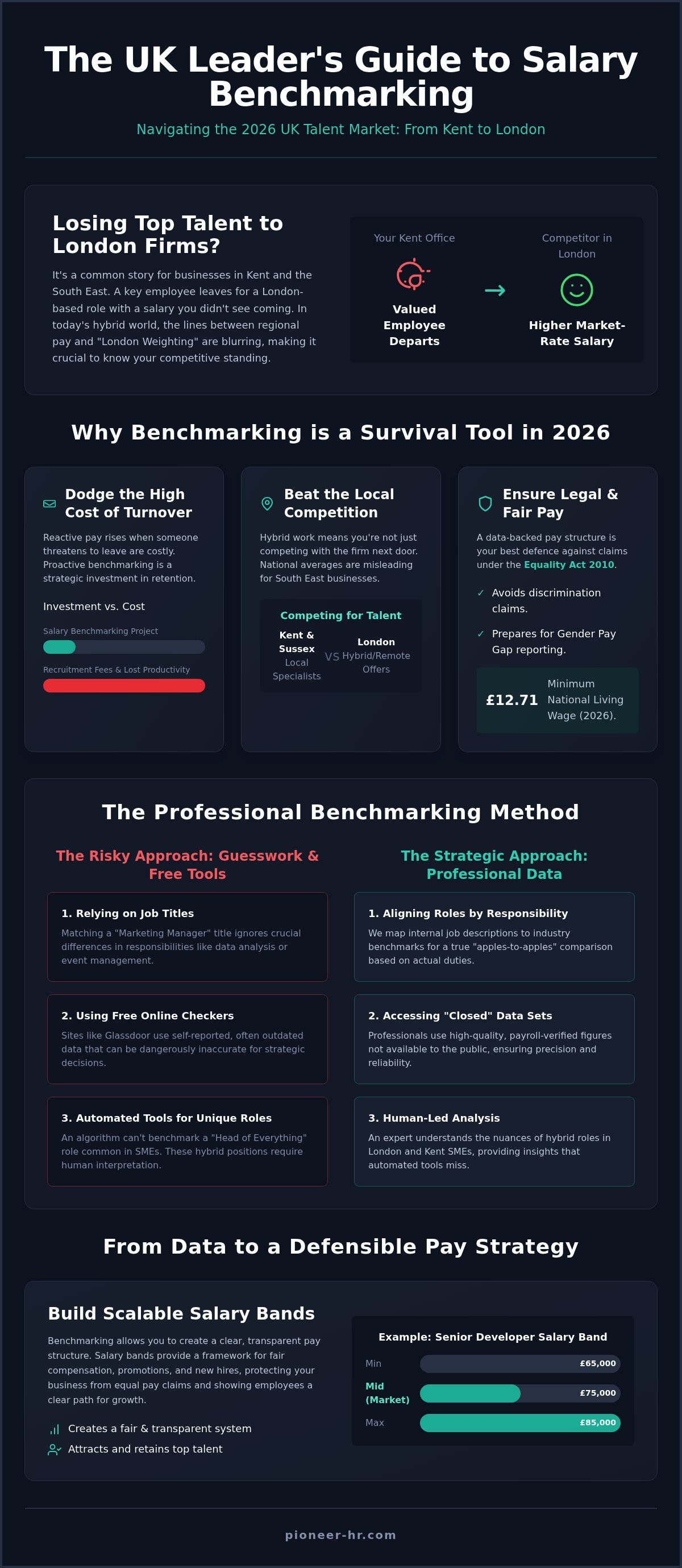
The UK talent market in 2026 is defined by a unique paradox: while there is a high volume of applicants, there remains a critical shortage of "right-fit" specialists. With median pay awards holding steady at 3.3% as of June 2026, businesses can't afford to guess what the "going rate" is. Understanding how to conduct salary benchmarking uk leaders can rely on is no longer a luxury; it's a survival tool. In a professional setting, a salary is determined by comparing market pay-rates alongside the specific value a role brings to the organization. When we get this balance wrong, we don't just lose money; we lose the trust of our best people.
The high cost of turnover is perhaps the most compelling reason to invest in a robust salary benchmarking exercise. Recruitment fees, onboarding time, and lost productivity for a single specialist role often far exceed the investment required for a strategic reward review. By moving beyond reactive pay rises, where we only increase salaries when someone threatens to leave, we can use data to drive proactive retention. This creates a culture of fairness where staff don't feel they have to look elsewhere just to get a market-aligned wage.
The Local Market Factor: London vs. Kent and Sussex
In 2026, the traditional "London Weighting" has evolved. Hybrid working has blurred the regional pay boundaries that once clearly separated the capital from Kent and Sussex. Many firms in Brighton, Hove, and the wider South East now find themselves competing with London-based companies that offer "London salaries" for roles that are primarily remote. We've seen that relying on national averages is often misleading for businesses in our region. A specialist in Kent might command a premium that a national data set simply won't capture, making localized, human-led data essential for staying competitive.
Legal Compliance and the Equality Act 2010
Benchmarking is also your strongest shield against legal and reputational risks. Under the Equality Act 2010, having a documented, data-backed pay structure is vital for defending against potential discrimination or equal pay claims. With the private sector gender pay gap reporting deadline falling on April 4, 2026, for employers with over 250 staff, transparency is becoming a non-negotiable standard. We must also ensure our lowest pay points stay safely above the 2026 statutory floor, as the National Living Wage for those aged 21 and over has risen to £12.71 per hour. Proactive benchmarking helps us identify and close internal gaps before they become a liability.
The Methodology: How to Conduct Salary Benchmarking in the UK
Professional salary benchmarking is far more than a simple price check. At its core, it's the strategic alignment of your internal roles to external market data based on actual responsibilities, not just job titles. We've seen many SMEs in Kent and London struggle because they've tried to match a "Marketing Manager" role using only a title, ignoring that their specific role might also encompass data analysis and event management. When you're looking at how to conduct salary benchmarking uk businesses can actually trust, you have to look beneath the surface of the job description.
There's a significant data advantage when you move beyond free, unverified online tools. While sites like Glassdoor or Indeed offer a quick glimpse, they rely on self-reported, often outdated information. Professional consultants utilize "closed" data sets. These are high-quality, payroll-verified figures that aren't accessible via a standard Google search. This level of precision is vital when you're making decisions that affect your bottom line and your employees' livelihoods. A typical project usually spans four to eight weeks, providing a structured timeline for data collection, analysis, and final recommendations.
We also have to consider the human element. An automated tool simply cannot accurately benchmark a "Head of Everything" role common in smaller firms. These hybrid positions require a human-led approach to understand the true weight of the role. If you're feeling overwhelmed by the complexity of these unique positions, our Fractional CPO service can provide the strategic leadership needed to navigate these nuances without the cost of a full-time executive.
Data Collection and Market Mapping
Market mapping is the process of matching internal job descriptions to industry-standard benchmarks to ensure an "apples-to-apples" comparison. To do this effectively, we must identify your true "peer group." You aren't just competing with the business next door in Hove; you're competing with any firm in the South East or London that offers hybrid working. We also distinguish between base salary, total cash compensation, and total reward. In 2026, a competitive pension or private healthcare can often be the deciding factor for top talent, even if the base pay is similar to a competitor's offer.
Job Evaluation and Grading (JEGs)
For many SMEs, Job Grading is the missing piece of the puzzle. It's a simple way to create a fair, hierarchical structure that makes sense to your staff. By using JEGs, we can rank roles based on their complexity and impact, rather than just seniority. This allows us to balance the external "Market Rate" with your "Internal Value." It ensures that two people doing work of equal value are paid fairly, which is the best defense against internal friction and potential equal pay claims. If you're ready to bring this level of clarity to your business, exploring a professional pay benchmarking project is the logical next step.
Benchmarking vs. Market Reality: Beyond the Numbers
Data is only as good as the person interpreting it. If you're figuring out how to conduct salary benchmarking uk businesses can actually use to grow, don't just aim for the middle. The 50th percentile, often called the "market average," might feel like a safe target, but it's frequently the wrong goal for a growing SME. If your strategy is to hire the best talent in competitive hubs like London or Brighton, paying exactly the median won't give you a competitive edge. It might even leave you vulnerable to losing your top performers to firms that understand the nuances of the 2026 landscape.
Sarah-Jane and our team bring over 30 years of expertise to this process. We've learned that raw data is a blunt instrument; it takes a human touch to apply nuance to those figures. For example, a role based in Kent with a heavy hybrid requirement needs a different approach than a fully office-based role in the same town. We look at the "Total Reward" package, benchmarking not just the base salary but also pensions, holiday allowances, and flexible working arrangements. This holistic view ensures your business isn't just "paying the market rate" but is offering a package that truly resonates with the people you want to keep.
The Problem with Free Salary Tools
It's tempting to use free online salary checkers, but they come with significant hidden dangers. The biggest issue is data lag. Crowdsourced data from 2025 is largely irrelevant for a 2026 strategy, especially given the recent shifts in the UK economy. There's also a heavy "Self-Reporting Bias" to consider. Employees often over-report their earnings online, either through aspirational thinking or by including one-off bonuses that don't reflect a standard base pay. Relying on these unverified figures can lead to expensive pay-scale errors that damage your bottom line.
Contextualising Data for Your Business Culture
Benchmarking isn't just about giving pay rises; it's about clarity. When budgets are tight, robust data can help you justify pay freezes by showing staff that their current package remains competitive within the wider South East market. It's about integrating non-monetary benefits into your overall Reward Strategy. By using clear data, you can manage employee expectations during the annual review cycle and have honest, transparent conversations. This builds a foundation of trust that is far more valuable for long-term retention than a reactive, unbudgeted salary bump.
Turning Data into a Strategic Salary Framework
Once the data is in your hands, the real work begins. Moving from a detailed report to a living, breathing salary framework is where many UK businesses falter. It's about taking those verified market figures and weaving them into a structure that supports your specific business goals. If you're wondering how to conduct salary benchmarking uk firms can actually use for the long term, the answer lies in scalability. You need a system that works for your current ten employees in Sussex but won't break when you double that headcount next year.
A key part of this transition is handling the "outliers", those valued team members who, for various reasons, sit outside your new benchmarks. If someone is paid below the new band, a phased plan to bring them up to speed is often the fairest approach. Conversely, for those paid above the benchmark, we might look at "freezing" base pay while focusing on other elements of their total reward. This is where a Fractional CPO provides immense value, offering the strategic oversight to manage these sensitive transitions without causing internal friction.
Developing Pay Scales and Bands
Scalable pay bands are the backbone of a fair organization. We recommend creating "room to grow" within each grade. This prevents the common problem of career stagnation, where a high performer hits the top of their pay bracket and feels their only option is to leave. Bands should be wide enough to accommodate different levels of experience while maintaining internal equity. By linking these scales to clear performance metrics, you provide a roadmap for career progression that keeps your team motivated and engaged.
The Communication Strategy: Building Trust
Data alone won't keep your team happy; how you explain it will. Crafting a transparent narrative around pay changes is essential for building trust. We often see businesses make the mistake of keeping benchmarking results a secret, which only breeds suspicion. Instead, train your managers to have confident, data-backed salary conversations. When a manager can explain why a salary sits where it does, it transforms a potentially difficult meeting into a supportive career discussion. If you want to ensure your pay structure is both fair and transparent, our salary benchmarking services can help you build that foundation today.
Pioneer HR: Expert Salary Benchmarking Services for UK SMEs
We understand that for many business owners, knowing how to conduct salary benchmarking uk style can feel like a full-time job in itself. That's why we've designed our approach to be human-led. While automated tools might spit out a generic report in seconds, they lack the context of your specific culture or the subtle shifts in the Kent and London markets. We don't just provide numbers; we provide a strategic partnership that helps you understand exactly where you stand. Our goal is to ensure your reward strategy is a tool for growth, not a source of stress.
Large consultancies often use rigid templates that don't fit the agility of an SME in Brighton or Hove. Our Salary Benchmarking Service is built specifically for smaller teams where every hire is a critical investment. We ensure your pay structure is fair, competitive, and sustainable for your specific budget. By focusing on the South East market, we can provide insights that national data sets often miss, giving you a genuine edge in attracting top talent.
Our Proven Benchmarking Process
We've refined our process over decades to ensure it delivers maximum value with minimal disruption to your daily operations. Our approach follows three clear steps:
Step 1: Role analysis and culture deep-dive. We take the time to understand what your people actually do, looking past job titles to the real-world impact of each role.
Step 2: Rigorous market matching. Using payroll-verified UK data, we find the closest matches for your roles within your specific industry and geography.
Step 3: Strategic report delivery. We don't just hand over a spreadsheet; we provide a clear report with actionable pay recommendations and a roadmap for implementation.
Ready to Secure Your Talent?
Sarah-Jane brings over 30 years of HR and reward expertise to every project she leads. This isn't just about ticking a compliance box; it's about the peace of mind that comes from knowing your staff are rewarded fairly and your business is protected. Whether you're facing a specific retention challenge or simply want to ensure your 2026 pay reviews are backed by solid data, we can help. We offer both one-off benchmarking projects and ongoing retained HR support to suit your business needs. It's time to move away from guesswork and toward a transparent, data-backed future. Speak to Sarah-Jane about your pay structure today and let's build a reward strategy that truly works for your team.
Building a Future-Proof Reward Strategy
Mastering the balance between competitive pay and sustainable growth is the hallmark of a resilient business. We've explored how moving beyond generic online tools allows you to capture the true value of your team, especially when navigating the unique pressures of the London and South East talent markets. By understanding how to conduct salary benchmarking uk leaders can ensure their firms remain attractive without overextending their budgets. It's about creating a culture where employees feel valued and your business remains agile.
Our team, led by Sarah-Jane with over 30 years of specialist HR experience, provides the human-led nuance that automated systems simply can't match. We offer comprehensive reports covering everything from base salary to total reward packages, specifically tailored for SMEs in Kent, Sussex, and London. Whether you're looking for a one-off project or strategic guidance, we're here to help you navigate the 2026 landscape with confidence and clarity.
Get a Tailored Salary Benchmarking Quote and start building a more transparent, competitive workplace today. We look forward to helping your business thrive.
Frequently Asked Questions
What is the difference between salary benchmarking and a salary survey?
Salary benchmarking is the strategic process of comparing your specific internal roles to external market data to ensure they're aligned correctly. A salary survey is the broad data collection exercise that gathers those market rates in the first place. Benchmarking takes that raw survey data and applies it to your unique business context, helping you make informed decisions about your own pay scales.
How often should a UK business benchmark its salaries?
We recommend that most UK businesses conduct a full benchmarking exercise once a year to keep pace with the market. However, if you operate in a high-growth sector or a competitive hub like London, a mid-year check for specialist roles is often wise. Regular reviews prevent the "salary lag" that often leads to your best people being approached by competitors offering more current rates.
Can salary benchmarking help us close our gender pay gap?
Yes, it's one of the most effective ways to identify and address pay disparities within your organization. By establishing objective, data-backed pay bands for every role, you ensure that compensation is based on the weight of the position rather than individual negotiation. This creates a fair foundation that supports your DEI commitments and helps you stay compliant with the Equality Act 2010.
Is salary benchmarking worth it for a small business with under 30 staff?
It's often more critical for smaller firms because losing even one key employee can have a disproportionate impact on your operations. Understanding how to conduct salary benchmarking uk SMEs can rely on helps you protect your team from being "poached" by larger firms in Kent or Sussex. It gives you the confidence to know you're paying fairly without overstretching your limited budgets.
Where do professional salary benchmarking services get their data?
Professional services move beyond unverified, crowdsourced websites that rely on self-reported figures. We utilize payroll-verified databases and "closed" industry-specific data sets that provide a much higher level of accuracy. These sources are updated regularly, ensuring that the figures we use reflect the real-world economic conditions of 2026 rather than outdated trends from several years ago.
How long does a typical salary benchmarking project take to complete?
A typical project usually spans between four and eight weeks from start to finish. This timeframe allows for a deep-dive into your current roles, a rigorous market matching process, and the development of a strategic report. We take the time to ensure every role is matched accurately, providing you with a robust framework that you can implement with total confidence.
What should I do if the data shows I am significantly underpaying a key employee?
The best approach is to be proactive and transparent with the employee. We usually suggest creating a phased plan to bring their salary into the new band over a set period, such as six to twelve months. This demonstrates your commitment to fair pay and loyalty, which is often enough to secure their long-term engagement even if you can't fix the gap overnight.
Does benchmarking include benefits like private healthcare and pensions?
Yes, a comprehensive review should always look at the "Total Reward" package rather than just the base salary. We benchmark pensions, holiday allowances, and private healthcare because these elements are often what make an offer truly competitive in the South East. In 2026, flexible working and robust benefits are frequently just as important to candidates as the figure on their payslip.


Comments