
Managing Absenteeism: Strategic Guide for UK Employers
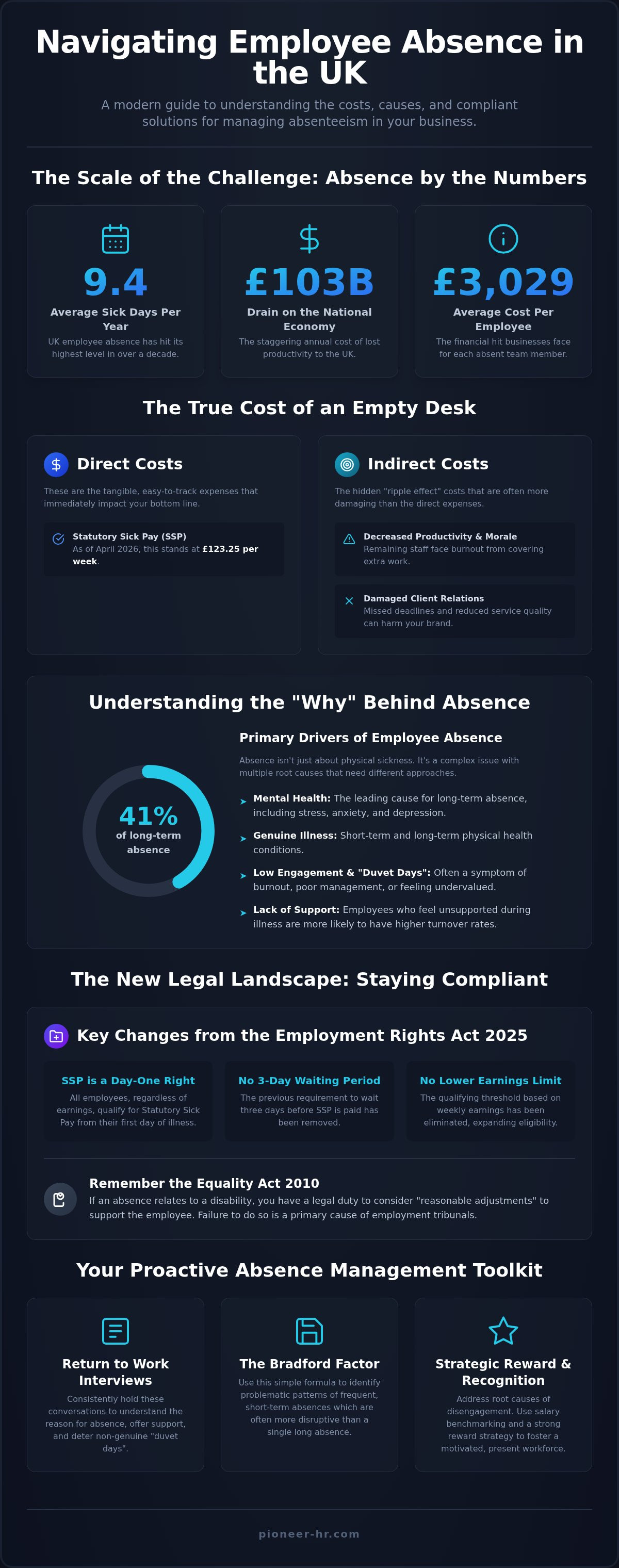
With UK employees taking an average of 9.4 sick days per year, workplace absence has reached its highest level in over a decade. This isn't just a scheduling headache; it's a £103 billion drain on the national economy that leaves many leaders feeling stuck between empathy and the need for productivity. When you're managing absenteeism, the goal isn't simply to track hours lost. It's about understanding why they're lost in the first place and how to build a more resilient, present team.
We know how exhausting it is to watch your most dedicated staff burn out while covering for absent colleagues. You're likely worried about the legal risks of taking action, especially with the significant shifts introduced by the Employment Rights Act 2025. This article provides a clear roadmap to help you reduce disruption and protect your business from the fear of employment tribunals. We'll show you how to align your strategy with the latest 2026 Statutory Sick Pay regulations while using tools like salary benchmarking to boost genuine engagement. By the end of this guide, you'll have the framework to create an absence policy that supports your people and your bottom line.
Table of Contents
The True Cost of Employee Absenteeism for UK Businesses in 2026
Every empty desk in your office or missing icon on your Slack channel represents more than just a temporary gap in the rota. To effectively begin managing absenteeism, we must first understand its complexity. While most absences stem from legitimate physical or mental health struggles, others fall into the category of "duvet days." These are short-term, non-medical absences often driven by low engagement or burnout. A foundational look at What is Absenteeism? reminds us that it's a multidimensional issue involving social, psychological, and economic factors that require a nuanced response.
For SMEs across London and Kent, the productivity gap is widening. When a team member is away, the burden doesn't vanish; it shifts. We see this ripple effect daily: missed deadlines, overtime costs for those "picking up the slack," and the significant drain on management time spent reallocating resources. In smaller organisations, these disruptions are felt more acutely. This often leads to a decline in morale that's harder to repair than the initial loss of output. When high absence becomes the norm, your best people start to feel undervalued and overstretched.
Direct vs. Indirect Costs of Absence
The financial impact is staggering. Research indicates the annual cost of absenteeism to the UK economy has reached approximately £103 billion, or roughly £3,029 per employee. Direct costs are the easiest to track, such as Statutory Sick Pay (SSP) which, as of April 2026, stands at £123.25 per week. However, the indirect costs often carry a heavier weight. In the competitive markets of the South East, a drop in customer service quality due to understaffing can permanently damage your brand reputation. We also see the rise of "presenteeism," where employees show up while unwell. This results in lower quality work and, eventually, longer periods of total absence.
Absence Trends in the Post-2025 UK Workplace
The implementation of the Employment Rights Act 2025 has fundamentally changed how we track sickness. With SSP now a day-one right, the administrative burden on HR teams has grown. In London’s corporate sectors, mental health remains the leading cause of long-term absence, accounting for 41% of cases. Meanwhile, businesses in Kent and Sussex are reporting higher turnover rates. Employees who feel unsupported during periods of illness often look for new opportunities elsewhere. Our retained HR support helps businesses navigate these trends by providing the strategic oversight needed to identify patterns before they become systemic failures.
Managing Absenteeism Within the UK Legal Framework
The legislative environment for UK employers shifted significantly with the implementation of the Employment Rights Act 2025. Managers now navigate a landscape where Statutory Sick Pay (SSP) has become a day-one right for all staff. This change removed the previous three-day waiting period and the Lower Earnings Limit, ensuring all workers qualify for support from their first day of illness. When managing absenteeism, you must ensure your internal triggers and disciplinary actions don't inadvertently penalise employees for exercising these expanded statutory rights.
Compliance extends well beyond sick pay. The Equality Act 2010 remains a cornerstone of employment law, requiring us to avoid discrimination when absence triggers are met. If an absence relates to a disability, you're legally obligated to consider "reasonable adjustments." This might involve modified working hours, specialised equipment, or phased returns to work. Failing to explore and document these considerations is often what leads to costly employment tribunals. A proactive approach involves viewing these legal requirements not as hurdles, but as a framework for fair and transparent management.
Navigating Sickness and Disability
Managers often struggle to distinguish between short-term persistent absence and genuine long-term illness. The former, often referred to as "intermittent absence," usually requires a disciplinary track focused on attendance standards. In contrast, long-term illness requires a capability-based approach. For these cases, we recommend obtaining medical reports to understand the prognosis and recovery timeline. Always ensure you have written consent under the Access to Medical Reports Act 1988. Understanding the UK Legal Framework for Absence is vital to ensure you're supporting the employee while protecting your business interests.
The Importance of a Robust Absence Policy
A clear, well-communicated employee handbook is your first line of defence. It should specify exactly who an employee must contact and by what time. Does a text message suffice, or is a phone call to a line manager mandatory? Clear boundaries reduce ambiguity and prevent the "ghosting" that disrupts operations for SMEs in London and Kent. Your policy must also outline the consequences of failing to follow these procedures. If your current documentation feels outdated or lacks the latest 2025 updates, our Retained HR Support provides the expert oversight needed to keep your policies compliant and effective.
Documentation is your best defence in any legal dispute. Every return-to-work meeting, medical report request, and adjustment discussion should be recorded in writing. Tribunals look at the whole process. They scrutinise every step you took and every conversation you had before reaching a final decision. By maintaining meticulous records, you demonstrate a commitment to both your legal duties and the wellbeing of your team.
Addressing the Root Causes: From Reward Strategy to Burnout
When managing absenteeism, it's easy to focus on the symptoms rather than the underlying disease. Many UK businesses treat high absence rates as a purely disciplinary matter. In our experience, however, frequent short-term absences are often a "canary in the coal mine" for deeper organisational issues. If your team feels undervalued or emotionally exhausted, their resilience to minor illnesses or personal stressors drops significantly. By the time an employee reaches a formal absence trigger, the opportunity for early intervention has often already passed.
A Fractional CPO can provide the high-level perspective needed to identify these cultural red flags. They look beyond the spreadsheets to see if your leadership style or workload distribution is inadvertently causing burnout. In the fast-paced London corporate sector, mental health accounts for 41% of long-term absences. This isn't just a health issue; it's a structural one. Shifting from a reactive "tracking" mindset to a proactive "support" mindset is what separates successful organisations from those struggling with revolving-door turnover.
The Role of Salary Benchmarking in Reducing Absence
There's a direct, measurable link between reward and attendance. Employees who feel they're being paid below market rates are more likely to experience "disengagement absence." If the financial reward doesn't feel commensurate with the effort required, the motivation to "power through" a difficult day evaporates. We use Salary Benchmarking Services to help SMEs in Kent and London ensure their pay scales remain competitive against 2026 standards. When your reward strategy is transparent and fair, you build a foundation of mutual respect that naturally encourages higher presence levels.
Culture and Leadership Coaching
Poor management is a primary driver of stress-related absenteeism. In 2024, 64% of organisations reported stress as a major cause of absence. This figure often rises when managers lack the confidence to have difficult, empathetic conversations. We believe that training your leadership team to spot the early signs of burnout is the most effective way to keep your workforce healthy and present. Following Acas guidance on reducing absence, we recommend a holistic approach that balances clear expectations with genuine wellbeing support.
Building a "presence-positive" culture starts with listening. Regular employee engagement surveys allow you to catch toxicity before it manifests as a spike in sick days. It's about creating an environment where people feel they belong and their contribution matters. Non-monetary rewards, such as flexible working patterns or professional development opportunities, can be just as powerful as a salary bump in fostering the loyalty that keeps a team together during busy periods.
Proven Strategies for Reducing Absence in Your Organisation
Effectively managing absenteeism requires a balance of data-driven tracking and human-centric conversation. One of the most common tools we recommend is the Bradford Factor. This formula weights frequent, short-term absences more heavily than single, long-term blocks of illness. It helps managers identify patterns that cause the most operational disruption. However, data alone isn't a solution. It's a starting point for a professional conversation. By setting clear "trigger points" in your policy, you ensure that every team member is treated with the same level of fairness and transparency.
Return to Work (RTW) interviews are perhaps the most powerful tool in your management kit. When done correctly, they aren't an interrogation. They're a support mechanism. They signal to employees that their absence was noticed and that their health is a priority. This consistency often discourages "duvet days" while ensuring those with genuine health challenges feel supported. We've seen that businesses which conduct these interviews after every single absence, regardless of length, see a marked improvement in overall attendance rates.
The Return to Work Interview Framework
A structured approach ensures consistency across your organisation. We suggest a three-step framework. First, welcome the employee back and sincerely check their wellbeing. This is the time to ask if they're truly fit to resume their duties. Second, explore if any workplace factors, like high stress or physical strain, contributed to the absence. Finally, gently update them on key developments they missed. This helps them reintegrate without feeling overwhelmed by a mountain of unread emails or missed deadlines.
Managing AWOL and Gross Misconduct
There's a clear line between a sick employee and one who is "Absent Without Leave" (AWOL). If a team member fails to follow your reporting procedure, it shifts from a health matter to a disciplinary one. Persistent failure to communicate can eventually be treated as gross misconduct. For businesses in London or Kent, having a clear paper trail is essential to avoid tribunal claims. If you're unsure how to handle a specific case of unauthorised absence, our Retained HR Support provides the expert guidance needed to manage the process legally and professionally.
We often get asked about attendance bonuses. While they might seem like a quick fix, they carry risks. They can inadvertently encourage "presenteeism," where sick employees come into work and spread illness or perform poorly. Instead of cash incentives, focus on building a culture where people want to be present because the work is rewarding and the environment is supportive. High attendance should be a natural byproduct of a healthy workplace, not something you have to buy.
How Pioneer HR Supports Strategic Absence Management
Generic HR templates often fail because they don't account for the unique culture or specific challenges of your business. When you're managing absenteeism, you need more than a one-size-fits-all checklist; you need a strategy that reflects your values and protects your commercial interests. At Pioneer HR, we bring over 30 years of experience to help UK SMEs in London, Kent, and Sussex move beyond reactive tracking. We believe that every absence tells a story about your organisation's health, and we're here to help you read between the lines.
Our Retained HR Support provides you with a dedicated expert at the end of the phone, ensuring you never have to face a complex absence case alone. This service removes the administrative burden of tracking and allows you to focus on growth. For businesses looking for deeper transformation, our Fractional Chief People Officer services offer high-level strategic leadership. We step into your team to identify cultural toxicity and implement long-term changes that prevent burnout before it starts. By empowering your managers through leadership coaching, we give them the confidence to handle difficult conversations with empathy and legal precision.
Our Approach to Absence and Reward
We don't look at attendance in a vacuum. By combining your absence metrics with detailed salary data, we help you find the "why" behind the numbers. Our Reward Strategy Consultancy ensures your compensation packages are competitive enough to drive genuine engagement. We recently helped a UK-based client significantly reduce their short-term absence rates by implementing a clearer job grading structure. This clarity gave employees a sense of progression and purpose, proving that when people feel their career path is secure and fairly rewarded, they're far more likely to show up and perform.
Getting Started with Pioneer HR
The first step toward a more present workforce is understanding where you stand today. We recommend booking a comprehensive HR audit to identify your current risks, from outdated policies to non-compliance with the 2026 SSP regulations. This audit serves as a baseline for your future growth. Whether you need a steady hand for day-to-day issues or a strategic partner to lead your cultural evolution, we tailor our involvement to your specific needs. Transitioning to a fractional model allows you to access C-suite expertise without the full-time overhead, providing a scalable solution for ambitious SMEs. Contact Pioneer HR today for a free initial consultation and let's build a more resilient team together.
Building a More Resilient and Present Workforce
Effective managing absenteeism requires looking beyond the spreadsheet to address the human and structural root causes within your organisation. By aligning your reward strategy with modern UK standards and maintaining strict compliance with the latest 2025 employment reforms, you transform absence from a drain on productivity into a valuable metric for engagement. Leadership coaching and consistent return-to-work frameworks ensure your team feels supported rather than simply policed.
With over 30 years of UK HR experience, we specialise in using salary benchmarking and fractional CPO leadership to help SMEs build high-performing cultures. You don't have to navigate these complex legislative shifts alone. Book a consultation with our UK HR experts to manage your absenteeism today and start creating a workplace where people are motivated to show up. We're here to help you turn these strategic insights into lasting business value and a more motivated team.
Frequently Asked Questions
What is the maximum period of self-certification for sickness in the UK?
In the UK, employees can self-certify their illness for up to 7 calendar days, including weekends and bank holidays. Once they reach the eighth day of absence, they must provide a fit note from a doctor or eligible healthcare professional to justify their time off. When you're managing absenteeism, ensure your policy clearly states how and when this documentation should be submitted to avoid delays in processing sick pay.
How do I calculate the Bradford Factor for my employees?
The Bradford Factor is calculated using the formula S² x D, where "S" is the total number of separate absences (spells) and "D" is the total number of days absent over a rolling 52-week period. For example, two absences of five days each would result in a score of 40 (2² x 10). This metric helps you identify frequent, short-term disruptions which often have a greater impact on team productivity than a single long-term illness.
Can I dismiss an employee for high levels of short-term absenteeism?
Yes, you can dismiss an employee for persistent short-term absence, but you must follow a fair and transparent procedure to avoid unfair dismissal claims. This usually involves a series of formal warnings and a thorough investigation into any underlying health issues. It's essential to demonstrate that you've supported the employee and that the level of absence has become unsustainable for the business. Always document every stage of the process to protect your organisation.
What are the rules for statutory sick pay (SSP) in 2026?
From 6 April 2026, Statutory Sick Pay is a day-one right for all UK employees, as the previous three-day waiting period has been abolished. All workers now qualify regardless of their earnings because the Lower Earnings Limit was removed. The weekly rate for the 2026 to 2027 tax year is £123.25. For lower-paid staff, the payment is either £123.25 or 80% of their average weekly earnings, whichever is the lower amount.
What is the difference between a capability and a disciplinary procedure for absence?
A capability procedure is used when an employee is genuinely unwell and simply cannot perform their role due to health reasons. It's a supportive process focused on adjustments and medical evidence. Conversely, a disciplinary procedure is appropriate for conduct issues, such as failing to follow reporting rules or taking unauthorised "duvet days." Distinguishing between the two is vital for fair management and ensures you're applying the correct legal framework to each specific situation.
How should I handle a long-term absence that is stress-related?
Handling stress-related absence requires an empathetic, proactive approach focused on identifying workplace triggers. You should maintain regular, sensitive contact and consider a referral to Occupational Health to understand how the business can support their return. In many cases, managing absenteeism of this nature involves looking at workload, management styles, or interpersonal conflicts. Implementing reasonable adjustments, such as flexible hours or a phased return, is often the most effective way to facilitate a successful recovery.
Can I contact an employee while they are off sick?
Yes, you're entitled to maintain reasonable contact with an employee during their sickness absence. In fact, regular check-ins are often considered best practice to ensure the employee feels supported and to help you plan for their return. However, the contact should be handled sensitively and shouldn't be seen as a way to pressure them back to work. Your absence policy should ideally outline the expected frequency and method of communication during these periods.
What reasonable adjustments should I consider for mental health absence?
Reasonable adjustments for mental health vary depending on the individual's needs and the nature of their role. Common examples include offering a phased return to work, allowing flexible start and finish times, or providing a quieter workspace. You might also consider temporary changes to their job description or redistributing high-pressure tasks. The goal is to remove barriers that hinder their performance while ensuring they feel safe and valued as they reintegrate into the team.


Comments