
Retained HR vs In-House HR: 2026 Strategy Guide for UK SMEs
If you're a founder in London or Kent, you've likely felt the weight of the upcoming 2026 employment law changes, from "Day One" sick pay to the launch of the Fair Work Agency. But what if the "safe" choice of hiring a full-time HR Manager is actually the very thing slowing your growth? Deciding between retained HR vs in-house HR isn't just about headcount; it's about matching your people strategy to your current stage of evolution.
We understand that most SME leaders reach a point where handling employee relations and pay structures feels like a second, exhausting job. You want to protect your culture and avoid the looming threat of a tribunal, yet the high cost of a senior in-house hire can seem impossible to justify. It’s a common dilemma for growing teams, but it doesn't have to lead to founder burnout.
In this guide, we'll provide a clear financial justification for your HR choice and reveal a scalable model that supports your growth to 200 employees and beyond. We’ll compare the 2026 regulatory landscape with the true costs of London-weighted salaries, ensuring you have the strategic insight to build a compliant, thriving workplace.
Table of Contents
When Does a UK SME Need Professional HR Support?
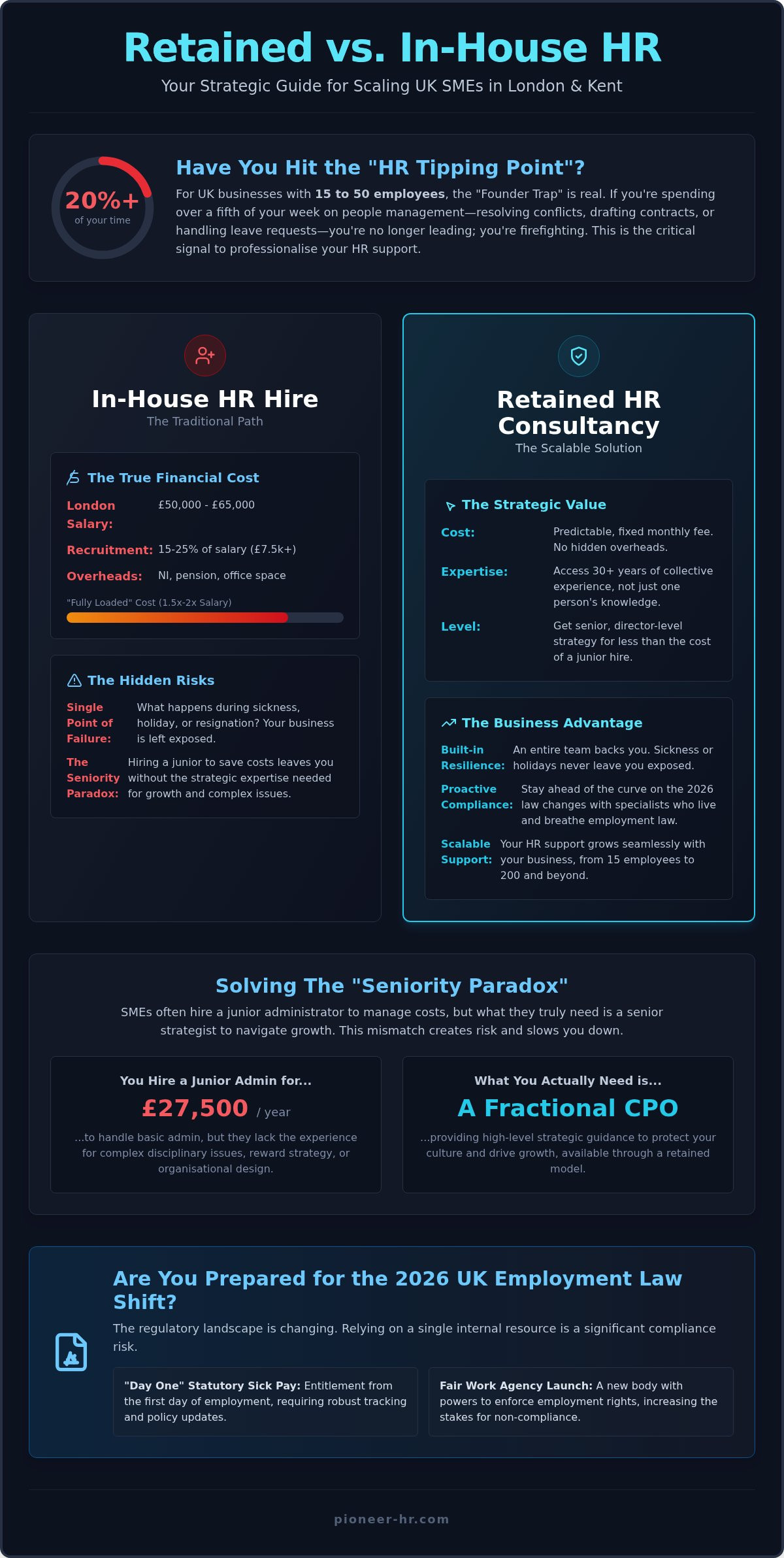
Growth is a double-edged sword. As your headcount climbs, the very culture that made you successful can start to feel frayed. For most UK businesses, the "HR Tipping Point" arrives when you reach between 15 and 50 employees. At this stage, the administrative burden and emotional weight of people management often trigger the "Founder Trap." If you find that 20% or more of your time is consumed by resolving conflicts, drafting contracts, or answering holiday queries, you've moved from leading your business to being stuck in its engine room.
Many leaders consider the business practice of outsourcing to reclaim their schedule and focus on high-level strategy. When weighing up retained HR vs in-house HR, the decision often hinges on whether you need reactive "firefighting" or proactive strategy. In 2026, simply having someone to file paperwork isn't enough. With European employee engagement sitting at just 13% according to Gallup, your HR model needs to actively build culture and performance, not just manage absence.
The Symptoms of an HR Gap
It isn't always a single crisis that signals the need for professional help. Often, it's a slow accumulation of friction points that stall your momentum. Look for these signs in your organization:
High employee turnover: If good people are leaving despite competitive salaries, your internal structures or culture might be the culprit.
Difficulty attracting talent: In competitive hubs like London and Kent, top candidates expect professional onboarding and clear career paths.
Inconsistent procedures: When different managers handle similar issues in different ways, it creates a sense of unfairness and erodes trust.
Why "Doing it Yourself" is a Compliance Risk
The regulatory environment is shifting rapidly. With the April 2026 updates making Statutory Sick Pay a "Day One" right and the launch of the Fair Work Agency, the margin for error has vanished. Handling gross misconduct cases or complex grievances without professional documentation is a significant gamble. We often see founders struggle with Managing Disciplinary Procedures effectively, which can lead to costly tribunals and reputational damage. Whether you choose retained HR vs in-house HR, the goal remains the same: ensuring your business stays compliant while you focus on the growth that matters.
The True Cost of In-House HR vs. Retained Consultancy
When founders compare retained HR vs in-house HR, they often start with a simple salary-to-fee comparison. However, a permanent hire's true cost goes far beyond the monthly paycheck. In the UK, especially across London and the South East, the "fully loaded" cost of an employee can be 1.5 to 2 times their gross salary once you account for National Insurance, pension contributions, and office overheads. We believe that understanding these hidden variables is essential for making a sustainable strategic choice.
Financial Breakdown: The Permanent Hire
Hiring an internal HR professional involves significant upfront and ongoing investment. Recruitment fees alone typically range from 15% to 25% of the annual salary. For an HR Manager in London, where salaries for a role at a large organisation or competitive SME range from £50,000 to £65,000, this is a substantial day-one expense. Beyond the hire, you must factor in Continuous Professional Development (CPD) and CIPD membership fees to keep your staff compliant with evolving laws. There's also the "single point of failure" risk; if your only HR person is on leave or resigns, your business is left exposed during critical moments.
The Seniority Paradox
We often see SMEs fall into what we call the "Seniority Paradox." To manage budgets, they hire a junior HR Administrator or Assistant, often at a median salary of £27,500. While this handles basic admin, it fails when the business needs high-level strategy, such as organizational development or complex reward structures. You end up paying for an administrator when you actually need the expertise of a Director to navigate growth. This gap is where many firms realize the value of HR Retainer Services, which provide senior-level guidance without the executive price tag.
The Retained Advantage for SMEs
A retained model transforms HR from a variable risk into a predictable, fixed monthly cost. You gain access to a collective 30 years of industry experience for a fraction of the cost of one senior full-time hire. There are no employer NI or pension obligations for a consultancy fee. You also benefit from a team approach that eliminates the "single point of failure" during holidays or sickness. This partnership allows for the seamless integration of specialized projects. For example, staying competitive in the Kent or Hove talent markets often requires regular salary benchmarking to ensure your pay structures aren't driving turnover. By choosing a partner rather than just a person, you ensure your HR function scales alongside your ambitions.
Compliance, Culture, and Continuity: Comparing the Models
The choice between retained HR vs in-house HR often boils down to a question of perspective. Many founders in London and Sussex worry that an external partner might feel detached from their daily operations. However, we've found that acting as a bridge-builder allows us to integrate deeply with your team while maintaining the professional distance needed for objective advice. While a single in-house manager relies on their individual career history, a retained partnership offers the weight of 30 years of collective industry experience. This depth is essential as we move into the complexities of 2026.
Compliance is no longer just about contracts; it's about staying ahead of rapid legislative shifts. By October 30, 2026, UK employers will face a new legal duty to take all reasonable steps to prevent sexual harassment. Simultaneously, the expected reduction in the unfair dismissal qualifying period on January 1, 2027, means your management of the first six months of employment must be flawless. A consultancy stays updated on these trends across multiple sectors, whereas an internal hire can easily become buried in the admin of a single business, missing the broader regulatory horizon.
Handling Complex Employee Relations
Sensitive issues like grievances or disciplinary hearings require a delicate balance of empathy and legal rigour. When an internal manager handles these cases, personal biases or existing workplace friendships can cloud their judgement, leading to claims of unfairness. An external partner provides an unbiased perspective that protects both the employee and the business. This objectivity is particularly vital in high-stakes situations. If you're managing a difficult exit, our Gross Misconduct Guide provides a framework for handling these cases with the human-centric approach that Sussex and London businesses value.
Maintaining Strategic Continuity
One of the biggest risks of the in-house model is the "knowledge gap." When an internal HR manager leaves, they take their institutional memory, undocumented processes, and relationship history with them. This often leaves the business in a state of paralysis during the recruitment of a successor. Retained support provides permanent continuity. We ensure your HR policies remain living documents that evolve with your business, rather than files gathering dust. Whether you're scaling in Kent or refining a tech team in Brighton, this model ensures your people strategy isn't dependent on a single individual's presence.
Strategic HR: How Fractional CPOs Bridge the Gap
When businesses weigh up retained HR vs in-house HR, they often overlook the middle ground that provides board-level expertise. A Fractional Chief People Officer (CPO) isn't just an extra pair of hands; they are a strategic partner who works part-time to align your people operations with your commercial goals. For a scale-up in London or Kent, hiring a full-time HR Director can cost upwards of £110,000 in median salary. A Fractional CPO offers that same level of 30-year industry experience but at a fraction of the cost, making it a powerful alternative to a full-time mid-level manager who might lack the experience to navigate complex organizational growth.
When to Choose a Fractional CPO
This role is particularly effective when your business faces a significant pivot or period of rapid change. If you're preparing for an investment round, venture capitalists will look for robust people structures and scalable cultures. A Fractional CPO ensures your organizational design is fit for purpose, helping you restructure for better performance before the pressure of new capital hits. They act as a sounding board for the CEO, providing the dispassionate, senior-level advice needed to make tough decisions. If your business is at this crossroads, exploring a Fractional CPO Service can provide the leadership you need without the overhead.
Linking Pay to Performance
Strategic HR isn't just about compliance; it's about using your budget to drive the right behaviours. A Fractional CPO brings a data-driven approach to your reward strategy, ensuring every pound spent on compensation contributes to retention and morale. By using Salary Benchmarking UK, we can help you design market-led pay structures that reflect 2026 standards. This is a significant advantage in competitive markets like Brighton or London, where "job-hugging" is on the rise. Employees might stay for security, but they only excel when they feel their reward is fair and aligned with their performance.
Ultimately, the debate of retained HR vs in-house HR shouldn't just be about who answers the emails. It should be about who helps you build a more valuable company. A Fractional CPO bridges that gap, providing the executive-level foresight required to scale from 50 to 200 employees while keeping your culture intact.
Implementing Your HR Strategy in London, Kent, and Hove
Success in the UK market often depends on understanding local nuances. A tech startup in the Brighton or Hove scene has vastly different cultural and reward expectations compared to a long-standing manufacturing firm in Kent. When choosing between retained HR vs in-house HR, you need a partner who understands these regional dynamics. We don't believe in remote-only, faceless support. High-touch local support, including site visits in London and the South East, ensures we aren't just an email address but a visible extension of your leadership team.
The 30-Day HR Transition
Moving from a "no HR" or founder-led model to professional support doesn't have to be a disruptive process. We follow a structured 30-day plan to ensure you're protected and productive immediately. First, we conduct an HR audit to identify immediate compliance risks, such as outdated contracts or missing policies that could trigger Fair Work Agency inspections. Next, we establish a communication "bridge" between our team and yours, ensuring your employees know exactly where to find support. Finally, we build a 12-month people roadmap that aligns your talent strategy with your commercial goals. This phased approach provides the peace of mind that your business is in safe hands from day one.
Your Next Steps for Growth
Evaluating your "People ROI" is the first step toward a more strategic organisation. If your current setup feels like a series of reactive fires rather than a driver of value, it's time for a change. We invite you to a strategic consultation with Sarah-Jane to discuss your specific challenges and growth plans. Whether you're navigating the 2026 legislative shifts or looking to overhaul your pay structures, we're here to help. You can Book an HR Health Check with Pioneer HR today to start your journey toward a more scalable, compliant, and human-centric workplace.
To help finalise your decision between retained HR vs in-house HR, consider this final checklist:
Headcount: Are you between 15 and 50 employees? Retained is usually the most cost-effective entry point.
Strategic Need: Do you require executive-level reward strategy or just administrative support?
Budget: Can you justify the £50,000 plus London salary for an internal manager right now?
Compliance: Are you fully prepared for the "Day One" statutory rights coming in April 2026?
By matching your HR model to your business stage, you ensure that your people strategy remains a catalyst for growth rather than a barrier to it.
Building a Scalable Future for Your UK Team
The choice between retained HR vs in-house HR isn't just about balancing a spreadsheet; it's about giving your business the room to breathe and grow. We've explored how a retained model eliminates the "single point of failure" and the hidden overheads of permanent hires, while providing the senior oversight needed for the 2026 legislative shifts. Whether you're navigating the tech landscape of Hove or the manufacturing hubs of Kent, your people strategy should be a source of strength, not stress.
By leveraging 30+ years of HR expertise, we help you transition from reactive firefighting to proactive growth. From bespoke salary benchmarking data that keeps your talent loyal to strategic Fractional CPO leadership that guides your board-level decisions, we act as the bridge between where you are and where you want to be. It's time to reclaim your focus and build a culture that lasts.
Secure your business with expert Retained HR Support today and ensure your team is ready for whatever the future holds. We look forward to helping you scale with confidence.
Frequently Asked Questions
Is retained HR support cheaper than hiring a full-time HR Manager?
Retained HR support is generally more cost-effective for SMEs than hiring a full-time HR Manager, especially in London where salaries range from £50,000 to £65,000. When you factor in employer National Insurance, pension contributions, and recruitment fees, the total cost of a permanent hire can be double their gross pay. A monthly retainer provides access to senior expertise for a predictable, fixed fee without the long-term overheads of a full-time executive.
Can an outsourced HR consultancy really understand my company culture?
We act as a bridge-builder rather than a detached outsider. By conducting site visits in Hove and London, we integrate with your leadership team to understand your unique values and team dynamics. This partnership ensures that we provide advice that isn't just legally sound but also reflects your specific culture. Effective HR isn't about imposing rigid rules; it's about creating a supportive environment where your people can thrive within your business's unique context.
What is the difference between a Fractional CPO and an HR Consultant?
A Fractional Chief People Officer (CPO) provides board-level strategic leadership, while a standard HR consultant often focuses on operational tasks like contracts or grievances. When comparing retained HR vs in-house HR, the Fractional CPO model offers high-level foresight for investment rounds or restructuring. They help align your people operations with commercial goals, whereas consultants typically manage the day-to-day administration and compliance requirements of your workforce.
How does retained HR help with UK employment law compliance in 2026?
We provide proactive updates on the significant 2026 legislative shifts, such as "Day One" statutory rights and the new Fair Work Agency. Because we work across multiple sectors, we have a broader view of how these changes affect different industries in Kent and London. We ensure your policies, from sexual harassment prevention to dismissal procedures, are updated before deadlines pass, protecting you from the risk of costly employment tribunals.
Do I still need a retained HR partner if I only have 10 employees?
Even with 10 employees, you face the same legal obligations as larger firms. The first few hires are often the most critical for setting culture and establishing compliant procedures. Retained support for smaller teams ensures that your contracts are solid and your disciplinary processes are professional from the start. This foundation prevents small issues from escalating into expensive disputes, giving you peace of mind while you focus on scaling your business.
What happens if we have an urgent disciplinary issue and use a retained service?
Urgent issues like gross misconduct require immediate, objective handling to avoid legal pitfalls. Our retained service ensures you have a dedicated partner to guide you through the process, from initial investigation to the final hearing. We provide an unbiased external perspective that internal managers often struggle to maintain. This professional distance is vital for ensuring fairness and protecting your reputation during sensitive employee relations cases in your workplace.
Can Pioneer HR help with salary benchmarking as part of a retainer?
Yes, salary benchmarking is one of our primary specialisms. We use bespoke market data to ensure your pay structures remain competitive in the London and South East talent markets. When choosing between retained HR vs in-house HR, the ability to integrate real-time market data into your reward strategy is a major advantage. We help you design pay frameworks that drive performance and prevent turnover, ensuring your budget is spent effectively.
Is retained HR suitable for businesses based in both London and Hove?
Our service is specifically tailored for businesses across London, Hove, and the wider South East. We understand the different market dynamics, such as the competitive tech scene in Brighton versus the industrial sectors in Kent. By offering high-touch support and site visits, we provide the local relevance that generic national providers often lack. This regional expertise ensures your HR strategy is perfectly aligned with the local talent pool and economic landscape.


Comments