
Salary Benchmarking: A Strategic Guide for UK Businesses
With the National Living Wage rising to £12.71 and the median London salary reaching £47,455 in 2026, simply guessing your pay scales is no longer a viable business plan. We've seen how easily top talent can be lured away by competitors in Kent or the City when internal pay feels inconsistent or outdated. It's a frustrating position to be in, especially when you're trying to balance employee morale with the need for a clear ROI on your compensation spend. We believe that pay shouldn't be a source of friction; it should be a strategic tool for growth.
We've designed this guide to help you move beyond spreadsheets and start using salary benchmarking for reward strategy that actually works. You'll learn how to transform raw market data into a fair, transparent structure that attracts and motivates your best people. We'll walk you through the impact of the 2026 UK economic climate, from new transparency expectations to the latest legislative shifts. By the end, you'll have a clear roadmap to build a competitive pay plan that provides stability for your business and security for your team.
Table of Contents
The Strategic Link Between Salary Benchmarking and Reward
We often see businesses treating salary benchmarking as a simple box-ticking exercise. In reality, it's the heartbeat of a healthy organisation. Effectively using salary benchmarking for reward strategy allows us to align your financial decisions with your 2026 business goals. Whether you're looking to scale your team in Kent or maintain stability in London, you need to understand how your market pay-rates compare to your direct rivals. This isn't just about matching numbers; it's about defining who you are as an employer.
Choosing your market position is a core strategic decision. A "market-matching" stance helps you stay competitive and manage costs. On the other hand, a "market-leading" position is a deliberate choice to attract the top tier of talent. Many UK SMEs in the South East find this particularly challenging. You're often competing with the high salaries of the City while operating with the margins of a growing business. Finding that sweet spot requires more than a glance at a spreadsheet.
Why Raw Data Isn’t a Strategy
It's tempting to rely on free online salary checkers, but we've found these tools often provide a skewed view. They lack the vital context that makes data useful. A role title like "Operations Manager" means something very different in a boutique Kent firm compared to a global London corporation. Contextual factors include:
Company Size: Smaller firms often offer broader responsibilities that aren't captured in generic data.
Specific Industry: Tech and finance benchmarks move at different speeds than retail or manufacturing.
Regional Nuances: The "London weighting" continues to evolve as hybrid work patterns shift in 2026.
Without these layers, raw data can lead to expensive hiring mistakes or internal pay friction. Professional salary benchmarking ensures your data reflects your actual reality and organisational culture.
The Pillars of a Modern UK Reward Strategy
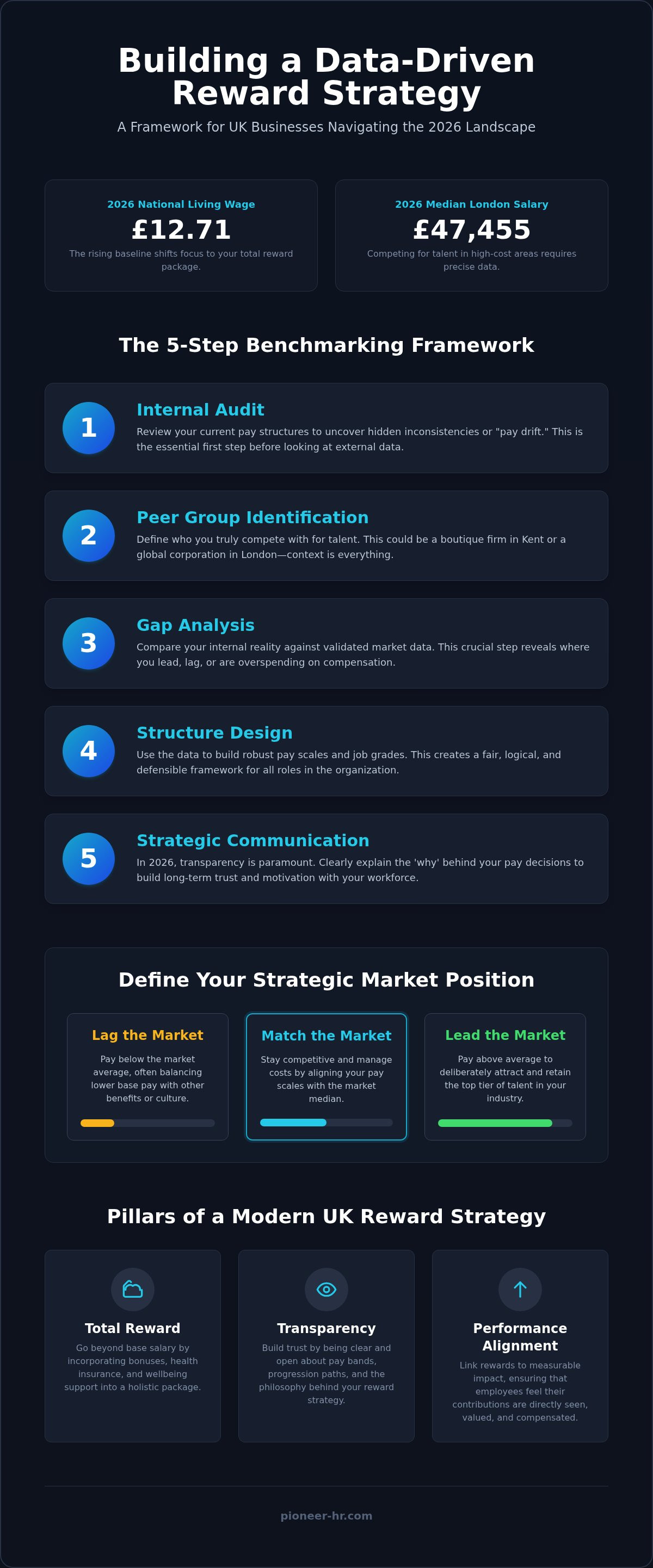
A modern reward strategy in 2026 isn't just about the figure on a payslip. It's a holistic package designed to support your people. With the National Living Wage at £12.71 as of April 2026, the baseline has shifted. This makes the layers above base pay even more critical for retention. We focus on three key pillars:
Total Reward: Incorporating bonuses, private medical insurance, and wellbeing support.
Transparency: Building trust by being clear about pay bands and progression.
Performance Alignment: Linking rewards to measurable impact so employees feel their contribution is valued.
When these elements work together, you create a culture where employees feel secure, respected, and motivated to help the business succeed.
A Step-by-Step Framework for Building a Data-Driven Reward Strategy
We've found that many businesses treat benchmarking as a static, one-off report. It's actually a dynamic tool. When we partner with clients on using salary benchmarking for reward strategy, we follow a logical path that ensures the results are both fair and sustainable. It's not just about what the person next door pays; it's about building a structure that reflects your unique value proposition. We typically break this down into five essential stages.
Step 1: Internal Audit. We start by looking at what you're actually paying right now. This reveals hidden inconsistencies or "pay drift" that might be causing friction within your teams.
Step 2: Peer Group Identification. You need to know who you're really competing with. This might be a boutique firm in Kent or a global giant in London. We help you define a peer group that matches your industry and scale.
Step 3: Gap Analysis. This is the "moment of truth" where we compare your internal reality against the market standards to see where you're falling behind or overspending.
Step 4: Structure Design. Using the data, we help you build robust pay scales. This often involves job grading to ensure every role has a clear place in the hierarchy.
Step 5: Strategic Communication. In 2026, transparency is everything. We help you explain the "why" behind your pay decisions to build long-term trust with your workforce.
Gathering and Validating Market Data
Choosing the right data source is critical. While internal surveys provide a pulse check, they often lack the breadth of external consultancy data. For an authoritative perspective on how large-scale organisations approach this, the UK Government pay benchmarking report offers a great example of aligning complex roles with private sector standards. If you're dealing with niche roles where data feels scarce, we combine multiple high-quality sources to find a reliable middle ground. You can learn more about this in our guide to salary benchmarking uk.
Bridging the Gap: Implementation Tactics
The hardest part of any reward project is the rollout. If the data shows an employee is paid below the market rate, we recommend a phased approach to bring them up to speed without shocking your budget. Conversely, handling "red-circled" employees who are paid above the benchmark requires a delicate touch. Rather than cutting pay, we often suggest freezing base increases while focusing on non-financial rewards or performance-based bonuses. A realistic timeline is your best friend here; trying to fix everything in one month is rarely successful. If you're feeling overwhelmed by these moving parts, our bespoke benchmarking services can provide the clarity you need to move forward with confidence.
Beyond the Numbers: Addressing Pay Equity and Transparency
We've found that the most successful organisations in 2026 view pay equity as a core brand value rather than a compliance hurdle. It's a shield against reputational damage. When we talk about using salary benchmarking for reward strategy, we aren't just looking at the bottom line. We're looking at how your business treats its people. In regions like Kent and Sussex, where professional networks are closely knit, a reputation for unfair pay spreads quickly. Conversely, a "Fair Pay" narrative becomes a powerful recruitment tool that differentiates you from competitors who still hide behind "competitive salary" labels.
The UK Government's 2026 consultation on mandatory salary information in job adverts, which remains open until 27 October 2026, signals the end of pay secrecy. Proactively using benchmarking data allows you to identify and close gender or ethnicity pay gaps before they become legal liabilities. A clear, data-backed strategy significantly reduces the risk of costly employment tribunals. It gives your leadership team the confidence to stand by their decisions, knowing every pound spent is justified by objective market evidence.
The Legal and Ethical Case for Transparency
The shift toward transparency is driven by both legislation and candidate expectations. The influence of the EU Pay Transparency Directive is being felt across the UK, even for firms without a continental presence. Transparency improves applicant quality because high-calibre talent won't waste time on roles with mystery pay scales. We suggest having open conversations about pay during regular reviews. When your team understands that their compensation is tied to a professional reward strategy, trust grows. Retention follows naturally when employees don't feel they have to leave just to find out what they're worth.
Job Grading as a Foundation for Equity
You can't have pay equity without a consistent way to measure role value. This is why job grading is the essential first step in any benchmarking project. It's easy to get distracted by job titles. An "Operations Lead" in one department might carry the same weight as a "Senior Manager" in another. We help you assess roles based on their actual impact and requirements. This objective approach ensures internal consistency across your entire organisation. It prevents "pay drift" where certain departments or individuals negotiate higher rates simply because they're more vocal, rather than because their role demands it.
Aligning Market Data with Your Business Objectives and Culture
We believe that market data shouldn't dictate your culture; it should support it. Deciding your market position is a pivotal moment for any leadership team. We often see businesses struggle to choose between leading, lagging, or matching the market. If you're a high-growth firm in London, leading the market might be essential to secure top-tier specialists. Conversely, a stable business in Hove might find that matching the market while offering superior work-life balance is a more sustainable path. This is the essence of using salary benchmarking for reward strategy. It's about making a conscious choice rather than reacting to every resignation letter.
Your reward framework should also reflect your internal culture and values. If you pride yourself on innovation, your rewards should incentivise high performance and professional development. We also need to consider demographic shifts. A Gen Z employee might value mental health days and flexible hours over a slightly higher pension contribution, whereas a Boomer nearing retirement might have the opposite priority. Customising these rewards ensures your spend has the maximum possible impact on every member of your team.
Designing a Total Reward Package
Base salary is only one part of the story. A modern reward strategy incorporates non-monetary benefits that resonate with your specific workforce. In London and Hove, the demand for flexible working has fundamentally changed salary expectations. We've seen candidates accept a lower base pay in exchange for genuine flexibility. Benchmarking helps us put a value on these "hidden" benefits, such as Employee Assistance Programmes (EAPs) or extra leave. This ensures your total package remains competitive without overstretching your base payroll.
Scaling Your Strategy for Growth
Scaling a business requires moving away from ad-hoc, reactive pay rises toward a formalised review cycle. This transition provides the financial predictability you need for long-term planning. We help you build pay structures that have room for growth, so you don't have to reinvent the wheel every time you hire a new manager. Many of our clients find that a Fractional Chief People Officer is the most effective way to manage this evolution. They provide the strategic foresight of a seasoned HR leader on a part-time basis, which is ideal for SMEs looking to professionalise their reward systems.
If you want to ensure your pay structures are ready for the next stage of your business journey, our Fractional CPO leadership can guide you through the process.
Optimising Your Reward Strategy with Pioneer HR’s Expertise
At Pioneer HR, we don't believe in handing over a spreadsheet and walking away. We understand that using salary benchmarking for reward strategy is a continuous journey that requires both precision and empathy. Our team, led by SJ with over 30 years of HR leadership experience, specialises in helping UK SMEs navigate these complexities. We provide a true end-to-end service. This starts with a deep-dive audit of your current pay structures and moves through to the practical implementation of a robust framework. It's a strategic partnership designed to build a sustainable future for your organisation.
Our local roots in the South East give us a unique advantage. We understand the specific pressures of the Kent, Hove, and Sussex markets. Businesses in these areas often feel the gravitational pull of London's high salaries while trying to maintain their own unique culture. We help you use regional data to create a package that competes effectively without compromising your financial stability. This local insight ensures your benchmarks are realistic and relevant to the talent you actually want to hire.
Our Strategic Benchmarking Process
We provide access to verified, high-quality UK market data sets that go far beyond what you'll find in generic online tools. Our pay benchmarking reports are entirely bespoke. We tailor every report to your specific industry, headcount, and growth stage. SJ and the team provide the expert analysis needed to turn these numbers into actionable insights. This ensures your reward decisions are always backed by evidence, giving you the confidence to discuss pay with your board and your employees. It's about moving from guesswork to a professional reward consultancy approach.
Retained Support for Long-Term Success
A reward strategy isn't something you set and forget. Inflation, legislative shifts, and market trends mean your pay scales need regular monitoring. This is where our HR retainer model provides the most value. It allows us to act as your long-term strategic advisor, keeping your strategy aligned with the market as it evolves. We monitor shifts in real-time, ensuring you aren't caught off guard by sudden wage spikes. For many businesses, combining this with a Fractional Chief People Officer provides the senior leadership needed to maintain a high-impact reward culture. If you're ready to professionalise your approach, contact us today for a strategic reward audit.
Building a Future-Proof Reward Framework
Managing the complexities of the 2026 UK labour market requires more than a passing glance at competitors' job adverts. We've explored how moving from raw data to a structured framework ensures your pay scales are fair, transparent, and aligned with your unique organisational culture. Whether you're based in the heart of London or a growing hub in Kent, your reward strategy should be a reflection of your values and a magnet for the talent you need.
Effectively using salary benchmarking for reward strategy isn't a one-time project; it's a commitment to your people's long-term success and your business's stability. With our 30 years of HR expertise, we help UK SMEs bridge the gap between market reality and internal goals through bespoke benchmarking and Fractional CPO leadership. We're here to help you turn compensation from a source of friction into a strategic advantage.
Ready to professionalise your approach and secure your best talent? Book a Strategic Reward Strategy Consultation with Pioneer HR today. We look forward to partnering with you on this journey.
Frequently Asked Questions
How often should a UK business perform salary benchmarking?
We recommend that UK businesses conduct a full review at least once a year. In fast moving sectors or locations like London where talent competition is fierce, a biannual pulse check might be necessary. Aligning this process with your annual budgeting cycle ensures you have the financial headroom to make adjustments. Regular updates prevent your pay scales from falling behind, which is vital for maintaining a fair and competitive workplace.
Is salary benchmarking worth it for a company with fewer than 50 employees?
It's often more critical for smaller firms. When you have fewer than 50 employees, the loss of even one key specialist can be devastating. Small businesses in Kent or Sussex often compete with larger London firms for the same talent. Using salary benchmarking for reward strategy helps you identify where you can't match on base pay but can lead on flexible benefits or a supportive company culture.
What is the difference between salary benchmarking and a pay review?
Benchmarking is the external analysis of market rates, whereas a pay review is your internal process for awarding increases. Think of benchmarking as the evidence gathering stage that informs your final decisions. A pay review looks at individual performance and tenure, but it should always be grounded in the market data you've collected. This ensures your internal raises don't drift too far from external reality and remain sustainable.
Can I use free online salary data for my reward strategy?
While free tools offer a quick snapshot, they often lack the depth required for strategic decisions. They rarely account for specific industry nuances, company scale, or the London weighting that affects regions like Hove. Relying on unverified data can lead to expensive hiring mistakes or internal pay gaps. We use high quality, professional data sets to ensure your reward framework is built on a solid and defensible foundation.
How do I handle employees who are already paid above the market rate?
This is a common challenge known as red circling. We don't suggest cutting an employee's salary, as this damages morale and trust. Instead, you might choose to freeze their base pay increases until the market catches up. During this period, focus on non financial rewards or performance linked bonuses. This approach keeps your fixed costs under control while still showing the employee that you value their ongoing contribution to the team.
What should be included in a total reward statement?
A total reward statement should go far beyond base salary to show the full value of your package. Include employer pension contributions, private medical insurance, and any performance related bonuses. Don't forget to highlight soft benefits like flexible working arrangements, wellbeing support, and professional development opportunities. By presenting the complete picture, you help employees understand the true scale of your investment in their career and their overall wellbeing.
How does the London weighting affect salary benchmarking in Kent or Hove?
The proximity to London creates a competitive halo effect for businesses in the South East. We've seen many firms in Kent or Hove lose talent to the City simply because they didn't account for this weighting. You don't always have to match London salaries pound for pound, but you must be aware of them. Your strategy might involve offering a slightly lower base pay paired with a significantly better lifestyle.
What are the risks of having a reward strategy that isn’t backed by data?
The primary risks include high staff turnover and potential legal issues related to pay inequality. Without data, your pay decisions can feel arbitrary, which quickly erodes employee trust. You also risk overpaying for roles that aren't critical to your growth while underpaying the specialists who drive your success. Using salary benchmarking for reward strategy ensures every pound you spend is working toward your long term business objectives.


Comments