
London Salary Guide 2026: The Strategic SME Guide to Benchmarking and Pay
Updated: Jul 17
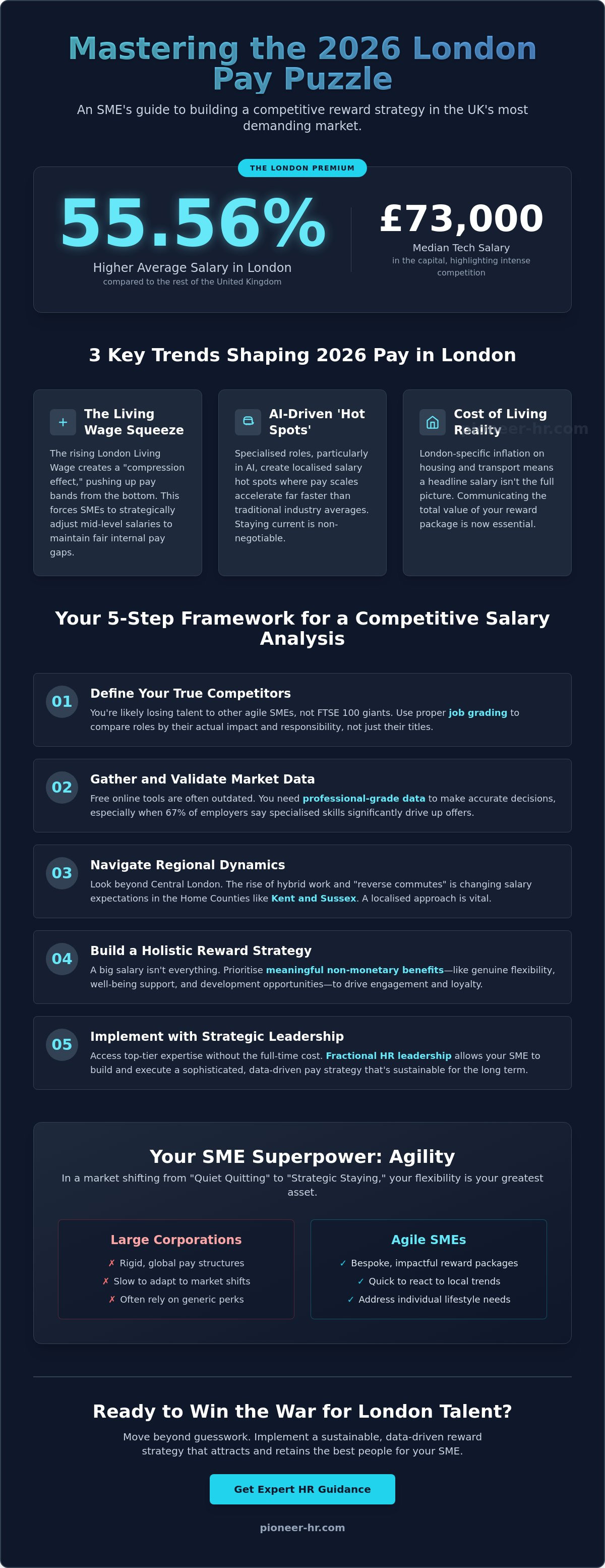
Did you know that the London salary premium has climbed to a staggering 55.56% compared to the rest of the UK? For many SMEs in the capital and surrounding areas like Kent, this figure highlights the growing pressure to keep pace with rising expectations. We understand how difficult it feels to balance a sustainable budget while trying to conduct a competitive salary analysis london that actually keeps your best people from joining larger competitors.
It's a challenge we've seen many leadership teams face, especially when reliable, localized data feels out of reach. In this guide, we'll help you master the 2026 pay landscape by providing a clear framework for setting fair, transparent salaries. You'll learn how to navigate the London Premium and discover actionable strategies for using non-monetary rewards to build a culture where talent wants to stay for the long term.
Table of Contents
The 2026 London Salary Landscape: Trends Every SME Must Know
The London pay gap isn't just widening; it's evolving into a complex, multi-tiered system. As of June 2026, the salary premium in the capital has reached a significant 55.56% compared to the rest of the UK. This isn't just a dry statistic for a boardroom report. It's a daily reality for SMEs trying to secure talent in a city where the median tech salary has climbed to £73,000. To remain a preferred employer, you need a deep understanding of London's economic landscape to ensure your offers are both realistic and impactful.
Inflation and the Cost of Living in the Capital
London-specific inflation, particularly regarding housing and transport, means a £50,000 salary in 2026 doesn't buy the same quality of life it did even two years ago. This is why we encourage our partners to move beyond the "headline figure" during interviews. You've got to communicate the total value of your package. Whether it's subsidised travel or flexible hours that reduce childcare costs, these elements are vital when competing with big-city firms. Transparency is no longer optional. Londoners are discussing pay more openly than ever, and a clear, honest explanation of how you calculate reward builds the trust that keeps people from looking elsewhere.
Why 2026 is a Turning Point for SME Compensation
The era of the blanket pay rise is effectively over. We're seeing a decisive move toward highly specific, performance-linked and skill-based pay models. SMEs are uniquely positioned to win here because, unlike large corporations hamstrung by rigid global grading structures, they possess the agility to design bespoke reward strategy packages that address the specific lifestyle needs of their London-based teams.
Accessing high-level expertise through a Fractional Chief People Officer allows smaller firms to implement these sophisticated structures without the overhead of a full-time executive. This strategic approach helps you manage overheads while ensuring your team feels valued. In 2026, the market priority has shifted from "quiet quitting" to "strategic staying." Professionals want stability, but they also want to know their specific expertise is being recognised in their monthly pay packet.
How to Benchmark Salaries in London: A Strategic Framework
Relying on "average" pay figures is one of the most common mistakes we see London SMEs make. If you simply target the middle of the road, you risk losing your most talented people to firms that understand the nuances of the 2026 market. A successful competitive salary analysis london requires a more surgical approach. It isn't just about what others are paying; it's about what your specific peers are paying for the exact same level of responsibility and impact. While UK average earnings indicators provide a useful macro-perspective, they don't capture the micro-shifts happening in hubs like Shoreditch, Canary Wharf, or even the growing business districts in Kent.
Step 1: Defining Your True Competitors
We often find that SMEs aren't actually losing talent to FTSE 100 giants. Instead, they're losing people to other SMEs that offer more flexibility or a more compelling mission. When you benchmark, you must compare like-for-like. A "Marketing Manager" in a five-person startup has a completely different remit than one in a multi-national corporation. This is why robust job grading is essential. It allows us to strip away confusing titles and look at the actual weight of the role, ensuring your benchmarking data is truly relevant to your business size and sector.
Step 2: Gathering and Validating 2026 Market Data
Free online salary checkers are a starting point, but they're often based on unverified, self-reported data that can be months out of date. In a fast-moving market where 67% of employers say specialized skills significantly drive up offers, you need precision. Professional-grade data helps you spot outliers that could otherwise skew your entire 2026 budget. Our team's 30 years of industry experience proves vital here because interpreting London pay data requires a seasoned eye to distinguish between a temporary market spike and a long-term structural shift in expectations.
Once you have the data, the challenge is balancing external competitiveness with internal equity. It's no use hiring a new specialist at a 2026 "market rate" if it creates a sense of unfairness among your existing team. We believe in building pay structures that are transparent and defensible. If you're finding it difficult to strike this balance, our salary benchmarking services can provide the objective, data-led clarity you need to make confident decisions. By following a structured five-step review process-from role definition to final adjustment-you ensure that your reward strategy supports both your budget and your culture.
London vs. The Home Counties: Navigating Kent and Sussex Pay
The relationship between London and the Home Counties has shifted dramatically. In 2026, the "commuter discount" isn't as straightforward as it once was. While it's often still more cost-effective to hire in Kent or Sussex compared to Central London, the gap is closing because of hybrid work. Many professionals now expect a salary that reflects their proximity to the capital's opportunities, even if they're only heading into the office twice a week. We've seen London firms successfully open satellite offices in towns like Sevenoaks or Ashford to manage overheads. However, this move requires a nuanced competitive salary analysis london to ensure local pay remains attractive without spiralling out of control.
The Kent and Sussex Talent War
Businesses in Brighton and Hove are facing a unique "reverse commute" challenge. Professionals are increasingly living in London for the lifestyle but seeking roles in coastal Sussex for a better work-life balance. This means local firms are now competing directly with London-level expectations. According to the Office for National Statistics Earnings Data, regional pay variations are becoming more fluid. We recommend that Sussex and Kent employers lean into "Quality of Life" factors, such as reduced travel time or local community engagement, to offset base salaries that might sit slightly below the London median. This approach should be part of a wider salary benchmarking UK strategy that looks at the total value proposition rather than just the monthly pay packet.
Hybrid Work and Geographic Pay Scales
The biggest debate in 2026 revolves around geographic pay scales. Should you pay based on your office location or where your employee actually lives? For London SMEs, the consensus has moved toward a tiered London Weighting system. Fully remote staff might not receive the full capital premium, but they often expect an allowance that covers the occasional, high-cost travel into the city. It's about fairness. If you're conducting a competitive salary analysis london, you must account for these hidden costs. A fair policy doesn't just look at the bank balance; it considers the employee's total expenditure and time. We've found that companies which are transparent about how they calculate these geographic adjustments tend to have much higher retention rates.
Building a 2026 Reward Strategy: More Than Just a Paycheck
In 2026, matching a corporate giant pound-for-pound is often an impossible task for a growing SME. But here's the reality: you don't always have to. While our previous sections focused on the technical side of a competitive salary analysis london, this is where we look at the "what else" that keeps people loyal. A robust reward strategy is your secret weapon. It allows you to compete on value rather than just volume. By focusing on "Total Reward"-the sum of everything an employee receives-you can build a proposition that feels more substantial than a simple monthly bank deposit.
Benefits That Retain London Talent
The London job market has moved past surface-level perks. Free fruit and office games are relics of a different era. Today's talent prioritises stability and autonomy. Flexible working is no longer a perk; it's a default expectation for almost any role that can be done from a laptop. We're also seeing a significant rise in demand for health, wellbeing, and financial coaching. Living in the capital brings unique stresses, and employees value partners who proactively address these pressures. Consider these three pillars for your 2026 strategy:
Autonomy: True flexible working that respects personal time and reduces the cost of the London commute.
Security: Private healthcare and meaningful financial coaching to address capital-specific cost-of-living pressures.
Growth: Clear pathways for management training and upskilling, showing a long-term commitment to their career.
Communicating Value to Your Team
Even the most generous benefits package fails if your team doesn't understand its true worth. This is where Total Reward Statements become essential. These documents break down the full cost of employment, including pension contributions, insurance, training budgets, and the value of extra holiday days. It turns a "salary" into a "comprehensive package." Transparency is the other half of the equation. People want to know how their pay rises are calculated. When you're open about your benchmarking process, it removes the mystery and the resentment that often drives talent toward your competitors.
A fair pay structure is the foundation of employee engagement. It provides the security people need to focus on their work rather than their bank balance. If you're ready to move beyond generic perks and build a structure that truly reflects your company's values, we can help. Our team specialises in designing a bespoke reward strategy that aligns with your specific growth goals while keeping your London-based team motivated and loyal.
Navigating 2026 with Strategic HR Leadership
The Fractional CPO Advantage
A Fractional Chief People Officer offers a vital bridge between high-level strategic thinking and the practical realities of running a growing firm. It's a cost-effective way for London SMEs to access board-level HR expertise without the commitment of a full-time executive salary. We work with you to link your salary benchmarking directly to your business goals. Whether you're expanding a creative team in Soho or building an operational hub in Kent, your pay strategy needs to reflect those specific milestones. This strategic leader doesn't just look at what you pay; they look at how your entire people operation supports your bottom line.
Securing Your 2026 Talent Pipeline
Peace of mind comes from knowing your foundations are solid. A retained HR support model ensures you're never caught off guard by shifts in the market or the law. As we move through 2026, staying ahead of legislative changes affecting UK payroll and benefits is essential for maintaining trust with your team. Generic guides can't tell you how a new regulation will impact your specific bonus structure or pension contributions. We believe the most effective salary guide isn't a PDF you download from a website. It's the one we build together, tailored to your business, your sector, and your specific location.
The next step for many leadership teams is a comprehensive HR audit. This process identifies pay gaps, compliance risks, and opportunities to improve your reward structure before they become problems. It's about moving from a reactive stance to a proactive one. By securing expert guidance now, you ensure that your 2026 talent pipeline remains strong, stable, and fully aligned with your vision for the future.
Future-Proof Your London Talent Strategy
Mastering the 2026 landscape requires moving beyond generic data and embracing a more nuanced approach to reward. We've seen that the most successful SMEs in London and the South East are those that combine a rigorous competitive salary analysis london with a holistic view of employee value. By integrating flexible working, professional development, and transparent pay structures, you create a culture that doesn't just attract talent but keeps it for the long term.
With over 30 years of HR and reward experience, we specialise in helping growing firms navigate these specific regional challenges. From providing Fractional CPO expertise to conducting detailed job grading, our goal is to ensure your people strategy supports your business growth. It's about building a foundation of trust and stability that allows your team to thrive even as the capital's market continues to evolve.
Ready to gain a clearer perspective on your current pay structures? Get a professional, tailored salary benchmarking report for your business and start making data-led decisions with confidence. We look forward to supporting your journey toward a more sustainable and rewarding workplace.
Frequently Asked Questions
What is the average salary increase expected in London for 2026?
Salaries in London are projected to see an average increase of approximately 5% in 2026, mirroring the trends observed in specialized sectors over the past year. This growth is largely driven by the need to offset capital-specific inflation and the rising cost of living. We recommend reviewing your budgets early to ensure these adjustments don't compromise your operational stability or long-term growth plans.
How much is the London weighting allowance in 2026?
While there isn't a single statutory figure, the London weighting allowance in 2026 typically ranges between £4,500 and £7,500 for private sector roles. This premium accounts for the 55.56% salary gap between the capital and the rest of the UK. The exact amount often depends on whether your office is based in Inner or Outer London and the specific commuting costs your team faces.
Should I pay my remote employees based on London or regional rates?
We generally recommend a tiered approach where remote employees receive a base rate linked to their local market, supplemented by a smaller allowance if they are expected to travel to the capital. Paying a full Central London rate to someone living in a significantly lower-cost area can create internal equity issues. It's better to focus on a package that reflects their actual cost of living while recognizing their value to your firm.
What are the most in-demand skills in London for 2026?
Specialized skills in AI implementation, revenue operations, and business continuity are the most sought-after in the 2026 market. We've seen that 67% of employers are now willing to offer higher salaries for candidates with these niche capabilities. If you're conducting a competitive salary analysis london, ensure you're looking at these specific skill premiums rather than just general job titles to get an accurate market view.
How often should a London SME benchmark its salaries?
Most London SMEs should conduct a full benchmarking exercise at least once a year to stay aligned with the capital's fast-moving market. In high-growth sectors like tech or financial services, a bi-annual pulse check is often more appropriate. Regular reviews help you spot emerging trends before they lead to talent loss, ensuring your pay scales remain defensible, fair, and attractive to new hires.
Is it better to offer a higher salary or better benefits in the current market?
While 76% of professionals might return to the office for a higher salary, a balanced Total Reward package is often more sustainable for growing SMEs. High headline salaries are important, but they don't replace the long-term value of flexibility and professional development. We've found that candidates increasingly scrutinize the whole package, including pension contributions and workload sustainability, rather than just the basic pay figure.
What is a fair pay structure for a growing London-based startup?
A fair structure for a startup is built on transparent job grading and performance-linked progression. You don't need to match corporate giants on day one; instead, focus on creating a clear roadmap that shows how pay increases as the business scales. This transparency builds the trust necessary for a high-performance culture, ensuring every team member understands the value of their contribution and their future path.
How can I compete with corporate salaries in London as a small business?
You can compete by offering the agility and bespoke rewards that large corporations often lack. Focus on your Employee Value Proposition by highlighting your unique culture, direct impact on business goals, and genuine flexible working. Smaller firms win by being more human-centric, providing a level of personal growth and professional intimacy that a FTSE 100 firm simply cannot replicate for its employees.



Comments