
Improving Company Culture in London: A 2026 Strategic Guide for SMEs
- Pioneer HR
- May 4
- 13 min read
Updated: May 8
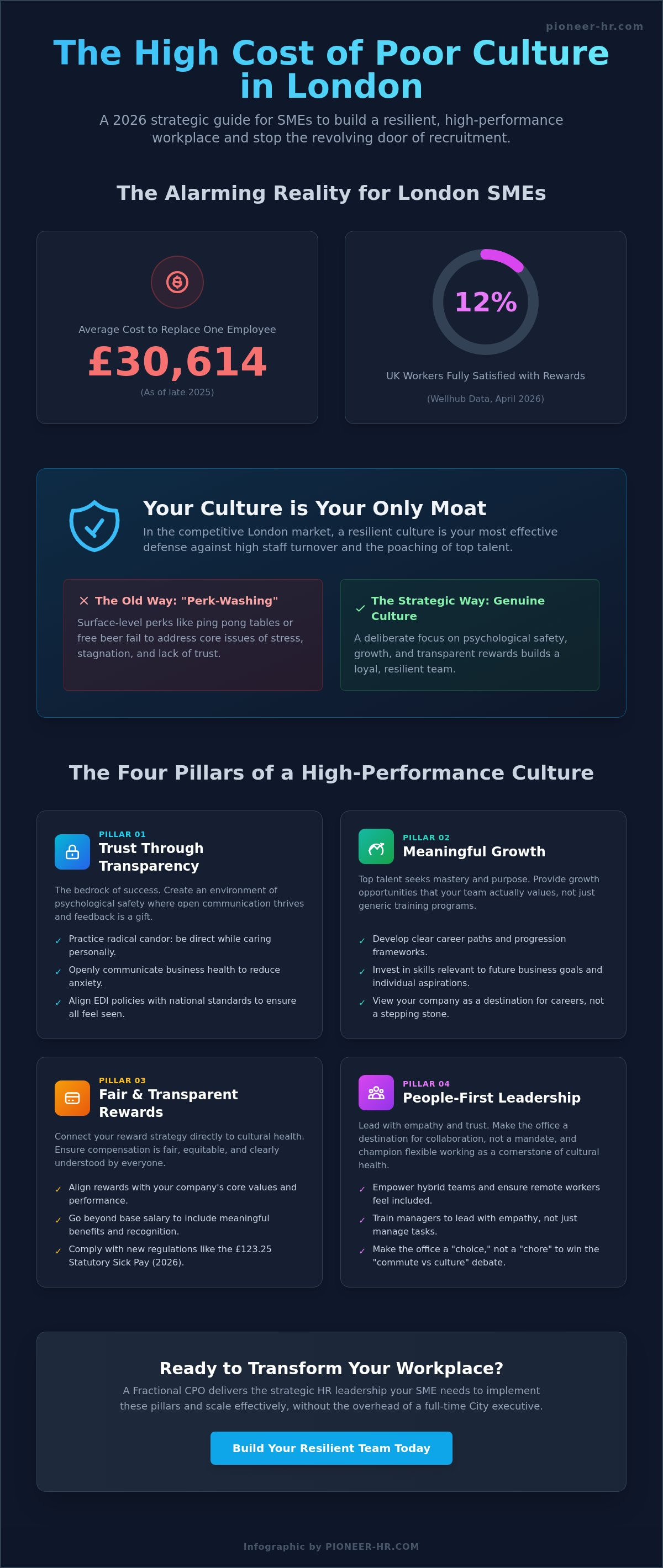
What if the secret to stopping the revolving door of recruitment isn't a higher salary, but a smarter strategy? With the average cost to replace an employee in the UK reaching £30,614 as of late 2025, SMEs across the capital are feeling the pressure. You've probably noticed that traditional perks aren't enough anymore, especially when only 12% of UK workers feel fully satisfied with their current rewards according to Wellhub data from April 2026. We understand the frustration of losing top talent to big-name competitors in the City or seeing engagement dip in your hybrid teams. Improving company culture in london has become a necessity for survival rather than a luxury.
We've designed this guide to help you transform your workplace into a high-performing environment where people actually want to stay. You'll discover how to leverage the 2026 Employment Rights Act changes, including the updated £123.25 Statutory Sick Pay rates, to build trust from day one. We'll walk you through a strategic framework that combines fair reward systems with the kind of "people-first" leadership that defines the top London employers. By the end, you'll have a clear roadmap to reduce recruitment costs and build a loyal, resilient team that views your company as a destination, not a stepping stone.
Key Takeaways
Understand why a resilient workplace culture is your most effective defense against the competitive "London Premium" and high staff turnover.
Learn why improving company culture in London requires a strategic alignment between transparent reward systems and genuine employee trust.
Discover the four essential pillars of high performance, ranging from psychological safety to the growth opportunities your team actually values.
Get a practical roadmap for auditing your current culture and redefining core values through collaboration rather than top-down mandates.
See how a Fractional CPO can deliver the strategic HR leadership your SME needs to scale without the overhead of a full-time City executive.
Table of Contents The 2026 London Market: Why Workplace Culture is Your Only Moat The Four Pillars of a High-Performance London Culture Connecting Reward Strategy to Cultural Health Practical Steps to Audit and Evolve Your Workplace Culture How a Fractional CPO Can Transform Your London Business
The 2026 London Market: Why Workplace Culture is Your Only Moat
In 2026, the London business environment is defined by a paradox. While the City remains a global magnet for talent, the high cost of living has shifted the power balance. With a single person needing up to £4,323 monthly to thrive in the capital, employees are no longer willing to tolerate mediocre environments. For SMEs, improving company culture in london isn't just about making people smile; it's about building a strategic moat that protects your team from being poached by larger firms with deeper pockets. We define culture as the shared values and behaviours that survive the Southeastern train ride or the Central Line squeeze. It's the invisible thread that keeps a team together when they aren't sitting in the same room.
A solid foundation begins with understanding organizational culture as a lived experience rather than a mission statement on a wall. In the current market, employees expect what we call a "London Premium." This isn't just about a higher salary to cover Zone 1 rents, which averaged £2,300 for a one-bed flat in early 2026; it's an expectation of high-calibre leadership and psychological safety. "Perk-washing", the 2022-era habit of offering free beer or ping pong tables, no longer works for sophisticated talent. If the fundamental work environment is stressful or stagnant, no amount of artisanal coffee will stop a developer from moving to a competitor. In fact, Wellhub data from April 2026 shows that only 12% of UK workers are fully satisfied with traditional rewards, proving that culture must go deeper than surface-level treats.
The High Cost of Poor Culture in the Capital
With the average cost to replace an employee reaching £30,614 as of late 2025, a toxic culture is a direct hit to your bottom line. In London’s hyper-connected Tech and Finance hubs, a single negative Glassdoor review can dry up your candidate pipeline for months. We see many SMEs struggling with "Quiet Quitting," where staff do the bare minimum because they don't feel a sense of belonging. This lack of engagement is often a side effect of poor communication during the hybrid transition, leading to a fragmented workforce that feels more like a collection of freelancers than a cohesive team. When culture fails, recruitment fees skyrocket as you struggle to fill the same roles repeatedly.
The "Commute vs. Culture" Debate
For a team member commuting from Kent or Surrey, the office must be a destination worth the journey. In 2026, a mandate to be at a desk for the sake of it is a major cultural red flag. Instead, successful London businesses use their physical space for high-impact collaboration and social connection. This may involve investing in the tactile quality of the environment; for example, a communal kitchen featuring bespoke design from Nispero Kitchens can turn a standard breakroom into a focal point for team interaction. Flexible working is no longer a "benefit"; it's a cornerstone of cultural health. By balancing the needs of commuters with a strong central identity, we help companies ensure that the person working from a home office in Guildford feels just as valued as the one in a Shoreditch studio. Making the office a "choice" rather than a "chore" is the ultimate sign of a mature, trust-based culture.
The Four Pillars of a High-Performance London Culture
Building a resilient workplace doesn't happen by accident. It's the result of deliberate choices that align your business goals with the lived experience of your team. When we talk about improving company culture in london, we focus on four structural pillars that turn a group of individuals into a high-performing collective. These pillars address the unique pressures of the capital, from the high cost of living to the intense competition for niche skills. It's about creating an environment where the "London Premium" we discussed earlier is felt through support and growth, not just a paycheck.
Building Trust Through Transparency
Psychological safety is the bedrock of any successful London SME. In a city where economic shifts happen fast, open communication about business health reduces the "commuter anxiety" that often plagues hybrid teams. We've seen that radical candour helps teams move faster; it's about being direct while showing you care personally. This transparency must extend to your EDI efforts. Aligning your internal policies with the UK government's diversity and inclusion strategy ensures that your diverse London workforce feels seen and respected. It's not enough to have a feedback loop; your team needs to see that their input actually results in tangible changes to how the business operates.
Growth Beyond the Promotion
London talent is notoriously savvy about their career trajectories. They often value skill acquisition and mentorship over traditional job titles that might mean little outside your specific office. As highlighted by faculty at London Business School, meaningful progress is a primary driver of retention. We recommend creating "horizontal" growth paths where staff can master new technologies or leadership techniques. This is particularly vital in 2026, as UK salary increase budgets have stabilised at 3.6% according to recent industry benchmarks. Since you can't always win on pay alone, your culture must win on professional development. You might consider how a bespoke reward strategy can recognise these developmental milestones, ensuring your team feels their growth is being tracked and celebrated.
The remaining pillars focus on strategic reward and leadership consistency. Moving beyond the annual bonus is essential; recognition should be frequent and tied to your core values. Finally, leadership must be a unified front. Whether it's the CEO in a Mayfair boardroom or a first-time manager leading a Zoom call from Kent, the cultural experience should be identical. Consistency breeds security, and security is what keeps your best people from answering that next recruiter's call on LinkedIn. If you're unsure where your current leadership stands, it might be time to audit your internal communication channels for consistency.
Connecting Reward Strategy to Cultural Health
While we previously discussed the structural pillars of a healthy workplace, the most visible test of your culture is your reward strategy. You cannot expect high engagement if your team perceives their pay as arbitrary or unfair. In 2026, the gap between the London Living Wage and actual market rates for skilled roles has become a flashpoint for employee trust. This alignment is a core principle of The Taylor Review of Modern Working Practices, which argues that fairness and decency are the foundations of "good work". If your compensation doesn't respect the economic reality of the capital, even the most visionary leadership will struggle to gain traction.
We believe that improving company culture in london requires a move away from "pay secrecy" towards a model of radical transparency. When employees understand how their pay is calculated, the anxiety often associated with the high cost of living in the South East begins to dissipate. Your reward system should act as a physical manifestation of your company values; if you claim to value "collaboration," your bonus structures shouldn't incentivise internal competition. Instead, they should reward the collective behaviours that drive your business forward.
The Role of Salary Benchmarking in Fairness
Using objective data to set pay levels is the most effective way to remove emotion and bias from the compensation conversation. By implementing salary benchmarking, you show your team that their earnings are based on market reality rather than who is best at negotiating. This transparency is becoming the gold standard for London SMEs. It allows managers to have honest conversations about career progression and pay increases without the cloud of perceived favouritism. When people understand the "why" behind their salary, they can focus on their work rather than scouring LinkedIn for a better offer.
Non-Monetary Rewards That Matter in London
Since only 12% of UK employees feel fully satisfied with their benefits as of April 2026, there's a massive opportunity to differentiate your culture through non-monetary perks. We've found that Londoners are increasingly prioritising preventative health and wellbeing over traditional office snacks. According to Wellhub data, specific benefits are now highly valued by the workforce:
Fitness support and gym access, valued by 57% of employees.
Access to health information and screenings, prioritised by 54%.
Stress management programs, which 51% of workers now consider essential.
Tailoring these rewards to a multi-generational workforce is vital. While Gen Z staff might lean towards mental health support, your team members commuting from Kent might place a higher value on "time-back" initiatives or enhanced family leave. For teams that include professional counsellors or therapeutic specialists, you can learn more about specialized business coaching and accredited CPD training to support their professional growth. By offering personalised benefits through digital platforms, you ensure your reward strategy feels relevant to every individual, regardless of their life stage or location. This level of care is what transforms a standard employment contract into a long-term cultural commitment.
Practical Steps to Audit and Evolve Your Workplace Culture
Transforming your environment requires more than just a new set of posters in the Shoreditch office. It's a structured process that moves from deep listening to decisive action. When we partner with SMEs on improving company culture in london, we treat it as a diagnostic exercise first. You can't fix what you haven't accurately measured. This evolution is particularly urgent in 2026, as the new Fair Work Agency begins enforcing stricter standards on holiday pay and sick leave. Your culture must not only be inspiring but also legally robust and ethically consistent.
Auditing Your Current Cultural State
The first step is identifying the "unwritten rules" that govern your team's behaviour. These are the habits that form when no one is watching. Are people actually taking their lunch breaks, or are they eating at their desks to signal "busyness"? We recommend using employee engagement surveys to uncover these hidden pain points. However, data from surveys only tells half the story. You should also scrutinise your exit interview data. If 40% of your leavers mention a "lack of flexibility" as their reason for heading to a competitor, your culture has a structural flaw that no Friday social can fix. Analyzing these recurring themes allows us to build a roadmap based on reality rather than assumptions.
Once the audit is complete, you must define your core values through collaborative workshops. A top-down mandate from the board rarely sticks. Instead, involve your staff in Kent, Surrey, and central London to define what "excellence" or "collaboration" looks like in their specific roles. Following this, align your HR policies with your desired culture. For instance, if you value trust, consider implementing trust-based leave or "work from anywhere" weeks. With the 2026 Employment Rights Act now providing day-one rights for paternity and unpaid parental leave, your policies should reflect a culture that supports the whole person, not just the worker.
Empowering Managers as Culture Champions
Culture is won or lost at the mid-management level. Your managers are the ones who translate your vision into daily reality, especially in hybrid settings where face-to-face time is limited. We've found that management training is the single best investment for cultural change. Leaders need coaching on how to lead by example; they shouldn't be sending emails at 11 PM if the company claims to value work-life balance. By setting cultural KPIs for your leadership team, you make cultural health as important as financial performance. If you're ready to start this diagnostic journey, our strategic HR retainer services provide the ongoing expertise needed to audit and evolve your workplace effectively.
Finally, remember that culture is a living organism. It requires constant measurement and iteration. What worked for your team of 10 in a Soho basement won't necessarily work for a team of 50 spread across the South East. Regularly revisit your audit findings and be prepared to pivot your strategy as the London market continues to shift.
How a Fractional CPO Can Transform Your London Business
The SME dilemma in the capital is often a financial one. You know that improving company culture in london is the key to scaling, but your budget might not yet stretch to a full-time Chief People Officer salary, which frequently exceeds £120,000 in the City. This creates a strategic gap where founders end up handling complex HR issues themselves, often at the expense of business growth. A Fractional Chief People Officer provides the high-level strategy you need without the permanent overhead. With typical monthly retainers for these roles in the UK ranging between £5,000 and £13,000 as of April 2026, it's a pragmatic way to access decades of expertise on a flexible basis.
We see many businesses move from a "revolving door" turnover rate to "Best Place to Work" status by simply professionalising their approach to people. When you consider that the average cost to replace a single employee reached £30,614 in late 2025, the return on investment for a strategic hire becomes clear. A fractional leader doesn't just manage the present; they build the cultural infrastructure that secures your future.
Strategic HR vs. Basic Compliance
An office manager or a junior HR assistant is excellent for processing payroll and ensuring basic compliance, but they shouldn't be expected to fix a systemic culture issue. Navigating London’s complex talent wars requires a different set of tools. It takes a seasoned professional with 30+ years of experience to understand how to align a diverse workforce spread across Kent, Surrey, and central London. Strategic culture building involves deep data analysis, salary benchmarking, and leadership coaching. We bridge the gap between your commercial goals and your people strategy, ensuring that every hire you make is an investment in your long-term vision rather than just a temporary fix.
Starting Your Cultural Transformation
A culture turnaround doesn't happen overnight, but the first 90 days are a critical window for building momentum. We begin by dismantling the "quiet quitting" mindset that often takes root in hybrid teams. This involves a transparent audit of your current state followed by a clear, actionable roadmap for change. To get buy-in from a sceptical London workforce, you need a leader who speaks the language of the business while demonstrating genuine empathy. We've found that when staff see tangible changes to their working environment and reward structures, their engagement levels rise significantly. If you're ready to stop the drain of talent and start building a resilient team, booking a discovery call for a Fractional CPO consultation is the most effective next step. We'll help you diagnose the hidden pain points in your organisation and design a culture that acts as your ultimate competitive advantage.
Securing Your Competitive Edge in the London Market
The 2026 London market doesn't leave room for cultural complacency. We've explored how a robust culture acts as a shield against the £30,614 average cost of turnover and why transparent reward systems are non-negotiable for today's savvy workforce. From implementing the latest 2026 statutory rates to aligning your leadership across Kent and the City, every step you take towards improving company culture in london is an investment in your business's longevity. It's about turning your workplace into a destination where talent chooses to stay because they feel seen, valued, and challenged.
You don't have to navigate these complexities alone. At Pioneer HR, we bring 30+ years of HR leadership experience and a proven track record in reward strategy specifically for growing London SMEs. We understand the unique pressures of the South East and have the expertise to help you build a workplace that people don't want to leave. It's time to move beyond survival and start building a high-performance team that feels truly valued. Book a Strategic Culture Consultation with Pioneer HR today and let's transform your people strategy into your greatest strength. We're ready to help you build a future that lasts.
Frequently Asked Questions
How long does it take to see improvements in company culture?
Initial shifts in team sentiment typically appear within 90 days of implementing new communication habits or reward structures. However, achieving deep, structural change usually takes between 12 and 18 months of consistent leadership. We focus on "quick wins" in the first quarter, such as transparent town halls, to build the momentum required for long term cultural stability across your London and Kent offices.
Can we improve culture if most of our team works remotely in Kent and London?
Yes, because culture is defined by shared behaviours and values rather than physical proximity. For teams split between the City and the South East, we recommend focusing on asynchronous communication and making office days a "destination" for collaboration. It's about ensuring a developer in Guildford feels as connected to the mission as a manager in a Shoreditch studio through deliberate digital interaction.
What is the most effective way to measure company culture in an SME?
The most reliable method is combining an Employee Net Promoter Score (eNPS) with qualitative "stay interviews." While surveys provide the data, 1-on-1 conversations reveal the "why" behind the numbers. Tracking your staff turnover rate is also vital; since the average UK replacement cost reached £30,614 in late 2025, a declining turnover rate is a clear sign that improving company culture in london is working.
Is company culture really more important than salary for London employees?
Culture becomes the primary driver of retention only after a "fair" salary floor is established. With central London rents averaging £2,400 in early 2026, your pay must be competitive to meet basic needs. However, Wellhub's April 2026 data shows that only 12% of UK workers are satisfied with rewards alone. Once pay is fair, culture is what prevents your best people from being poached by larger competitors.
How do we fix a toxic culture that has existed for years?
Fixing a deep-seated issue requires a radical audit and the courage to remove "brilliant jerks" who undermine your values. You must identify the unwritten rules that allowed toxicity to flourish in the first place. This process often starts with a leadership reset and a new set of core values defined through workshops with the entire team, ensuring everyone feels ownership of the new direction.
What is the difference between an HR consultant and a Chief People Officer?
An HR consultant typically handles specific, time-bound projects like updating contracts or implementing a new payroll system. A Chief People Officer (CPO) owns the holistic people strategy and aligns it with your 3-year business goals. A Fractional CPO acts as a long-term strategic partner to the CEO, focusing on high-level culture building and talent development rather than just administrative compliance.
How much should a London SME budget for culture-building initiatives?
We generally recommend that SMEs allocate between 1% and 3% of their total payroll budget to cultural and engagement initiatives. This budget should cover more than just social events; it includes management coaching, mental health support, and regular salary benchmarking. In the competitive UK market, underinvesting in these areas usually leads to significantly higher recruitment and agency fees later on.
Does improving company culture actually impact profitability?
High-culture organisations frequently see a 20% to 30% increase in overall productivity and significantly higher profit margins. By improving company culture in london, you directly reduce the "recruitment tax" caused by constant turnover. When your team is engaged and feels psychologically safe, they innovate faster and provide a higher level of service to your clients, which protects your bottom line in any economy.


Comments