
How to Choose the Best Salary Benchmarking Provider in the UK (2026)
Updated: Mar 7

Losing a valued team member or a promising candidate to a competitor over salary is a frustration many UK businesses know all too well. This uncertainty not only impacts your ability to attract top talent but can also lead to internal pay equity issues and the constant worry of falling behind the market. Relying on generic, free online data often creates more questions than answers, leaving you unsure if your compensation strategy is a competitive advantage or a hidden liability.
Making informed, strategic decisions about compensation is no longer a luxury-it's essential for sustainable growth. The challenge, however, lies in navigating a crowded market to find the best salary benchmarking provider for your specific needs. In this comprehensive 2026 guide, we provide a clear framework specifically for UK SMEs. We will walk you through the essential criteria for evaluating providers, helping you move from guesswork to data-driven confidence. Our goal is to empower you to build a fair, transparent, and competitive pay structure that retains your key people and attracts the talent you need to thrive.
Key Takeaways
Move beyond generic online calculators by understanding why UK-specific context-including industry, company size, and region-is essential for competitive pay decisions.
Evaluate whether an automated SaaS platform or a strategic HR consultancy is the right fit for your SME by weighing the distinct advantages of each model.
Selecting the best salary benchmarking provider for your business involves asking targeted questions about their data sources, relevance, and methodology.
Transform your compensation approach from a reactive cost into a strategic tool for attracting and retaining top talent in the competitive UK market.
Table of Contents Beyond the Numbers: Why Raw Salary Data Isn't Enough for UK SMEs Choosing Your Approach: Data Tools vs. Consultancy Partners The UK SME's Checklist: How to Evaluate a Benchmarking Provider 10 Critical Questions to Ask a Potential Provider Why Pioneer HR is the Strategic Partner for UK SMEs
Beyond the Numbers: Why Raw Salary Data Isn't Enough for UK SMEs
In today's competitive talent market, determining the right salary for a role can feel like a high-stakes guessing game. While the internet is awash with free salary checkers, relying on this raw, unverified data is a significant risk for any UK SME. A figure on a screen lacks the critical context needed for strategic decision-making. Without understanding the nuances of industry, company size, and regional pay disparities, you risk not only losing top candidates but also demotivating your existing team.
The Problem with Free Salary Checkers
Free online tools often draw from self-reported, outdated, or unverified sources, providing a distorted view of the market. They typically fail to account for the complete picture of compensation and benefits, ignoring crucial elements like bonuses, pension contributions, or equity. Furthermore, their generic job titles rarely match the hybrid, multi-faceted roles common in agile SMEs, making direct comparisons unreliable and potentially misleading.
UK-Specific Challenges in Compensation
The UK presents a uniquely complex compensation landscape. Navigating the significant regional pay disparities-such as the premium for talent in London and the South East compared to Scotland or the North-requires granular data. Moreover, staying compliant with regulations like Gender Pay Gap Reporting demands a robust and defensible pay structure. For SMEs, the challenge is amplified when competing for talent against larger corporations with deeper pockets.
This competitive landscape is further complicated by the rise of remote work, which allows talent to consider opportunities globally. For businesses to stay competitive, it's helpful to understand this perspective, as employees now use resources like Where Can I Live to explore international relocation and lifestyle changes.
Getting compensation wrong has profound consequences, leading to high staff turnover, poor morale, and even potential legal challenges. This is why finding the best salary benchmarking provider is not just an HR task, but a strategic business imperative. Accurate benchmarking is the cornerstone of a competitive and sustainable reward strategy, empowering you to build fair, transparent, and motivating pay structures that attract and retain the talent needed to drive your business forward.
Choosing Your Approach: Data Tools vs. Consultancy Partners
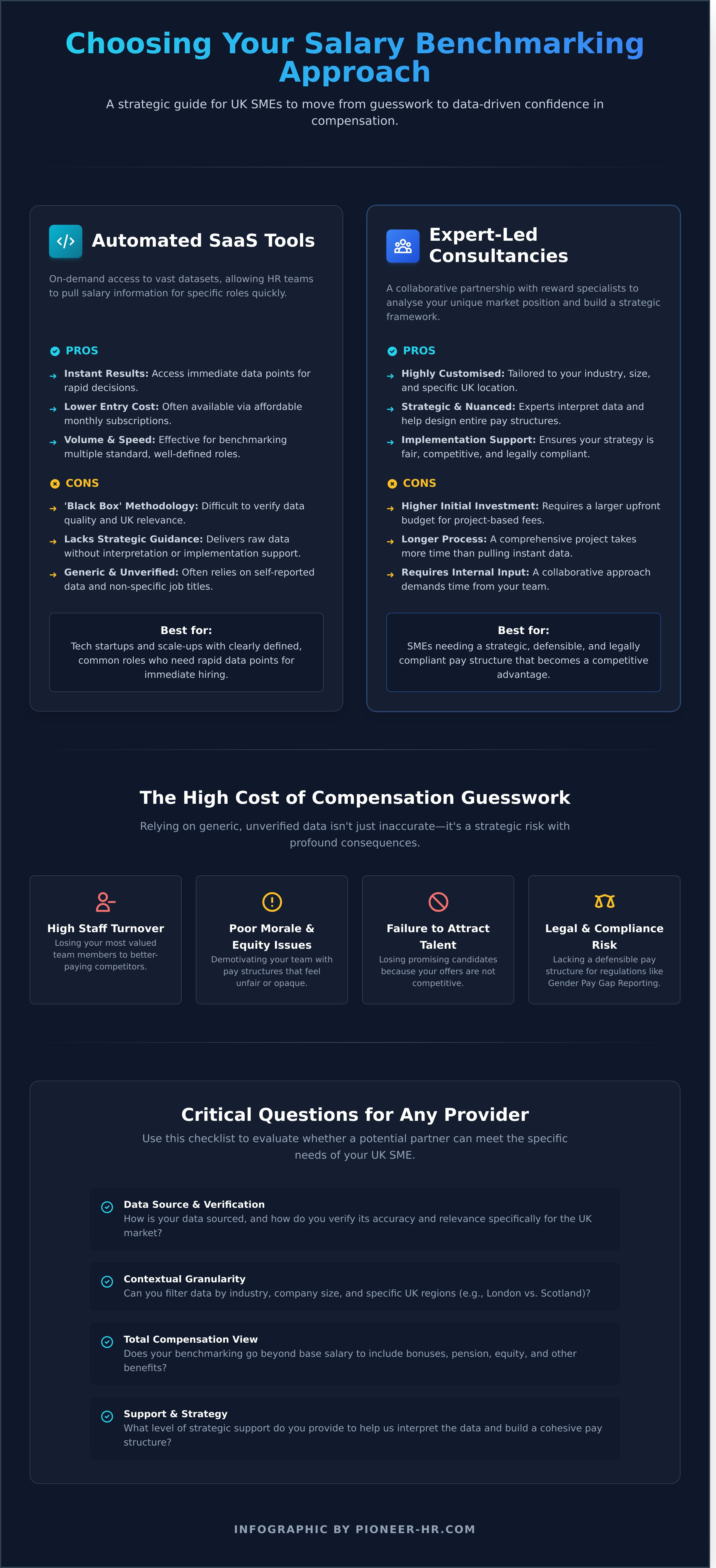
Once you've established the need for accurate salary data, the next critical step is to decide on the delivery model. The journey to finding the best salary benchmarking provider in the UK typically leads down one of two paths: leveraging an automated Software-as-a-Service (SaaS) platform or engaging an expert-led HR consultancy. This choice is not merely about preference; it's a strategic decision that directly impacts the depth, relevance, and application of the insights you receive. Each approach offers distinct advantages tailored to different business needs, sizes, and long-term objectives.
Automated Salary Benchmarking Tools (SaaS)
SaaS platforms offer on-demand access to vast datasets, allowing HR teams to pull salary information for specific roles quickly. They are engineered for speed and volume, making them an attractive option for businesses that need immediate data points without a comprehensive strategic overhaul.
Pros: These tools provide instant results at a lower entry cost, often with monthly subscriptions starting from a few hundred pounds. They are particularly effective for benchmarking standard, well-defined roles, especially within the tech sector where data is abundant.
Cons: The methodology can be a 'black box', making it difficult to verify the data's quality or its specific relevance to the UK market. Crucially, these platforms deliver raw data without the strategic guidance needed to interpret it or build a cohesive pay structure around it.
Best for: Tech startups and scale-ups with clearly defined, common roles who need rapid data points to inform immediate hiring decisions.
Expert-Led Benchmarking Consultancies
A consultancy partner moves beyond simply providing numbers. This approach involves a collaborative project with seasoned HR and reward specialists who analyse your unique position in the market. This is where the true value of strategic Benchmarking Compensation comes into play, transforming raw data into a competitive and equitable reward framework.
This expert-led model is essential not just in corporate settings but also in highly specialized recruitment fields, such as placing elite private household staff. For those curious about how a premier international agency operates in this niche, you can learn more about Superstar Nannies.
Pros: The process is highly customised to your industry, company size, and specific UK location. Experts provide nuanced interpretation, help design entire pay structures, and offer implementation support, ensuring your compensation strategy is fair, competitive, and legally compliant.
Cons: This bespoke service requires a higher initial investment, with projects often costing several thousand pounds, and follows a more deliberate, project-based timeline rather than offering instant results.
Best for: Small to medium-sized enterprises (SMEs) and established companies needing to build a robust, fair, and scalable reward framework that supports long-term growth and talent retention. Understanding this distinction is key to selecting the best salary benchmarking provider for your unique circumstances.
The UK SME's Checklist: How to Evaluate a Benchmarking Provider
Selecting a salary benchmarking partner is a significant strategic decision that extends far beyond a simple data purchase. For UK SMEs, the right provider offers a competitive edge in attracting and retaining top talent. Finding the best salary benchmarking provider for your unique needs requires a methodical evaluation. We recommend using this checklist to assess potential partners on the criteria that truly matter: data integrity, strategic depth, and genuine support.
Criterion 1: Data Quality and Relevance
The foundation of any valuable benchmarking exercise is the data itself. Generic, outdated, or irrelevant data can lead to costly missteps in your compensation strategy. Before committing, it's crucial to ask targeted questions about the provider's data sources and methodology.
Data Provenance: Where does the data come from? Is it compiled from robust, employer-submitted surveys or scraped from less reliable sources like job adverts? Ensure the data is recent-ideally updated quarterly-to reflect the fast-moving UK market.
UK Specificity: Does the dataset have sufficient granularity for your needs? A provider should be able to differentiate between roles in London, Manchester, and Edinburgh, as well as for remote positions.
Business Context: How effectively can they filter the data to match your company's profile? Ask if they can benchmark against companies of a similar size, industry, and-for start-ups-funding stage. This level of detail is essential for a true like-for-like comparison.
Criterion 2: Scope of Service and Strategic Input
A spreadsheet of salary figures is information, but it isn't insight. The real value lies in the interpretation and application of that data. The goal is to move from raw numbers to a coherent and defensible compensation framework that supports your business objectives. A key differentiator for the best salary benchmarking provider is their ability to act as a strategic partner.
Consider whether the service includes an interpretive report with clear recommendations or simply a data dump. A premier partner should help you build a robust compensation philosophy. For instance, do they offer expert support with job grading and levelling to create clear career pathways and ensure internal equity? A solid understanding of these principles is vital, and the CIPD guide to pay structures provides an excellent foundation. Finally, ask if they can help you develop a communication plan to transparently explain pay decisions to your team, which is fundamental for building trust and morale.
10 Critical Questions to Ask a Potential Provider
Selecting a salary benchmarking partner is a significant strategic decision. To find the right fit, you must look beyond the sales pitch and assess the core of their service: their data, their methodology, and their ability to understand your business. Arming yourself with specific, insightful questions is the most effective way to vet potential suppliers and ensure they can deliver the value you need.
A transparent and confident provider will welcome this scrutiny as the foundation of a strong partnership. Use the following questions during your evaluation process to make a truly informed choice.
Questions About Their Data and Methodology
The quality of any benchmarking project hinges on the quality of the underlying data. These questions help you probe the robustness and relevance of their information.
1. What are your primary data sources for the UK market?Look for a provider that uses a multi-layered approach, combining employer-reported data, robust third-party surveys, and proprietary data sets. Over-reliance on a single source, like job postings, can be misleading.
2. How frequently is your data updated?In a fast-moving market, stale data is dangerous. A reliable provider should be refreshing their data sets at least quarterly to reflect current market conditions accurately.
3. How do you match our unique roles against your dataset?A simple title match is not enough. A credible partner will use a structured job evaluation methodology, considering factors like seniority, scope of responsibility, and required skills to ensure a true like-for-like comparison.
4. Can you show us an anonymised sample report?This is non-negotiable. The sample will reveal the clarity, depth, and actionability of their final deliverable. Does it present data in a way your leadership team can easily understand and act upon?
Questions About Their Service and Your Business
Data alone is not a strategy. The best salary benchmarking provider will act as a partner, helping you interpret the results and apply them to your specific context.
5. What experience do you have in our industry/sector?Every industry has its own compensation nuances. Whether you are in tech, finance, or manufacturing, your provider should demonstrate a clear understanding of your specific talent landscape.
6. Who will be our main point of contact?You are investing in expertise, not just a platform. Clarify if you will have direct access to an experienced consultant who can provide guidance, or if you will be directed to a generic support desk.
7. How do you help us move from data to a concrete action plan?The ultimate goal is to build a competitive compensation strategy. Ask how they support this transition, whether through workshops, executive summaries, or implementation guidance.
8. What is the typical cost and timeline for a UK SME of our size?Request a clear, itemised quote in British Pounds (£) to understand the full investment. This helps you compare providers effectively and ensures there are no hidden costs.
At Pioneer HR, we believe these conversations are essential. They form the basis of a successful partnership built on clarity and trust. If you're ready to have this discussion, our specialists are here to help.
Why Pioneer HR is the Strategic Partner for UK SMEs
Throughout this guide, we have explored the critical factors in choosing a salary benchmarking service-from data accuracy to strategic application. For UK SMEs, selecting the right partner is not just about accessing data; it's about gaining a competitive advantage. This is where Pioneer HR moves beyond being a simple provider to become your dedicated strategic partner.
With over 30 years of specialised experience in the UK market, we understand the unique challenges and opportunities that small and medium-sized businesses face. Our approach is built on a foundation of deep market knowledge and a commitment to long-term success. We don't just deliver a report; we work alongside you to build a sustainable and compelling reward strategy that attracts, retains, and motivates top talent.
A Tailored Approach, Not a One-Size-Fits-All Report
Generic, off-the-shelf data reports often fail to capture the nuances of your business. We believe the best salary benchmarking provider invests time to understand your specific context. We start by learning about your company culture, strategic goals, and organisational structure. Our analysis is then meticulously tailored to your roles, ensuring the insights are relevant and impactful. The result is a clear, actionable plan to help you become an employer of choice.
Beyond the Benchmark: Comprehensive Reward Support
Accurate data is the starting point, not the final destination. Our expert salary benchmarking service provides the robust foundation needed to make informed decisions. But our support extends far beyond the initial analysis. We help you integrate the findings into your wider HR framework, assisting with:
Developing fair and consistent job grading systems.
Building transparent and equitable pay structures.
Designing motivating bonus and incentive schemes.
For businesses seeking ongoing strategic guidance, we offer flexible retained support and senior-level expertise through our Fractional CPO services. With Pioneer HR, you work directly with seasoned experts, not an impersonal dashboard, ensuring your reward strategy evolves and thrives with your business. Discover how a strategic partnership with Pioneer HR can transform your approach to compensation.
Your Strategic Partner in Compensation Excellence
Choosing the right support for your company's pay structure in 2026 is a critical strategic decision. As we have explored, the goal is not merely to acquire raw salary data, but to gain actionable insights tailored to the UK’s dynamic SME landscape. The best salary benchmarking provider is one that acts as a true partner, interpreting the numbers to give your business a clear and sustainable competitive advantage.
At Pioneer HR, this is the foundation of our approach. With over 30 years of dedicated HR experience, we specialise in empowering UK SMEs. We don't just hand you a report; we provide the strategic advice necessary to build a compensation framework that attracts and retains the talent you need to thrive. Our service is built on a deep understanding of your market, ensuring your decisions are both data-driven and commercially astute.
Ready to build a compensation framework with confidence and clarity? Get a quote for our expert salary benchmarking service today. Let us help you turn your remuneration strategy into a powerful tool for growth.
Frequently Asked Questions About Salary Benchmarking
How much does salary benchmarking cost for a UK SME?
The cost for a UK-based SME can range from approximately £500 for a basic report on a few roles to over £5,000 for a comprehensive, bespoke project. Key factors influencing the price include the number of positions being benchmarked, the required level of data granularity, and the provider's methodology. We believe investing in a tailored analysis provides a far greater return by ensuring your compensation strategy is both competitive and sustainable, directly impacting talent retention.
How long does a typical salary benchmarking project take?
The timeline for a salary benchmarking project depends entirely on its scope. Accessing a pre-existing salary survey report might take just a few business days. However, a more in-depth, customised project that involves detailed job matching and analysis typically requires between two to four weeks from the initial consultation to the final report delivery. This considered pace ensures the data is precisely matched to your unique organisational structure, guaranteeing accuracy for your strategic decisions.
Is salary benchmarking legal in the UK?
Yes, salary benchmarking is perfectly legal in the UK when conducted correctly. Professional providers operate strictly within UK competition law and GDPR guidelines. The critical principle is the use of aggregated and anonymised data from multiple, independent sources. This prevents any anti-competitive behaviour, such as wage-fixing, and ensures the process is both insightful and fully compliant, protecting your business from legal risk while upholding the highest ethical standards.
What's the difference between market pricing and salary benchmarking?
While often used interchangeably, these terms have distinct meanings in HR. Salary benchmarking is the broad, strategic process of comparing your company's entire compensation philosophy and structure against the external market. Market pricing is a more tactical component of this process; it is the specific action of assigning a competitive market value or 'price' to an individual job role based on the benchmark data. Benchmarking defines the strategy, while market pricing executes it for each position.
How often should my business benchmark salaries?
As a strategic best practice, we recommend that businesses conduct a full salary benchmark review annually. This ensures your pay structures remain competitive and aligned with current market trends. However, for organisations in fast-moving sectors like technology or during periods of high inflation, a more frequent bi-annual review may be more prudent. Proactive and regular benchmarking is a key tool for retaining top talent and preventing salary compression issues before they arise.
Can salary benchmarking help with pay transparency and fairness?
Absolutely. Salary benchmarking is a foundational element for building a fair and transparent pay framework. By grounding compensation decisions in objective, external market data, you can create consistent and defensible salary bands, removing subjectivity and unconscious bias from the process. This empowers you to have open, evidence-based conversations with employees about their remuneration, which is essential for building trust and preparing for emerging pay transparency legislation.
What are the most reliable sources for UK salary data?
The most reliable UK salary data comes from specialist compensation survey providers who gather information directly from employers. Reputable recruitment consultancies with dedicated data teams also hold valuable, up-to-date insights. While the Office for National Statistics (ONS) offers useful macroeconomic trends, its data is often too general for specific roles. The best salary benchmarking provider will synthesise data from multiple robust sources to deliver a nuanced and accurate picture, avoiding the inconsistencies of free online aggregators.


Comments