
Actioning Employee Survey Feedback: A Guide for UK Business Leaders
- Pioneer HR
- May 6
- 12 min read
Did you know that poor engagement is currently costing the UK economy an estimated £257 billion a year in lost productivity? With only 10% of the UK workforce feeling fully engaged as of May 2026, many leaders from London to Kent find themselves buried under mountains of data without a clear path forward. We know that actioning employee survey feedback often feels like opening a Pandora’s box of expectations you might not have the time or budget to meet.
It's completely normal to feel overwhelmed by hundreds of open-ended comments or to fear that asking for opinions will only highlight problems you can't fix immediately. However, with the average UK attrition rate hitting 19% in 2025, the risk of doing nothing is far greater than the risk of starting the conversation. We've designed this guide to help you move past the "Survey Silence" trap and turn your data into a strategic action plan that actually boosts retention.
By following our "Listen-Validate-Prioritise" framework, you'll learn how to identify high-impact changes that align with the Employment Rights Act 2025 without draining your schedule. We'll show you exactly how to build a reputation as a listening employer; ensuring your team feels valued, heard, and motivated to stay for the long term.
Key Takeaways
Understand why "listening without acting" creates a trust gap and how to avoid the 'Survey Silence' trap that often leads to higher attrition in UK SMEs.
Get a clear roadmap for actioning employee survey feedback by categorising raw data into strategic insights and manageable "quick wins."
Learn to use the 'Impact vs. Effort' matrix to prioritise changes, including how to address pay concerns using professional salary benchmarking.
Discover the most effective ways to communicate your action plan to teams in London and beyond, ensuring every employee feels their voice has triggered a tangible result.
Shift from annual snapshots to a permanent culture of engagement by integrating continuous listening into your long-term organisational development.
Table of Contents The 'Survey Silence' Trap: Why Actioning Feedback Matters in the UK Analysing the Data: From Spreadsheets to Strategic Insights The Prioritisation Framework: Impact vs. Effort Building and Communicating Your UK Action Plan Strategic HR: Making Feedback Actioning Permanent
The 'Survey Silence' Trap: Why Actioning Feedback Matters in the UK
We've all been there. You launch a comprehensive survey, the results trickle in, and then... silence. In the UK business world, we call this the 'Survey Silence' trap. It's a dangerous place to be. When you ask your team for their honest opinions but fail to follow up with visible change, you aren't just missing an opportunity; you're actively damaging trust. Research from 2025 shows that the average UK attrition rate hit 19%, and a staggering 79% of employees who left their roles cited a lack of appreciation as a primary reason. If you don't prioritise actioning employee survey feedback, you're essentially telling your staff that their voices don't carry weight.
Listening without acting is actually more damaging than not surveying at all. It creates a "listening gap" that breeds cynicism. For businesses across London and the South East, where the talent market is exceptionally competitive, this gap is a luxury you can't afford. We see a direct 'Feedback ROI' when leaders move beyond data collection. This return on investment manifests as lower recruitment costs, higher productivity, and a team that feels psychologically invested in the company's success. Employee surveys are a foundational tool, but their value is only realised when they trigger a tangible response.
Understanding the UK 'Stiff Upper Lip' in Surveys
In a UK cultural context, we often deal with the 'stiff upper lip' or a tendency toward being 'polite' rather than blunt. This means your data might look better than reality. A high participation rate, perhaps over 70%, doesn't always signal high engagement; sometimes, it just means your team is compliant. To find the real issues in Kent or Sussex teams, you must look at the delta between anonymous and attributed feedback. Building psychological safety is the only way to move past surface-level comments. If your people don't believe their honesty is safe, they'll give you the answers they think you want to hear, rather than the ones you need to know.
Avoiding the 'Box-Ticking' Exercise
Running a survey simply because it's an annual HR requirement is a recipe for disengagement. Staff can sense a 'box-ticking' exercise from a mile away. Before you even launch, you must have a clear commitment to a budget and a timeline for change. It's better to ask three questions you can actually act on than thirty questions that will sit in a drawer. Setting expectations early is vital. Tell your staff exactly when they'll hear the results and how you'll involve them in the solution. Meaningful action is defined as a measurable, documented shift in company policy or culture that directly addresses a specific piece of employee feedback. For many SMEs, bringing in a Fractional Chief People Officer can provide the strategic oversight needed to ensure these changes aren't just promised, but delivered.
Analysing the Data: From Spreadsheets to Strategic Insights
Once the survey closes, you're often left with a spreadsheet that feels more like a puzzle than a strategy. For a UK SME, the goal isn't just to look at the numbers; it's about finding the narrative hidden within the responses. Start by cleaning your data to ensure accuracy. Remove any duplicate entries and categorise results by department or location. This is particularly important if you have split teams, such as a creative hub in London and operations in Kent, as their daily experiences will differ wildly. This structured approach ensures that actioning employee survey feedback becomes a logical process rather than a reactive guessing game.
During this initial phase, keep a sharp eye out for 'Red Flags' that require immediate attention. With UK sickness absence reaching an average of 9.4 days in 2024, any mentions of burnout, extreme stress, or bullying are urgent. These aren't trends to be discussed in next month's board meeting; they are operational risks that need addressing now. To clean your data effectively, we suggest following these steps:
Verify Participation: Ensure the sample size is large enough to be representative of your specific UK office or department.
Categorise by Theme: Group comments into buckets like 'Communication', 'Workplace Environment', or 'Management Support'.
Identify Urgency: Separate 'hygiene factors' (like office temperature) from 'motivators' (like career progression).
Actioning employee survey feedback effectively begins with this granular view, allowing you to see where the real pressure points lie before you commit your budget to changes.
Quantitative vs. Qualitative: Finding the 'Why'
Numerical scores give you the 'what', but the comments give you the 'why'. A high score in 'Job Satisfaction' might mask a low score in 'Work-Life Balance'. We recommend a thematic analysis of open-ended comments from your London-based staff to find the sentiment behind the statistics. This process of translating feedback into actionable insights helps you distinguish between a one-off complaint and a systemic issue. If you notice an 'outlier' comment that's particularly negative, don't ignore it. It might be the first sign of a localised management issue that hasn't yet hit the main statistics.
Benchmarking Against the UK Market
Comparing your Sussex-based engineering firm to a global tech giant in Silicon Valley won't give you useful data. To make sense of your results, you must benchmark against UK industry standards for 2026. For example, if 36% of your staff feel underpaid, check this against local salary benchmarking uk data. It might be that your rates are actually competitive, but your communication around total reward is lacking. Using industry-specific UK data ensures you aren't chasing 'perfect' scores that don't exist in your sector. If you find the data analysis phase daunting, our Fractional Chief People Officer service can help you turn these spreadsheets into a high-level strategic roadmap.
The Prioritisation Framework: Impact vs. Effort
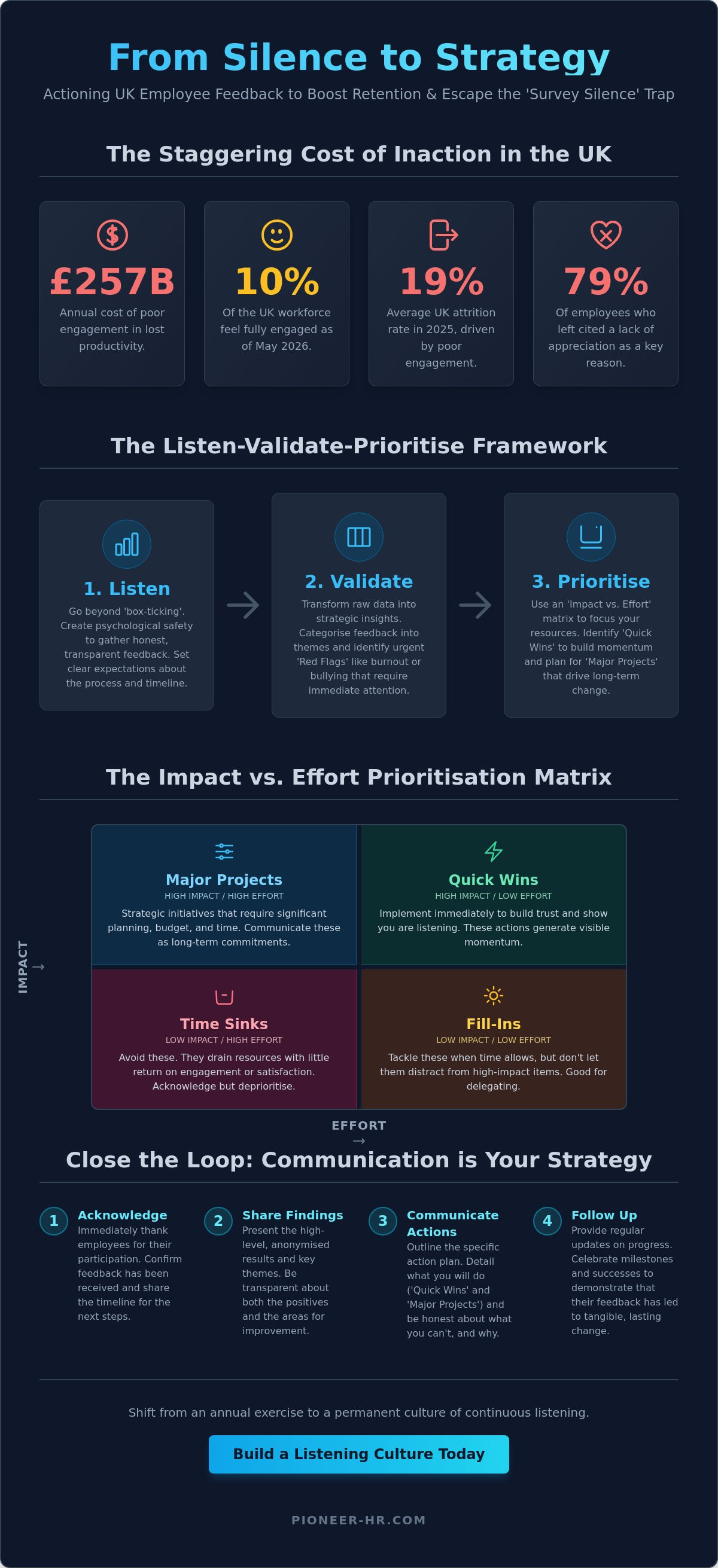
Once you've decoded your data, the real challenge begins. You can't fix every issue at once, and trying to do so often leads to "initiative fatigue." We recommend using a 'Quick Win vs. Strategic Shift' matrix to guide you in actioning employee survey feedback without overstretching your leadership team. This simple four-quadrant tool allows you to plot feedback based on the effort required to implement a change versus the impact it will have on your culture. In a busy Kent office, for example, adjusting the meeting culture to include 'no-meeting Fridays' costs exactly £0 but can drastically improve daily productivity and morale.
Handling 'The Impossible Ask' is where many UK leaders stumble. If your team requests a wholesale move to a four-day week or a 20% pay rise that the business simply can't sustain, don't ignore the request. Transparency is your best tool here. Explain the 'why' behind the 'no'. When you're honest about commercial constraints, you maintain the psychological contract even when you can't deliver on every wish list item. It's about showing that the feedback was considered, even if it couldn't be implemented immediately.
The Reward Connection: Addressing Pay and Benefits
Pay is frequently the loudest point of feedback. In 2025, 36% of UK workers stated they felt underpaid, making it a primary driver for job hunting. Before you react, use this data to refine your reward consultancy approach. If feedback suggests your pay benchmarking is out of sync with the London market, a professional audit is necessary. However, if your rates are fair, the issue might be a lack of appreciation. Since 79% of employees cite a lack of recognition as a reason for leaving, non-monetary rewards can often close engagement gaps more effectively than a small percentage increase.
Quick Wins: Building Momentum in the First 30 Days
Building momentum in the first 30 days is crucial to prevent 'survey cynicism'. If staff in your Sussex branch suggest smaller changes, like improved coffee facilities or flexible start times to avoid the morning commute, implement these fast. These visible changes prove you've actually listened. We call this the 'You Said, We Did' approach. By actioning employee survey feedback through small, immediate wins, you buy the trust and time needed to tackle larger, more complex organisational shifts over the following six months. This rapid response helps build your reputation as a listening employer in the local market.
Building and Communicating Your UK Action Plan
Once you've mapped out your priorities using the matrix we discussed, it's time to put pen to paper. A formal action plan needs three core elements to succeed: a clear owner, a firm deadline, and a measurable KPI. Without these, the momentum you built in the first 30 days will evaporate. When we partner with clients on actioning employee survey feedback, we often suggest assigning 'Action Champions' from various departments. This ensures the plan doesn't just feel like something 'HR is doing to us'; it becomes a collaborative effort that lives within the teams themselves.
To truly involve your team, move beyond the survey data by hosting departmental focus groups. These smaller, facilitated sessions allow you to dig into the 'why' behind the scores and co-create solutions with the people they affect most. It's one thing for a leadership team in a London boardroom to decide on a new policy, but it's quite another to have your Kent-based operations team help design the rollout. We recommend a six-month review cycle to ensure these initiatives don't stall after the initial excitement fades. Regular check-ins keep the accountability high and the progress visible.
Transparent Communication Strategies
Choosing the right medium for your message is just as important as the message itself. While a detailed email is useful for documentation, a Town Hall meeting, whether in-person or virtual, is far more effective for building empathy. You must tailor the delivery to your workforce's reality. Your London commuters might prefer a recorded session they can listen to on the train, while Kent-based remote workers will appreciate a dedicated live Q&A slot to feel truly included. Don't be afraid to share the 'bad' news or low scores. Radical transparency is the best trust-builder in HR. By acknowledging where the business has fallen short, you create a baseline for improvement that employees will actually respect.
Setting Measurable KPIs for 2026
In 2026, we need to look beyond the 'Engagement Score' alone to measure success. Track how actioning employee survey feedback impacts your retention rates and recruitment costs across the South East. If feedback highlighted a lack of career clarity, implementing a structured job grading system provides a clear, objective metric for progression. We also suggest monitoring productivity levels and sickness absence rates as secondary indicators of cultural health. If you need help structuring these complex conversations or defining your metrics, our Retained HR Support provides the ongoing expertise to keep your culture moving forward.
Strategic HR: Making Feedback Actioning Permanent
Effective actioning employee survey feedback shouldn't be treated as a yearly box-ticking exercise. If you only listen to your team once every twelve months, you're missing out on the real-time shifts that define a high-performance culture. In the fast-moving South East market, waiting for an annual report to address turnover risks is a dangerous strategy. By the time the data is analysed, your best talent might already be halfway through a notice period. We believe that the most successful organisations are those that integrate feedback into their DNA, making it a permanent part of how they operate.
When you move from a reactive model to a proactive one, you stop seeing surveys as a chore and start seeing them as a competitive advantage. This transformation requires consistent focus and professional oversight. Using retained HR support provides the structural backbone needed to ensure your action plans don't gather dust in a digital folder. It's about maintaining the momentum we've discussed throughout this guide, ensuring that every promise made to your staff in London or Kent is followed by a concrete, visible result.
The Fractional CPO Advantage for SMEs
Many SME owners across Kent and the wider South East find themselves trapped in the day-to-day operations of their business. They often lack the time to deeply analyse complex survey data or facilitate the difficult conversations that arise from leadership feedback. This is where a Fractional Chief People Officer becomes invaluable. An external expert brings a level of objectivity that internal teams often struggle to maintain. They can bridge the gap between basic HR admin and high-level people strategy, helping you navigate sensitive issues without the overhead of a full-time executive hire.
Creating a 'Continuous Listening' Culture
The trend for 2026 is a move toward 'continuous listening'. Instead of one massive annual survey, we recommend implementing quarterly pulse checks. These shorter, more focused surveys allow you to track the impact of your actions in real-time. Integrating these results into your regular HR audit process ensures that your culture stays aligned with your commercial goals. This approach reduces survey fatigue and keeps the communication lines open between the boardroom and the front line. If you're ready to transform your raw data into a strategic roadmap for retention, contact Pioneer HR today to discuss a tailored reward and engagement plan for your team.
Ultimately, the journey from raw survey data to a high-performance UK culture is built on trust and transparency. When your employees see that their feedback leads to actual change, their commitment to the business deepens. You've seen the roadmap: from avoiding the 'Survey Silence' trap to using strategic prioritisation and clear communication. Now, it's time to make those changes stick. By adopting a permanent, strategic approach to feedback, you don't just fix problems; you build a resilient, engaged workforce that is ready for whatever the 2026 market throws your way.
Elevate Your Organisation Through Strategic Listening
Moving from raw data to a thriving workplace culture doesn't happen by accident. By identifying your 'Red Flags' early and using a structured prioritisation matrix, you've already taken the first steps toward reducing that 19% attrition rate seen across the UK in 2025. Success in actioning employee survey feedback depends on maintaining a continuous cycle of listening, validating, and implementing visible changes that resonate with your teams from London to Kent.
Whether you're looking to refine your reward strategy through expert salary benchmarking or need the strategic oversight of a Fractional CPO, we're here to help. With over 30 years of HR expertise, our team specialises in bridging the gap between employee sentiment and measurable business growth. Don't let your valuable survey insights sit on a spreadsheet while your competitors build more engaged, loyal teams.
Book a consultation with Pioneer HR to transform your survey feedback into a winning strategy and start building the 'listening' reputation your business deserves. Your team is ready to be heard; it's time to show them you're ready to act.
Frequently Asked Questions
What is the best way to share negative survey results with my UK team?
Lead with transparency and a face to face approach. Host a Town Hall session where you acknowledge the low scores directly without becoming defensive. This avoids the "stiff upper lip" culture and proves you're committed to actioning employee survey feedback honestly; even when the data is difficult to hear.
How long should it take to create an action plan after a survey ends?
You should aim to share a high level plan within 30 days of the survey closing. Delaying beyond this window creates a communication vacuum where cynicism grows. Rapid response is key to maintaining the psychological contract in the 2026 job market; especially for teams in London and the South East.
What if employees only ask for pay rises in their survey feedback?
Conduct a formal salary benchmarking exercise to see if your rates align with current UK market standards. If your pay is fair, the feedback might actually signal a lack of appreciation. Since 79% of workers leave due to feeling unappreciated, focus on recognition strategies alongside your financial reviews.
Can I use an external consultant to help action survey feedback in London?
Absolutely; London businesses often use a Fractional Chief People Officer to provide an objective, external perspective. This is particularly helpful when the feedback involves sensitive leadership issues that internal HR teams might find difficult to navigate alone. An expert can facilitate the difficult conversations needed to drive real change.
How many focus areas should a small business prioritise from one survey?
Limit your focus to three key areas to ensure you don't overstretch your resources. For a small business in Kent, it's better to deliver 100% on three promises than 10% on ten. This prevents the "box ticking" feeling that staff often resent and ensures your actions have a measurable impact.
What happens if we can't afford to implement the changes staff want?
Explain the commercial "why" behind the decision with total honesty. Employees in the UK generally respect transparency over silence. If you can't afford a specific change, look for a smaller, non-monetary "quick win" to show you're still listening. Honesty prevents the "Survey Silence" trap from damaging trust.
How do I know if our action plan is actually working?
Monitor your retention rates and sickness absence figures, which hit a high of 9.4 days in 2024. If these numbers improve alongside your next quarterly pulse check, your strategy is working. Actioning employee survey feedback should result in a measurable dip in your attrition rate over a six month period.
Is it better to have anonymous or non-anonymous surveys for UK SMEs?
Anonymous surveys are usually more effective for UK SMEs because they provide the psychological safety required for blunt honesty. This helps you move past polite, surface level comments to find the operational risks that actually drive staff away. Anonymity is often the only way to get the truth in a traditional work culture.


Comments