
The Ultimate Guide to Compensation and Benefits Packages in the UK (2026)
- Pioneer HR
- 10 minutes ago
- 12 min read
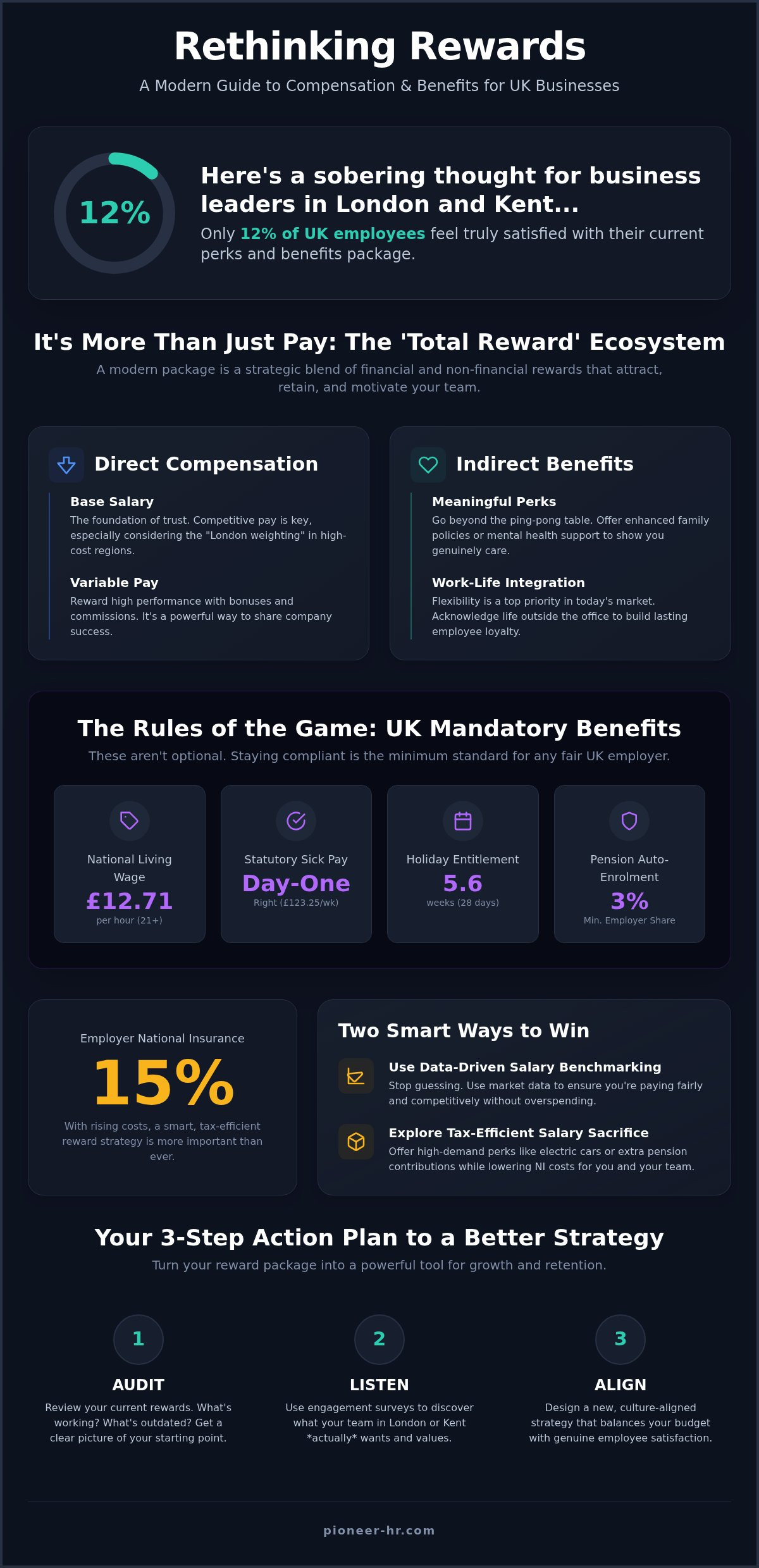
Did you know that only 12% of UK employees feel truly satisfied with their current perks? It's a sobering figure for any business leader in London or Kent trying to keep talent from walking out the door. Building a compensation and benefits package uk businesses can actually afford has never felt more like a balancing act. With employer National Insurance rates hitting 15% and Statutory Sick Pay now a day-one right, the pressure on your bottom line is real. We understand that you want to reward your team fairly without compromising your company's financial stability.
We agree that the old "ping-pong table and free fruit" approach no longer cuts it in a market where financial security and flexibility are the top priorities. This guide will help you master a reward strategy that is both compliant and culture-aligned. We'll show you how to use professional salary benchmarking to stay competitive, explain the nuances of tax-efficient salary sacrifice schemes, and provide a clear framework for balancing your budget with genuine employee satisfaction. Let's look at how you can turn your reward strategy into a sustainable tool for growth.
Table of Contents
What is a Compensation and Benefits Package in the UK?
Defining the compensation and benefits package uk businesses offer today requires looking past the monthly bank transfer. We see a modern package as a "Total Reward" ecosystem. It's a strategic alignment of every financial and non-financial tool we use to attract, retain, and motivate our people. In 2026, your package is your brand's promise in action. It's no longer just a transaction; it's a statement about how much you value the human element of your business.
The current shift in the UK market focuses heavily on financial wellbeing and work-life integration. With the 2026/27 tax year bringing an employer Class 1 NICs rate of 15% on earnings above the £5,000 secondary threshold, we must be smarter about how we structure these rewards. A well-designed strategy ensures that every pound spent contributes to a culture where people feel secure and supported. We define Total Reward as a comprehensive strategy that aligns financial and non-financial incentives with business goals to drive long-term engagement and performance rather than just managing simple costs.
Direct Compensation: The Foundation of the Package
Base salary remains the most visible part of any reward strategy. For our clients in London and Kent, the "London weighting" isn't just an extra; it's a necessity to remain competitive in a high-cost region. We often help businesses move away from arbitrary raises toward market-led data analysis. This ensures you aren't overpaying or losing talent to competitors just down the road.
Variable pay, including bonuses and commissions, adds the performance-driven layer that many employees crave. It's a way to share the company's success directly with those who create it. We must always ensure that overtime and shift allowances strictly follow the UK Working Time Regulations. This prevents burnout and keeps your business legally compliant while maintaining operational excellence.
Indirect Benefits: The 'Perks' That Drive Engagement
Beyond the salary, Employee benefits in the UK are what truly build long-term loyalty. When we design a compensation and benefits package uk employees value, we distinguish between mandatory requirements, like the 5.6 weeks of statutory holiday, and supplementary perks that reflect your specific company values. These perks often carry more weight than a small salary bump because they solve real-world problems for your team.
The psychological impact of these benefits is profound. When you offer enhanced family-friendly policies or mental health support, you aren't just ticking a box. You're telling your team that you care about their lives outside of the office. This is where culture is built. Whether it's through a tailored reward strategy or simple tax-efficient perks, these choices signal that your business is a partner in your employees' success. It's about creating a sustainable professional relationship that lasts.
The UK Legal Framework: Mandatory Benefits in 2026
The baseline for any compensation and benefits package uk businesses manage is strict legal compliance. In 2026, the landscape has evolved significantly, particularly with the removal of the three-day waiting period for Statutory Sick Pay (SSP). It's now a day-one right at £123.25 per week, or 80% of average earnings if that is lower. Additionally, the National Living Wage has reached £12.71 per hour for workers aged 21 and over. These figures aren't just numbers; they represent the minimum threshold you must meet to avoid legal repercussions and maintain your reputation as a fair employer in a tight labour market.
Managing Pension Auto-Enrolment
Pension duties are a cornerstone of UK employment. For the 2026/27 tax year, the earnings trigger for auto-enrolment remains at £10,000. While the 3% minimum employer contribution is standard, the rising cost of National Insurance, now 15% for employers on earnings above the £5,000 secondary threshold, means your total payroll budget needs careful management. Choosing between NEST and a private scheme depends on your team's needs. Private schemes often provide more flexibility for senior staff in London's competitive market. If you feel your current scheme is outdated, a Fractional CPO can audit your pension compliance to ensure your strategy remains both legal and cost-effective.
Holiday and Leave Policies
Every full-time worker is entitled to Statutory Holiday Entitlement of 5.6 weeks, or 28 days. Whether you include bank holidays in this total or offer them as an extra is a strategic choice that can set you apart in the Kent and South East job markets. We've seen more firms move toward structured carry-over rules to avoid a "holiday mountain" at the end of the year. While "unlimited leave" makes headlines in the tech sector, most businesses find that clear, fair allowances provide the best balance of rest and operational consistency. If you're looking to refine these policies, our retained HR support can help you draft a handbook that works for everyone.
Statutory pay for family leave has also seen adjustments. Statutory Maternity Pay (SMP) and Statutory Paternity Pay (SPP) are now set at £194.32 per week, or 90% of average earnings if lower. It's important to remember that paternity leave is now a day-one right, even if the 26-week service requirement for the actual statutory pay remains in place for 2026. Keeping track of these shifts ensures your business stays on the right side of the law while supporting your team through life's big moments.
Strategic Salary Benchmarking: Designing a Fair Pay Structure
Setting salaries based on "what we paid the last person" is a risky strategy in today's market. For businesses in London and Kent, where the cost of living remains a primary driver for employee movement, strategic benchmarking is essential. A competitive compensation and benefits package uk professionals will actually sign for requires a deep understanding of real-time market data. We've moved into an era where pay transparency is no longer optional. With the ripple effects of international pay reporting trends reaching the UK, employees expect to know where they stand within a fair, structured system.
Relying on gut feeling often leads to pay compression or losing your best people to a competitor just across the South East. If you're struggling to fill roles, a targeted salary benchmarking project can identify exactly where your offer is falling short. This isn't just about matching the highest bidder; it's about finding the sweet spot that balances your budget with the expectations of the current talent pool. Data-led analysis allows us to build a reward strategy that is both sustainable for the business and attractive to the individual.
The Benchmarking Process
The process starts by identifying comparable roles not just by title, but by actual responsibility. A "Marketing Manager" in a small Kent firm has a different market value than one in a global London agency. While free online tools offer a tempting shortcut, they often lack the nuance required for a professional compensation and benefits package uk. We recommend using professional salary benchmarking services that account for industry-specific fluctuations and regional adjustments. In August 2026, the average growth in regular pay was 3.5%, a figure that must be factored into your reviews to ensure your salaries don't fall behind inflation.
Building Job Grades and Pay Scales
Once you have the data, you need a structure to house it. Implementing job grading allows you to group roles of similar value together, creating a transparent career path. This structure is your best defence against unintended pay gaps. By anchoring pay to specific grades rather than individual negotiations, you ensure pay equity across gender and ethnicity. Clear communication of these scales builds immense trust. When your team understands how they can progress and what they need to achieve to reach the next level, morale and retention naturally improve. We believe that a clear structure is the foundation of a healthy, high-performing culture.
Supplementary Benefits: Tax-Efficient Perks for UK SMEs
Once you've established a fair base salary, supplementary benefits are where you can truly differentiate your business. In a competitive compensation and benefits package uk SMEs offer, these perks often provide the highest return on investment by focusing on tax efficiency. Salary sacrifice schemes are a standout example of this. By allowing employees to give up a portion of their gross salary for non-cash benefits like electric vehicles or extra pension contributions, both parties save on National Insurance. For employers, with the 15% NIC rate on earnings above £5,000, these savings can be substantial over a full tax year.
We've also seen a significant shift toward "green" benefits. Electric Vehicle (EV) schemes and Cycle to Work programs are no longer just for large corporations. They're highly valued by staff in Kent and London who are conscious of both their carbon footprint and their commuting costs. These schemes allow your team to access high-value items through their pre-tax income, making sustainability an affordable part of their lifestyle.
Health and Wellbeing Perks
Health remains the top priority for staff in 2026. Private Medical Insurance (PMI) has seen a surge in popularity, with 31.5% of employers now offering it as a core benefit. It's the most requested perk for a reason. While it's a taxable Benefit-in-Kind, the peace of mind it offers employees is invaluable. We also recommend looking at Health Cash Plans. These are lower-cost alternatives that cover everyday expenses like dental and optical care, providing high perceived value for a relatively small monthly outlay.
Employee Assistance Programmes (EAPs) are another essential tool in your kit. They offer a clear ROI by reducing absenteeism and supporting mental health before it becomes a crisis. When we combine these with wellness stipends or gym memberships, we create a holistic support system that resonates with a modern workforce. These perks signal that you're invested in your team's long-term health, not just their daily output.
Lifestyle and Financial Benefits
Financial security is a major focus for reward strategies this year. We're seeing more businesses in the South East offer financial education and technology schemes to help staff manage their money more effectively. Workplace nurseries or childcare support are also vital for retaining experienced parents who might otherwise leave the workforce due to rising costs.
Don't overlook zero-cost benefits like flexible and hybrid working. For many commuters in the South East, the ability to work from home is worth more than a minor pay rise. It's about building a package that respects their time and their life outside of work. If you're ready to build a more impactful offer, our reward strategy experts can help you select the perks that align with your budget and culture.
How to Implement a New Reward Strategy
Implementing a new compensation and benefits package uk businesses can truly rely on requires more than just a new spreadsheet. It starts with a thorough audit of your existing rewards. We often find that companies pay for perks that go completely unused, which is essentially wasted capital. Once you've identified the gaps, you must consult your team. Using employee engagement surveys is the most effective way to understand what your staff in London and Kent actually value. This data-driven approach ensures your reward strategy isn't based on assumptions but on the real needs of your workforce.
Budgeting for the long term is where many strategies falter. You need to ensure that any new benefit is sustainable, even as your business scales. The rollout itself must be handled with care. Clear, transparent communication is vital to avoid "benefit fatigue." We recommend a phased approach, explaining the "why" behind every change so the team feels like partners in the process rather than just recipients of a new policy. When people understand the value of what's being offered, the impact on morale is significantly higher.
The Role of a Fractional CPO in Implementation
For many SMEs, hiring a full-time HR Director isn't always financially viable. This is where a Fractional CPO provides immense value. They bring executive-level thinking to your reward strategy, ensuring it supports your 3-5 year business goals. Whether you're planning a major expansion across the South East or looking to stabilise after a period of growth, a Fractional CPO manages the transition smoothly. They handle the complex side of contractual changes and employee relations, allowing you to focus on running the business while we ensure the internal foundation is secure.
Measuring Success and ROI
We don't just implement and walk away; we track the results. One of the clearest indicators of a successful compensation and benefits package uk is your offer acceptance rate. If you're winning top talent in a competitive London market, your package is doing its job. We also monitor staff turnover and analyze exit interview data for any recurring pay-related themes. Reviewing your package annually is non-negotiable. Market trends move quickly; staying ahead of the curve ensures your business remains an employer of choice in an ever-changing landscape.
Building a Sustainable Future for Your Workforce
Designing a compensation and benefits package uk employees truly value requires shifting from transactional pay to a holistic, strategic approach. We've explored how data-driven benchmarking and tax-efficient salary sacrifice schemes can protect your margins while supporting your team in London and Kent. By auditing your current offerings and listening to your staff through engagement surveys, you can build a culture that attracts the best talent in the South East. It's about finding that delicate balance between business sustainability and genuine human empathy.
With 30+ years of strategic HR experience, we specialize in providing expertise in UK-wide salary data and tailored reward strategies for SMEs. Our team is here to help you move away from guesswork and toward a structure that drives performance and loyalty. If you're ready to align your pay structures with your long-term business goals, you can Book a Salary Benchmarking Review with Pioneer HR today. Let's work together to create a workplace where both your business and your people can thrive in 2026 and beyond.
Frequently Asked Questions
What are the mandatory employee benefits in the UK for 2026?
Statutory pension contributions, paid holiday, and statutory pay for sickness or parental leave are the core legal requirements. In 2026, you must contribute at least 3% to a workplace pension for eligible staff earning over £10,000. Employees are entitled to 5.6 weeks of paid holiday. You also need to provide Statutory Sick Pay from day one and Statutory Maternity or Paternity Pay at the current rate of £194.32 per week.
How much does a typical UK benefits package cost an employer?
Beyond base salary, employers should budget for National Insurance at 15% on earnings above £5,000 and pension contributions at 3% of qualifying earnings. Supplementary perks like private medical insurance or life assurance typically add another 5% to 15% to your total payroll costs. The exact figure depends on your specific industry and whether you're competing for talent in high-cost areas like London or more rural parts of Kent.
Is private medical insurance (PMI) a taxable benefit in the UK?
Yes, PMI is considered a Benefit-in-Kind, meaning employees must pay income tax on the value of the premium. As the employer, you're also responsible for paying Class 1A National Insurance on the cost of the benefit. Despite this tax, it remains the most requested perk in a compensation and benefits package uk because it provides faster access to healthcare, which is a major priority for staff in 2026.
Can an employer reduce salary to provide better benefits (Salary Sacrifice)?
You can implement salary sacrifice schemes where an employee agrees to a lower cash salary in exchange for non-cash benefits. This is common for electric vehicles, cycle-to-work schemes, or extra pension contributions. It's a win-win because it reduces the salary subject to National Insurance for both you and the employee. However, you must ensure the sacrifice doesn't push the employee's remaining pay below the National Living Wage of £12.71 per hour.
What is the difference between compensation and benefits?
Compensation refers to the direct monetary rewards an employee receives, such as base salary, bonuses, and commissions. Benefits are the non-cash components, including pensions, health insurance, and flexible working arrangements. Together, they form the Total Reward package. A balanced strategy uses both to ensure staff feel financially secure while also enjoying a supportive work environment that promotes long-term loyalty and professional growth within your company's unique culture.
How often should a UK business perform salary benchmarking?
We recommend a comprehensive review at least once a year to keep pace with the shifting UK labour market. In high-growth sectors or competitive regions like London, you might need to check your data every six months. Regular benchmarking prevents your pay scales from falling behind competitors, which is crucial when average pay growth is hovering around 3.5%. Staying proactive helps you avoid losing key talent to unexpected salary spikes elsewhere.
Are small businesses in Kent required to pay London-weighted salaries?
There's no legal requirement to pay London weighting in Kent, but it's often a strategic necessity if you're competing for the same talent pool. Many commuters in the South East weigh up the cost of travel against the higher salaries offered in the capital. To remain an attractive employer, your compensation and benefits package uk should reflect a fair local rate that acknowledges the regional cost of living without necessarily matching inner-London peaks.
What is a 'Total Reward Statement' and should I provide one?
A Total Reward Statement is a document that shows an employee the full value of their package, including salary and all hidden benefits. It's an excellent tool for boosting engagement because it highlights costs that employees often overlook, such as pension contributions and insurance premiums. Providing these statements helps your team see that their value to the business goes far beyond the basic figure on their monthly payslip, fostering a sense of appreciation.


Comments