
UK Performance Management: Strategic Guide for SMEs 2026
- Pioneer HR
- Aug 17
- 12 min read
What if the 2026 changes to UK employment law aren't actually a compliance hurdle, but your biggest opportunity to outpace the competition in London's crowded talent market? We know that for many SMEs in Kent and across the UK, the thought of performance reviews often brings a collective sigh. Managers frequently dread the awkward feedback loops, while employees feel their hard work isn't reflected in their pay packets. It's frustrating when you see a clear disconnect between individual effort and your overarching business goals.
This guide is designed to help you build an effective performance management strategy for the UK, transforming these frustrations into a clear roadmap for growth and fairer reward structures. You'll discover how to foster a high-performance culture that retains your best talent and stays ahead of the latest UK employment standards. We'll walk you through aligning team efforts with commercial outcomes, preparing for the Fair Work Agency’s new oversight, and navigating the April 2026 shifts in statutory pay and worker rights. By the end of this guide, you'll have the tools to transform performance management from a box-ticking exercise into a genuine engine for business growth.
Table of Contents
Beyond the Appraisal: What is a Performance Management System?
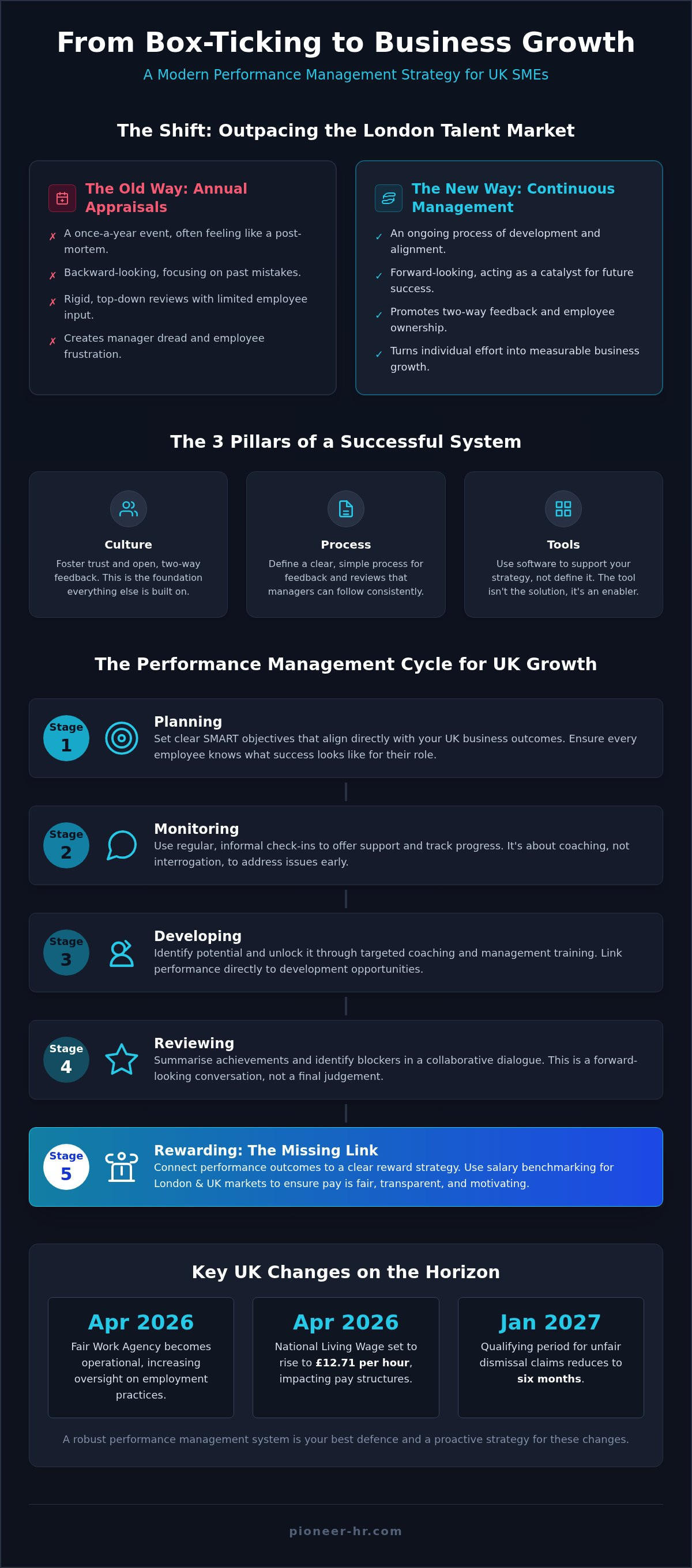
A performance management system is far more than a digital dashboard or an annual meeting. It's a continuous, integrated process designed to identify, measure, and develop the performance of your workforce. For many businesses, the traditional performance appraisal has become a relic of the past. These once-a-year events often felt like a post-mortem of past mistakes rather than a catalyst for future success. In contrast, a modern performance management strategy uk focuses on real-time development and constant alignment.
We view a true system as a delicate balance of three pillars: culture, process, and tools. Without a culture of trust and a clear process for feedback, even the most expensive software becomes a burden. By 2026, strategic alignment is the goal. Every individual objective must ripple upwards to support your organisation's long-term vision. This ensures that employee effort translates directly into business growth, making every role a vital part of your 2026 success story.
The Shift from Compliance to Contribution
SMEs across London and Kent are moving away from rigid, top-down reviews. The modern UK workplace thrives on two-way feedback where employees have a voice in their own development. This shift isn't just about morale; it's a practical necessity. With the Fair Work Agency now operational as of April 2026, having a robust system reduces the risk of legal challenges surrounding incapability dismissals. It ensures that if a role isn't working out, you have a documented history of support and clear expectations. This proactive approach is essential as we prepare for the qualifying period for unfair dismissal claims to reduce to six months in January 2027.
Software vs. Strategy: Why the Tool Isn’t the Solution
It's tempting to think that a new piece of software will fix a performance problem. However, the tool isn't the solution. Buying a platform before defining your people strategy is like buying a car without knowing how to drive. We often see a disconnect between the data software provides and the actual management of people. At Pioneer HR, we help bridge the gap between data and action. Whether through Fractional CPO support or our Retained HR Support, we focus on the strategy first. We believe manager training is the most critical component. Without confident leaders who know how to hold difficult conversations, no system can truly succeed.
The Performance Management Cycle: A 5-Stage Framework for UK Growth
The cycle isn't a linear path with a finish line. It's a repeating loop that ensures no employee is left behind as your business evolves. This continuous flow is the heartbeat of a successful performance management strategy uk. By breaking the process down into five manageable stages, we move away from the stress of the "big reveal" at the end of the year and towards a culture of steady, predictable growth.
Planning is the first step. We set SMART objectives that actually matter to a UK business owner. These shouldn't be vague; they must be outcomes that move the needle. Monitoring follows, focusing on check-ins over interrogations. Regular touchpoints allow managers to offer support before a small issue becomes a performance gap. Developing then links performance to coaching. It's about identifying where Management Training or individual coaching can unlock potential. Finally, Reviewing involves summarising achievements and identifying blockers. As the CIPD performance management factsheet suggests, this is a collaborative dialogue that looks forward as much as it looks back.
Stage 5: Rewarding - The Missing Link
Most systems fail because they stop at the review. If an employee exceeds expectations but sees no impact on their package, motivation drops. Linking performance outcomes to a clear Reward Strategy is vital. With the National Living Wage rising to £12.71 per hour in April 2026, managing pay expectations through 2025 and 2026 requires transparent data. When rewards are based on objective performance metrics, salary discussions become much easier to navigate. If you're unsure how your current pay scales compare, our Salary Benchmarking service can provide the market data you need to reward fairly.
Adapting the Cycle for Remote and Hybrid Teams
London-based firms often face unique challenges with hybrid staff. Maintaining visibility without falling into the trap of micromanagement is a delicate balance. Virtual check-ins should focus on output rather than hours logged. We recommend using structured agendas for these calls to ensure they remain focused on development and alignment. If you feel your current process is struggling to bridge the remote gap, our Fractional Chief People Officer service can help design a framework that keeps your team connected, regardless of where they work. This ensures your performance management strategy uk remains effective even when your team isn't in the same room.
Overcoming the "Box-Ticking" Trap: Performance in UK SMEs
Many SME owners across the UK tell us they simply don't have time for formal performance systems. They see it as a distraction from the daily grind. However, when a process feels like an administrative burden, it's usually because it lacks a clear purpose. This leads to the "box-ticking" trap, where forms are filled out just to satisfy a policy, providing zero value to the business or the employee. It's a waste of energy that breeds cynicism across the team.
A lack of manager confidence often stands in the way of a successful performance management strategy uk. Without proper support, managers frequently fall prey to recency bias; they only remember what an employee did in the last fortnight rather than the whole period. To break this cycle, we often recommend starting with an HR Audit. This process identifies exactly where your current framework is failing and where the gaps in manager capability lie. For many of our clients, bringing in a Fractional Chief People Officer is the turning point. This allows you to implement scalable, professional systems that work for your specific headcount without the overhead of a full-time executive.
Manager Confidence: The Secret Ingredient
Managers in Kent and Sussex often find themselves promoted because they're great at their technical jobs, not necessarily because they're natural coaches. This often leads to a struggle with difficult conversations. They might avoid giving honest feedback to keep the peace, which only stores up trouble for the future. This is especially risky given the upcoming 2027 changes to unfair dismissal qualifying periods, where the window to address underperformance narrows significantly. Our approach focuses on management training that shifts the mindset from policing to coaching. We believe that when a manager feels supported, they can turn a standard review into a powerful development session.
Goal Alignment: Connecting the Hove Office to the Big Picture
It's vital that every team member, whether they're in a London hub or our local Hove office, understands how their daily tasks contribute to the company's 2026 vision. If there's a disconnect between individual effort and business goals, motivation will inevitably slip. According to the CIPD performance management factsheet, aligning these objectives is the cornerstone of high performance. We use tools like Insights Discovery to help managers tailor these conversations to each person's unique communication style. This ensures the message isn't just delivered, but truly heard and acted upon, creating a unified drive toward your commercial targets.
Linking Performance to Pay: The Role of Reward Strategy
Performance management doesn't happen in a vacuum. If you're asking for high performance without a clear link to reward, you'll likely find that even your most dedicated staff eventually lose their spark. For a performance management strategy uk to be truly effective, it must be underpinned by a transparent and competitive Reward Strategy. When employees see a direct correlation between their output and their package, the entire system gains credibility. It transforms a "nice to have" conversation into a meaningful business process.
We often find that SMEs struggle with the "fairness" element of pay. This is where Salary Benchmarking becomes indispensable. Without objective market data, pay rises can feel arbitrary or based on who asks the loudest. By using professional data, you can justify your decisions and show employees exactly where they sit within the market. This baseline of fair pay is essential, but it's only the start. To create a long-term career path, we recommend using Job Grading. This provides a clear map for progression, showing staff how they can grow their responsibilities and their earnings over time. While fair pay is the baseline, performance-related rewards act as the accelerator for your business growth.
Benchmarking Against the UK Market
For firms in London and the surrounding areas, the "London-weighting" factor adds a layer of complexity. Salaries in the capital often change the performance-reward equation significantly. If your pay scales haven't been reviewed recently, you risk "quiet quitting," where employees do the bare minimum because they feel their compensation doesn't match the local cost of living or their professional output. Using Salary Benchmarking Services UK ensures you stay competitive as we move through 2026. This is particularly vital as the National Living Wage reaches £12.71 per hour in April 2026, which naturally pushes up expectations across all pay grades.
Non-Monetary Rewards and Engagement
While the figures on a payslip matter, they aren't the only way to drive performance. Recognition often carries more weight than a small, one-off bonus. We suggest using regular Employee Engagement Surveys to measure how effective your reward system actually is. For Sussex-based SMEs, creative rewards like extra "well-being days" or local perks can be highly effective. The goal is to build a culture where people feel seen and valued for their unique contributions. If you're worried your pay scales are slipping behind the market, our team can conduct a professional Salary Benchmarking review to ensure you're rewarding fairly and keeping your best talent.
Implementing Your System: From Strategy to Success
A successful implementation isn't about the day you go live; it's about the consistent habits that form in the months that follow. Building a performance management strategy uk requires a shift in mindset across the entire organisation. It's a change management project that needs careful handling to ensure your team sees the value rather than just another task on their to-do list. We believe that a phased approach is the most effective way to embed these new behaviours.
We recommend following these five steps to ensure your system takes root:
Step 1: Define what "good" looks like. Start by aligning your core values with specific performance behaviours. If you value collaboration, how is that measured?
Step 2: Design a simple process. Don't over-engineer it. For most SMEs, a simple, repeatable framework is far more effective than a complex system that nobody uses.
Step 3: Select the right tool. Choose a platform only after your strategy is defined. The tool should support your conversations, not dictate them.
Step 4: Train your managers. As we've discussed, manager confidence is the secret ingredient. Launch with transparency and ensure every leader knows how to hold a constructive dialogue.
Step 5: Review the system. Treat your performance framework as a living document. Review its effectiveness annually to ensure it still meets your business needs.
The "Fractional" Advantage for Scale-Ups
For growing businesses in Brighton & Hove, Kent, or London, the leap from a 10-person team to a 50-person organisation is often where performance systems break down. You need executive-level guidance, but you might not be ready for the £100,000+ salary of a full-time People Director. This is where a Fractional CPO provides the strategic infrastructure you need at a fraction of the cost. Many local firms choose our retained HR support to ensure they have a dedicated partner who understands their culture and can scale the performance process as the headcount grows.
Next Steps: Your High-Performance Journey
Your journey toward a high-performance culture doesn't have to be overwhelming. We suggest starting with a professional HR Audit to identify your current strengths and the gaps that might be holding your team back. Once you have a clear picture of your people landscape, you can move toward more advanced strategies like professional Reward Consultancy. This ensures your pay structures are as high-performing as your people. If you're ready to transform how you manage and reward your talent, we're here to help. Book a consultation with us today, and let's build a strategy that drives genuine growth for your business.
Securing Your Competitive Edge for 2026
Developing a robust performance management strategy uk is about much more than just compliance. It's the engine that drives your business forward by aligning individual talent with your 2026 commercial vision. By moving away from the static annual appraisal and embracing a continuous cycle of growth, you create an environment where employees feel valued and managers feel confident in their leadership roles.
Integrating these processes with a clear reward strategy ensures your team stays motivated and your pay scales remain competitive in markets like London and Kent. With over 30 years of HR expertise, we specialise in providing tailored support for UK SMEs through our strategic Fractional CPO services. We're here to help you bridge the gap between people data and practical action.
Ready to transform your workplace? Build a high-performance culture with Pioneer HR today and take the first step toward a more engaged, productive workforce. Your people are your greatest asset; let's ensure they have the roadmap they need to succeed.
Frequently Asked Questions
Is a performance management system legally required in the UK?
While there's no specific law stating you must have a formal performance management system, UK employment standards effectively make one a necessity. With the Fair Work Agency operational as of April 2026 and unfair dismissal rights becoming a day-one right by 2027, you must be able to prove that any performance-related dismissals were fair and well-documented. A clear strategy ensures you meet these legal obligations while supporting your staff's professional growth.
How often should performance reviews take place in an SME?
We recommend moving away from the "once-a-year" model in favour of a more agile approach. For most UK SMEs, a combination of monthly informal check-ins and quarterly formal reviews works best. This frequency allows you to adjust goals in real-time and address issues before they escalate. It also ensures that your performance management strategy uk remains relevant to the fast-changing economic conditions we expect throughout 2026.
What is the difference between a performance appraisal and a performance management system?
A performance appraisal is an isolated event, typically a meeting where past performance is discussed. A performance management system, however, is a holistic strategy that encompasses goal setting, continuous feedback, and professional development. It links individual effort to the company's broader vision. While the appraisal is a component, the system is the overarching framework that ensures every team member's contribution is measured and rewarded consistently throughout the year.
Can a performance management system help with underperforming employees?
A structured system is your most effective tool for managing underperformance fairly. It allows you to identify gaps early and implement Performance Improvement Plans (PIPs) that offer genuine support. By setting clear, measurable targets, you provide the employee with a fair chance to improve. If performance doesn't reach the required standard, your system provides the essential evidence needed to follow a legally compliant dismissal process under UK law.
Should I link performance directly to pay rises?
Linking pay to performance is a powerful motivator, but it must be handled with care. We advise using objective data and professional salary benchmarking to ensure rewards are fair and transparent. This prevents pay decisions from feeling arbitrary or biased. When staff see a clear path between achieving their SMART objectives and receiving financial recognition, it significantly reduces the risk of "quiet quitting" and helps retain your top performers.
What are the best performance management tools for UK small businesses?
The "best" tool is the one that your managers will actually use. We don't believe in a one-size-fits-all software solution; instead, we help you select a platform that fits your specific culture and headcount. Whether you're a 10-person start-up or a 50-person scale-up, your chosen tool must support your performance management strategy uk by making documentation easy and feedback visible, without adding unnecessary administrative complexity.
How do I handle performance reviews for remote workers in London?
Managing remote workers in London requires a shift from monitoring "hours at a desk" to measuring tangible outputs. We suggest using structured video check-ins that focus on progress against specific, pre-agreed objectives. It's vital to maintain regular communication to prevent remote staff from feeling isolated. Using shared digital workspaces for goal tracking ensures that both the manager and the employee have a clear, real-time view of what has been achieved.
How can a Fractional CPO help my business implement a system?
A Fractional Chief People Officer brings executive-level expertise to your business at a fraction of the cost of a full-time hire. We use our 30+ years of industry experience to design a bespoke system that fits your unique needs. By acting as a strategic partner, a Fractional CPO ensures that your performance framework isn't just an HR exercise, but a commercial tool that drives growth, improves engagement, and ensures full legal compliance.


Comments