
The Essential HR Compliance Checklist for UK SMEs in 2026
By April 2026, the traditional UK employee handbook won't just be outdated; it could be a significant legal liability for your business. Most SME owners in London and Kent are already feeling the weight of the Employment Rights Act 2025 and searching for a reliable hr compliance checklist uk 2026. You're likely worried about how "Day One" paternity rights and rising Statutory Sick Pay (SSP) costs will impact your bottom line. It's completely natural to feel overwhelmed by the administrative burden these changes bring to your desk.
We believe that compliance shouldn't feel like a barrier to growth. Our promise is to help you turn these legislative hurdles into a strategic advantage that protects your company and supports your team. We've designed this guide to provide a clear, actionable roadmap through the upcoming policy shifts and essential updates you need to implement before the spring deadline hits. By following these steps, you can balance your legal obligations with a sustainable reward strategy that keeps your business competitive.
Key Takeaways
Prepare your business for the full implementation of the Employment Rights Act 2025 and understand the unique competitive challenges facing London and Kent SMEs.
Master the transition to "day-one" rights for paternity and parental leave, ensuring you clearly distinguish between legal leave entitlements and pay requirements.
Use our strategic hr compliance checklist uk 2026 to audit your payroll systems for the removal of the Lower Earnings Limit and the shift to day-one Statutory Sick Pay.
Learn how to review and update outdated employment contracts to remove length-of-service clauses that could lead to non-compliance by April 2026.
Discover how a proactive HR partnership can safeguard your business from costly tribunals while helping you attract top talent in a shifting regulatory market.
Table of Contents The 2026 HR Landscape: Understanding the Employment Rights Act Revolution The "Day-One" Rights Revolution: Paternity and Parental Leave Statutory Sick Pay (SSP) and the Removal of the Lower Earnings Limit The Strategic HR Compliance Checklist: Action Items for MDs Partnering for Compliance: How Pioneer HR Secures Your Future
The 2026 HR Landscape: Understanding the Employment Rights Act Revolution
The UK employment landscape is undergoing its most significant transformation in decades. By the time we reach April 2026, the full implementation of the Employment Rights Act 2025 will have fundamentally altered how small and medium-sized enterprises (SMEs) manage their people. We've moved away from a system where rights were earned through years of service; instead, we're entering an era of "day-one" protection. This shift means your hr compliance checklist uk 2026 must be more than a simple legal tick-box exercise. We define HR compliance in 2026 as the alignment of legal safety with strategic reward.
For SMEs in London and Kent, the stakes are particularly high. The proximity to the capital's aggressive talent market means that falling behind on compliance doesn't just invite legal risk; it actively pushes your best staff toward competitors who offer better-protected working conditions. We've observed that businesses failing to adapt their culture alongside these legal changes face higher turnover rates and increased recruitment costs. It's no longer enough to just follow the rules. You need to demonstrate a commitment to these new standards to remain an employer of choice in the South East.
Key Legislative Milestones for April 2026
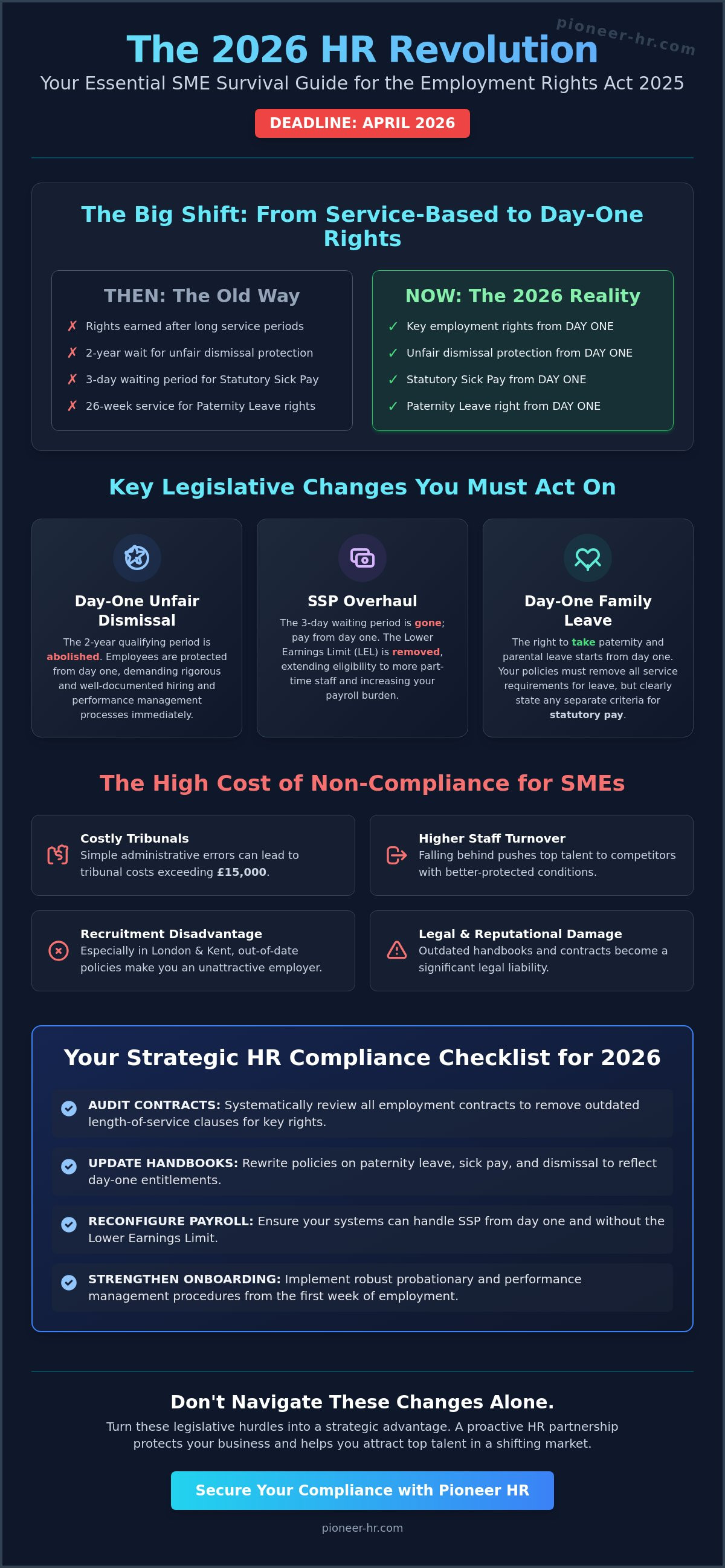
The changes arriving in April 2026 represent a complete overhaul of UK employment law that removes traditional barriers to worker support. One of the most immediate financial impacts is the removal of the three-day waiting period for Statutory Sick Pay (SSP). Your business must now budget for sick pay from the very first day an employee is unwell. Furthermore, the government has abolished the Lower Earnings Limit (LEL) for SSP eligibility. This means even your lowest-paid part-time staff are now entitled to support, which significantly increases the administrative burden for payroll teams.
Perhaps the most daunting change is the introduction of day-one rights against unfair dismissal. The previous two-year qualifying period has been scrapped. This means your hiring processes and probationary periods must be tighter than ever before. If you don't have clear, documented performance procedures from the first week of employment, you're leaving the business vulnerable to claims that didn't exist a few years ago.
The Impact on SMEs in London and the South East
Local market dynamics in Kent and Sussex influence compliance costs more than you might think. With many employees commuting into London, local firms often feel pressured to match the rigorous HR standards of global corporations. We've found that "winging it" with old contracts is a high-risk strategy in 2026. Outdated templates won't cover the new nuances of flexible working requests or the updated SSP rules, potentially leading to £15,000+ in tribunal costs for even simple administrative errors.
Many growing businesses are finding that they can't manage these complex shifts alone. The role of a retained HR partner has evolved from a luxury to a necessity for navigating these shifts. By having professional oversight, you ensure that your hr compliance checklist uk 2026 remains proactive rather than reactive. This partnership allows you to focus on growth while we ensure your contracts, handbooks, and management styles stay on the right side of the law.
The "Day-One" Rights Revolution: Paternity and Parental Leave
The legislative landscape for 2026 marks a significant departure from traditional service-based entitlements. For years, UK SMEs relied on the 26-week qualifying period as a buffer for paternity and parental leave. That's changing. Under the updated framework, these become "day-one" rights. This shift is a core component of your hr compliance checklist uk 2026, requiring immediate attention to avoid costly tribunal claims and reputational damage.
We've identified four critical steps to ensure your business stays ahead of these changes:
Step 1: Audit every existing paternity and parental leave policy. You must remove any mention of "minimum service requirements" or the "26-week rule" for the right to take leave.
Step 2: Distinguish between the "right to leave" and the "right to pay". While an employee can take leave from their first day, Statutory Paternity Pay (SPP) often still carries specific earnings and service thresholds. Clear communication here prevents mid-month payroll shocks for new parents.
Step 3: Rebuild your onboarding protocols. Your new-starter packs should clearly outline how to request leave, even if the employee hasn't officially finished their first week of induction.
Step 4: Update manager training modules. Your team leaders need to know that a leave request on day three isn't a performance issue or a sign of low commitment; it's a legal right that must be facilitated.
Updating Your Employee Handbook for 2026
Handbooks need a total refresh to reflect these modern standards. In Sussex and Kent, where competition for talent is fierce, transparent policies act as a recruitment tool and a compliance necessity. You'll need to rewrite paternity clauses to state that leave is available regardless of tenure. We recommend being explicit about how this affects probation periods. A new hire taking parental leave doesn't pause their probation automatically. You'll need clear wording to manage these overlapping timelines fairly and legally. If you're feeling overwhelmed by these legislative updates, our HR retainer service provides the ongoing strategic support needed to keep your documentation legally sound.
Manager Training: Handling Early Leave Requests
The "day-one" revolution requires a total shift in management mindset during the onboarding phase. We've seen cases where managers react poorly to early leave requests, viewing them as a disruption. In 2026, this attitude is a fast track to a discrimination claim. Train your managers using practical scenarios. If a new hire in Tunbridge Wells or Ashford requests paternity leave in their first week, the manager's response should be supportive and process-driven. Consistency is your best defense. When every manager follows the same protocol, you eliminate the risk of "inconsistency" being cited in legal disputes. It's about building a culture where rights are respected from the moment a contract is signed, ensuring long-term engagement from your team.
Statutory Sick Pay (SSP) and the Removal of the Lower Earnings Limit
The 2026 regulatory environment has fundamentally altered how UK SMEs handle illness. Under the updated Employment Rights Act, the previous three-day waiting period for Statutory Sick Pay is a thing of the past. Employees now qualify for SSP from their very first day of absence. For a small business in London or Kent, this isn't just a policy shift; it's a direct increase in the daily cost of doing business. You'll need to account for these immediate payments in your hr compliance checklist uk 2026 to avoid unexpected budget deficits during peak flu seasons.
The removal of the Lower Earnings Limit (LEL) represents another major milestone for payroll departments. Previously, workers earning less than £123 per week didn't qualify for SSP. By 2026, this barrier has been dismantled, bringing nearly 1.5 million part-time and low-earning workers into the system. While this provides a vital safety net for your staff, it requires business owners to be more precise with their financial forecasting. We recommend using salary benchmarking to ensure your total compensation package remains sustainable while absorbing these new statutory costs.
Calculating the Real Cost of Sick Pay in 2026
Payroll budgeting for 2026 must be more granular than in previous years. Short-term absences, often dismissed as minor "duvet days" or 24-hour bugs, now carry a tangible price tag from day one. If an employee takes two days off, you're now liable for those costs immediately. This makes robust return-to-work interviews essential for every single instance of leave. These meetings help you understand patterns, offer support where needed, and ensure that your hr compliance checklist uk 2026 includes measures to prevent minor illnesses from becoming long-term drains on your productivity.
Absence Management Strategies
Updating your sickness policy is the first step in managing this new financial burden. Your documentation should clearly state that "Day One" payments are standard, but also outline the expectations for reporting and medical evidence. We've seen that businesses investing in Employee Assistance Programmes (EAPs) and occupational health see a 20% reduction in short-term absence rates. If your internal team is stretched thin, a Fractional CPO can help you design a proactive wellness strategy. This approach moves beyond simple compliance, focusing on keeping your workforce healthy and present in the office or on the shop floor.
Absence management is no longer just an administrative task. It has become a critical financial metric that directly impacts your bottom line. By tracking these costs and implementing supportive health measures, you can mitigate the impact of these legislative changes while remaining an employer of choice in a competitive UK market.
The Strategic HR Compliance Checklist: Action Items for MDs
Managing Directors in London and across the UK face a shifting regulatory environment that demands more than just administrative updates. This hr compliance checklist uk 2026 is designed to help leaders move from reactive fixes to strategic stability. We recommend starting with a comprehensive audit of your employment contracts. Many SMEs in Kent and the surrounding areas still use templates tied to the old two-year qualifying period for unfair dismissal. Since the 2024 Employment Rights Bill reforms take full effect by April 2026, these service-length clauses are effectively obsolete and could create legal vulnerabilities if left unchanged.
Your payroll infrastructure requires immediate attention to handle the removal of the three-day waiting period for Statutory Sick Pay. From 2026, employees qualify for SSP from their first day of illness. Relying on manual calculations or outdated software often leads to costly errors and disgruntled staff. We've found that integrating automated payroll systems now prevents the administrative bottleneck that occurs when "day-one" rights become the standard across your entire workforce.
Reviewing your financial commitments is the next priority. With the National Living Wage projected to stay on an upward trajectory, your current reward strategy might need a complete overhaul to offset these statutory cost increases. It's about finding a balance where you meet legal pay requirements without eroding your profit margins. This often involves a difficult but necessary look at which discretionary benefits provide the most value to your team and which can be adjusted to accommodate mandatory hikes.
The Policy Audit: What to Change Now
Update your Paternity, Sick Pay, and Unfair Dismissal policies to reflect immediate eligibility. You must ensure these "day-one" rights appear clearly in your offer letters and recruitment advertisements to remain transparent. We suggest verifying every internal procedure against the 2026 ACAS guidance. This ensures your managers follow the correct disciplinary and grievance paths from an employee's first hour on the job, protecting the business from early-stage tribunal claims.
Benchmarking and Reward: Staying Competitive
Compliance is the bare minimum for any business, but to stand out as a "Pioneer" employer, you need to go further. We use job grading to help our partners ensure internal equity while meeting new legal pay standards. Compare your total package against the latest UK market standards to see where you sit. If statutory increases make high salary jumps impossible, focus on non-monetary benefits like flexible working patterns or enhanced career development paths that modern candidates value.
Staying ahead of these changes requires a high-level view of your people strategy. If you're concerned about how these legislative shifts will impact your 2026 budget, our Fractional CPO services offer the expert guidance needed to navigate this transition smoothly.
Partnering for Compliance: How Pioneer HR Secures Your Future
Managing a workforce in 2026 requires more than just a template and a prayer. For small and medium businesses across London and Kent, the legal landscape has become a moving target. We've spent 30 years helping companies move away from "panic compliance," where you're constantly putting out fires, and toward strategic excellence. By partnering with us, you aren't just ticking boxes on an hr compliance checklist uk 2026; you're building a foundation that protects your reputation and your bottom line. We believe that HR should be a bridge, not a barrier, connecting your business goals with the people who make them happen.
Why Retained HR Support is the Smart Choice for 2026
Employment tribunals can be devastating for an SME. In the 2023/24 period, the average award for unfair dismissal sat at £11,914, but when you factor in legal fees and lost management time, the true cost often exceeds £25,000. We provide a retained service that acts as your internal HR department without the overhead of a full-time executive salary. Our team monitors legislative shifts in real time so you don't have to. We handle the policy updates and contract tweaks while you focus on running your business.
Our local expertise is a significant advantage. We understand the specific employment market pressures in Hove, Brighton, and the fast-paced financial sectors of London. This geographical insight allows us to provide advice that isn't just legally sound, but also culturally relevant to your specific workforce. It's about having a fixed monthly cost that prevents the expensive surprises that come with a single legal mistake or a missed regulatory update.
Next Steps: Booking Your 2026 HR Audit
The journey toward total peace of mind starts with a comprehensive audit. We look at every facet of your current operations, from your handbook and disciplinary procedures to your remote work policies. A critical part of this process involves salary benchmarking. We ensure your pay structures are legally compliant with the latest equal pay legislation while remaining competitive enough to keep your best people from being headhunted.
We don't just deliver a list of problems. We provide a clear, prioritised roadmap to ensure your hr compliance checklist uk 2026 is fully addressed. Our goal is to integrate these changes seamlessly into your existing culture, ensuring that your team feels supported rather than restricted by new rules. You'll receive a dedicated advisor who understands your history and your ambitions.
Contact Pioneer HR today for a strategic compliance review.
By transforming rigid legal requirements into a framework for a fair, transparent, and high-performing culture, Pioneer HR turns 2026 compliance into a distinct competitive advantage that attracts and retains the best talent in the UK.
Future-Proof Your Business for the 2026 Employment Shift
The upcoming legislative changes represent the most significant shift in UK employment rights for a generation. We've seen how "day-one" rights for parental leave and the removal of the Lower Earnings Limit for SSP will fundamentally change your payroll and recruitment processes. Staying ahead means you'll need to audit your existing contracts and update your internal policies well before the 2026 deadlines. This proactive approach doesn't just prevent legal risks; it builds a more resilient and attractive workplace for your team.
Navigating this transition is easier when you have a strategic partner by your side. At Pioneer HR, we bring over 30 years of strategic HR experience to help SMEs across London, Kent, and the South East. We specialize in UK reward strategy and precise salary benchmarking, ensuring your business stays competitive while remaining fully compliant. By utilizing a dedicated hr compliance checklist uk 2026, we'll help you turn these regulatory challenges into a clear roadmap for growth. We're here to support you every step of the way.
Let's build a stronger, more compliant future for your organization together.
Frequently Asked Questions
What are the biggest changes in the Employment Rights Act 2025 for 2026?
The most significant changes involve the removal of the two-year qualifying period for unfair dismissal and the introduction of day-one rights for various leaves. By April 2026, employees will have the right to claim unfair dismissal from their first day on the job. We see this as a fundamental shift in UK employment law that requires businesses to be much more diligent during their hiring and initial onboarding phases. It's a move toward greater security for about 9 million workers across the country.
Do I really have to pay Statutory Sick Pay from the first day of illness in 2026?
Yes, you'll need to pay Statutory Sick Pay (SSP) from the very first day an employee is unable to work due to illness. The previous three-day waiting period is being abolished to ensure workers don't face financial hardship for short-term health issues. This change means your payroll processes must be updated to track and pay for every single day of absence. We recommend reviewing your absence management policies now to ensure your budget accounts for these additional payment days.
Is paternity leave a day-one right for all UK employees now?
Paternity leave becomes a day-one right for all eligible UK employees starting in April 2026. Previously, staff had to complete 26 weeks of continuous service to qualify for this benefit. This update is a core component of our hr compliance checklist uk 2026 recommendations for growing businesses. By removing the service requirement, the government is making it easier for new parents to support their families regardless of how recently they started their role.
How does the removal of the Lower Earnings Limit affect my part-time staff?
Removing the Lower Earnings Limit means your part-time staff will qualify for Statutory Sick Pay even if they earn less than £123 per week. This change is designed to protect the lowest-paid workers who were previously excluded from the safety net of sick pay. Approximately 1.5 million low-paid workers will benefit from this legislative update. We suggest you audit your current part-time contracts to identify how many additional employees will now fall under SSP eligibility.
Can I still have a probation period if unfair dismissal is a day-one right?
You can still use probation periods, but they must comply with a new statutory framework that includes a proposed nine-month limit. While unfair dismissal becomes a day-one right, the government intends to allow a "light-touch" dismissal process during this initial period. This doesn't mean you can dismiss without cause; it means the procedural requirements will be less complex than for long-term staff. We help our partners develop structured assessment milestones to ensure these periods are managed legally and effectively.
How much does an HR compliance audit cost for a UK SME?
A professional HR compliance audit for a UK SME typically costs between £1,000 and £5,000 depending on your total headcount and the complexity of your existing contracts. These figures reflect current 2024 market rates for comprehensive reviews by qualified consultants. While this is an upfront investment, it's significantly lower than the average cost of an Employment Tribunal claim. According to recent Ministry of Justice data, the average award for unfair dismissal can exceed £14,000 plus legal fees.
What happens if my employee handbook is not updated by April 2026?
Failing to update your handbook by April 2026 leaves your business exposed to significant legal risks and potential breach of contract claims. If your written policies still state that employees need two years of service for certain rights, they'll be legally void and misleading. This can be used as evidence of poor management in a tribunal setting. We believe that keeping your documentation current is the simplest way to demonstrate professional transparency and protect your company's reputation.
Should I use a local HR consultant in London or Kent for these changes?
Choosing a consultant with specific expertise in the London and Kent markets offers a clear advantage because they understand the regional recruitment landscape. Local experts are familiar with the specific challenges of the South East, such as higher living costs and competitive benefit expectations. Whether your office is in Maidstone or the City of London, having a partner who can provide on-site support is invaluable. This local insight is a vital part of completing your hr compliance checklist uk 2026 with confidence.



Comments