

Salary Benchmarking UK: A Strategic Guide for Employers in 2026
Updated: Apr 6
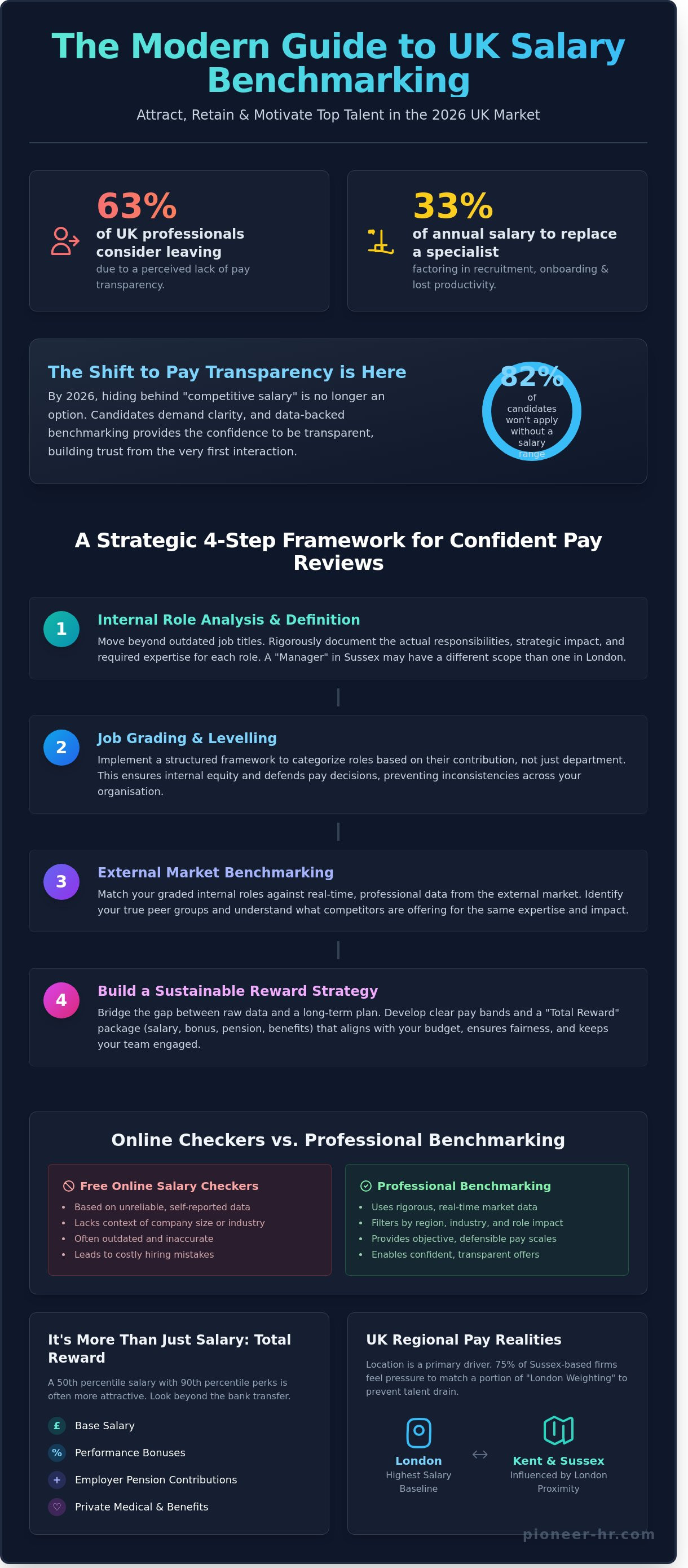
What if your most talented employees are currently browsing job boards simply because your pay structure hasn't kept pace with the 2025 market? Recent data shows that 63% of UK professionals consider leaving their roles when they perceive a lack of transparency in pay. For many businesses, the challenge isn't just about the total figure; it's about the confusion surrounding regional variations and the pressure to get salary benchmarking uk right. Whether you're managing a team in the heart of London or a growing office in Kent, we understand that finding the balance between budget constraints and fair compensation is a complex task.
We agree that it's difficult to maintain a competitive edge while ensuring internal equity and closing gender pay gaps. You'll discover how to use professional salary benchmarking to attract top talent, ensure pay equity, and build a sustainable reward strategy for your UK business. We'll provide a clear, four step framework for setting salaries that gives you total confidence during your next round of annual pay reviews.
Key Takeaways
Understand why pay transparency and fair market alignment are now non-negotiable for UK businesses navigating the 2026 economic landscape.
Learn how to handle regional pay variations, such as the "London Weighting," to ensure your offers remain competitive for talent in Kent and Sussex.
Discover why professional salary benchmarking uk is essential for avoiding the costly hiring mistakes associated with outdated or self-reported online data.
Follow our strategic process for auditing your internal pay structures and identifying the specific peer groups you are actually competing with for talent.
Explore how to bridge the gap between raw data and a sustainable reward strategy that keeps your team motivated and engaged for the long term.
Table of Contents What is Salary Benchmarking and Why is it Critical for UK Businesses in 2026? The Mechanics of a Professional UK Salary Review Salary Checkers vs. Professional Benchmarking: Which is Right for You? How to Organise Your Internal Benchmarking Process Building a Sustainable Reward Strategy with Pioneer HR
What is Salary Benchmarking and Why is it Critical for UK Businesses in 2026?
We define salary benchmarking uk as the rigorous process of matching your internal roles and pay scales against real-time data from the external market. In 2026, this isn't just a back-office exercise for HR; it's a vital component of business resilience. Whether you're a high-growth tech firm in London's Silicon Roundabout or a manufacturing powerhouse in Kent, your people are more informed about their market value than ever before. We help you look beyond your own walls to see exactly what your competitors are offering for the same expertise.
There's a massive difference between paying the "market rate" and creating a "competitive advantage." The market rate is simply the baseline needed to avoid immediate turnover. In a talent-short environment where UK job vacancies are expected to remain above 900,000 through 2026, just being "average" isn't enough. A strategic approach to salary benchmarking uk allows you to position your brand as an employer of choice. Research suggests that companies offering just 7% above the median market rate see a 25% increase in high-quality candidate applications.
Benchmarking also serves as a critical tool for Diversity, Equity, and Inclusion (DEI). By using objective data, we can strip away the unconscious bias that often leads to unintended pay gaps. It ensures that two people doing the same job in your London or Kent offices are paid based on their contribution and market value, not their negotiation skills.
The Shift Towards Pay Transparency
The UK's regulatory landscape has evolved rapidly. By 2026, the influence of the EU Pay Transparency Directive has made "competitive salary" a phrase of the past. Recent surveys show that 82% of UK candidates won't even apply for a role if the salary range isn't clearly stated. Benchmarking gives you the data-backed confidence to be transparent. It builds immediate trust, showing your workforce that you value fairness over secrecy.
Benchmarking as a Retention Tool
The financial impact of losing a key team member is staggering. Replacing a specialist typically costs 33% of their annual salary when you factor in recruitment, onboarding, and lost productivity. Regular benchmarking prevents "salary compression," where new hires are brought in on higher rates than loyal veterans. This keeps your internal structure logical and your best people engaged. Salary benchmarking is a strategic diagnostic tool for organisational health.
The Mechanics of a Professional UK Salary Review
You can't hit a target you haven't defined. Success in salary benchmarking uk starts with clarity, not spreadsheets. Most businesses fail because they try to match outdated job descriptions to modern market data. A 2025 study found that 40% of UK vacancies remain hard to fill because of misaligned pay expectations. We've seen that a role titled "Operations Manager" in a Sussex SME often carries more weight than the same title in a London corporate. You need to document the actual impact and daily responsibilities before you look at the numbers.
We also look at "Total Reward" rather than just the monthly bank transfer. A competitive 2026 package includes employer pension contributions above the 3% legal minimum, private medical insurance, and performance bonuses. If your base salary is in the 50th percentile but your perks are in the 90th, you're often more attractive to top talent than a high-paying firm with zero benefits. Balancing what the market pays with what your budget allows is the final piece of the puzzle. Internal equity ensures your long-standing team members don't feel undervalued when you hire new talent at current market rates.
Job Grading and Levelling
Comparing a "Marketing Manager" in Brighton to one in Manchester is useless without context. We recommend a structured job grading framework to assess roles by their strategic impact and required expertise. This creates a fair environment where roles are categorised by responsibility rather than just tenure. It ensures a Senior Engineer in your IT team isn't earning less than a less-experienced Finance lead just because one department feels more expensive. Consistency across departments is the only way to defend your pay decisions during annual reviews.
Regional Pay Realities: London, Kent, and Hove
The commutable distance to London remains a primary driver for pay in the South East. While remote work has changed the landscape, 75% of Sussex-based firms still face pressure to match a portion of "London Weighting" to prevent talent drain. Employers in Hove or Tunbridge Wells don't necessarily need to match central London overheads, but they must offer a quality of life premium. This includes hybrid flexibility or shorter commutes to balance the slightly lower base pay. If you're struggling to find this balance, our pay benchmarking services can provide the granular data you need to stay competitive in the local market.
Salary Checkers vs. Professional Benchmarking: Which is Right for You?
Many London startups and established firms in Kent begin their search for pay data using free online calculators. While these tools offer a quick snapshot, they often lack the precision required for a robust 2026 financial plan. Relying on unverified aggregators can lead to expensive mistakes. A 2024 analysis indicated that crowdsourced salary figures can vary from actual payroll data by up to 18%. This discrepancy creates a significant "Data Quality" problem for employers who need to justify every pound of their reward budget.
We've found that professional salary benchmarking uk services provide the necessary depth that simple algorithms overlook. It's not just about finding a number; it's about understanding the context of that number within the local market. For an SME, moving from "best guesses" to a structured strategy is vital once you reach 25 employees or plan a recruitment drive that increases your headcount by 10% or more.
The Pitfalls of Crowdsourced Data
Crowdsourced sites are often skewed by extreme cases. Employees typically share their salary when they feel significantly underpaid or exceptionally well-compensated, leaving the middle ground underrepresented. Recruitment agency "salary guides" also present challenges. These reports sometimes inflate figures by 10% to 15% to attract candidates to their books or to increase their own commission-based fees. We prefer "clean" data sourced from verified payroll systems, ensuring the figures reflect what businesses are actually paying in 2025 and 2026.
The Human Element: Strategic Interpretation
Data alone doesn't build a culture. Our consultants interpret market data to account for your specific niche, company size, and the unique benefits you offer. Benchmarking isn't just about matching a median; it's about deciding where you want your brand to stand. Data provides the range, but strategy decides the point within that range. A professional salary benchmarking service helps you navigate these choices, ensuring your pay scales in London or the South East remain competitive without compromising your bottom line.
How to Organise Your Internal Benchmarking Process
Establishing a robust internal framework is the backbone of any successful salary benchmarking uk strategy. We recommend starting with a structured, five-step approach that balances fiscal responsibility with talent retention. We begin by looking inward to audit your current pay structures. This process identifies "red-circle" employees who are paid above their grade's ceiling, often due to historical legacy decisions or rapid counter-offers. Identifying these outliers early prevents them from skewing your overall data set.
Once the audit is complete, we follow these essential steps to build your 2026 roadmap:
Step 1: Internal Audit. Categorise every role and identify pay inconsistencies across departments.
Step 2: Define Peer Groups. Determine which companies are truly competing for your specific talent pool.
Step 3: Source UK Data. Use 2025 and 2026 market datasets that reflect specific regional nuances, such as the pay differential between Kent and Central London.
Step 4: Gap Analysis. Calculate the exact percentage difference between your current rates and your desired market position, whether that is the 50th or 75th percentile.
Step 5: Phased Rollout. Create a 12 to 18-month implementation plan to adjust salaries without destabilising your annual budget.
Defining Your Peer Group
Context is everything in recruitment. It's a mistake for a growing tech firm in Hove to benchmark against a global conglomerate in London. The cost of living and local talent scarcity in East Sussex create a different economic reality than the City. We help you identify "direct competitors" who hire from your same talent pool and "aspirational peers" who represent where you want to be in three years. For niche roles, we prioritise sector-specific data over general UK averages to ensure accuracy.
Communicating Pay Changes
Transparency reduces workplace anxiety. Research shows that roughly 64% of employees feel more engaged when they understand the logic behind their compensation. We believe the manager's role is vital here. They must be equipped to explain that benchmarking isn't just about raises; it's about fairness and long term stability. If market data shows a role is already paid at the top of its bracket, the conversation should pivot toward professional development and total reward packages.
If you need help navigating these complexities, our team provides bespoke salary benchmarking uk services to align your pay strategy with the 2026 market.
Building a Sustainable Reward Strategy with Pioneer HR
Raw data is just the starting point. To truly thrive in the 2026 talent market, we help you turn those numbers into a roadmap for growth. Relying on outdated spreadsheets often leads to reactive decision-making. Instead, we integrate salary benchmarking uk into a broader reward strategy that aligns your commercial goals with employee motivation. It's about creating a structure where people feel valued for their specific contributions, not just their job titles.
Our team sees a recurring pattern in the South East: businesses that skip annual reviews often face "emergency retention raises" that cost 15% to 20% more than planned increases. These reactive bumps disrupt internal equity and strain budgets. Regular, proactive benchmarking is simply more cost-effective. It allows you to manage expectations and adjust pay scales incrementally rather than facing a mass exodus of talent.
For growing SMEs in London or Kent that don't require a full-time HR Director, a fractional CPO offers a strategic advantage. We provide the high-level expertise needed to design complex pay structures without the executive price tag. This partnership ensures your long-term pay planning remains agile and data-driven as your headcount scales.
Beyond the Paycheque: Non-Monetary Rewards
Benchmarking reveals where your cash compensation sits, but it also highlights where your benefits can do the heavy lifting. If your base salary is slightly below the London median, we look at enhancing flexibility or professional development. These elements are often more persuasive to the UK workforce than a minor cash increase. We'll help you communicate this through a Total Reward statement. When a team member sees the value of their pension, health cover, and training budget in one place, the perceived value of their role increases significantly.
This holistic view is crucial, as salary is just one component of the overall employee journey. To get a complete picture, platforms like Benchmarcx allow businesses to measure and benchmark their entire talent experience in real-time, providing insights that go far beyond just compensation data.
Your Partner in Strategic HR
With over 30 years of experience in the UK market, we understand the specific pressures facing businesses in the South East. We don't just hand over a generic report; we provide actionable insights tailored to your local competition and industry niche. Our goal is to build a bridge between your financial constraints and your people's aspirations. Contact Pioneer HR today for a professional salary review and start building a more resilient organization.
Future-Proof Your Recruitment Strategy for 2026
Navigating the UK's shifting economic landscape requires more than just intuition or a quick look at free online tools. By 2026, the difference between a standard pay packet and a strategic reward structure will determine which businesses thrive in competitive hubs like London and Kent. We've found that professional salary benchmarking uk provides the clarity needed to attract top-tier talent while maintaining sustainable profit margins. Our team at Pioneer HR uses 30 years of specialist experience to move beyond generic data, providing tailored reports that address the specific needs of South East SMEs. We don't just provide numbers; we offer a roadmap for long-term employee engagement and financial stability. It's time to replace guesswork with precision to ensure your team feels valued and your business remains resilient. We're ready to help you build a compensation strategy that truly reflects your company's worth and ambition. Let's start the conversation today to secure your place as an employer of choice.
Frequently Asked Questions
How often should a UK business benchmark its salaries?
We recommend you review your pay scales every 12 months to stay competitive in the shifting UK market. In fast-moving sectors like London's fintech scene, 6-month checks are becoming the 2026 standard for high-demand roles. This regular cadence ensures your budget accounts for the 4% average wage growth projected for the coming year.
What is the difference between a salary survey and salary benchmarking?
A salary survey is the raw data collection from various firms, while salary benchmarking uk is the strategic process of comparing your specific roles against that data. Think of the survey as the ingredients and benchmarking as the recipe we create for your Kent-based business. We use these insights to align your internal grades with the external market accurately.
Does salary benchmarking help with Gender Pay Gap reporting?
Benchmarking is a vital tool for meeting the UK's 2017 Gender Pay Gap reporting requirements. It allows us to spot pay discrepancies between similar roles that might otherwise go unnoticed during daily operations. By using objective market data, we help you build a transparent structure that ensures 100% compliance with equal pay legislation.
Can I benchmark salaries for remote workers across different UK regions?
You can definitely benchmark for remote teams, but we suggest using specific regional weightings to stay fair. A software engineer living in Kent often costs 15% less than one based in central London due to lower local living costs. We help you decide whether to pay a flat national rate or adjust based on the employee's specific location.
How much does professional salary benchmarking typically cost for an SME?
For a UK SME with 50 to 250 employees, a professional project typically costs between £2,500 and £6,000. This investment covers premium data access and expert analysis of your specific job descriptions. We find that this upfront cost prevents the much higher £30,000 expense associated with replacing a single senior staff member who leaves for better pay elsewhere.
What happens if the benchmarking data shows we are underpaying our staff?
If the data shows you're underpaying, we'll help you build a 12-month roadmap to phased pay increases. This protects your cash flow while showing staff you're committed to fair rewards. Ignoring a 10% market lag usually leads to a 25% increase in recruitment costs within the first year as turnover rates spike.
Is salary benchmarking legal and GDPR compliant?
Professional salary benchmarking uk is fully legal and compliant with the 2018 Data Protection Act. We only use aggregated, anonymized data sets where individual employees can't be identified by their specific details. This protects your business from privacy risks while providing the robust evidence needed for your board-level compensation decisions.
How do I choose the right peer group for my UK business?
We select your peer group by looking at firms with similar headcounts and turnover within your specific sector. If you're a law firm in Kent, we'll compare you against other Southeast firms rather than global Magic Circle giants in London. We typically choose 8 to 12 comparable organisations to ensure the statistical data is reliable and relevant to your niche.



Comments