
Building a Fair Pay Structure: A Strategic Guide for UK SMEs in 2026
- Pioneer HR
- 3 days ago
- 13 min read
If your most valuable employee in London or Kent walked into your office tomorrow with a rival offer, would you have the data to respond with confidence? Many UK business owners find themselves in this exact position, fearing they're losing talent to competitors with better-defined packages or worrying about the legalities of equal pay. We know that building a fair pay structure can feel like a daunting task, especially when you're trying to balance the 2026 National Living Wage of £12.71 with the need for sustainable growth.
You deserve a framework that removes the guesswork and ensures you're paying market rates that reflect the true value of your team. In this guide, we'll explore how to design a transparent, competitive, and legally compliant salary framework that attracts top talent and retains your best people. We'll look at why most firms are planning 3% increases this year and how to use precise benchmarking to build a culture of trust and professional pride.
Key Takeaways
Move beyond the "ad-hoc trap" by understanding how a structured hierarchy of job grades prevents internal friction and builds long-term stability for your team.
Discover how building a fair pay structure relies on accurate salary benchmarking to ensure your rates remain competitive within the London and Kent job markets.
Compare the benefits of narrow-graded structures versus broadbanding to determine which model best supports your organisation's growth and career progression.
Learn the essential steps for successful implementation, starting with a pay gap audit to identify inequalities and ensure your framework is legally compliant.
Find out how a professional reward strategy can transform awkward salary reviews into transparent, data-driven conversations that strengthen employee trust.
Table of Contents
Why Building a Fair Pay Structure is Critical for UK SMEs in 2026
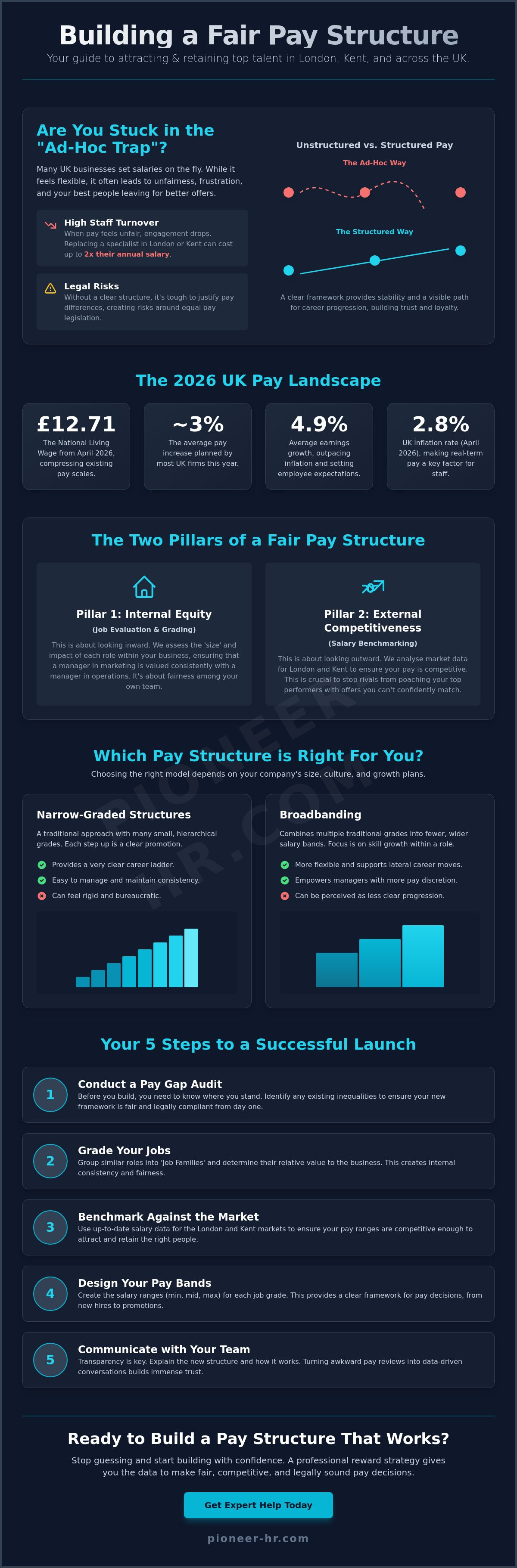
A pay structure is far more than a simple spreadsheet of numbers. It's a logical hierarchy of job grades and salary ranges that defines how value is recognised within your business. When we partner with clients on building a fair pay structure, we often start by dismantling the "ad-hoc trap." This is the common SME habit of seting salaries based on whatever the business can afford at the moment of hire. While this feels flexible in the short term, it inevitably leads to internal friction when long-standing employees realise new starters are earning more for the same responsibilities.
The legal landscape in 2026 makes this structure even more vital. With the National Living Wage having risen to £12.71 in April, many firms are finding that their existing pay scales have "compressed," leaving little difference between entry-level roles and supervisory positions. Beyond basic compliance, UK government guidance now strongly encourages transparency. Even if you don't yet meet the 250-employee threshold for mandatory gender pay gap reporting, your team likely expects that level of clarity. Proactively creating a reward strategy ensures you stay ahead of these expectations rather than reacting to them under pressure.
The Hidden Costs of an Unstructured Pay Policy
Workplace morale often hinges on the perception of fairness. In the era of total transparency, "salary secrets" rarely stay secret. When staff feel undervalued compared to market rates or their peers, engagement drops and turnover rises. Replacing a specialist in Kent or London is expensive, often costing up to double their annual salary when you factor in lost productivity and recruitment fees. Unstructured pay also creates unintentional legal risks. Without clear job grading, it's difficult to prove that pay differences are based on objective criteria rather than protected characteristics. Many organisations find that integrating performance-related pay systems into a formal structure is the most effective way to reward high achievers while maintaining equity.
Navigating the South East Talent Market
Businesses in Brighton, Hove, and across Kent face a unique challenge in 2026. The traditional "London Weighting" has been disrupted by remote and hybrid work models. You're no longer just competing with the shop down the road; you're competing with London-based firms offering city salaries for remote roles. A structured approach is your best defense against aggressive poaching. By building a fair pay structure that is grounded in local data but acknowledges these blurred geographic boundaries, you provide the stability and career progression that top talent craves. It gives you the confidence to look an employee in the eye and explain exactly how their pay is determined and what they need to do to reach the next level.
The Foundation: Salary Benchmarking and Job Evaluation
Before you can start assigning numbers to roles, you need a solid base. Building a fair pay structure requires a dual focus: looking inward at your own team and outward at the broader UK market. We find that this balance between internal equity and external competitiveness is the critical "sweet spot." If you focus too much on internal fairness, you risk losing talent to higher-paying firms in London. If you only chase market rates, you'll likely create resentment among your loyal, long-standing staff in Kent or Sussex.
Job evaluation is the analytical tool that helps you navigate this. It's about assessing the "size" and impact of a role, regardless of who's currently sitting in the chair. In 2026, this has become even more critical. With UK inflation sitting at 2.8% in April 2026 and average earnings growing by 4.9%, the ground is shifting quickly. You can't rely on data from two years ago. Regular reviews ensure your framework reflects the actual demand for specific skills, such as AI or data analytics, which are currently commanding significant premiums.
Job Grading: Categorising Roles Fairly
Job grading is the process of determining the relative value of different roles within an organisation.
For many SMEs, a "whole-job ranking" system is often the most practical choice, as it avoids the complexity of large-corporate points-factor systems. By grouping similar roles into "Job Families," you can ensure consistency across different departments. This means a manager in marketing and a manager in operations are treated with the same level of professional respect and financial reward, provided their impact on the business is comparable.
External Benchmarking: Looking Outside the Business
Once you've graded your roles, you need to see how they stack up against the competition. This is where salary benchmarking becomes indispensable. While it's tempting to use free online "salary checkers," these often provide skewed data that doesn't account for the nuances of your sector or the specific "London Weighting" pressures in the South East. Effective building a fair pay structure relies on this external context to ensure you aren't overpaying or underpaying for talent. You might also consult a CIPD factsheet on pay structures to understand different models before applying verified market data.
Remember that benchmarking shouldn't just focus on the base salary. In the 2026 market, your "total reward" package, including hybrid work flexibility, health benefits, and professional development, is often what tips the scales for candidates. If you're unsure where your current packages sit, a professional reward strategy audit can help you identify exactly where you're winning and where you're falling behind.
Designing Your Framework: Grades, Bands, and Spines
Once you've established your job evaluations and benchmarked your data, the next stage of building a fair pay structure is designing the actual architecture. This is where we move from abstract data to a functional system that rewards your team fairly. You have several options here, and the choice depends heavily on your company culture and growth stage. Narrow-graded structures, which feature many small steps, offer high levels of control and a very clear path for progression. However, they can feel overly rigid for fast-growing startups or smaller teams in Kent where roles often overlap and evolve quickly.
Alternatively, many modern UK SMEs are moving toward broadbanding. This model uses fewer, much wider salary bands. It provides the flexibility needed for lateral moves and encourages employees to develop their skills within a grade rather than just "title hunting" for the next promotion. While this flexibility is a major benefit, broadbanding requires careful management to avoid "pay creep," where salaries drift toward the top of the band without a corresponding increase in responsibility or market value.
Choosing the Right Structure for Your SME
While "Pay Spines" are a staple in the UK public sector, we find they are often too bureaucratic for private SMEs in the South East. For a business based in Kent or London, a more agile approach usually works best. Broad bands allow you to reward expertise and professional growth without the need for constant re-grading. When you implement these new bands, you will inevitably find "outliers." These are employees currently paid above or below their proposed range. We recommend a phased approach for these cases, such as "green-circling" those who are underpaid by adjusting their salary immediately, while managing "red-circled" overpaid staff through performance bonuses or role expansion rather than pay cuts.
Calculating Midpoints and Differentials
The midpoint is the most important part of your band; it represents the market rate for a fully competent employee in that role. You calculate a salary band midpoint using the formula: (Minimum + Maximum) / 2. In the 2026 UK market, we typically see a range spread of 20% to 40% from the minimum to the maximum of a band. This allows plenty of room for an employee to grow as they gain experience.
It's also vital to ensure there is enough "daylight" between the midpoints of different grades to make a promotion feel meaningful. However, don't be afraid of some overlap between bands. A high-performing, experienced junior in a London-based tech role might naturally earn more than a brand-new senior who is still finding their feet. This overlap is a healthy sign of a mature approach to building a fair pay structure that values actual contribution over mere job titles.
Implementation: From Paper to Payday
Moving from a theoretical framework to a live system is where the real work begins. Building a fair pay structure demands a meticulous implementation process that starts with a thorough pay gap audit. This step is non-negotiable for identifying existing inequalities that may have crept in over years of ad-hoc hiring. For instance, the mean gender pay gap in the UK still sits at 10.7% as of 2026. Addressing these discrepancies before you map employees to new grades prevents you from baking old biases into your new system. Once the data is clear, you can map every current employee to their new grade and band with total confidence.
Managing Pay Progression in 2026
The 2026 landscape has moved decisively away from "automatic" annual increases. With the National Living Wage reaching £12.71 in April, many SMEs are finding their budgets tighter than ever. We encourage our clients to shift toward value-based progression. This means pay rises are earned through skill development and measurable performance rather than simply "time served." By using a clear reward strategy, you can incentivise the specific behaviours that drive your business forward. This transition requires your managers to be well-prepared; they need the skills to hold constructive, data-driven pay conversations without the usual awkwardness. We often find that providing management training is the missing piece that ensures these new policies actually stick.
Communicating the New Structure
Transparency is the best antidote to workplace gossip and resentment. When you roll out the new framework, don't just send a memo about salary changes. Provide "Total Reward Statements" that highlight the full value of the package. This should include pension contributions, hybrid work flexibility, and professional development opportunities. This is especially important for staff in Kent or London who might be comparing their base salary against city-firm offers without considering the full benefits of your organisation.
You will inevitably face difficult conversations, particularly with employees who are already at the top of their band. In the South East, where competition for talent is fierce, these moments are high-stakes. Instead of a flat "no" to future raises, focus on the opportunities for progression into the next grade or lateral moves that build new skills. Explain the "why" behind the structure with empathy. When people understand the logic and the market data supporting your decisions, they are far more likely to trust the process. If you're looking for a partner to guide you through these complex changes, our retained HR support provides the ongoing expertise needed to manage your people strategy with precision.
How Pioneer HR Supports Your Pay Strategy
Turning a complex set of market data into a functional reality requires more than just a spreadsheet. We understand that for many UK SMEs, the challenge of building a fair pay structure often clashes with the day-to-day pressures of running a business. Our approach bridges this gap by offering expert consultancy that respects your commercial needs while ensuring you remain a competitive employer in the London and South East markets. We don't believe in one-size-fits-all templates; we believe in strategic partnerships that reflect the unique heartbeat of your organisation.
Our work begins with bespoke salary benchmarking that's tailored specifically to your sector and location. Whether you're a tech startup in Brighton or an established logistics firm in Kent, we provide the precise data you need to make confident decisions. For those seeking long-term strategic guidance, our Fractional CPO service offers the high-level expertise of a Chief People Officer without the full-time overhead. This ensures your people strategy remains aligned with your growth goals throughout 2026 and beyond.
Our Approach to Reward and Recognition
We design reward frameworks that are more than just a list of numbers; they're a reflection of your company culture and values. By integrating job grading with your specific recruitment and retention goals, we help you build a system that rewards the right behaviours. We treat your pay structure as a living document. It must evolve as the 2026 market shifts, ensuring you aren't caught off guard by rising inflation or sudden changes in regional demand. Our goal is to create a sense of professional pride within your team, where every employee knows their value is recognised through a transparent and objective process.
Ready to Build a Fairer Workplace?
The journey toward a more equitable organisation often starts with a simple HR audit. This process can quickly reveal the "leaks" in your current approach, such as unintentional pay gaps or outdated benefits that no longer appeal to the modern workforce. There's immense peace of mind that comes from having professional, third-party validation of your pay practices. It protects you from legal risks and, more importantly, it builds a foundation of trust with your people.
If you're ready to take the next step in building a fair pay structure, contact Pioneer HR today. We'd love to have a conversational, no-obligation chat about your reward strategy and how we can help your business thrive in Sussex, London, and beyond. Let's work together to create a framework that truly supports your best people.
Securing Your Future with a Strategic Reward Framework
A robust salary framework is the backbone of a resilient organisation. By moving away from the "ad-hoc trap" and embracing data-driven job grading, you're not just ticking a compliance box; you're actively protecting your most valuable asset: your people. We've seen how building a fair pay structure transforms awkward salary reviews into transparent, trust-building conversations that keep your best talent from looking toward London rivals. It's about creating a culture where every team member understands their value and their path for progression.
At Pioneer HR, we bring over 30 years of HR experience to help you navigate these complexities with confidence. Our specialist UK salary benchmarking data provides the clarity you need to stay competitive in 2026, whether you're based in Hove, Brighton, or the heart of Kent. We're here to ensure your reward strategy is commercially viable, legally compliant, and deeply human. Ready to take the guesswork out of your payroll? Book a consultation with our Reward Strategy experts to build your fair pay structure today. Let's create a framework that reflects the true value of your team and sets your business up for long-term success.
Frequently Asked Questions
What is the difference between a pay grade and a salary band?
A pay grade represents a specific level of responsibility or seniority within your organisation's hierarchy, while a salary band is the financial range assigned to that grade. You can think of the grade as the "rank" and the band as the "pay room" within that rank. This distinction is a fundamental part of building a fair pay structure, as it allows for individual salary growth without needing a constant change in job title.
How often should a UK SME review its salary structure?
We recommend a full review of your salary structure at least once a year to stay aligned with the market. This is particularly important in 2026, given that the National Living Wage rose to £12.71 in April. Regular reviews help you spot "pay compression," where the gap between entry-level and senior roles shrinks too much. Staying on top of these shifts ensures your business remains competitive against both local Kent firms and larger London competitors.
Can we have different pay structures for different locations (e.g., London vs. Kent)?
It's entirely possible to maintain different pay structures or "location weightings" for offices in London and Kent. Many SMEs do this to account for the higher cost of living and travel in the capital. The key is to ensure your reasoning is documented and applied fairly across all roles. This prevents resentment and ensures your regional offices aren't unfairly penalised by city-centric data that might not reflect local market realities.
Is it legal to pay two people in the same role different amounts?
It is legal to pay employees in the same role different amounts, provided the difference is based on objective criteria. This might include varying levels of experience, specific technical certifications, or measurable performance outcomes. A structured framework is your best defense here. It allows you to justify these pay gaps with clear data, ensuring you don't fall foul of equal pay legislation or unintentional discrimination between your team members.
What should I do if an existing employee is already paid above their new salary band?
This situation is known as "red-circling," and it requires a delicate, empathetic approach. You should protect the employee's current salary to maintain trust, even if it sits above the new band maximum. You might choose to freeze their base pay increases until the market or the band catches up. Instead of a standard raise, you could reward their high performance through non-consolidated bonuses or by helping them transition into a higher-graded role.
How do I explain a new pay structure to my team without causing panic?
Start by framing the new structure as an investment in fairness and transparency for everyone. Explain that building a fair pay structure provides the team with a clear roadmap for their career and future earnings. We suggest holding one-to-one meetings for anyone directly affected by band changes. When you lead with empathy and focus on the long-term benefits of professional growth, you replace uncertainty with a sense of security and value.
What are the benefits of broadbanding for a small business?
Broadbanding simplifies your HR processes by using fewer, wider pay ranges instead of many narrow grades. For a smaller business, this flexibility is invaluable because it rewards skill acquisition rather than just "climbing the ladder." It allows an employee to grow their salary significantly as they become an expert in their current role. This reduces the pressure on you to invent new job titles just to give someone a well-deserved raise.
How does a fair pay structure impact employee retention?
Fairness is a powerful retention tool that builds deep-seated loyalty within your workforce. When staff feel their pay is determined by an objective system rather than "who asks loudest," trust in leadership grows. Employees who see a clear, structured path for their future earnings are far less likely to be tempted by recruiters. A transparent framework proves that you value their contribution, which is often more important for long-term loyalty than the base salary alone.


Comments