
Salary Benchmarking: A Complete Guide for UK Businesses in 2026
Updated: Mar 7

Does the thought of losing a star candidate to a competitor over a salary dispute feel frustratingly familiar? Or perhaps you're concerned that your most valued team members might be tempted by more lucrative offers elsewhere. These challenges are common, but they often point to a single, solvable issue: a disconnect between your compensation strategy and the realities of the market. In the dynamic UK business landscape of 2026, guesswork is no longer a viable option when it comes to pay. This is where a robust and data-driven approach to salary benchmarking becomes an indispensable tool for sustainable growth.
In some cases, especially within the tech sector, benchmarking might reveal that the cost and competition for permanent, specialised roles are exceptionally high. When direct hiring becomes a bottleneck, businesses often turn to flexible talent solutions to maintain momentum. For those considering this path, you can learn more about Staff Augmentation as a strategic alternative to access critical software development skills without the long-term overhead.
Navigating the complexities of fair and competitive pay can feel overwhelming, but it doesn’t have to be. In this complete guide, we will demystify the process for UK businesses. We’ll explore precisely what salary benchmarking entails, why it is so critical for attracting and retaining top talent, and provide a clear, actionable framework for implementing a system in your own organisation. By the end, you will have the confidence and knowledge to build a pay structure that is not only competitive and transparent but also a cornerstone of your company's long-term success.
Key Takeaways
Understand salary benchmarking as a strategic process, not just a quick search, to ensure your pay structures are competitive and fair within the UK market.
Discover how a data-driven approach to compensation moves beyond talent attraction to improve budget accuracy and provide greater control over payroll costs.
Learn a clear, five-step process for conducting effective salary benchmarking, from defining key roles to identifying reliable, UK-specific data sources.
Identify the common pitfalls of DIY benchmarking, such as using outdated free data, to avoid making costly and misinformed pay decisions.
Table of Contents What is Salary Benchmarking? (And Why It’s Critical for UK SMEs) The Strategic Benefits: Beyond Just Attracting and Retaining Talent How to Conduct Salary Benchmarking: A 5-Step UK Process Common Pitfalls of DIY Benchmarking (And How to Avoid Them) Partnering with an Expert: How Pioneer HR Delivers Accurate Benchmarking
What is Salary Benchmarking? (And Why It’s Critical for UK SMEs)
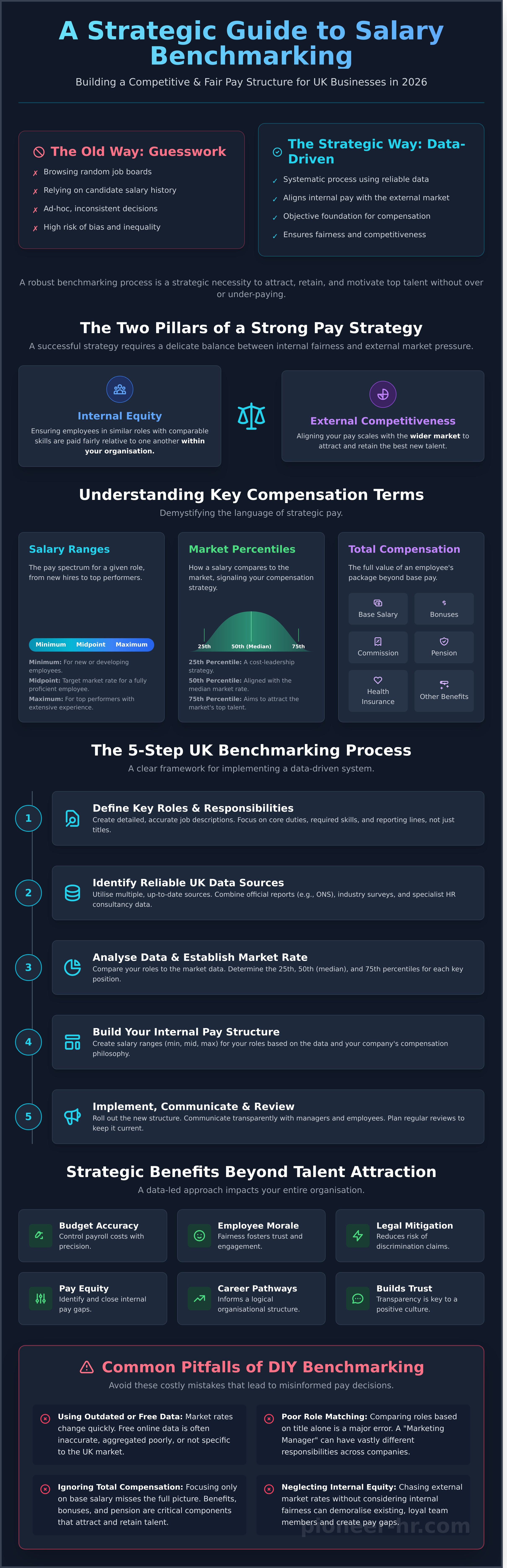
Salary benchmarking is a systematic, data-driven process for determining the market rate for a specific role. It moves beyond guesswork and ad-hoc methods-like browsing job boards or asking candidates about their salary history-to provide an objective foundation for your compensation strategy. The core purpose is to align your internal pay structures with the external market, ensuring you can attract, retain, and motivate the right talent without over- or under-paying.
For UK SMEs navigating the landscape of 2026, this process is no longer a luxury but a strategic necessity. In an era defined by intense talent wars, persistent inflationary pressures, and a growing legislative push for pay transparency, having a defensible and competitive pay structure is critical. A robust salary benchmarking exercise provides the clarity needed to make confident and fair compensation decisions.
Internal vs. External Benchmarking
A successful compensation strategy requires a delicate balance between two key perspectives. Internal equity focuses on ensuring that employees in similar roles, with comparable skills and responsibilities within your organisation, are paid fairly relative to one another. In contrast, external competitiveness involves aligning your pay scales with the wider market to attract new talent. Neglecting one for the other can lead to either internal dissatisfaction or an inability to compete for skilled professionals.
Key Terminology Explained
To navigate compensation effectively, it's essential to understand the language of the field. We find that demystifying these terms helps build a solid foundation for strategic planning:
Salary Ranges: For any given role, this defines the pay spectrum. It includes a minimum (for new or developing employees), a midpoint (the target market rate for a fully proficient employee), and a maximum (for top performers with extensive experience).
Percentiles: These indicate how a salary compares to the market. The 50th percentile is the median market rate. Paying at the 25th percentile might be suitable for a cost-leadership strategy, while aiming for the 75th percentile signals a desire to attract the market's top talent.
Total Compensation: This looks beyond the basic salary to include the full value of an employee's package, such as bonuses, commission, pension contributions, private health insurance, and other benefits. This holistic view is fundamental to understanding employee wages and what truly motivates them.
The Strategic Benefits: Beyond Just Attracting and Retaining Talent
While attracting top candidates and retaining key employees are the most immediate outcomes of competitive pay, the true value of salary benchmarking extends far deeper into your organisation's strategic core. Moving beyond reactive salary negotiations, a data-led approach provides the financial foresight and structural integrity necessary for sustainable growth. It allows you to manage your largest expense-payroll-with precision, ensuring every pound spent on compensation delivers a clear return on investment.
This data-driven clarity directly impacts employee morale and engagement. When your team understands that their pay is determined by objective market data and a consistent internal framework, it fosters a powerful sense of fairness. This transparency replaces uncertainty with trust, mitigating the risk of dissatisfaction and disputes while creating a more stable and motivated workforce. Furthermore, it protects your business by helping to mitigate legal risks associated with the UK's Equal Pay Act and potential discrimination claims.
Driving Pay Equity and Transparency
A systematic benchmarking process is your most effective tool for identifying and closing internal pay gaps based on gender, ethnicity, or other protected characteristics. By comparing your pay structures against robust external sources, including official UK earnings data, you can make informed adjustments to ensure equitable compensation. This proactive stance is crucial as the UK moves towards greater pay transparency, enabling you to build a culture of trust long before legislation mandates it.
Informing Organisational Structure
Effective salary benchmarking provides the objective evidence needed to design a logical and defensible organisational structure. It helps define clear job levels and career progression pathways, ensuring that pay scales are directly aligned with the scope of responsibility and business impact of each role. This process removes ambiguity and subjectivity, forming the foundation of a wider job grading exercise that brings clarity to your entire organisation.
Ultimately, these elements-financial control, legal compliance, fairness, and structural logic-are not isolated benefits. They are interconnected pillars that support a holistic and effective reward strategy, transforming compensation from a simple cost centre into a strategic driver of business performance.
How to Conduct Salary Benchmarking: A 5-Step UK Process
Effective salary benchmarking is not a one-off task but a structured process that transforms raw data into a strategic asset. By following a clear methodology, UK businesses can ensure their compensation strategy is competitive, fair, and defensible. We guide our partners through a proven five-step framework designed to deliver clarity and confidence.
Define and Document Key Roles: The foundation is absolute clarity. We begin by ensuring your key roles have detailed, up-to-date job descriptions that accurately reflect responsibilities, required skills, and reporting lines. Without this, accurate market matching is impossible.
Identify Reliable UK Data Sources: With roles clearly defined, the next step is to gather robust market intelligence. A blended approach, combining different types of data, provides the most comprehensive view of the UK pay landscape.
Match Your Roles to External Market Data: This crucial step requires precision. It involves mapping your internal job titles and responsibilities to standardised roles within the external data sets. An inexact match can lead to skewed and unreliable results.
Analyse the Data and Establish Salary Ranges: Here, raw data becomes actionable insight. We analyse the benchmarks-typically looking at the 25th, 50th (median), and 75th percentiles-to establish logical salary bands that reflect your company's pay philosophy.
Create a Formal Pay Structure and Communication Plan: Finally, the insights are formalised into a transparent pay structure. This framework must be documented and communicated effectively to managers, ensuring it aligns with best practices and legal standards, such as the Acas guidance on pay and hours, to build trust.
Choosing the Right Data Sources in the UK
Selecting the appropriate data is fundamental to the accuracy of your salary benchmarking. A multi-source strategy is always recommended for a balanced perspective.
Free Sources (ONS, Industry Reports): The Office for National Statistics (ONS) provides high-level UK wage data. While useful for general trends, it lacks the granularity needed for specific roles and industries.
Paid Salary Surveys: These are the cornerstone of reliable benchmarking. Reputable providers offer detailed breakdowns by sector, company size, and UK region, giving you a much more accurate comparison.
Consultancy Data: For highly specialised or senior roles, bespoke data from HR consultancies offers real-time market intelligence, reflecting current hiring dynamics that may not yet appear in annual surveys.
Analysing the Data and Setting Your Pay Philosophy
Once you have reliable data, the final step is to interpret it in the context of your business strategy. This is where you define how you want to position your organisation within the market.
Decide Where You Want to Sit: Will you lag the market (paying below the median), meet it (aligning with the median), or lead it (paying above the median)? Leading the market can attract top-tier talent but comes with higher costs.
Factor in UK Regional Differences: Compensation is not uniform across the UK. It is essential to account for regional pay variations, most notably the significant 'London weighting' required to attract talent in the capital.
Consider Your Total Rewards Package: Base salary is only one part of the equation. Factor in bonuses, pension contributions, health benefits, and flexible working policies, as these elements complete your competitive offer.
Common Pitfalls of DIY Benchmarking (And How to Avoid Them)
In today's data-rich world, the temptation to simply Google a salary range is strong. While a quick search can provide a starting point, relying on this method for strategic decisions is fraught with risk. Effective salary benchmarking is a nuanced process that goes far beyond surface-level data, and getting it wrong can have significant consequences for your budget, employee morale, and talent retention.
Attempting a DIY approach often leads to several critical errors. By understanding these pitfalls, you can ensure your compensation strategy is built on a foundation of accuracy and trust.
The Dangers of an 'Apples to Oranges' Comparison
The most common mistake is mismatching job roles based on title alone. A 'Project Manager' at a 50-person tech startup in Manchester has vastly different responsibilities and market value compared to a 'Project Manager' at a FTSE 100 financial firm in London. Free, aggregated data rarely accounts for these crucial distinctions, leading to flawed conclusions. To avoid this, you must look deeper:
Scope and Seniority: Does the role involve managing a team, controlling a budget, or shaping company strategy? A generic title doesn't reveal this.
Contextual Factors: Industry, company size, and UK location dramatically influence pay. A role in FinTech will often command a higher salary than an equivalent role in the third sector, and the same principle applies to service industries built on skilled trades. For a look at a company in a competitive field like HVAC, you can check out BulletProof Air.
Total Reward: Focusing only on base salary ignores the complete picture. Bonuses, commission structures, equity, and benefits are powerful components that a simple search will miss.
Inaccurate matching inevitably leads to either overpaying and straining your budget or underpaying and losing valuable talent to better-informed competitors.
Forgetting to Communicate the 'Why'
Even a perfectly executed salary benchmarking analysis can fail if the results are implemented without a clear communication plan. Introducing a new pay structure in a vacuum breeds suspicion and erodes trust. Employees need to understand the methodology and the philosophy behind the changes. Explain how the new structure promotes fairness, market competitiveness, and internal equity. Without this transparency, you risk creating more disengagement and anxiety than you solve, turning a positive initiative into a source of internal friction.
Partnering with an Expert: How Pioneer HR Delivers Accurate Benchmarking
Understanding the principles of salary benchmarking is one thing; implementing it with precision and confidence is another. While DIY methods and free online tools can offer a starting point, they often lack the depth, accuracy, and strategic context required to make critical business decisions. This is where a specialist partner becomes invaluable, transforming raw data into a powerful tool for talent acquisition and retention.
At Pioneer HR, we move beyond generic data sets. Our approach is built on a foundation of multiple, robust, and up-to-date UK salary data sources, ensuring the information you receive reflects the true market rate. We believe that effective compensation is not just about a number; it’s about building a fair, transparent, and motivating reward strategy that aligns perfectly with your company's goals.
Our Bespoke Benchmarking Process
Our methodology is designed to provide clarity and actionable results. We partner with you to:
Understand Your Context: We start by delving into your unique business objectives, organisational culture, and budget constraints to ensure our recommendations are both competitive and sustainable.
Conduct Thorough Job Matching: We go beyond titles to analyse the true scope, responsibility, and impact of each role, ensuring we compare your positions to genuinely equivalent roles in the market.
Deliver Actionable Insights: You receive a clear, comprehensive report with recommended salary bands, market positioning, and the strategic rationale behind our findings.
From Data to Decision: Your Strategic Partner
Receiving a report is just the beginning. Our true value lies in helping you translate that data into a coherent, long-term pay structure. We empower your leadership team with the confidence to make competitive offers, conduct fair and consistent pay reviews, and communicate compensation decisions transparently. Our ultimate goal is to equip you with a lasting competitive edge in the dynamic UK talent market, turning your reward strategy into a key driver of success.
Ready to ensure your pay scales are precise, competitive, and fair? See our detailed approach to professional pay benchmarking and discover how we can support your business.
Transform Your Reward Strategy for 2026 and Beyond
In today's competitive UK market, a reactive approach to compensation is a significant business risk. As we've explored, a proactive and data-led reward strategy is essential for attracting and retaining top talent, while avoiding the costly pitfalls of inaccurate, DIY analysis. Effective salary benchmarking is the cornerstone that ensures your remuneration is not just competitive, but also equitable and sustainable for long-term growth.
Making these critical decisions with confidence requires a trusted partner. At Pioneer HR, we leverage over 30 years of dedicated HR experience and our specialist focus on the UK SME market to deliver the clarity you need. Our data-driven approach transforms your reward strategy from an operational task into a powerful competitive advantage. Take the decisive step towards building a more resilient, engaged, and motivated workforce. Get a bespoke salary benchmarking report for your business and secure your position as an employer of choice.
Frequently Asked Questions About Salary Benchmarking
How often should a UK business conduct salary benchmarking?
We recommend a comprehensive salary benchmarking exercise at least once a year. The UK labour market is dynamic, and factors like inflation and evolving talent demands can quickly render pay scales outdated. For rapidly growing sectors or businesses experiencing high staff turnover, a bi-annual review may be more prudent. This proactive approach ensures your compensation strategy remains competitive and supports long-term talent retention, preventing costly employee attrition before it begins.
What is the difference between salary benchmarking and a salary survey?
A salary survey is a raw data collection tool, providing aggregated pay information from various companies for specific roles. In contrast, salary benchmarking is the strategic process of analysing this data and comparing it against your organisation's internal roles and compensation philosophy. Think of a survey as the raw market intelligence; benchmarking is the tailored analysis that transforms that intelligence into an actionable, competitive pay structure for your unique business needs.
How much does professional salary benchmarking cost for an SME?
The cost for a UK SME can vary based on the project's scope. For a small number of standard roles, you might expect costs to start from £1,500 to £3,000. A more comprehensive project involving multiple departments, niche roles, and a detailed benefits analysis could range from £5,000 to over £10,000. We provide tailored quotes because the investment depends on the depth of analysis required to give you a true competitive advantage in the talent market.
Can salary benchmarking help with roles that are new or unique to our industry?
Absolutely. For new or unique roles where direct market data is scarce, we employ a more analytical approach. This involves breaking the position down into its core competencies and benchmarking against similar skill sets in established roles. We also analyse data from adjacent or innovative industries that may have comparable positions. This methodology allows us to construct a robust, data-backed salary range, ensuring you can attract niche talent confidently even without a direct one-to-one market comparison.
What are the most reliable sources for UK salary data?
The most reliable data comes from established, multi-source providers. We prioritise large-scale compensation surveys from reputable HR consultancies, which aggregate anonymised payroll data directly from businesses. Industry-specific reports from professional bodies are also invaluable for niche sectors. For strategic decisions, we always cross-reference data with official sources like the Office for National Statistics (ONS) for a comprehensive and defensible view of the market.
How do I adjust salaries for remote workers based in different parts of the UK?
There are three primary strategies for this. You can adopt a single national pay scale, which promotes internal equity but may be uncompetitive in high-cost areas like London. Alternatively, a location-based model uses geographical pay zones (e.g., London, South East, Rest of UK) to reflect living costs. A hybrid approach may set a national baseline but offer a cost-of-living supplement. The right choice depends on your company culture, talent strategy, and commitment to fairness.
Does salary benchmarking consider bonuses and other benefits?
Yes, a truly comprehensive exercise looks beyond base salary to evaluate the entire 'Total Rewards' package. This includes variable pay like bonuses and commission, as well as non-cash benefits such as pension contributions, private healthcare, and annual leave allowance. Comparing only base pay can be misleading; to attract and retain top talent, it's crucial to understand how your complete compensation and benefits offering stacks up against the market.
How do I communicate new salary bands to my existing employees?
Communication should be transparent, consistent, and well-planned. We advise training managers first so they can confidently answer team questions. Prepare clear documentation explaining the methodology and the company's compensation philosophy-the 'why' behind the changes. For employees whose pay is affected, individual conversations are essential to explain the personal impact and next steps in a supportive and empathetic manner, reinforcing trust and fairness.


Comments