
Pay Rise 2026 UK: What Happened & How It Shapes Your 2026 Salary Strategy
Updated: Mar 7
Pay Rise 2025 UK: What Happened & How It Shapes Your 2026 Salary Strategy
Are you finding it increasingly difficult to keep your best people, watching them leave for competitors with deeper pockets? It’s a common story for business leaders across the UK, from busy offices in London to growing enterprises in Kent. The constant pressure of salary demands and the uncertainty surrounding the pay rise 2025 landscape have made strategic planning more challenging than ever, leaving many to wonder if their compensation is truly competitive.
But navigating this complex environment doesn’t have to be a source of anxiety. In this article, we’ll cut through the noise and provide the clarity you need. We will break down the definitive trends and statistics that shaped 2025, showing you how to use these vital insights to build a fair, affordable, and highly effective reward strategy for 2026. Together, we'll explore how to create a plan that not only retains your star performers through competitive pay but also strengthens your business for the year ahead.
Key Takeaways
Understand the key data behind the average UK pay rise 2025 and why a purely reactive approach is unsustainable for your business.
Discover how to reframe salary reviews from an operational cost into a strategic investment for retaining your most valuable employees.
Gain a clear framework for building a 2026 pay strategy that is both competitive in the UK market and equitable for your internal team.
Learn how to use objective market data to benchmark your salaries, ensuring you can attract and keep the talent your business needs to grow.
Table of Contents A Look Back: The UK Pay Rise Landscape in 2025 From Reaction to Strategy: Interpreting the 2025 Data for 2026 Affordability vs. Competitiveness: Solving the SME's Dilemma Your 2026 Pay Review Action Plan: A 5-Step Framework Build a Resilient 2026 Reward Strategy with Pioneer HR
A Look Back: The UK Pay Rise Landscape in 2025
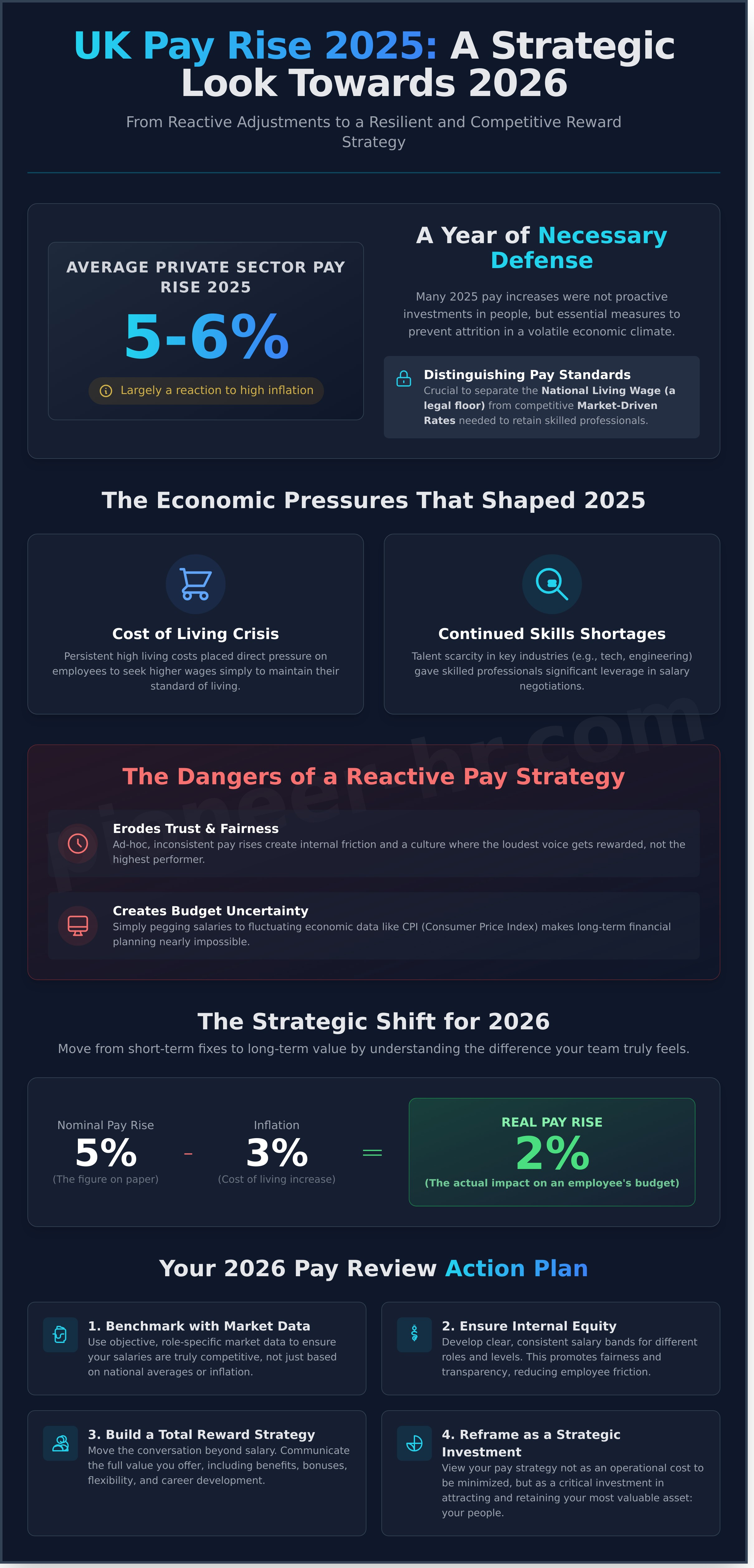
To effectively handle pay rise requests today, we must first understand the landscape we've just navigated. The year 2025 was defined by a complex interplay of economic pressures and evolving employee expectations. Following a period of high inflation in late 2024, businesses across the UK faced significant pressure to adjust their compensation strategies. This culminated in two key benchmarks: the government-mandated National Living Wage (NLW) increase in April, and an average private sector pay rise that hovered around 5-6%.
However, this national average concealed vast disparities. The salary expectations for a software developer in London's competitive tech hub were fundamentally different from those of a hospitality worker in Kent. For employers, the central challenge was balancing mandatory compliance with strategic talent retention in a volatile market. The most common pay rise 2025 was, in essence, a direct response to a demanding economic climate.
National Living Wage vs. Market-Driven Averages
It’s crucial to distinguish between the NLW and competitive market rates. The NLW serves as a legal floor-a minimum standard of pay that is not intended as a benchmark for all roles. For skilled or experienced professionals, relying solely on this statutory increase was a significant retention risk. In 2025, companies that failed to align salaries with the market rate for specific roles saw their most valuable employees become prime targets for competitors.
The Economic Drivers Behind 2025's Salary Reviews
The salary review season was largely shaped by reactive pressures rather than proactive talent strategies. The primary drivers included:
The Cost of Living Crisis: Persistent high living costs placed direct pressure on employees to seek higher wages to maintain their standard of living. This pressure is a recurring theme when analysing historical UK income data.
Continued Skills Shortages: Key industries, from engineering to healthcare, continued to face talent shortages. This scarcity gave skilled professionals significant leverage in salary negotiations, forcing employers to offer more competitive packages.
For skilled professionals in high-demand sectors like healthcare, higher earnings often coincide with major financial decisions. Navigating complex processes such as securing a mortgage can be particularly challenging, which is why specialist services like Doctors Mortgages exist to provide tailored support for medical professionals.
Ultimately, these factors meant that many salary increases in 2025 were a necessary defence against attrition, rather than a forward-thinking investment in people.
From Reaction to Strategy: Interpreting the 2025 Data for 2026
The past year has seen many UK businesses adopt a reactive stance on salaries, with decisions often driven by headline inflation figures. While understandable, this approach to the typical pay rise 2025 was a short-term fix, not a sustainable strategy. Continuing to make ad-hoc adjustments based on fluctuating economic data creates budget uncertainty and, more damagingly, internal inequality. As we plan for 2026, it is crucial to move beyond simple percentage increases and develop a comprehensive total reward strategy that aligns with long-term business goals.
Simply pegging salaries to the Consumer Price Index (CPI) is a flawed approach. CPI measures the changing cost of a national "basket of goods," which may not accurately reflect the specific financial pressures on your employees or the talent market conditions in your sector. It is a blunt instrument for a delicate task.
The Hidden Dangers of Inconsistent Pay Rises
When pay decisions are made in isolation, they can quickly erode trust and morale. An employee in your Kent office who negotiated a higher raise than a peer in London can create significant internal friction. This inconsistency dismantles carefully constructed salary bands and fosters a culture where the loudest voice gets rewarded, not necessarily the highest performer. This undermines fairness and can lead to the loss of your most valuable, and often quietest, team members.
Understanding 'Real' vs. 'Nominal' Pay Growth
To build a fair system, it’s essential to distinguish between two key concepts. A nominal pay rise is the figure on paper-for example, a 5% increase. However, the real pay rise is what remains after inflation is accounted for. This is the figure that truly impacts an employee's household budget. While official UK average weekly earnings data may show nominal growth, the real-terms value is what your team feels. A well-structured reward strategy helps communicate the total value you offer, moving the conversation beyond a single percentage to include benefits, bonuses, and career development opportunities.
Affordability vs. Competitiveness: Solving the SME's Dilemma
For many SME owners across the UK, from bustling hubs in London to growing businesses in Kent, the prospect of salary increases can trigger a single, pressing question: "How can we possibly afford this?" It's a valid concern, but we encourage you to reframe the conversation. Viewing a pay rise not as a sunk cost, but as a strategic investment in talent retention, is the first step toward a sustainable solution.
Consider the true cost of employee turnover. Replacing a skilled team member earning £45,000 can easily cost your business over £12,000 in recruitment fees from firms like McGlynn Personnel, lost productivity, and training. When you weigh this against a 5% salary increase (£2,250), the financial case for investing in your existing talent becomes clear. A competitive pay rise 2025 strategy is fundamentally a risk management tool against the far greater expense of recruitment and retraining.
Beyond the Paycheque: High-Impact, Low-Cost Rewards
Competing on salary alone is a race few SMEs can win. Instead, we help our partners build a compelling 'Total Reward' package where salary is just one component. High-impact benefits that resonate deeply with UK employees often carry a manageable cost:
Flexible and Hybrid Working: Now a key expectation, this offers immense value by reducing commuting costs and improving work-life balance, at little direct cost to the business.
Professional Development: A dedicated training budget or a clear career progression framework demonstrates a long-term investment in an employee's future with your company.
Enhanced Benefits: Offerings like private health top-ups, a wellness allowance for gym memberships, or an extra day of annual leave have a high perceived value that can far outweigh their actual cost.
Even small, thoughtful gestures can make a big impact. Recognizing employee milestones or holidays with a well-chosen gift can be a powerful, low-cost way to show appreciation. For managers looking for inspiration, online guides like Bra Presenter offer a wide range of ideas suitable for various occasions.
How to Communicate Total Value to Your Team
A brilliant benefits package loses its impact if its value isn't understood. To bridge this gap, proactive communication is essential. We recommend implementing Total Reward Statements, which provide each employee with a personalised breakdown of their entire compensation package, including salary, pension contributions, and the monetary value of their benefits. It's also vital that your base pay remains compliant and fair; keeping up with the official 2025 minimum wage rates is a non-negotiable starting point. By training managers to discuss career growth and benefits during reviews, you transform the pay conversation from a simple transaction into a meaningful dialogue about long-term, mutual value.
Your 2026 Pay Review Action Plan: A 5-Step Framework
A fair and transparent pay review process doesn't happen by accident; it's the result of careful, proactive planning. As you reflect on the outcomes of the pay rise 2025 season, now is the perfect time to build a robust framework for the year ahead. A structured approach not only ensures fairness but also strengthens employee trust and protects your business. Here is our recommended 5-step plan to guide you.
Step 1: The Critical Role of Salary Benchmarking
The foundation of any fair pay decision is objective data. While free online salary checkers can offer a broad overview, they often lack the specificity needed for UK businesses. A salary for a Marketing Manager in Hove, for instance, will differ significantly from one in London. To make defensible decisions, you need data tailored to your specific industry, company size, and geographical location. This accuracy is what transforms your pay strategy from guesswork into a clear, evidence-based policy. Get the confidence you need with professional salary benchmarking.
Step 2: Ensuring Internal Equity with Job Grading
Once you understand the external market, you must look internally. Job grading is the systematic process of determining the relative value of different roles within your organisation. It ensures that employees in positions with similar levels of responsibility, skill, and impact are paid consistently, regardless of who holds the job. This is your most effective defence against pay discrimination claims and a powerful tool for improving team morale and perceived fairness. We can help you build a robust job grading framework.
For larger organizations that rely on comprehensive HR systems like PeopleSoft to manage these frameworks, specialized partners like PS WebSolution can provide the automation needed to maintain consistency and efficiency.
With these foundations in place, the final steps bring your strategy to life:
Step 3: Define a Clear Budget. Before any review begins, establish a realistic and affordable budget for salary increases. This figure should align with your company's financial performance, strategic goals, and market position.
Step 4: Differentiate Rewards. Fair does not mean equal. Use your performance management data to differentiate pay rises based on individual contribution, critical skills, and business impact. This ensures you are rewarding and retaining your top performers.
Step 5: Prepare Your Communication Plan. How you communicate pay decisions is as important as the decisions themselves. Prepare clear, consistent, and empathetic messaging for managers to deliver before any announcements are made. Transparency builds trust, even when the news isn't what an employee hoped for.
Build a Resilient 2026 Reward Strategy with Pioneer HR
Navigating pay discussions amidst fluctuating inflation and a competitive UK talent market presents a significant challenge for any business leader. For small and medium-sized enterprises in Hove, Sussex, and across the country, making reactive decisions based on ad-hoc requests is no longer sustainable. It can lead to internal inequity, budget overruns, and the risk of losing your best people.
At Pioneer HR, we partner with you to move beyond this cycle. We help you build a proactive, transparent, and data-driven reward framework that not only addresses today's challenges but also strengthens your business for the future. The outcome is simple: you attract, motivate, and retain the high-calibre talent you need to achieve your growth ambitions.
Data-Driven Decisions, Confident Leadership
Instead of relying on guesswork or outdated national averages, we provide you with bespoke salary benchmarking reports tailored to your specific roles, industry, and geographical market. This means every salary review and new job offer is grounded in robust, real-time data. Armed with this insight, you can lead compensation conversations with confidence, clearly justifying your decisions to both candidates and your existing team as you plan for the next pay rise 2025 cycle.
Ongoing Strategic HR Support
Our expertise extends far beyond a one-off report. A salary benchmark is a starting point; a comprehensive reward strategy is the goal. We work alongside you to design and implement a complete framework that aligns with your long-term business objectives, incorporating everything from non-monetary benefits and flexible working policies to performance-related pay structures. For continuous peace of mind and expert guidance on tap, explore our flexible retained HR support services.
By embedding a fair and transparent pay structure, you create an environment where your team feels genuinely valued. This is the key to building loyalty and performance. Stop reacting to individual requests and start building a forward-thinking strategy. Let's work together to make your approach to any pay rise 2025 decision a strategic advantage, not an administrative headache. Contact Pioneer HR today to build a reward framework that secures your business's future.
From 2025 Insights to 2026 Impact: Securing Your Reward Strategy
As we've seen, the trends from the UK pay rise 2025 landscape offer critical lessons, not just reflections. They underscore the importance of moving from reactive adjustments to a proactive, data-driven reward strategy. For SMEs, navigating the balance between affordability and market competitiveness is essential for attracting and retaining the very best talent.
Building this strategy requires precision and local insight. With over 30 years of HR experience, we are specialists in UK salary benchmarking and reward strategy. As a trusted partner to SMEs across Sussex and the South East, we understand the unique challenges you face and provide the clarity needed to make confident decisions. You don't have to navigate this complex landscape alone.
Get expert help with your 2026 pay review. Contact our team today.
Let’s work together to build a resilient and competitive compensation plan that empowers your team and drives your business forward in 2026 and beyond.
Frequently Asked Questions
What was the average pay rise in the UK for 2025?
While final figures are collated retrospectively, projections for the average pay rise 2025 in the UK hover around 4-5%. However, this figure varies significantly by industry and location. For example, tech roles in London may see higher increases compared to other sectors in Kent. We recommend using industry-specific salary survey data to ensure your pay decisions are both competitive and fair within your specific market, rather than relying solely on the national average.
Is a 5% pay rise good in 2026?
Whether a 5% pay rise is considered good in 2026 will depend heavily on the rate of inflation at the time. If the Consumer Price Index (CPI) is below 5%, then it represents a real-terms increase in an employee's purchasing power. Conversely, if inflation exceeds 5%, it amounts to a pay cut. We advise clients to view pay rises in the context of the wider economic climate to ensure they are meaningful and support employee financial wellbeing. This reality has led many people to seek additional pathways to financial security, with some building side businesses with support from platforms like Living the Hustle and others turning to property investment education from training companies like Property-CEO to build long-term wealth. For those planning even further ahead and exploring how to make long-term financial goals like retiring abroad a reality, you can check out Expat Retirement Chronicles.
Am I legally required to give my employees a pay rise every year?
In the UK, there is no overarching legal obligation to give employees a pay rise every year. The main exceptions are if an annual increase is a contractual entitlement or if a salary adjustment is needed to meet the new National Living Wage or National Minimum Wage rates, which are updated annually. Beyond these legal requirements, annual pay reviews and subsequent rises are at the discretion of the employer, often based on company performance and policy.
Do I have to give a pay rise that matches inflation?
There is no legal mandate for employers to provide a pay rise that matches inflation. However, it has become a significant factor in employee expectations. Failing to account for the rising cost of living can negatively impact morale, engagement, and retention. We encourage businesses to treat inflation as a key benchmark in their reward strategy, balancing it against affordability and performance metrics to maintain a motivated and committed workforce.
What is the new National Living Wage in the UK for 2026?
The National Living Wage (NLW) for 2026 will be officially announced by the UK government in the autumn of 2025, with the new rate taking effect from 1st April 2026. For planning purposes, the rate for those aged 21 and over from April 2024 is £11.44 per hour. It is crucial for all employers to monitor the government's Autumn Statement to ensure payroll is updated correctly, as compliance with the NLW is a legal requirement.
How should I handle a conversation with an employee who is unhappy with their pay rise?
When an employee is unhappy with their pay rise 2025 award, it's essential to listen with empathy. Schedule a private meeting to understand their concerns and expectations. Transparently explain the rationale behind the decision, linking it to the company's pay philosophy, individual performance, and market data. While the decision may not change, a respectful and clear conversation demonstrates that the process was fair and can help preserve a positive working relationship.
Is it fair to give different pay rises to different employees?
Yes, it is both fair and standard practice to award different pay rises, provided the decisions are based on objective and non-discriminatory criteria. A well-structured performance management system is key. Linking salary increases to factors like individual contribution, achievement of goals, and skill development allows you to reward top performers effectively. This approach ensures the process is equitable and transparently rewards merit, which can be a powerful motivator.
How often should a business review its salary benchmarks?
We strongly recommend reviewing salary benchmarks at least once a year. The UK labour market is dynamic, and compensation trends can shift rapidly due to economic changes and talent demand. An annual review ensures your pay structures remain competitive, which is fundamental for attracting and retaining the best people. For highly competitive sectors, such as technology or finance, a bi-annual check-in may be a more prudent approach to stay ahead of the curve.


Comments