
SWOT Analysis for HR: A Strategic Guide for UK Businesses in 2026
Updated: Mar 10
Is your HR department constantly firefighting, reacting to one crisis after another instead of driving strategic growth? As UK businesses, from the bustling heart of London to the innovation hubs in Kent, look towards 2026, the pressures are mounting. You're likely grappling with persistent labour shortages and a board that demands clear justification for every pound spent. It's a challenging position, but what if you had a proven framework to shift from firefighting to future-proofing? A comprehensive SWOT analysis for your HR department provides exactly that: a structured method to diagnose your current state and build a proactive people strategy.
In this guide, we will walk you through how to conduct a powerful HR SWOT analysis tailored for the unique challenges and opportunities of the 2026 UK market. We’ll equip you with a clear roadmap to identify your internal strengths and weaknesses, anticipate external opportunities and threats, and ultimately, present a compelling, data-backed strategy to your stakeholders. Let's work together to transform your HR function into the core strategic asset it is meant to be.
Key Takeaways
Learn why this framework is a vital tool for UK businesses to shift from reactive to proactive HR management ahead of 2026.
Discover how to objectively assess your internal HR function by analysing key data like employee turnover and engagement scores.
Gain clarity on how to perform a swot analysis that links external factors in the UK labour market directly to your company's strategic priorities.
Find a step-by-step guide for not only conducting your audit but also translating your findings into an actionable people strategy.
Table of Contents What is a SWOT Analysis in HR and Why Does it Matter in 2026? The Internal Audit: Identifying Your HR Strengths and Weaknesses The External Landscape: Opportunities and Threats in the UK Market How to Conduct a SWOT Analysis: A Step-by-Step UK Framework From Analysis to Action: How Pioneer HR Supports Your Strategy
What is a SWOT Analysis in HR and Why Does it Matter in 2026?
Many business leaders are familiar with the classic SWOT model-a framework for assessing Strengths, Weaknesses, Opportunities, and Threats. However, when we apply this lens specifically to Human Resources, it transforms from a simple business-planning tool into a powerful strategic instrument for your people. An HR-focused SWOT analysis moves beyond balance sheets and market share to evaluate the core of your organisation: your team.
For ambitious SMEs across the UK, from the creative hubs of Hove to the financial centres of London, this shift is critical. It marks the transition from reactive HR-simply firefighting daily issues-to a proactive strategy that anticipates challenges and builds a resilient, engaged workforce. In an era defined by the "People First" culture, such strategic audits are no longer a luxury; they are essential for talent retention and sustainable growth as we look towards 2026. This foundational analysis informs every aspect of a robust people strategy, acting as the starting point for wider organisational development.
The 4 Quadrants of HR Strategy
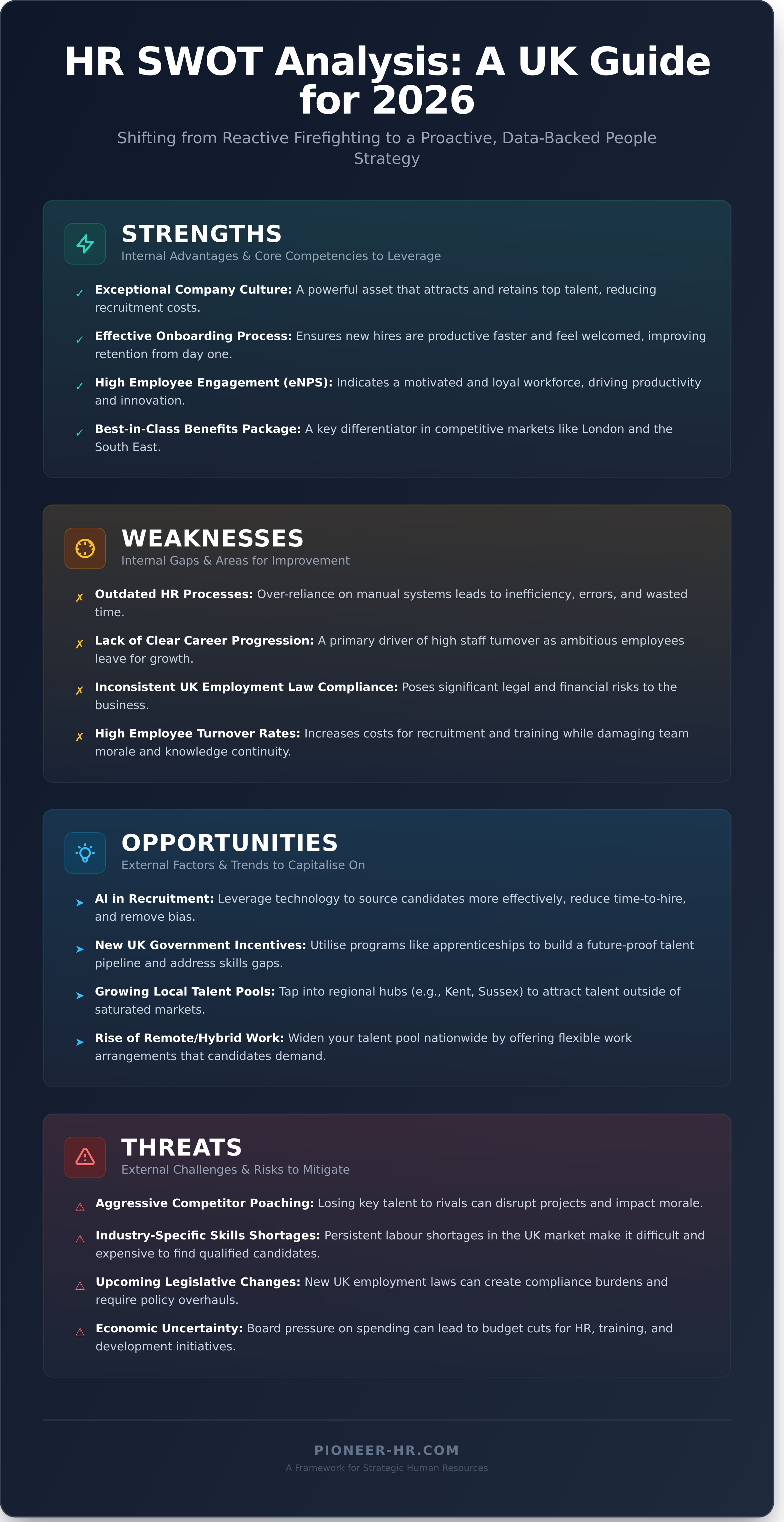
A SWOT analysis tailored for HR provides a 360-degree view of your people operations. We break it down into four key areas:
Strengths: These are your internal advantages. What is your "secret sauce"? It could be an exceptional company culture that attracts top talent, a highly effective onboarding process, or a best-in-class benefits package.
Weaknesses: This requires honest self-assessment. Where are the gaps? Perhaps your HR processes are outdated, compliance with UK employment law is inconsistent, or there's a lack of clear career progression paths.
Opportunities: These are external factors you can leverage. Think about emerging trends like AI in recruitment, new UK government incentives for apprenticeships, or a growing local talent pool.
Threats: External challenges that could impact your team. This might include aggressive competitor poaching for key roles in the South East, upcoming legislative changes, or a skills shortage in a niche technical field, such as the one serviced by specialists like Drone Doctor LLC.
Why General Business SWOTs Fail HR
The greatest danger of a generic corporate SWOT is that it often treats employees as just another resource, overlooking the nuanced human element that truly drives success. A standard business plan might identify a 'weakness' in production capacity without diagnosing the root cause: high staff turnover due to poor management.
A dedicated HR swot analysis provides far deeper insights, connecting people metrics directly to business outcomes. It uncovers the 'why' behind your retention problems or recruitment successes. Put simply, an HR SWOT is a diagnostic tool for the health, engagement, and future-readiness of your workforce in 2026.
The Internal Audit: Identifying Your HR Strengths and Weaknesses
Before you can plan for the future, you must have an honest, unbiased view of your present. The first half of your swot analysis-Strengths and Weaknesses-is an internal audit of your team and HR functions. This means looking beyond surface-level assumptions and digging into the data. To do this effectively, we recommend a structured approach, like the CIPD SWOT analysis framework, which helps remove bias from the process. Start by analysing key metrics: what are your employee turnover rates, engagement scores, and average time-to-hire?
Beyond the numbers, consider the qualitative elements. Is your leadership team a cohesive unit that inspires loyalty, or are they a liability causing friction and disengagement? A critical part of this audit involves evaluating your current reward strategy. Does it truly align with employee expectations and market rates, or is it a holdover from a previous era? Answering these questions honestly is the first step toward meaningful change.
Finding Your Internal Strengths
Every organisation has unique strengths. Perhaps you have a high employee Net Promoter Score (eNPS), a robust and welcoming onboarding process, or a unique company culture that people genuinely love. These are not just "nice-to-haves"; they are powerful assets. A strong culture, for example, can be leveraged to attract top talent in competitive areas like Kent and Sussex. Documenting these strengths is crucial for building a compelling Employer Brand. To do this effectively, many businesses partner with a creative studio like Hatfield Creative to translate their culture into a brand that resonates with candidates in 2026 and beyond.
The physical workspace is a tangible part of this culture. A well-designed office isn't just a cost; it's a strategic asset that can boost morale and attract talent. For a look at how strategic thinking is applied in architecture and real estate, the blog from Martin Bonauer offers some fascinating perspectives that can inspire HR leaders to think differently about their own environments.
This extends to common areas like the office kitchen, where even a simple refresh can boost morale. As an example of this kind of visual transformation, you can explore Cabinet Painting to see how updating functional spaces can create a more inviting atmosphere.
Creating a warm, inviting atmosphere can also be a unique strength. For visual inspiration on how a central hearth can anchor a communal space—a concept that translates from homes to modern offices—see the examples at hrejicikrby.cz.
Visually documenting that culture is just as important. Professional photography at company events, for instance, provides authentic content for recruitment materials that strengthens your employer brand. Even for businesses outside of Canada, the work of specialists like Fotoreflection serves as a great example of how to capture a company's vibrant team spirit.
For instance, a commitment to a family-friendly culture could be demonstrated through an on-site creche, using equipment from a trusted UK supplier like softplaytoys4kids.co.uk to create a safe and stimulating environment.
This could even extend to unique team-building and reward experiences that become a legendary part of your culture. For example, forward-thinking businesses might use high-impact activities from providers like UK Skydiving to foster trust and create a truly magnetic employer brand.
Thoughtful corporate gifting can also play a role, reinforcing culture through unique, handcrafted items that show genuine appreciation. Sourcing from UK-based artisans for such rewards is a growing trend, with examples of bespoke tweed gifts available from providers like createdbytheridleys.co.uk.
Acknowledging Internal Weaknesses
It’s equally important to face your weaknesses head-on. For many SMEs, these often include a lack of documented policies, over-reliance on manual processes like payroll, or inconsistent management styles across departments. The most dangerous weakness, especially for established Hove businesses, is the mindset of "we’ve always done it this way." This resistance to change stifles innovation and can lead to outdated pay scales that directly impact staff morale and retention, leaving your business vulnerable to competitors.
The External Landscape: Opportunities and Threats in the UK Market
A team doesn't exist in a vacuum. The most effective strategies are built with a clear understanding of the world outside your office walls. The 'Opportunities' and 'Threats' components of your swot analysis require an honest look at the external factors shaping the UK market, particularly in competitive areas like London and the South East. As the CIPD factsheet on SWOT analysis explains, this external scan is critical for building a resilient and forward-thinking people strategy. These outside forces-from economic shifts to new technologies-directly dictate your internal HR priorities for 2026 and beyond.
Seizing HR Opportunities in 2026
The modern labour market is rich with opportunities for agile businesses. The rise of flexible working models allows SMEs to access top-tier strategic expertise without the commitment of a full-time salary; engaging a Fractional CPO can transform your people function. Technologically, the growth of AI presents a chance to automate routine HR administration, freeing your team for more strategic work. Locally, leveraging vibrant networks like the Brighton and Hove business community can uncover exceptional talent pools right on your doorstep.
Another powerful opportunity lies in modernising employer branding. By collaborating with content creators, businesses can showcase their culture authentically, and a dedicated Influencer platform can be a key tool in connecting with the right voices to attract top talent.
This principle of leveraging specialized digital platforms for strategic advantage is not unique to HR. For instance, professionals in the property sector use dedicated resources to make data-driven investment decisions, and you can learn more about Multifamily Intelligence to see how this approach is applied in that industry.
Similarly, companies focused on scaling their sales efforts use sophisticated SaaS solutions to manage their partner ecosystems; you can discover Computer Market Research for an example of how channel management is automated.
Mitigating External Threats
Proactive planning is your best defence against market volatility. For businesses in Kent and Sussex, the "London Drain" remains a significant threat, pulling talent towards the capital. The solution isn't just about higher pay; it's about smarter compensation. Using tools like salary benchmarking ensures your packages are competitive and sustainable. Furthermore, persistent economic uncertainty and the "Cost of Living" crisis put pressure on wages and employee retention, demanding more empathetic and flexible financial planning. Constantly evolving regulations, such as updates to IR35 or visa sponsorship rules, can significantly complicate recruitment and increase compliance risks for UK employers.
Another critical external threat lies in cybersecurity. HR departments manage vast amounts of sensitive employee data, often through web-based portals for payroll, applications, and internal communication. Ensuring these digital assets are secure is no longer just an IT issue; it's a core business continuity and HR risk. Automated security testing platforms like Penetrify can help identify and mitigate these vulnerabilities, protecting both the company and its people.
For companies with an international footprint, this extends to providing relocation support. For instance, a business expanding into the US market might partner with a regional expert like County Properties to help employees navigate the complex housing market in areas like Southern California, turning a potential stressor into a supported transition.
How to Conduct a SWOT Analysis: A Step-by-Step UK Framework
Transforming the theoretical SWOT grid into a powerful strategic tool requires a structured and collaborative approach. A successful swot analysis is not a solitary task completed in an office; it's a dynamic, team-driven process grounded in real-world data. We guide our partners through a proven five-step framework designed to deliver clarity and actionable outcomes.
Assemble Your "Strategic Squad": The most insightful analysis comes from diverse perspectives. We recommend assembling a cross-functional team including leadership, HR, and representatives from key departments. This ensures the findings are holistic, not siloed.
Gather Your "Hard Data": Base your discussion on evidence, not just opinion. Collate key documents such as employee engagement survey results, recent performance data, benchmarking reports against UK industry standards, and even audits of your HR policies against current employment law.
Facilitate a Non-Blame Session: The goal is honest evaluation, not finger-pointing. Create a psychologically safe environment where every voice is heard. The focus should be on understanding the "what" and "why," not the "who."
Rank by Impact and Urgency: Your grid will likely be full of valuable points. Prioritise them using a simple matrix that plots each item's potential impact on the team against the urgency of addressing it. This helps focus your resources where they matter most.
Translate into an HR Roadmap: The final output shouldn't be a static document. Convert your top priorities into a tangible 12-month action plan with clear owners, timelines, and measurable KPIs.
Facilitating the Session Like a Pro
In a smaller team setting, such as you might find in a growing Kent-based business, it’s crucial to prevent the session from becoming a complaint forum. Using a neutral facilitator can help keep the conversation constructive. Tools like Insights Discovery can also provide a common language for understanding team dynamics and communication styles, ensuring feedback is delivered and received effectively. To avoid "groupthink," we often start with silent, individual brainstorming on sticky notes before opening the floor to group discussion.
Turning Data into Action
A "finding" identifies a reality (e.g., "Our junior staff retention is 15% below the London average"), whereas a "strategy" is the plan to address it (e.g., "Launch a structured mentorship programme in Q3"). When presenting your results to the board, frame your proposed strategies in business terms-highlighting how they will mitigate risks, improve productivity, or support commercial goals. From there, each strategy must be broken down into SMART goals, turning your analysis into a measurable plan for success. For expert guidance on this process, contact our team.
From Analysis to Action: How Pioneer HR Supports Your Strategy
A thorough swot analysis provides a powerful snapshot of your team's current state, but insight without implementation is simply a missed opportunity. This is where the real work begins-and where we step in as your strategic HR partner. For SMEs in Hove, Kent, and across the UK, we help transform your analytical findings into a tangible, forward-looking people strategy that delivers measurable results.
The true value of this exercise lies in the actions you take next. It’s about building a resilient organisation that can confidently leverage its strengths and navigate its challenges.
Our Approach to Strategic HR
We specialise in bridging the gap between identified 'Weaknesses' and desired 'Strengths'. Through targeted coaching, leadership development, and structural reviews, we turn vulnerabilities into genuine opportunities for growth. An external perspective is often crucial; our independent HR audits reveal underlying issues that are difficult to see from within the business. We create tailored solutions because we understand the needs of a 10-person team in London are vastly different from a 200-person company elsewhere in the UK, supporting businesses from 5 to 250 employees.
The insights gained from your team analysis become the foundation of a proactive HR plan. Rather than a one-time report that gathers dust, we integrate these findings directly into our retained HR support model. This ensures continuous improvement, helping you manage risks, develop talent, and build the long-term business resilience needed to thrive. It’s about closing the loop between analysis and sustained success.
Next Steps for Your Business
With over 30 years of dedicated experience in the UK HR sector, we have the expertise to guide your next steps. If you're ready to move from paper to practice and build a stronger, more effective team, we invite you to book a discovery call with us. Let's review your current people strategy and explore how we can support your goals.
Let’s build your 2026 HR roadmap together.
From Analysis to Advantage: Building Your 2026 HR Strategy
As we've explored, navigating the complexities of the 2026 UK business landscape requires more than just intuition-it demands strategic clarity. A thorough HR swot analysis provides precisely that, offering a clear framework to leverage your internal strengths, address weaknesses, and proactively respond to external opportunities and threats. It’s the foundational step in building a resilient and high-performing team that is ready for the future.
However, the true value lies in translating this analysis into decisive action. With over 30 years of dedicated HR expertise in the UK market, Pioneer HR specialises in guiding SMEs across London, Kent, and Hove. We provide the strategic Fractional CPO leadership and tailored support needed to transform your insights into a powerful, actionable plan that drives real business growth.
Ready to build a workforce that gives you a competitive edge? Book your HR Strategy Session with Pioneer HR today and let's pioneer your path to success, together.
Frequently Asked Questions
What is the primary goal of a SWOT analysis in HR?
The primary goal is to create a strategic framework that aligns your team’s capabilities with the company's objectives. It provides a clear snapshot of internal Strengths and Weaknesses, such as team skills or company culture, alongside external Opportunities and Threats, like market trends or talent shortages. This allows HR and leadership to make informed decisions, optimise resources, and proactively plan for the future, ensuring your people strategy directly supports business growth.
How often should a UK SME conduct an HR SWOT analysis?
For most UK small and medium-sized enterprises (SMEs), we recommend conducting a thorough HR SWOT analysis on an annual basis. This provides a consistent rhythm for strategic review. However, if your business experiences significant change-such as rapid growth, a major restructuring, or new market entry-it is wise to perform one more frequently. This ensures your people strategy remains agile and responsive to the evolving needs of your business and the market.
Do I need an external consultant to do a SWOT analysis?
While not a strict requirement, engaging an external consultant can be incredibly valuable. An impartial expert brings an objective viewpoint, free from internal biases that can sometimes cloud judgement. They can identify blind spots your team may have missed and provide benchmark data from across your industry. This external perspective often leads to a more robust and honest assessment, particularly when tackling sensitive internal weaknesses or complex market threats facing your business in the UK.
What are the most common HR threats for UK businesses in 2026?
Looking ahead, UK businesses face several critical HR threats. Persistent skills shortages, especially in digital and green economy roles, will intensify the war for talent. Rising salary expectations driven by the cost of living will continue to pressure budgets. Furthermore, evolving employment legislation and the growing demand for permanent flexible working models present significant strategic challenges for companies, from start-ups in Kent to established firms in London.
Can a SWOT analysis help with employee retention?
Absolutely. A SWOT analysis is a powerful tool for improving retention. By systematically identifying internal Weaknesses, such as a lack of clear career progression or outdated benefits, you can take direct action to fix them. It also highlights external Threats, like a local competitor offering a better benefits package, allowing you to adapt your strategy proactively. This process helps you build a more resilient and appealing workplace that encourages long-term commitment.
What is the difference between a SWOT and a PESTLE analysis for HR?
The key difference lies in their scope. A SWOT analysis assesses both internal factors (Strengths, Weaknesses) and external ones (Opportunities, Threats) that directly impact your team. In contrast, a PESTLE analysis is exclusively external, examining broader macro-environmental forces: Political, Economic, Social, Technological, Legal, and Environmental. Often, the insights from a PESTLE analysis will directly inform the Opportunities and Threats sections of your SWOT.
How do I involve my employees in the SWOT process without causing alarm?
Communication and framing are essential. Position the exercise as a positive, collaborative effort to build a stronger future together, not as a search for problems or a precursor to redundancies. Emphasise that the goal is to improve processes and culture. Using anonymous surveys or confidential focus groups, facilitated by a neutral party, can encourage honest feedback and ensure employees feel safe to share their valuable perspectives without fear of reprisal.
Is SWOT analysis still relevant for very small businesses with under 10 staff?
Yes, it is not only relevant but highly effective. In a team of under 10, the impact of each individual is magnified, making it crucial to understand collective strengths and address skill gaps. A streamlined SWOT analysis provides a simple, low-cost framework for strategic planning without requiring significant resources. It helps even the smallest business align its team's capabilities with its core ambitions, ensuring everyone is pulling in the same direction.


Comments