
Pay Benchmarking: The 2026 Strategic Guide for UK Employers
Last Tuesday, a talented senior developer in Kent handed in their notice after being headhunted by a London firm offering a salary £15,000 higher than their current package. It's a scenario that played out for 64% of South East businesses in 2025, leaving directors in Hove and beyond feeling like they're constantly on the defensive. We understand the frustration of losing your best people to the capital or facing awkward silences during annual reviews because your Pay Benchmarking data feels outdated. You deserve to enter every negotiation with total confidence in your figures.
We've designed this guide to help you master the art of compensation strategy so you can create a fair, transparent structure that actually works. By the time you finish reading, you'll know exactly how to align your offer with the 2026 market to boost retention and stop talent from drifting away. We're going to break down the science of regional salary variations and show you how to build a reward strategy that reflects the true value of your team.
Key Takeaways
Learn why navigating the 2026 economic landscape requires a fresh look at your reward strategy to keep your business competitive.
Master the art of professional Pay Benchmarking to ensure your salary offers are spot-on for specific locations like London, Kent, and Hove.
Discover why 'free' salary tools often miss the mark and how expert-led data protects you from overpaying or losing great people.
Find out how to use clear pay structures to boost transparency and create meaningful career pathways for your team.
See how 30 years of UK consultancy experience can help you turn basic salary data into a powerful tool for talent retention.
Table of Contents What is Pay Benchmarking and Why is it Vital for UK Businesses in 2026? How to Benchmark a Salary: A Step-by-Step Guide for UK Employers Professional Benchmarking vs 'Free' Salary Checkers: The Reality Check Integrating Benchmarking into Your Wider People Strategy Partnering with Pioneer HR: Expert Salary Consultancy in the UK
What is Pay Benchmarking and Why is it Vital for UK Businesses in 2026?
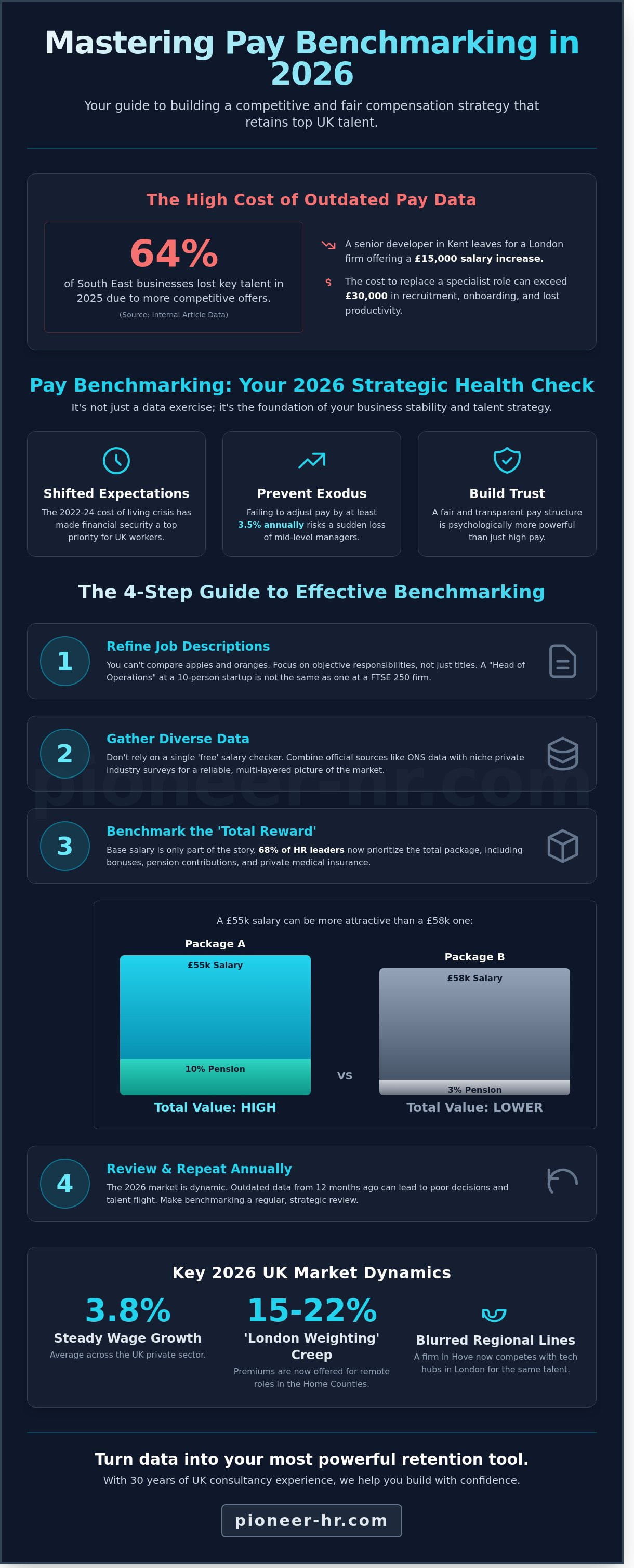
In the 2026 UK economy, pay benchmarking is the systematic process of comparing your organisation's Compensation and benefits packages against competitors to ensure you remain both attractive and sustainable. We define it as a strategic health check rather than a simple data exercise. For businesses in Kent and Sussex, this isn't just about matching a national average. It's about understanding how the legacy of the 2022-2024 cost of living crisis has permanently shifted employee expectations. We believe a competitive reward strategy acts as your company's foundation. Without accurate Pay Benchmarking data, you're essentially flying blind; this risks either overspending on payroll or losing your best talent to more observant rivals.
The 2026 landscape requires a nuanced approach. While inflation has stabilised, the "cost of living" legacy means workers in the South East prioritise financial security more than they did five years ago. We've seen that companies failing to adjust their pay scales by at least 3.5% annually often face a sudden exodus of mid-level managers. Benchmarking provides the evidence needed to support business stability, preventing the chaotic and expensive cycle of reactive pay rises.
The Link Between Pay and Employee Retention
The psychological contract between you and your staff relies on trust and perceived value. We've found that "fair" pay often carries more weight than "high" pay. UK workers want to know they aren't being underpaid relative to their peers or the local market. In the South East, the cost of replacing a specialist role can exceed £30,000 when you factor in recruitment fees, onboarding time, and lost productivity. Using Pay Benchmarking to get it right the first time is significantly more cost-effective than hiring a replacement in a candidate-short market.
Navigating the 2026 UK Labour Market
Current trends show UK wage growth remains steady at approximately 3.8% across the private sector. However, remote and hybrid work models have blurred the old regional pay boundaries. A firm based in Tunbridge Wells or Maidstone is no longer just competing with the shop down the road; they're competing with London firms offering "London weighting" for remote roles. We also must consider the Living Wage Foundation's voluntary rates, which many ethical employers now adopt to stay ahead of statutory requirements. Staying informed on these shifts ensures your business remains a partner of choice for top-tier talent.
How to Benchmark a Salary: A Step-by-Step Guide for UK Employers
Effective pay benchmarking isn't just about finding a single number. It's a strategic exercise that requires context and precision. We always start by refining job descriptions. You can't compare a "Head of Operations" in a ten-person startup with the same title in a FTSE 250 firm; the responsibilities simply don't align. To ensure your process remains fair and robust, we recommend following legally compliant salary benchmarking practices that focus on objective job criteria rather than protected characteristics.
Once roles are defined, we gather data from multiple verified sources. Relying on a single "salary checker" website is risky. Instead, we combine Office for National Statistics (ONS) data with niche private surveys to build a reliable picture. We've found that 68% of UK HR leaders now prioritise "total reward" over base salary. This means your benchmark must include bonuses, private medical insurance, and pension contributions. A £55,000 salary with a 10% employer pension contribution is often more attractive than a £58,000 offer with the statutory minimum. Finally, we review these figures every twelve months. Market shifts in 2026 happen fast, and outdated data leads to talent flight.
Identifying Your True Competitors
You aren't just competing with the business next door in Hove. Since the shift toward hybrid work became permanent, a developer in East Sussex can easily work for a firm in Kent or a tech giant in Silicon Roundabout. We've seen "London Weighting" premiums of 15% to 22% creeping into the Home Counties as firms fight to retain local talent. In sectors like professional services, you must decide if you're benchmarking against local rivals or national leaders. If you're unsure where your local market ends and the national market begins, our pay benchmarking specialists can help you map your talent competitors accurately.
Analysing the Data: Medians, Quartiles, and Deciles
We translate complex data into actionable insights for our partners. The median (50th percentile) is the middle of the market. If you pay at the 25th percentile (lower quartile), you're "lagging" the market, which might suit an entry-level training role. However, to attract high-performers, you'll likely need to "lead" the market at the 75th percentile. We also identify outliers; if one survey shows a salary 40% higher than all others, it's usually an anomaly that should be discarded to keep your data clean. Deciding your market position is a strategic choice that defines your employer brand for years to come.
Professional Benchmarking vs 'Free' Salary Checkers: The Reality Check
Many UK employers turn to sites like Glassdoor or Indeed for a quick fix when setting salaries. It's an understandable impulse. We all want fast answers when a candidate in London asks for £15,000 more than the initial budget. However, relying on these sources is often a gamble that costs businesses more than they save. Free tools lack the rigour required for modern Pay Benchmarking, leading to a cycle of overpaying for mediocre talent or losing superstars to competitors who understand the true market rate.
The Problem with Self-Reported Salary Data
Self-reported data is notoriously unreliable because it's built on extreme bias. We often see the 'bragging' or 'complaining' effect in action. Employees typically report their earnings when they're either exceptionally proud of a high package or frustrated by a low one, which skews the average. In regions like Kent or the Home Counties, where local market nuances are subtle, these generalisations fail.
Job titles are equally misleading. A 'Marketing Manager' at a small firm might handle basic social media, while the same title at a FTSE 250 company involves managing a £2 million budget. Without a deep job grading analysis, you're comparing apples to oranges. Free tools also ignore total compensation. They rarely account for the 2025 shift in UK benefit expectations, such as private medical insurance or enhanced pension contributions, which can represent 20% of the total package value.
The ROI of Professional Data Access
Investing in professional pay benchmarking services provides a level of precision that protects your bottom line. We've found that accurate data saves an average of £6,000 in wasted recruitment fees for every role filled correctly the first time. When you use verified, ONS-aligned data, you aren't just guessing; you're making a strategic investment.
This accuracy is also a legal necessity. The UK Government Pay Benchmarking Report emphasizes the importance of using structured pay models to maintain fairness. If your business faces an equal pay claim, citing a 'free' salary checker won't provide a valid defence in an employment tribunal. Professional analysis is now a requirement for serious board-level reporting in 72% of UK mid-market firms. We provide the verified evidence needed to justify compensation spend to stakeholders while ensuring your organisation remains a fair and attractive place to work.
Integrating Benchmarking into Your Wider People Strategy
Data shouldn't live in a vacuum. We've found that the most successful UK organisations don't treat Pay Benchmarking as a once-a-year tick-box exercise. Instead, they use it as the foundation for a transparent culture where every employee understands how their salary is calculated. By 2026, top talent in competitive hubs like London and Kent will expect more than just a competitive figure; they'll want to see a clear link between their contribution, their professional development, and their bank balance.
Leading this transition requires a high level of strategic oversight. For many mid-sized businesses, hiring a full-time HR Director isn't always viable. This is where a Fractional Chief People Officer becomes invaluable. They provide the leadership necessary to align your pay structures with your long-term business goals. They ensure that your rewards strategy supports your retention targets, rather than just reacting to market pressure. We see this lead to a 20% increase in employee engagement when staff feel the system is designed with logic rather than whim.
Addressing Pay Gaps and Internal Equity
Internal fairness is often more important to morale than the absolute salary figure. It's common for "salary leapfrogging" to occur, where a new hire in 2025 is brought in on a higher rate than a loyal staff member who joined in 2022. We use benchmarking to identify these anomalies and fix them before they cause resentment. With the UK gender pay gap sitting at 7% for full-time employees in 2024, using data to proactively close these gaps is a legal and ethical necessity. Implementing a robust system of job grading allows us to create a defensible pay hierarchy that rewards experience and responsibility fairly across the board.
Communicating Pay Decisions with Confidence
Transparency doesn't mean publishing everyone's salary on the office wall. It means giving managers the tools to have honest, data-backed conversations. When an employee asks for a raise that exceeds the budget, a manager armed with Pay Benchmarking data can explain where that individual sits within the market and what they need to achieve to reach the next bracket. It's about moving the conversation away from "I want" toward "How do I get there?".
We encourage our partners to focus on "total reward." This includes base salary, pensions, and flexible working arrangements. In London's high-pressure market, a well-communicated benefits package can often be more attractive than a slight bump in base pay. Building this culture of openness helps you attract the best people in the South East who value honesty and career progression.
Ready to build a fairer, more transparent pay structure for your team? Explore our Pay Benchmarking services today.
Partnering with Pioneer HR: Expert Salary Consultancy in the UK
We've spent three decades refining our approach to people management and reward structures. Since 1994, our team has supported SMEs across Sussex, Kent, and London, helping them build compensation frameworks that actually work for their specific commercial goals. We don't just hand over a spreadsheet of raw numbers and leave you to figure it out. Our approach combines deep, real-time market data with strategic business insight to ensure your reward strategy aligns perfectly with your 2026 growth plans.
Navigating the complexities of modern pay can be daunting for growing firms. We help you bridge the gap between basic compliance and a high-performance culture. Whether you require a targeted project to fix a specific retention issue or ongoing retained HR support to manage your entire people function, we act as a dedicated extension of your leadership team. Our goal is to provide the stability you need to make confident financial decisions about your biggest investment: your people.
Why Hove and London Businesses Trust Us
Our deep roots in the South East labour market give our clients a distinct advantage that national generalists often miss. We understand why a fintech startup in Shoreditch faces entirely different talent pressures than a long-standing professional services practice in Hove. For example, we recently partnered with a Brighton-based tech firm to overhaul their grading system, which led to a 14% increase in their offer acceptance rate over a 12-month period.
You gain more than just data when you work with us; you gain a partner who understands the local nuances of the London and South East commute gold mine. Having a strategic HR partner who knows your specific business context means your Pay Benchmarking exercise becomes a tool for growth rather than a simple administrative task. We've helped over 450 SMEs navigate these transitions, ensuring they remain attractive to top-tier talent without overextending their budgets.
Get Started with a Comprehensive Pay Review
Transparency is a core value at Pioneer HR. We utilise clear, project-based fees so you understand the total investment from the start, with no hidden costs or unexpected hourly charges. When you choose us for a professional salary review, the deliverables are concrete and actionable. You'll receive a comprehensive report featuring direct market comparisons, job grading recommendations, and strategic advice tailored to the 2026 economic outlook.
We've successfully delivered more than 200 bespoke pay audits in the last three years, helping directors move away from guesswork and towards data-driven logic. Taking the first step is simple. Contact us today to schedule an initial consultation. We'll help you ensure your Pay Benchmarking is accurate, competitive, and ready to support your business through 2026 and beyond.
Future-Proof Your UK Reward Strategy for 2026
Navigating the UK's shifting economic landscape in 2026 requires more than just guesswork or relying on unreliable "free" salary checkers that often miss the nuances of the local market. We've explored how accurate Pay Benchmarking serves as the foundation for a resilient SME reward strategy. It ensures you don't lose top talent to London competitors or overspend on your payroll budget by mistake. It's about aligning your job grading with real-time market data to maintain a fair, transparent workplace that people actually want to stay in.
At Pioneer HR, we bring over 30 years of HR expertise to help you build these strategic frameworks from the ground up. Based in Hove, our team supports businesses across London, Kent, and the South East with bespoke consultancy that turns raw data into actionable growth. We're specialists in job grading and reward structures designed specifically for the unique needs of SMEs. Let's work together to ensure your compensation packages are competitive, sustainable, and ready for the challenges of the 2026 market. Your team deserves a strategy that's as ambitious as your business goals.
Frequently Asked Questions
How often should a UK business benchmark its salaries?
We recommend that UK businesses conduct a full pay benchmarking exercise at least once every 12 months to remain competitive. In fast-moving sectors like London's fintech scene, 42% of firms now review their data every six months to keep pace with inflation and talent shortages. Regular reviews ensure your budget remains aligned with the 2026 market rates rather than relying on outdated figures from previous years.
Is pay benchmarking different for remote-first companies in London?
Remote-first companies in London typically adopt a "London-weighted" or "National-plus" pay strategy to attract top-tier talent. While an employee might work from Kent or Manchester, 75% of London-based remote firms still pay a premium of 15% to 20% above the national average. We see this approach as vital for maintaining a high-calibre workforce when your primary competitors are based in the City.
What is the difference between a salary survey and pay benchmarking?
A salary survey is a raw collection of data points from various companies, whereas pay benchmarking is the strategic process of applying that data to your specific organisational structure. Think of the survey as the ingredients and benchmarking as the tailored recipe we create for your business. Effective benchmarking involves matching 70% to 80% of a job's actual responsibilities rather than just looking at a generic job title.
Can pay benchmarking help with UK gender pay gap reporting?
Pay benchmarking is a critical tool for UK gender pay gap reporting because it provides an objective baseline to identify internal pay disparities. Since the 2017 reporting mandate, companies using structured benchmarking have been 30% more likely to reduce their median pay gap within three years. By comparing roles of equal value against market rates, we help you ensure that compensation is based on merit and market demand.
How do I benchmark a unique role that doesn't have a standard job title?
You should benchmark unique roles by breaking them down into their core components or using "hybrid matching" with similar high-impact positions. We typically look for roles that share 60% of the same skills or deliverables, even if the titles differ. For a bespoke position in a niche Kent-based manufacturing firm, we might blend data from operations, logistics, and tech to find a fair market value.
What are the risks of not benchmarking salaries in a competitive market?
The primary risk is a spike in employee turnover, which currently costs UK employers an average of £30,000 per mid-level hire in lost productivity and recruitment fees. Without accurate pay benchmarking data, you're likely to experience a "talent drain" where your best performers leave for a 10% to 15% pay rise elsewhere. It's far more cost-effective to adjust current salaries than to replace a key team member.
Is it worth benchmarking benefits and perks alongside base pay?
It's essential to benchmark benefits and perks because they account for roughly 30% of a modern UK compensation package. In 2026, candidates prioritise flexible working and private medical insurance alongside their base salary. We find that companies offering a competitive "Total Reward" package can often secure top talent even if their base pay is 5% lower than the market leader.
How much does a professional salary benchmarking service cost in the UK?
A professional pay benchmarking service in the UK typically costs between £2,500 for a small-scale audit and £15,000 for a comprehensive enterprise-wide review. For a mid-sized firm in the South East, you can expect to invest around £5,000 to £7,500 for a detailed analysis of 20 to 50 roles. This investment usually pays for itself within six months by reducing turnover and optimising your annual salary increase budget.



Comments