
Part-Time HR Director in London: The Strategic Guide for SMEs in 2026
Updated: Mar 7
The full-time, £150,000+ HR Director is becoming an operational liability for most ambitious London SMEs. It’s a bold claim, but as we approach 2026, the traditional executive hiring model is showing its cracks, especially in a market where top talent is both scarce and expensive.
We understand the pressure. You're navigating the City's fiercely competitive talent market, striving for growth, yet the very leadership needed to secure your team feels financially out of reach. You know strategic people management is crucial for retention, but a full-time executive salary can stall vital investment elsewhere in the business. This guide is designed to change that perspective. We will show you precisely how engaging a part-time HR director in London provides the board-level strategic insight you need, without the prohibitive cost. You'll discover the fractional leadership model that London's fastest-growing SMEs are adopting to build scalable, resilient teams.
Together, we'll break down the financial benefits, explore how this role directly impacts employee retention, and provide a clear roadmap for integrating this strategic partner into your leadership team for sustainable growth.
Key Takeaways
Learn to identify the critical growth stage (30-50+ employees) where strategic HR becomes essential for navigating London's unique talent retention challenges.
Discover how a part-time hr director london provides board-level people strategy—from culture design to leadership coaching—without the six-figure salary commitment.
Evaluate the true costs and risks of a direct hire versus engaging a part-time hr director london to determine the most financially sound model for your business.
Uncover a clear framework for integrating a senior leader, including setting 90-day goals to ensure they deliver immediate and measurable impact.
Table of Contents The London SME Growth Trap: Why You Need Strategic HR in 2026 What Does a Part-Time HR Director Actually Do? Part-Time Employee vs. Fractional CPO Service: Which is Better? Integrating a Part-Time Leader into Your London Executive Team Why Pioneer HR is London's Choice for Fractional Leadership
The London SME Growth Trap: Why You Need Strategic HR in 2026
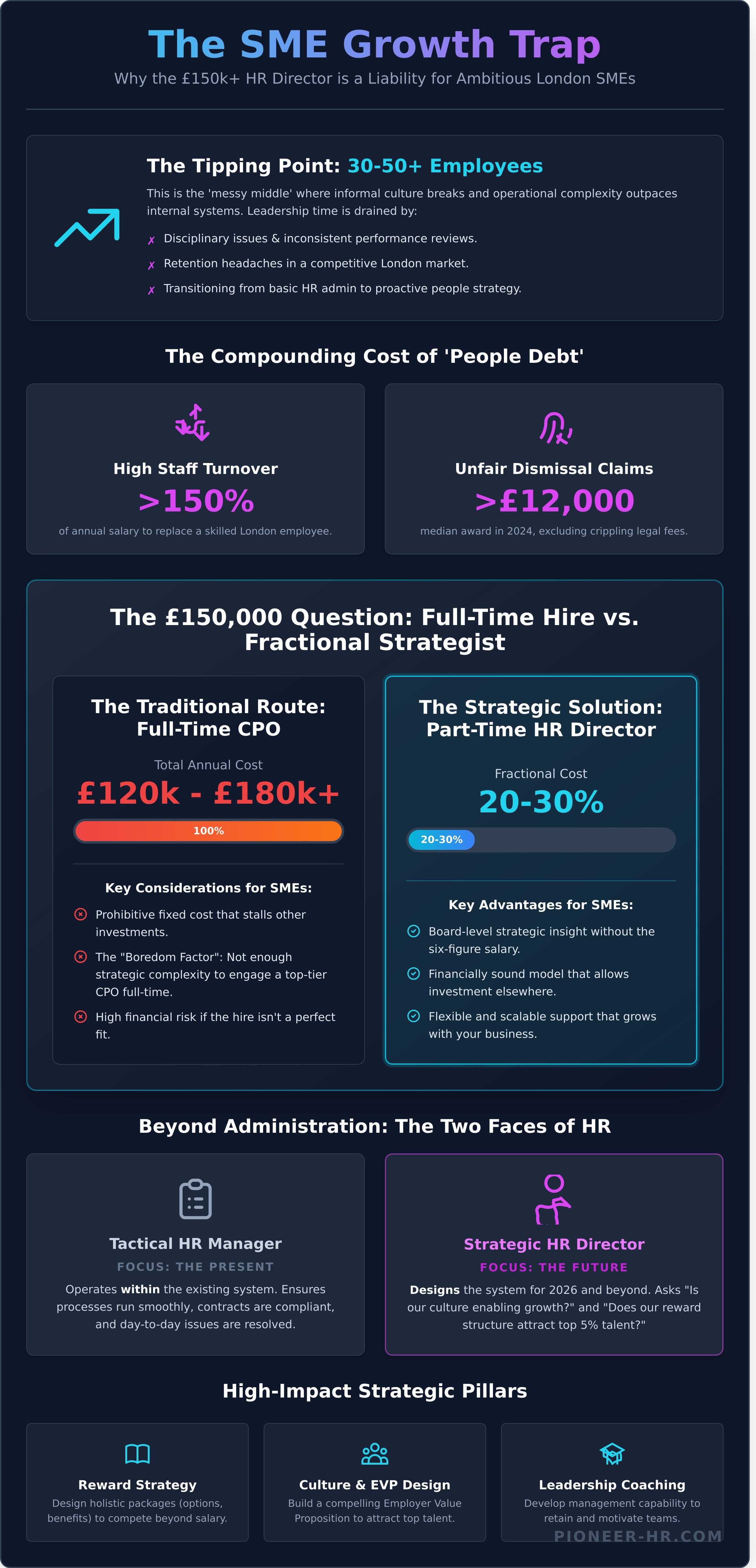
Your London-based SME has reached an exciting, yet perilous, milestone. You've scaled beyond 30 employees, and the informal, 'all-hands-on-deck' culture that fuelled your early success is beginning to show cracks. This is the growth trap: the 'messy middle' where operational complexity outpaces your internal systems, and the founder can no longer be the default Head of People.
What was once manageable is now a drain on leadership time. Disciplinary issues, inconsistent performance reviews, and retention headaches become daily fires to fight. This reactive state isn't just inefficient; it's a direct threat to your continued growth in London's hyper-competitive market. The core challenge is transitioning from basic HR administration to proactive, strategic people operations. The shift requires moving beyond simple compliance into strategic Human resource management (HRM), a discipline focused on proactively shaping your workforce and culture to meet future business goals. This often includes formalizing processes across the entire business to ensure consistency and quality, and for those ready to take that step, you can learn more about Align Quality and their approach to ISO 9001 certification.
This accumulation of unresolved issues creates what we call 'people debt'. It's the compounding risk of an employment tribunal claim, which in 2024 saw median unfair dismissal awards exceed £12,000, excluding crippling legal fees. It's the silent cost of high staff turnover, where replacing a skilled employee in London can cost over 150% of their annual salary. Without a strategic hand on the tiller, these costs don't just affect your bottom line; they stall your momentum entirely.
The 2026 London Talent Landscape
By 2026, the London talent market will be even more complex. Recent UK employment law updates, such as the Carer's Leave Act 2023 and the expanded rights to request flexible working from day one, demand robust and consistently applied policies. A competitive 'City' salary is now merely table stakes. Top candidates, particularly in the thriving London and Kent tech hubs, are vetting employers on their purpose, ESG commitments, and development opportunities. A compelling employer value proposition is no longer a nice-to-have; it's essential for survival.
Why a Full-Time CPO is Often a Mistake for SMEs
The logical next step might seem to be hiring a full-time Chief People Officer (CPO). However, with London salary benchmarks for this role sitting between £120,000 and £180,000 plus benefits, it's a prohibitive expense for most SMEs. Beyond the cost, there's the 'boredom factor'. A top-tier HR strategist requires complex challenges that a 50-person company simply can't provide on a full-time basis. This is where a part-time HR director in London provides the ideal solution, offering board-level strategic guidance at 20-30% of the cost of a full-time hire.
What Does a Part-Time HR Director Actually Do?
Many London SMEs reach a point where HR administration is handled, but strategic people leadership is missing. This is the precise gap a part-time HR Director fills. They are not a senior HR Manager working fewer days; they are a board-level executive who provides high-calibre people strategy on a flexible, non-full-time basis. Their focus is on shaping the future of the organisation, not just managing its present.
The core difference lies in perspective. An HR Manager is tactical, ensuring processes run smoothly, contracts are compliant, and day-to-day issues are resolved. They operate within the existing system. A strategic HR Director, however, designs that system. They ask the challenging questions: "Is our culture truly enabling our growth goals?" or "Does our reward structure attract the top 5% of talent in our industry?" This strategic focus is what fundamentally separates the two roles, a distinction explored in academic research on HR strategies in family and non-family businesses, which highlights how formalised people strategies directly correlate with SME success.
In practice, a part-time HR director in London acts as a strategic partner to the CEO and a collaborator with the finance and operations teams. They translate ambitious business objectives into a tangible people plan, ensuring the company has the talent, leadership, and culture to achieve its 2026 vision. They align workforce planning with financial forecasts and operational capacity, creating a cohesive leadership unit.
Strategic Pillars of the Role
The director's work is built on several high-impact pillars designed to create long-term value and competitive advantage. Their primary contributions include:
Designing a compelling reward strategy. In a market where City firms and tech giants can offer inflated salaries, SMEs must compete intelligently. This involves creating a holistic package with share options, meaningful benefits, and a clear link between performance and compensation that larger, more bureaucratic firms can't replicate.
Building robust succession plans. For rapidly scaling UK startups, demonstrating a strong leadership pipeline is critical for securing Series B funding and beyond. A part-time HRD identifies future leaders and develops clear pathways for their growth, mitigating key-person risk.
Leading organisational change. Whether it's navigating the complexities of a merger and acquisition, including TUPE transfers, or steering a cultural transformation, they provide the senior leadership needed to manage the human side of change effectively.
Tactical Oversight
While their focus is strategic, a great fractional HRD also provides crucial oversight and mentorship, elevating the entire HR function. They don't get lost in the weeds, but they ensure the daily execution is aligned with the bigger picture. This often looks like:
Mentoring junior HR staff. They upskill your existing HR coordinators or office managers, empowering them to handle daily operations with confidence and building your in-house capability for the future.
Handling high-risk employee relations. For complex issues like senior executive dismissals or discrimination allegations, their 'grey hair' experience is invaluable for navigating legal and reputational risk, saving the business potentially tens of thousands of pounds.
Implementing a scalable HR tech stack. They select and oversee the implementation of systems (like a modern HRIS or performance platform) that support growth and are fit-for-purpose for London's prevalent remote and hybrid working models.
Developing this strategic people function is a defining step in an SME's journey. If you're considering how a part-time HR director could integrate with your leadership team, we can help map out a plan that aligns with your specific growth ambitions.
Part-Time Employee vs. Fractional CPO Service: Which is Better?
As London SMEs plan for 2026, the decision to hire a part-time HR Director versus engaging a fractional service is a critical strategic fork in the road. The choice extends far beyond a simple comparison of day rates. It's a fundamental decision about risk, scalability, and the depth of expertise you integrate into your leadership team. While both models offer senior HR support without the full-time salary, their true value and total cost of ownership differ significantly.
Direct employment comes with substantial hidden costs that are often overlooked. Beyond the pro-rata salary, a London business must budget for Employer's National Insurance Contributions (currently 13.8% on earnings over the threshold), a minimum 3% pension contribution, and the cost of benefits like private health insurance or life assurance. Add the overhead of London office space, IT equipment, and a professional development budget, and the total cost can easily be 25-30% higher than the base salary. This financial commitment is fixed, regardless of your business's seasonal demands.
Perhaps the most significant risk is continuity. A talented part-time employee is often on a career trajectory toward a full-time role. When they inevitably move on, your business faces not only the disruption and recruitment costs (typically 20-30% of the annual salary) but also the loss of critical institutional knowledge. A fractional partnership, by contrast, is with a firm, not just an individual. This ensures that your strategic HR initiatives continue uninterrupted, backed by a consistent methodology and a team that understands your journey.
The "Consultancy Advantage" provides a breadth of knowledge that a single employee cannot replicate. A fractional leader from our team brings the anonymised, collective intelligence from dozens of other scaling businesses. They've seen what works and what doesn't across various sectors. This model is inherently designed to deliver effective Strategic Human Resource Management because it leverages a diverse portfolio of real-world challenges and successes. Finally, true flexibility is built-in. You can scale support up to three days a week during a critical funding round or down to one day during a stable period, ensuring your investment always matches your precise strategic needs.
The Fractional CPO Model Explained
Our fractional CPO service embeds executive-level HR leadership into your business without the full-time overhead and long-term commitment of an employee. This model thrives on cross-pollinating best practices from other successful London SMEs, giving you a competitive edge. Because they operate as external strategic partners, our fractional leaders remain objective, focused entirely on business outcomes rather than being influenced by internal office politics.
Cost-Benefit Analysis for London Employers
When comparing a £120,000 pro-rata salary for a 2-day-a-week employee (costing over £57,000 with on-costs) against a fixed-fee retainer, the fractional model often provides superior value. Our "Time to Value" is significantly faster; a seasoned consultant bypasses the typical 90-day onboarding and begins delivering strategic impact from day one. For a 50-person London tech firm, the ROI of fractional HR is realised by avoiding a single costly hiring mistake or employment tribunal, which can easily exceed £50,000, while simultaneously accelerating growth through a more engaged and productive team.
Integrating a Part-Time Leader into Your London Executive Team
Hiring a fractional leader is a strategic investment, not a temporary fix. The success of your new part-time hr director london hinges on a deliberate and structured integration process from the moment the contract is signed. Without a clear plan, their impact can be diluted, leading to confusion and missed opportunities. The goal is to empower them to deliver strategic value, not just manage administrative tasks.
Before their first day, it's crucial to define 2-3 'North Star' goals for their initial 90 days. These aren't just tasks; they are measurable outcomes tied directly to your 2026 business objectives. For instance, a goal might be to "reduce regrettable employee turnover by 15% in Q2" or to "fully implement a compliant and competitive compensation framework by Q3." This clarity provides immediate focus and a benchmark for success.
Equally important is communicating the role to your wider team. Proactively address the "is the boss in today?" ambiguity by outlining their working days, their strategic remit, and the best channels to engage with them. This establishes their authority and ensures employees see them as an integral part of the leadership team, not a visiting consultant. For this strategic role to function, they require full, unrestricted access to board-level financial data and growth plans. A people strategy built without insight into the P&L is simply guesswork.
Finally, success shouldn't be measured by hours logged in a London office. Instead, focus on tangible metrics that reflect their strategic impact. Track improvements in key indicators like employee engagement scores (aiming for a 10-point lift in your eNPS), retention rates for high-performers, and the cost-per-hire for critical roles. According to Gallup's 2023 analysis, businesses with highly engaged employees report a 41% reduction in absenteeism and 21% greater profitability. These are the numbers that define a successful partnership.
Setting the Strategic Agenda
The groundwork for success is laid before your part-time director even begins. We work with clients to build a strategic agenda focused on immediate priorities. This often starts with using robust salary benchmarking to ensure your 2026 pay scales are competitive enough to attract and retain top talent in London's fierce market. We then conduct a thorough 'People Audit' to identify compliance risks and capability gaps, aligning the people strategy directly with your three-year commercial plan, whether that’s for growth or a strategic exit.
The First 30 Days: A Practical Checklist
The initial month is about immersion, assessment, and building momentum. A robust plan ensures no time is wasted. Key activities include structured stakeholder interviews with the London leadership team to understand key challenges and commercial priorities. This is followed by a deep dive into existing compliance, including a review of job grading structures and employment contracts. The objective is to identify and execute 'Quick Wins' that build trust and demonstrate immediate value, such as optimising recruitment spend to save over £20,000 annually.
To ensure your new leader's first 90 days are impactful and aligned with your core business goals, let's build a strategic onboarding plan together.
Why Pioneer HR is London's Choice for Fractional Leadership
Choosing a strategic partner to guide your people strategy is one of the most critical decisions a founder can make. In a city as competitive as London, you don't just need advice; you need seasoned expertise grounded in decades of real-world application. At Pioneer HR, we bring over 30 years of collective experience to your leadership table, having navigated the UK’s most complex people challenges, from post-Brexit compliance shifts to the talent retention wars of the 2020s.
Our unique strength lies in our ‘Pioneer’ approach. We blend the robust, data-driven frameworks of corporate HR with the nimble, bespoke agility that a growing SME demands. This means you get the benefit of FTSE 100-level strategic thinking without the bureaucracy or prohibitive cost. We don't believe in one-size-fits-all solutions because we know the challenges of a Shoreditch tech start-up are fundamentally different from those of an established Mayfair financial firm.
This approach delivers tangible results. Consider our partnership with a London-based fintech client. When we joined them, they were a promising team of 15. Their goal was to scale to 60 within 18 months to secure Series B funding. This rapid growth created significant risks: diluting their culture, inconsistent hiring, and mounting compliance pressures. We embedded a part-time hr director london from our team who:
Designed and implemented a scalable recruitment framework that reduced average time-to-hire by 40%.
Developed a clear competency matrix for promotions, ensuring fairness and transparency.
Facilitated leadership workshops to codify their core values, turning abstract ideas into tangible behaviours.
The result? They successfully scaled to 62 employees, reduced staff turnover by 25% in the first year, and secured their funding. This is the impact of strategic, proactive HR.
Ultimately, we operate on a ‘Partner, not Provider’ philosophy. We integrate seamlessly into your team, attending leadership meetings and working to understand the commercial drivers behind your people decisions. We care about protecting your unique culture as much as you do, because we know it’s your most valuable competitive advantage.
Our Suite of Strategic Support
We offer a flexible range of services designed to meet your precise needs. Whether you require ongoing guidance through retained HR support or targeted help with a one-off strategic project like a company-wide restructuring, we build the solution around you. Our partners gain exclusive access to our proprietary salary and benefits benchmarking data for London and the South East, ensuring your compensation packages are both competitive and sustainable. We also provide dedicated leadership coaching to empower your existing managers, building capability from within.
Ready to Scale Your London Business?
The first step is a simple, no-obligation chemistry call with our founder, SJ, and the senior team. It’s an opportunity for us to listen and for you to determine if we're the right fit. If we agree there's a potential partnership, we’ll schedule a strategic discovery session. In this deep-dive meeting, we'll explore your specific growth ambitions and people-related pain points, providing initial, actionable insights you can use immediately. Let’s build your company’s future, together. Book your strategic HR consultation for your London SME today.
Build Your 2026 London Growth Strategy Today
Navigating London's competitive SME landscape in 2026 requires more than operational HR; it demands C-suite strategic leadership. For ambitious businesses, the choice isn't just about filling a role. It's about securing a strategic partner who can architect your people strategy for sustainable growth. This is where the right part-time hr director london becomes a catalyst, not a cost.
At Pioneer HR, we don't just provide a service; we become an integral part of your leadership team. As specialists in London SME growth cycles, we bring over 30 years of combined HR leadership experience directly to your boardroom, ensuring your people strategy aligns perfectly with your commercial objectives. We are strategic partners, not just service providers.
Ready to move beyond the growth trap and build a resilient, high-performing team? Secure your Fractional CPO and scale your London business with confidence. Let's build your future, together.
Frequently Asked Questions
What is the average day rate for a part-time HR Director in London in 2026?
The average day rate for a part-time HR Director in London is projected to be between £950 and £1,400 in 2026. This rate reflects the strategic value, C-suite experience, and commercial acumen an individual brings to your leadership team. The final figure depends on the scope of the role and the specific industry expertise required. It's an investment in proactive, strategic leadership rather than purely operational support, designed to deliver a measurable return on your people strategy.
How many days a month does an SME typically need a fractional CPO?
An SME with 50-150 employees typically requires a fractional Chief People Officer (CPO) for two to eight days per month. Businesses navigating significant change, such as rapid scaling or a merger, might need support at the higher end of this range. We work with you to conduct a needs analysis, ensuring the level of support is precisely tailored to your strategic goals. This flexible model allows you to scale the engagement up or down as your business evolves.
Can a part-time HR Director help with UK employment law compliance?
Yes, ensuring full compliance with UK employment law is a fundamental responsibility of a part-time HR Director. This includes everything from drafting compliant employment contracts and updating policies to managing complex employee relations cases like grievances or disciplinaries. They provide the strategic oversight to mitigate legal risks, ensuring your procedures are not only compliant with current legislation, such as the latest updates to the Equality Act 2010, but also reflect best practice.
Just as a strategic HR director helps a business navigate complex professional risks, it's equally important for key professionals to manage their personal financial risks. This is particularly true in high-stakes careers where specialized advice is paramount. For instance, medical professionals often require tailored financial protection, and you can learn more about Doctors Mortgages to see how this specialized approach works.
What is the difference between an HR Consultant and a Fractional CPO?
The primary difference is strategic integration versus project-based execution. An HR Consultant is typically engaged for a specific, time-bound project, like implementing a new HR system or rewriting an employee handbook. A Fractional CPO, or part-time HR Director, integrates into your senior leadership team. They take ownership of your entire people strategy, from organisational design to leadership development, driving long-term cultural and commercial growth as a continuous partner in your business.
Do you offer part-time HR support in Kent and Sussex as well as London?
Yes, we provide comprehensive part-time HR Director services across London and the South East, including dedicated support for businesses in Kent and Sussex. Our model is designed for modern business needs, combining essential on-site presence for leadership meetings and strategic workshops with efficient remote support. This hybrid approach ensures you receive consistent, high-impact strategic guidance regardless of your exact location, offering a seamless extension of your team.
How do I know if my business is ready for a strategic HR leader?
Your business is ready for a strategic HR leader when people-related issues begin to limit your growth. Key indicators include employee turnover rising above the 15% industry average, your senior leaders spending over 20% of their week on people problems, or a lack of a coherent plan to manage culture as you scale beyond 50 employees. If you're reacting to HR issues rather than proactively planning for them, it’s time for strategic leadership.
Will a fractional HR Director manage my existing HR administrator?
Absolutely. A fractional HR Director is perfectly positioned to lead and mentor your existing HR team members. They provide the strategic direction and senior-level expertise that empowers your HR administrator to excel in their operational role. This partnership creates a highly effective HR function, where your administrator manages daily tasks with expert guidance, freeing up the director to focus on high-impact initiatives that drive the business forward.
What are the key 2026 HR trends London SMEs should be aware of?
In 2026, London SMEs must master three key trends: AI-driven talent acquisition, the evolution of hyper-flexibility, and authentic ESG initiatives. AI will become essential for efficient and unbiased recruiting. Flexibility will move beyond simple remote work to include four-day weeks and personalised working patterns. Finally, a genuine ESG strategy is non-negotiable for attracting top talent, as over 70% of Gen Z employees prioritise a company's social impact. A skilled part-time hr director in London will be vital to navigate these changes effectively.


Comments