
How to Improve Staff Morale: Practical Steps for UK Employers
What if the best way to improve staff morale isn’t another perk, but fixing what makes work difficult every day? For UK employers, low morale can be hard to diagnose: the signs may be visible, while the reasons behind them are less clear. When concerns go unaddressed, they can affect performance and employees’ decisions to stay.
It’s understandable to look for a quick, visible change, especially when time and internal HR capacity are limited. But lasting improvements start with listening carefully and acting on what employees say. A gesture that doesn’t address the underlying issue can feel superficial; a realistic change, clearly explained and followed through, is more likely to build trust.
This guide explores the everyday factors that shape morale, from recognition and management behaviours to workload and communication. It covers practical ways to gather feedback, identify what’s affecting your team and choose improvements employees can see. You’ll also learn how employee engagement surveys, leadership coaching or ongoing HR support may help when challenges persist, whether your organisation is based in London, Kent or elsewhere in the UK.
Table of Contents
What does staff morale mean, and how can you recognise when it needs attention?
What affects staff morale? Look beyond perks to everyday working conditions
Is staff morale really about perks? Address the misconception before choosing a fix
How to improve staff morale: a practical listen, act and review plan
What does staff morale mean, and how can you recognise when it needs attention?
Staff morale is the collective outlook employees have about work and their workplace: how confident, positive or discouraged they feel about how things are going. It reflects the everyday experience of being part of an organisation, while recognising that individuals and teams may see things differently. For a foundational overview of what staff morale means, consider how shared feelings can influence the atmosphere people experience at work.
Morale isn’t the same as job satisfaction or employee engagement. Satisfaction is more about how someone evaluates parts of their job, such as their role or working conditions. Engagement describes a person’s connection to their work and willingness to contribute. These ideas overlap: someone who feels supported may be more positive about work and more inclined to take part. But none of them alone gives a complete picture.
How is staff morale different from employee engagement?
Think of morale as a snapshot of how people feel about work and the workplace at a particular time. Engagement is more closely related to how connected people feel to their work and whether they’re willing to contribute. An employee might remain committed to their responsibilities while feeling frustrated about a recent change, for example. Understanding the distinction helps managers ask better questions instead of treating one measure as a complete diagnosis.
A survey score or isolated incident can prompt further enquiry, but it shouldn’t determine conclusions on its own. Look at the wider context, listen to employees and check whether experiences differ between roles, teams or working arrangements.
What might low morale look like in a team?
Possible signs include less participation in meetings, recurring expressions of frustration, strained communication or a reduced willingness to offer ideas. A team that once raised concerns openly may become quieter, or colleagues may appear less confident that speaking up will lead to a response.
These are signals to explore, not proof of low morale. Reduced participation might reflect a change in meeting format, competing demands or uncertainty about responsibilities. Start with respectful, open questions rather than assumptions about attitude. Look for patterns across teams and roles, and invite employees to describe their experience in their own words.
For UK employers, the aim isn’t to label a team as positive or negative. It’s to understand what its members are experiencing and whether different groups are facing different conditions. That gives you a more reliable starting point if you decide to improve staff morale, and helps ensure your response addresses the issue employees actually identify.
What affects staff morale? Look beyond perks to everyday working conditions
Morale is shaped by what employees experience repeatedly, not just by occasional events or rewards. A role with competing deadlines, unclear ownership or missing equipment can make routine tasks harder than they need to be. In a London office, that might mean priorities regularly changing without explanation; in a Kent-based team, it could be uncertainty about who has authority to resolve a handover issue. The specific pressures differ, so find out how employees experience the work before choosing a response.
Manager behaviour matters, too. People are more likely to feel heard when expectations are clear, questions receive considered responses and similar situations are handled consistently. If a manager asks for feedback but never explains what happened next, trust may weaken. Access to useful resources and opportunities to develop can also affect how supported people feel. These factors won’t affect every employee in the same way, which is why assumptions are a poor substitute for listening.
How do workload and management practices influence morale?
When priorities compete, employees may feel they’re expected to deliver everything at once. Unclear responsibilities add friction: two colleagues might duplicate a task, or each may assume the other owns it. Managers can help by naming who is responsible, agreeing what takes priority and checking whether the team has the capacity and resources to meet expectations.
Consistency matters as well. If deadlines or standards shift between employees without explanation, frustration can build. Explain the reasoning, invite questions and revisit plans when circumstances change. This doesn’t mean every request can be accommodated; it means employees can understand how decisions are made.
Why do fairness and communication matter to employees?
Fairness is about more than identical treatment. Employees may want to understand how recognition, development opportunities and pay decisions are reached. A decision may not be changeable, but withholding its rationale can leave people to fill the gaps themselves. Clear communication helps employees distinguish between a difficult outcome and an arbitrary process.
Pay concerns deserve a considered review alongside other factors, rather than being treated as either the only cause of low morale or an issue that can be solved with a single adjustment. Employers reviewing pay can compare internal salaries with relevant market information and check whether their pay structures support their aims. Pioneer HR’s salary benchmarking service provides market data analysis and a review of pay structures.
Organisational change can affect teams differently. A revised process may reduce uncertainty for one group while creating new pressure for another. Ask what has changed in people’s day-to-day work, and compare experiences across roles and working arrangements before deciding what action is appropriate. Consulting established resources on workplace change can be a starting point for further reading, but feedback from your employees is essential to understanding your own organisation.
To improve staff morale sustainably, investigate the conditions behind the concern before choosing a response. You can then focus effort on the issues employees actually experience instead of relying on a change that may not address them.
Is staff morale really about perks? Address the misconception before choosing a fix
A team lunch, social event or reward can be appreciated, but it may not resolve why employees feel frustrated. If people are struggling with unrealistic workloads, unclear communication or inconsistent management, a perk can feel disconnected from their day-to-day experience. The useful question isn’t whether an initiative is enjoyable, but whether it responds to what employees say is affecting their work.
Recognition still matters. A sincere, specific thank-you can show that someone’s contribution has been noticed. It’s more credible when it’s appropriate and consistent, rather than reserved for a one-off campaign or offered instead of addressing a wider concern. Evidence can help make the case for taking working experience seriously: a University of Oxford study reported higher productivity among happier workers in its research setting. That finding is a reason to pay attention, not a guarantee that a particular perk will deliver the same result in every workplace.
When can a morale initiative feel tokenistic?
An initiative risks feeling tokenistic when employees are asked for feedback, then hear nothing about what was learned or what will happen next. If staff raise concerns about capacity or trust and the response is a social event, they may reasonably conclude that their underlying feedback hasn’t been addressed.
Close the loop instead. Explain what you heard, which action is possible and what can’t change at present. If there’s no immediate solution, explain why and when the issue will be reviewed. Clear communication won’t remove every difficulty, but it shows that feedback has been considered.
How can employers respond without making promises they cannot keep?
Separate practical steps you can take now from issues that need approval, resources or further review. For each agreed action, name an owner and set a check-in point. For example, a manager might clarify task priorities straight away, while a proposed change to a reward policy needs wider discussion. This keeps expectations realistic and lets employees see whether progress is being made.
Where feedback raises questions about how rewards are structured, a review may help clarify whether the approach is consistent with organisational aims. Pioneer HR’s reward strategy service may be relevant when employers are considering that broader question.
To improve staff morale, match the response to the concern instead of choosing a visible gesture first. Thoughtful recognition can be part of the picture, but trust grows when employers explain their decisions and follow through on agreed actions.
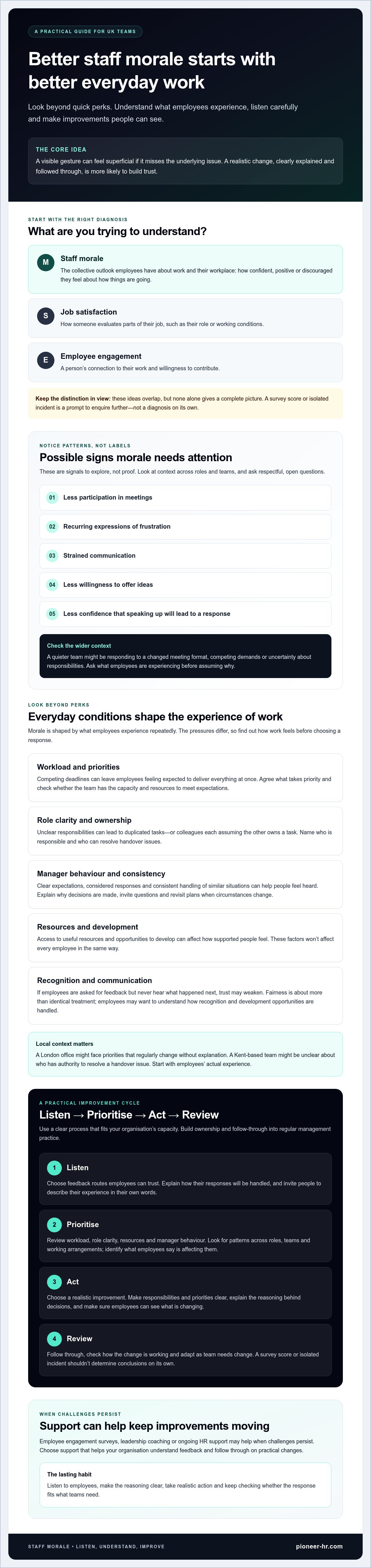
How to improve staff morale: a practical listen, act and review plan
A repeatable process helps turn employee feedback into changes people can see. For UK employers, it doesn’t need to begin with a complex programme. Start with a clear question, agree how you’ll gather and use responses, then follow through in a way that fits your organisation’s capacity.
A practical cycle is:
Listen: Gather views through conversations, structured feedback or a combination of both.
Identify themes: Look for recurring issues and differences between roles or teams.
Agree priorities: Choose a manageable number of areas to address, and explain why they matter.
Act: Define a specific action, an owner and a realistic point to check progress.
Review: Ask whether the change helped, and adapt the plan if it didn’t.
This cycle gives feedback a purpose. It also avoids treating one survey result as a complete picture or setting expectations the organisation can’t meet.
How can you find out what employees need?
Choose a feedback method that suits your team’s size, working arrangements and level of trust. Manager conversations may work well in some settings; structured employee engagement surveys can help gather views across a wider organisation. You might combine both, provided employees know how to take part and what will happen with their responses.
Ask open questions, such as “What helps you do good work?” and “What creates friction in your role?” Be precise about confidentiality. Explain who will see responses and how findings will be shared. Don’t promise anonymity unless the method genuinely supports it.
How should managers turn feedback into visible change?
Group responses into themes before deciding what to do. Check whether a concern is shared across the organisation or concentrated in a particular role, team or working arrangement. Then choose priorities based on their impact on employees and what the organisation can realistically address. Communicate both the decision and the reasoning, including issues that need more investigation.
For each action, record the next step, the person responsible and a review point. Consider relevant existing workforce information alongside qualitative feedback, such as recurring comments from check-ins or changes in participation. Use measures that fit your organisation rather than relying on generic benchmarks.
If you need structured feedback support, Pioneer HR offers employee engagement surveys. For ongoing help planning and reviewing improvements, you can explore retained HR support. With clear ownership and regular review, efforts to improve staff morale can stay focused on what employees say would make a practical difference.
How to sustain better staff morale across UK teams
Morale isn’t maintained through a one-off campaign. Employees’ experience can shift as workloads, leadership, team structures and organisational priorities change, so employers need to keep listening and show what happens next. To improve staff morale over time, make follow-up part of normal management practice rather than an extra initiative that loses momentum when attention moves elsewhere.
Build brief review conversations into existing team meetings or one-to-ones. Leaders can share what’s progressed, what needs more time and whether a planned action has changed. If circumstances mean an original commitment is no longer practical, explain why and discuss the next step. Honest updates help employees understand the process, even when an issue can’t be resolved immediately.
How can organisations keep morale improvements on track?
Give every agreed action a clear owner and review point, then revisit priorities when feedback or working conditions change. Keep the approach proportionate: one team might need more clarity around responsibilities, while another may need managers to improve how they share decisions. Employers in London and Kent, like those elsewhere in the UK, should consider their own workforce context instead of assuming that a change that works in one location will suit every team.
Check regularly whether actions are making a practical difference. That might mean asking employees directly, reviewing relevant comments from existing check-ins or discussing progress with managers. Use what you learn to adapt the response, not simply to report that a task has been completed.
When might external HR support be useful?
External expertise may help if feedback is difficult to interpret, the same concerns keep resurfacing, or leaders aren’t aligned on which issues to address first. Structured employee engagement surveys can help employers gather and understand employee perspectives. Leadership coaching can support managers in translating feedback into consistent day-to-day behaviours, while organisational development can help align wider changes with what teams need.
Pioneer HR offers these forms of support, drawing on its founder’s more than 30 years of HR industry experience. That experience can inform a considered approach, though outcomes depend on an organisation’s circumstances and follow-through. If your organisation needs ongoing help to plan and review improvements, explore retained HR support and discuss what would be useful for your team.
Make staff morale part of how your organisation works
Lasting progress starts with understanding what employees experience, not assuming a perk will fix the problem. Listen for themes across roles and teams, choose practical priorities, then make ownership and follow-up visible. This steady approach can help you improve staff morale while adapting actions to your organisation’s capacity.
External support may be useful if you need help gathering feedback, aligning managers or turning findings into organisational change. Pioneer HR offers employee engagement surveys, leadership coaching and organisational development, drawing on its founder’s more than 30 years of HR industry experience.
If you’re considering the next step for your team, talk with Pioneer HR about practical support for your people. With clear listening and consistent follow-through, your organisation can build improvements employees recognise and trust.
Frequently Asked Questions
How can you improve staff morale quickly without relying on perks?
To improve staff morale quickly, address a practical frustration employees have raised and tell them what you’re doing about it. Clarify competing priorities, resolve uncertainty about responsibilities or check that people have the resources to complete their work. Ask managers to recognise specific contributions sincerely, too. These steps won’t resolve every underlying issue immediately, but visible follow-through can show employees that their feedback has been heard and taken seriously.
What are the common signs of low staff morale?
Possible signs include reduced participation, recurring frustration, strained communication or less willingness to share ideas. Treat these as prompts to ask questions, not proof that morale is low. A change in participation, for instance, could reflect workload, team changes or meeting arrangements. Look for patterns across roles and teams, then invite employees to describe their experience. Their perspectives can help you distinguish a morale concern from another workplace issue.
Can staff morale improve without increasing pay?
It can, particularly if employees’ concerns relate to management communication, workload, role clarity, recognition or access to development. However, don’t assume non-pay changes will address a pay concern. Listen to what employees say, review whether pay decisions are understood and perceived as fair, and consider whether a reward or salary review is appropriate. Morale has several possible influences, so no single change, financial or otherwise, should be treated as a guaranteed fix.
How do you measure staff morale in a small business?
Combine regular one-to-one conversations with a simple, consistent way to gather feedback, such as a short set of questions. Ask what helps employees do good work and what makes work more difficult. Track themes over time alongside relevant existing workforce information, and explain how responses will be handled. If you promise confidentiality or anonymity, make sure your chosen method supports it. Focus on changes in your own team’s feedback rather than generic benchmarks.
What should a manager do when employees say morale is low?
Listen without becoming defensive, ask open questions and thank employees for raising the concern. Find out whether they’re describing a shared issue or different experiences within the team. Reflect back what you’ve heard, then explain what can be addressed, who will take responsibility and when you’ll provide an update. If a request can’t be met, give a clear reason. Employees may not expect every problem to disappear, but they should know their feedback has been considered.
How often should employers review staff morale?
There’s no single review schedule that suits every UK employer. Build regular listening into existing management routines, then revisit morale when significant workplace changes or new concerns arise. A review is useful when it leads to a conversation about what employees are experiencing and whether previous actions helped. Avoid asking for feedback more often than you can respond to it. Be clear about when employees will hear an update and what the next review will consider.
When should a UK business seek external HR support for staff morale?
Consider external HR support if feedback is difficult to interpret, concerns keep returning or leaders need help agreeing priorities and following through. Pioneer HR offers employee engagement surveys, leadership coaching and organisational development to support employers addressing persistent morale challenges. Its founder brings over 30 years of HR industry experience. The right support depends on your organisation’s needs; external expertise can help you assess options, but meaningful progress still relies on relevant action and review.


Comments