
How to Convince Your Boss You Need HR Help: A Step-by-Step UK Business Guide
What if the hours you spend untangling workplace disputes and drafting contracts are quietly costing your company far more than professional support ever would? If you're balancing daily operations alongside paperwork and recruitment, figuring out how to convince my boss we need hr help can feel like an uphill struggle. It's frustrating when leadership dismisses people management as an administrative expense rather than a vital safeguard for the bottom line.
We understand the strain of keeping a growing team aligned while quietly worrying about an expensive Employment Tribunal claim, especially as UK employment regulations tighten for businesses across London and Kent. You don't have to carry that operational risk alone. In this guide, you'll learn how to build an airtight business case proving that dedicated HR support protects profits and executive time. We'll share a structured framework to present to your managing director, along with a clear roadmap for choosing between retained HR, a permanent hire, or fractional support.
Table of Contents
Spotting the Warning Signs: When Your Business Has Outgrown DIY HR
Reframing the Conversation: Presenting HR as a Commercial Growth Driver
Evaluating Support Models: Retained HR, In-House Staff, or Fractional Leadership
A Step-by-Step Pitch Guide: How to Prepare and Present Your Proposal
Choosing the Right UK HR Partner to Secure Fast Operational Value
Spotting the Warning Signs: When Your Business Has Outgrown DIY HR
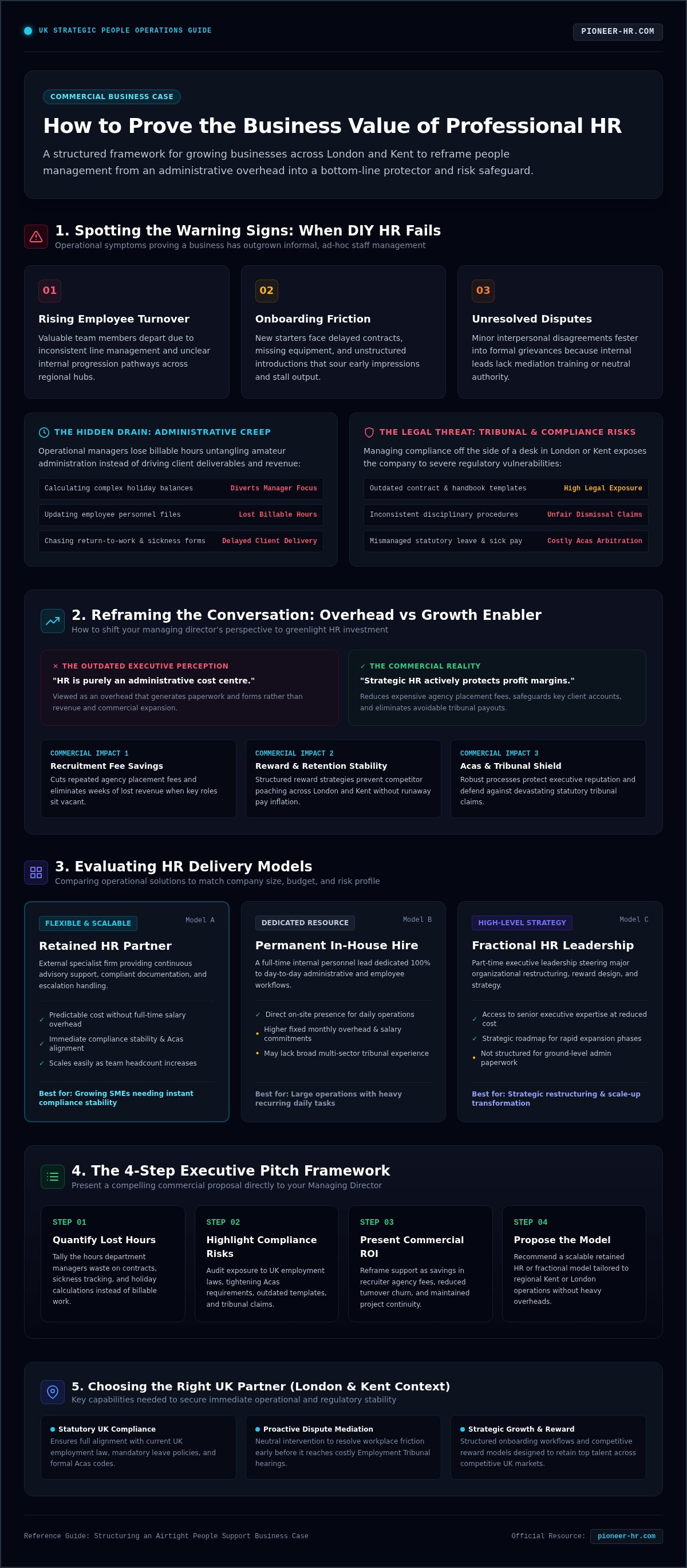
Every growing business reaches a tipping point where informal management stops working. In early days, managing staff through casual chats and shared spreadsheets feels nimble. As headcount rises across London offices or regional Kent hubs, this makeshift approach quickly turns into an operational drag. When you start researching how to convince my boss we need hr help, it is usually because the cracks are already showing across daily workflows.
Ad-hoc personnel management inevitably stalls progress. Instead of driving revenue, your key people get stuck putting out internal fires. The symptoms rarely appear overnight; they creep in through gradual friction:
Rising employee turnover: Capable team members walk away due to inconsistent line management or murky progression paths.
Recruitment and onboarding friction: New starters face delayed contracts, missing equipment, and unstructured introductions that sour initial impressions.
Unresolved workplace disputes: Small interpersonal disagreements fester into formal grievances because nobody has the training or neutral authority to mediate early.
The academic study of Human Resource Management (HRM) shows that structured people practices are foundational to organizational productivity. Without them, operational stability crumbles under the weight of preventable personnel friction.
The Hidden Cost of Administrative Creep on Operations
Operational managers lose substantial time handling basic administration. Instead of focusing on client deliverables, department leads find themselves calculating complex holiday balances, updating personnel files, and chasing sickness forms. This distraction pulls attention away from billable work and strategic projects. Teams across London and Kent often face missed deadlines simply because internal leaders are bogged down acting as amateur administrators rather than managing output.
Escalating Compliance and Employment Tribunal Risks
Operating with informal policies creates severe legal exposure. Relying on outdated contract templates or downloaded handbooks leaves your company vulnerable during formal disputes. Inconsistent disciplinary processes dramatically increase the danger of unfair dismissal claims and expensive Acas arbitration. Tracking statutory obligations around leave rights, sick pay, and workplace regulations requires dedicated focus. Trying to manage compliance off the side of your desk is an enormous risk; learning how to convince my boss we need hr help is often the most effective step you can take to safeguard the business against avoidable tribunal fallout.
Reframing the Conversation: Presenting HR as a Commercial Growth Driver
Most managing directors view human resources as an overhead: a necessary evil that generates paperwork rather than revenue. If you want to know how to convince my boss we need hr help, you have to change the language of the conversation. Leaders don't greenlight budget requests based on workplace frustration alone; they invest in solutions that protect margins, reduce financial risk, and drive commercial performance.
Positioning people operations as a growth enabler bridges this divide. When you align structured people processes with company objectives, you prove that sound HR management actively protects profitability. Strategic HR keeps experienced staff engaged, maintains project continuity, and safeguards vital client relationships across competitive markets in London and Kent.
Translating Everyday People Friction into Hard Business Metrics
Unplanned employee departures create direct commercial damage. When an experienced employee leaves, your company faces expensive recruitment agency fees, administrative disruption, and weeks of lost productivity while hunting for a replacement. Even worse, leaving client-facing roles vacant stalls project delivery and strains valuable client accounts.
You can turn these operational headaches into persuasive business figures by showing how stability drives revenue:
Recruitment savings: Replacing a team member frequently costs thousands in agency placement fees and lost operational output.
Retention stability: Developing a structured reward strategy stops competitors from poaching your best talent with marginal pay bumps.
Risk mitigation: Following clear Acas guidance on employment rules insulates your organisation from expensive grievances and tribunal settlements before disputes escalate.
Quantifying Reclaimed Executive and Management Hours
The heaviest hidden cost in any growing business is senior leadership time spent managing personnel issues off the side of their desk. When directors spend entire afternoons investigating informal grievances, amending contracts, or untangling holiday disputes, they are not developing new business or closing sales pipelines. When a managing director reclaims fifteen hours each month from personnel administration to focus on high-value client acquisition, the commercial upside easily offsets the cost of professional support.
Presenting this mathematical reality is the most effective approach for how to convince my boss we need hr help. Partnering with a dedicated partner for flexible retained HR support gives executive teams their working hours back, allowing your leadership to concentrate on strategic growth while leaving complex compliance in safe hands.
Evaluating Support Models: Retained HR, In-House Staff, or Fractional Leadership
One of the quickest ways to lose executive buy-in is proposing the wrong delivery vehicle. If your proposal assumes the only answer is hiring a permanent employee, leadership will instantly see mounting fixed overheads. Choosing the correct structure is essential when planning how to convince my boss we need hr help, because matching the model to your current business stage preserves operating margins.
Most growing UK firms don't actually need a permanent, full-time HR department sitting in the office. Bringing an in-house generalist onto the payroll introduces substantial salary obligations, employer National Insurance contributions, pension commitments, and line management requirements. Unless you have enough daily transactional volume to justify that permanent headcount, an internal hire often creates an unnecessary fixed burden.
Retained HR Support vs. Hiring a Full-Time In-House Manager
For most expanding teams across London and regional Kent, outsourcing through an ongoing partnership offers the sweet spot. Full-time internal generalists often possess narrow experience from just one or two prior workplaces. In contrast, an external advisory team brings diverse cross-sector knowledge, having resolved hundreds of complex employee situations.
Choosing a monthly retained HR support model gives your business several distinct advantages:
Predictable operating expenditure: You eliminate heavy recruitment agency placement fees, bonuses, and statutory benefits.
Agile capacity: The service expands or contracts alongside headcount changes, contract wins, or structural reorganisations.
Immediate impact: You gain seasoned advisory input instantly, avoiding lengthy hiring rounds and three-month executive notice periods.
When to Recommend a Fractional Chief People Officer
Sometimes businesses face complex organisational challenges that go beyond routine operational guidance. If your leadership team is managing rapid scaling, restructuring departments, or preparing for commercial investment, administrative support isn't enough. You need board-level thinking.
Engaging a fractional Chief People Officer delivers executive talent strategy without full-time C-suite expense. A fractional leader sits alongside your directors on flexible terms, designing organisational frameworks, auditing capability gaps, and aligning your workforce plan directly with commercial expansion goals. Presenting these options clearly is central to understanding how to convince my boss we need hr help, because it proves you are focused on cost-effective, commercially proportional solutions rather than simply adding payroll costs.
A Step-by-Step Pitch Guide: How to Prepare and Present Your Proposal
Walking into a director's office with vague complaints about feeling overwhelmed won't secure a budget. When considering how to convince my boss we need hr help, thorough commercial preparation is what transforms an emotional plea into an easy business decision. Managing directors approve initiatives that solve tangible operational pain while protecting the bottom line.
Follow this practical four-step process to build your proposal:
Document operational bottlenecks: Log the exact hours line managers spend rewriting policy documents, onboarding new joiners, or mediating team friction.
Gather feedback from department heads: Collate short, factual examples from colleagues showing where unclear procedures delayed client delivery.
Offer tiered solutions: Never present a single take-it-or-leave-it option. Give leadership a choice between retained advisory support, a strategic fractional role, or a targeted initial project.
Highlight immediate risk reduction: Show how external oversight swiftly insulates the firm against compliance missteps and expensive staff turnover.
Conducting an Internal People and Compliance Pain Audit
Start your preparation by listing recent operational hiccups. Did a disputed leave policy create resentment? Were contracts issued late for recent hires? Look closely at your current terms against UK statutory rules to spot compliance gaps before they turn into formal disputes. It is also wise to evaluate whether your current compensation packages match broader regional standards. Incorporating objective salary benchmarking data into your proposal demonstrates whether uncompetitive pay bands are driving talent straight to London or Kent competitors.
Handling the Leadership Team's Inevitable Objections
Expect pushback during your discussion. Business owners naturally scrutinise every new operational expense, but having clear, calm answers ready keeps the conversation constructive:
"We're too small for HR": Remind them that UK employment regulations and tribunal jurisdictions apply regardless of team size. Small companies face identical penalties for non-compliance, but with far smaller financial buffers to absorb them.
"We can't afford external support": Contrast the modest commitment of an ongoing retainer against the immediate hit of recruitment churn, lost client hours, or tribunal settlements.
"An outsider won't understand our culture": Emphasise that reputable advisors don't enforce rigid corporate bureaucracy; they design proportionate processes tailored around your team's specific working style.
Approaching the discussion as a collaborative problem-solver is the secret of how to convince my boss we need hr help. If you're ready to present a solid case to leadership, book an exploratory consultation with Pioneer HR to see how scalable retained support protects your company's time and margins.
Choosing the Right UK HR Partner to Secure Fast Operational Value
Once leadership agrees that professional support makes commercial sense, the final hurdle is selecting the right advisory provider. Recommending the wrong agency can quickly undermine your credibility. A partner who offers rigid legal theory instead of commercial answers will only frustrate department heads. When finishing your preparation on how to convince my boss we need hr help, presenting a vetted, commercially minded partner proves you are focused on real business execution.
A high-calibre advisory partner must balance responsive, day-to-day personnel guidance with long-term strategic clarity. Transparent scopes of work protect your monthly budget from unexpected project fees, while a well-planned onboarding process ensures your existing contracts and handbook policies are brought into full compliance right from week one.
Essential Criteria for Vetting an External HR Consultancy
Before submitting names to your managing director, run potential providers through a strict commercial filter:
Proven commercial experience: Look for consultants with decades of hands-on leadership experience across multiple UK sectors rather than textbook theorists.
Pragmatic mindset: Choose an advisor who finds viable commercial paths forward instead of hiding behind excessive red tape.
Regional market knowledge: Ensure they understand the distinct hiring challenges, salary expectations, and working cultures across London, Kent, and the wider South East.
How Pioneer HR Delivers Commercial Peace of Mind
Pioneer HR brings over 30 years of deep industry expertise led by founder Sarah-Jane, providing UK businesses with the exact blend of operational reassurance and executive insight they need. Whether your company requires a complete compliance overhaul or continuous workplace guidance, their retained advisory structures eliminate the overhead of full-time internal hires while shielding you from costly tribunal exposure.
By adapting their retained partnerships and organisational design projects around your operational stage, their team helps you protect profit margins and reclaim director hours. Having this tailored option in your back pocket completes the puzzle of how to convince my boss we need hr help, turning what started as internal operational stress into a strategic advantage. Take the next step to safeguard your business by choosing to partner with Pioneer HR for expert support.
Take the Next Step Towards Smarter Workplace Support
Bringing dedicated people expertise into your business isn't about creating extra red tape; it's about giving your leadership team the freedom to focus on commercial expansion. Successfully navigating how to convince my boss we need hr help comes down to demonstrating that operational compliance and protected management hours directly safeguard profitability. By highlighting internal bottlenecks and presenting scalable, cost-effective options, you position yourself as a forward-thinking problem solver.
With over 30 years of seasoned human resources leadership, Pioneer HR supports ambitious organisations across London, Kent, and the UK. Their tailored retained packages cover everything from essential compliance to long-term strategic people planning, delivering peace of mind without the overhead of an expensive internal department. You don't have to carry the burden of workplace friction alone. Discover flexible HR support for your business with Pioneer HR and give your organisation the foundation it needs to thrive.
Frequently Asked Questions
How do I convince my boss to invest in external HR support?
Frame the request around commercial risk and executive capacity rather than administrative frustration. Document the specific operational hours lost to disputes, recruitment logistics, or contract paperwork. When figuring out how to convince my boss we need hr help, presenting flexible options like retained advisory support shows you are guarding the bottom line rather than simply demanding extra overhead.
At what company size should a UK business get professional HR help?
Most UK businesses benefit from professional HR support once they reach around 10 to 15 employees. At this stage, informal management styles break down and line managers get pulled away from revenue generation. Bringing in external guidance early prevents compliance gaps from snowballing, ensuring contracts, leave policies, and disciplinary frameworks keep pace with expanding headcount across London or regional hubs.
What is the difference between retained HR support and hiring in-house?
Retained HR support provides scalable access to an experienced advisory team for an ongoing monthly fee, without the permanent overheads of employment. Hiring in-house adds a full-time salary, National Insurance contributions, pension costs, and additional management oversight. A retainer gives growing businesses cross-sector expertise and flexible capacity, whereas an internal hire locks the organisation into fixed headcount expenses.
Can poor HR practices lead to costly UK Employment Tribunals?
Yes, procedural errors during disciplinary procedures, grievances, or dismissals are the leading cause of expensive tribunal claims. Even well-intentioned managers can breach statutory guidance or misapply Acas codes without specialised advice. Facing a claim drains months of leadership energy and risks heavy compensation awards, making proactive external HR guidance an essential safeguard for UK employers.
How much management time does outsourcing HR tasks actually save?
Outsourcing routine people operations typically saves managers and directors between 10 to 20 working hours each month. Instead of drafting contracts, calculating complex holiday accruals, or investigating workplace friction, leadership teams reclaim that time for revenue-generating client work. Demonstrating these reclaimed hours is a powerful tactic when exploring how to convince my boss we need hr help.
What happens if our company continues using DIY HR processes?
Relying on DIY HR processes leads to operational bottlenecks, rising staff turnover, and heightened legal vulnerabilities. Unchecked interpersonal friction often ends in unplanned resignations, driving up costly recruitment fees and destabilising morale. As employment regulations evolve across the UK, outdated contracts and inconsistent disciplinary procedures expose the business to severe compliance penalties, operational drift, and avoidable commercial disruption.
Can external HR consultants help improve employee retention and morale?
External HR consultants boost morale by establishing fair, transparent workplace practices that employees trust. They introduce clear progression pathways, objective salary benchmarking, and effective reward structures that make staff feel valued. When disputes or grievances arise, an impartial external expert resolves issues swiftly, preventing toxic workplace dynamics from taking root and protecting your key talent from looking elsewhere.


Comments