
Measuring ROI of Management Training: 2026 UK Guide
What if the clearest evidence that management training works isn’t a positive course survey, but a measurable shift in how your business performs? For UK organisations, measuring roi of management training means linking what managers learn to changes in strategic KPIs, while recognising that other factors can influence the results.
If you’ve struggled to separate training’s impact from wider business changes, or to show a finance director why leadership skills deserve investment, you’re not alone. Without reliable internal tracking, even genuine progress can be difficult to demonstrate.
This guide explains how to build a practical ROI formula, choose KPIs that reflect your objectives and gather a useful baseline before training begins. It covers indicators such as team performance, employee retention and engagement, as well as ways to assess behavioural change without claiming training caused every improvement. You’ll also learn how to present evidence clearly to stakeholders, helping turn management training from an overhead cost into a considered strategic investment. Whether your organisation is in London, Kent or elsewhere in the UK, start by agreeing what success looks like and how you’ll measure it.
Table of Contents
Why Measuring ROI of Management Training is Critical for UK SMEs in 2026
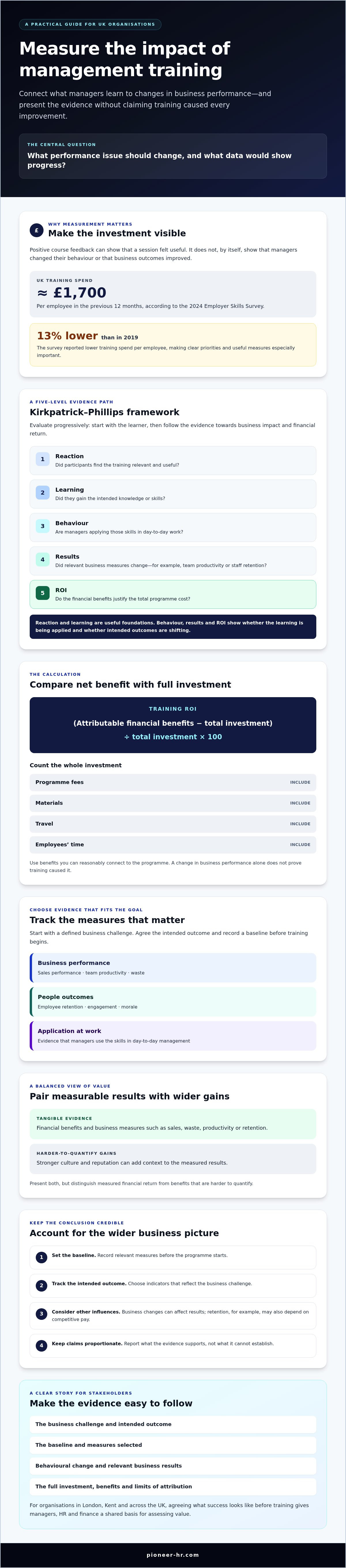
Management training can develop stronger leadership, but positive feedback forms alone don’t show whether it has helped the business. Training ROI is the measurable financial benefit an organisation receives from a programme compared with its cost. In learning and development (L&D), ROI is commonly expressed as the net financial benefit divided by the total investment, then multiplied by 100 to show a percentage.
For UK SMEs, measuring roi of management training matters because budgets need to support clear business priorities. The 2024 Employer Skills Survey found that UK organisations spent approximately £1,700 per employee on training in the previous 12 months, while spending per employee was 13% lower than in 2019. This makes it especially important to understand what training is intended to change and how progress will be assessed.
That means looking beyond “happy sheets”, or post-course reaction surveys. They can show whether participants found a session useful, but not whether managers applied what they learned or team outcomes improved. The evaluation approach builds on Kirkpatrick’s four-level model, progressing from learner reaction to learning, behaviour and results. The financial calculation is one part of a broader evidence picture, not a substitute for it.
The Cost of Ineffective Management in London and Kent
In competitive areas such as London and Kent, poor management can contribute to employees choosing to leave, particularly when they feel unsupported or unable to do their best work. Possible consequences include lower morale, presenteeism, and the time and expense involved in replacing staff. These costs can be difficult to isolate, so establish a baseline and track relevant indicators rather than attributing every change to training.
Retention also depends on whether pay remains competitive. Salary benchmarking can help an organisation compare pay with relevant market data. This complements management development by addressing another factor that may influence whether trained employees stay.
Moving Beyond the ‘Gut Feeling’ of HR
For business owners in Sussex, data-led decisions can make conversations about people investment more grounded and useful to the board. A Fractional Chief People Officer can help connect training objectives to financial priorities, agree measures before a programme starts and review results over time. This can shift HR’s contribution from being viewed solely as a cost centre towards being seen as a value driver, while keeping claims about impact proportionate to the evidence.
Begin with a business question, not a course: what performance issue should change, and what data would indicate progress? Agreeing this in advance gives managers, HR and finance a shared basis for judging whether the investment is delivering its intended value.
The Kirkpatrick-Phillips Framework: A Practical Model for UK Businesses
The Kirkpatrick-Phillips framework gives SMEs a sequence for evaluating management training, from participant feedback to financial return. Its first four levels follow Kirkpatrick’s model; Phillips adds a fifth level to connect business results with programme costs. The levels are:
Level 1, Reaction: Did participants find the training relevant and useful?
Level 2, Learning: Did they gain the knowledge or skills the programme set out to teach?
Level 3, Behaviour: Are they applying those skills in their day-to-day management?
Level 4, Results: Did relevant business measures change, such as team productivity or staff retention?
Level 5, ROI: Do the financial benefits justify the total cost of the programme?
Levels 1 and 2 provide useful foundations, but positive feedback and improved knowledge don’t prove that workplace behaviour has changed. Levels 3 and 4 test whether learning is being applied and whether intended business measures are shifting. Level 5 considers the financial value of those results, while taking care not to attribute every improvement to training alone. The University of Derby’s guide to calculating your ROI offers a practical reference for translating programme benefits and costs into a financial measure.
Adapting the Framework for SMEs
A London scale-up doesn’t need an elaborate evaluation system to use this framework. It needs a few measures linked to the reason for training and a baseline recorded before the programme starts. For example, if managers are learning to give clearer feedback, first check how consistently that behaviour appears in regular conversations. Then look for changes in broader team outcomes.
Level 3 is often a useful leading indicator for Level 5: if new skills aren’t being applied, a financial return is less likely to follow. Level 5 evaluation is the final step that translates business results into a percentage of financial return. In practice, calculate net programme benefits as a proportion of total programme costs, then multiply by 100.
Observing Behaviour in Kent Workplaces
In a Kent workplace, 360-degree feedback can gather observations from a manager’s colleagues, direct reports and supervisor. Compare feedback against the behaviours the training aimed to develop, then repeat the process later to look for evidence of change. Keep the questions consistent, and treat the findings as one source of evidence rather than proof that training alone caused an outcome.
Insights Discovery can support reflection on management preferences and communication style, helping participants identify behaviours they may want to adjust. It isn’t a standalone measure of ROI, so connect any learning to observable workplace actions. Where wider organisational changes are needed, Pioneer HR’s HR retainer support may provide a way to discuss how development fits broader people priorities. For SMEs considering a Fractional Chief People Officer, Fractional CPO support can help keep evaluation aligned with business objectives over time.
Step by Step: How to Calculate the ROI of Your Training Programme
Measuring roi of management training starts before the first session. Choose a specific business problem, record its current state, then track whether it changes after managers have had time to apply what they learned. This makes the calculation more useful than simply comparing feedback forms before and after a course.
1. Calculate the full cost. Include programme fees, materials, travel and the opportunity cost of participants’ time away from their usual work.
2. Define the business problem. Be precise: for example, an SME in Hove wants to reduce avoidable employee turnover. Record a baseline using existing HR data.
3. Measure the after state. Once the training has bedded in, review the same data, often after three to six months. Keep the measurement period consistent with the outcome you’re tracking.
4. Convert attributable improvement into money. Estimate the financial value of outcomes such as fewer resignations, using your own recruitment, vacancy and onboarding records.
5. Apply the formula.ROI (%) = [(Total Benefit − Total Cost) ÷ Total Cost] × 100.
Calculating the Monetary Value of Retention
A manager’s resignation can involve recruitment activity, time spent covering a vacancy and lost productivity while a replacement gets up to speed. Use your organisation’s records to estimate these elements, and avoid counting the same cost twice. Salary benchmarking can also help identify whether pay relative to the market may be undermining retention alongside management practices.
For illustration, suppose a 50-person London firm has annual turnover of 20%, then sees it fall to 10% after a management programme. That would mean five fewer leavers in the period, if workforce size stayed constant. Multiply those five avoided departures by the firm’s evidenced cost per replacement to estimate a potential benefit. This is a worked scenario, not a typical or guaranteed training outcome. You’d still need to assess how much of the change the programme plausibly influenced.
Isolating Training from Other Variables
Turnover and performance can shift for reasons unrelated to training, including market conditions or seasonal patterns. Compare results with the same period in a previous year, review a longer trend line, or, where practical, compare trained managers’ teams with a similar group that hasn’t yet received training.
If a control group isn’t feasible, use participant estimation: ask managers and their teams what proportion of the improvement they believe is linked to changed behaviours from the programme. Apply a conservative estimate, record how it was reached and deduct other known influences before calculating the benefit. This won’t establish perfect causation, but it makes your assumptions visible and your ROI case more credible.
Tangible vs. Intangible Gains: Measuring What Matters
Management training can influence outcomes that are easy to count and others that take more care to assess. Tangible gains can be measured in operational or financial records, such as increased sales, reduced waste or lower recruitment costs. Intangible gains include changes in employee engagement, workplace culture and the organisation’s reputation as an employer.
For UK boards and investors, financial evidence can make an investment case easier to assess, but it doesn’t tell the whole story. Engagement or culture scores aren’t automatically a financial return. Treat them as indicators: if they improve after managers change how they communicate or support their teams, check whether related outcomes, such as retention or productivity, also shift. This balanced approach makes measuring roi of management training more credible without claiming that every positive change was caused by the programme.
Employee Engagement Surveys can provide a consistent way to track employee views before and after training. Use questions related to the behaviours the programme aims to develop, compare results over time, and interpret them alongside operational measures. A favourable survey result is useful evidence, but report it as an engagement outcome unless you can link it to a clearly measured financial benefit.
Connecting Training to Reward Strategy
Management training can help managers communicate an organisation’s existing pay and benefits approach. When managers understand how to explain that approach clearly and handle questions consistently, employees may have a better understanding of how decisions are made. A Reward Strategy can provide the wider framework for those conversations, while training builds managers’ confidence in handling them.
To evaluate the connection, track salary-related grievances and the HR time spent supporting manager-led pay or benefits discussions before and after training. If those measures change, review other influences too, such as changes to pay arrangements or workforce composition. Record hours consistently, and don’t count an estimated time saving as cash saved unless it genuinely reduces expenditure or releases capacity for other work.
Intangible Benefits and the London Talent Factor
In competitive talent markets such as London and Kent, employees’ experience of management can shape how they describe an organisation to prospective colleagues. Leadership coaching may help managers build more constructive working relationships, which can contribute to employer reputation over time. Track internal promotion rates and employee feedback as indicators, and consider qualitative evidence such as staff testimonials where appropriate. These measures can strengthen the wider picture, but shouldn’t be presented as financial returns on their own.
To make the evidence useful, set a baseline, define the expected change and review both people measures and business results. Pioneer HR’s Reward Strategy support can help businesses consider how a clear reward approach complements management development.
Maximising ROI: How Pioneer HR Partners with UK Businesses
Management training is more likely to address a real business need when the organisation first identifies what should change. Workshops can provide useful foundations, but a generic programme may not reflect an SME’s specific challenges, team structure or strategic priorities. For more credible ROI measurement, define the issue, agree the intended outcomes and choose relevant KPIs before training begins.
Pioneer HR works with UK businesses to diagnose their needs and consider appropriate development, which may include management training or leadership coaching. A Fractional CPO service can help keep people priorities connected to board-level objectives and support ongoing review of agreed measures. Where pay and wider people practices may influence the same outcomes, an HR Audit and salary benchmarking can provide useful context, so training isn’t expected to solve an issue on its own.
Bespoke Training vs. Generic Workshops
For a Brighton business, tailored leadership coaching can be shaped around managers’ responsibilities and the behaviours the organisation wants to strengthen. A seminar in London may offer relevant ideas, but it won’t necessarily address the same organisational context. For South East employers managing hybrid teams, for instance, objectives might include clearer communication across locations or more consistent feedback. Define observable behaviours first, then assess whether managers apply them at work.
Rather than imply a verified Kent client result, consider this illustrative scenario: a Kent SME identifies delays caused by unclear delegation, sets a baseline for a relevant productivity measure, then trains managers to set responsibilities and follow up. The business can compare results later while checking for other changes that may also have affected productivity. This shows how a case study should be evidenced, not assumed.
Your Next Steps for Measurable Growth
To build a practical measurement plan, begin with an HR Audit to identify people-related priorities and potential development gaps. For leadership programmes planned in Q3 or Q4, agree a small set of KPIs before delivery, record the baseline and schedule follow-up reviews. Choose measures that match the objective, such as observed management behaviours, team feedback or a relevant operational result.
Measuring roi of management training is more useful when assumptions and limits are clear. If you’re considering how to connect management development with business priorities, contact Pioneer HR to discuss your management development strategy.
Make Your Next Management Programme Count
Management training becomes a stronger strategic investment when you define the business outcome first, track relevant measures over time and distinguish financial returns from wider gains in engagement and culture. The Kirkpatrick-Phillips framework can help structure that evaluation, while a clear baseline and thoughtful consideration of other influences make findings more credible.
Measuring roi of management training doesn’t require perfect data or a complex system to begin. It requires agreed priorities, consistent tracking and an honest account of what the evidence can and can’t show. Those foundations can help your team make more confident decisions about future leadership development.
Pioneer HR brings over 30 years of HR expertise, UK-wide support with a local focus in London, Kent and Sussex, and strategic Fractional CPO insights to help businesses connect people priorities with organisational goals. Contact Pioneer HR to discuss how to evaluate management development in your business.
With a clear purpose and a practical measurement plan, your next programme can be a considered step towards stronger leadership and sustainable growth.
Frequently Asked Questions
How long does it take to see a return on investment from management training?
It depends on the behaviour being developed and the business result you’re tracking. You may observe changes in how managers communicate or delegate before longer-term outcomes, such as retention, become clear. Set review points that suit your chosen measures, record a baseline before training and allow time for learning to be applied. Avoid promising a return by a fixed date, as results can also be influenced by factors beyond the programme.
Is it possible to measure ROI for ‘soft skills’ like empathy or communication?
Yes, although you’ll usually measure observable behaviours and related outcomes rather than empathy itself as a direct financial figure. For example, gather feedback on whether managers listen actively, then compare engagement responses or team outcomes over time. To support a financial ROI calculation, connect any attributable improvement to a measurable business benefit. Treat survey feedback as useful evidence, not proof on its own that training caused a change.
What is a good ROI percentage for management training in the UK?
There isn’t one percentage that counts as a good return for every UK business or programme. Judge the result against the organisation’s objectives, the full cost of training and the quality of the evidence linking benefits to the programme. A positive percentage can still be misleading if important costs are excluded or other influences aren’t considered. Agree what success means with finance and HR before training starts, then report assumptions transparently.
How do I calculate the cost of a manager’s time spent in training?
Estimate the manager’s employment cost for the hours spent in training, using your organisation’s own payroll and working-time records. A straightforward approach is to divide their relevant annual employment cost by their annual working hours, then multiply by training hours. Include employer on-costs if your internal method accounts for them, and consider any cover or lost work separately. Use a consistent approach across participants so programme costs can be compared fairly.
Can I measure ROI if I don’t have a dedicated HR data system?
Yes. A simple, consistently maintained spreadsheet can be enough to begin, provided you choose a small number of relevant measures and record them before training. You might track attendance, manager feedback, employee survey results or a business indicator already available in your records. Note the source, date and definition for each measure, and limit access to sensitive information appropriately. Consistency matters more than specialist software when you’re building an initial evidence base.
What are the most common mistakes when measuring training ROI?
Common pitfalls include relying only on post-course satisfaction, failing to record a baseline, overlooking costs such as participants’ time, and attributing every improvement to training. Another mistake is choosing measures that don’t match the original business need. To make measuring roi of management training more credible, define the intended outcome in advance, use consistent data sources and document assumptions about the programme’s contribution. Report limitations as well as positive findings.
Does management training always lead to higher employee retention?
No. Training may help managers build skills that support a better employee experience, but retention can also be affected by pay, career opportunities, workload and wider organisational changes. If retention is a programme goal, record a baseline and monitor departures alongside feedback about management behaviours. Review other possible influences before drawing conclusions. Salary benchmarking can also help an employer assess whether its pay remains aligned with relevant market information.
How often should I evaluate the ROI of my leadership programmes?
Plan evaluation at several relevant points rather than relying on a single end-of-course review. Gather an initial baseline, check whether managers are applying their learning, then review business outcomes after they’ve had time to develop. The right schedule depends on the measure: behaviour may be observable sooner than retention or financial results. Keep measures consistent between reviews, and share findings with stakeholders so they can inform future programme decisions.


Comments