
Fractional CPO UK: Strategic Scaling Guide 2026
If you’re searching for a fractional chief people officer UK businesses can engage, you may be looking for senior people leadership without adding a permanent executive role. When growth accelerates, people challenges rarely stay contained within HR. Rising turnover, reward packages that struggle to attract London talent and an uneven culture across hybrid teams in Kent and elsewhere can all affect a business’s ability to grow well.
A Fractional CPO can connect day-to-day HR with board-level strategy, helping leaders build a practical people roadmap, make better-informed reward decisions through UK salary benchmarking and develop junior HR colleagues. In this guide, we’ll look at when this model can support a growing SME, how it differs from interim leadership and the value it can bring as your organisation scales. Led by Sarah-Jane (SJ), Pioneer HR brings more than 30 years of experience supporting businesses across the UK, including London and Kent, with people strategy grounded in the realities of the UK salary landscape.
Table of Contents
What is a Fractional Chief People Officer and Why Does Your UK Business Need One?
A Fractional Chief People Officer is a senior people executive who works with a business part-time, providing strategic leadership and board-level expertise without taking on a full-time executive role. They help translate business priorities into a coherent plan for leadership, culture, organisation and capability. The Fractional executives model can suit UK SMEs and scale-ups that need experienced leadership but aren’t ready to appoint a permanent CPO.
For a growing business in London, Kent or elsewhere in the UK, the value lies in connecting people decisions to commercial priorities. That might mean strengthening leadership as the organisation expands, establishing consistent practices across hybrid teams or aligning reward with the skills the business needs to attract and retain. The role bridges operational HR and board-level strategy, helping leaders address immediate challenges while building foundations for sustainable growth.
The Evolution of the People Function in 2026
The people function has moved beyond a mainly administrative view of “personnel”. Organisations expect it to contribute to business transformation, workforce planning, productivity and leadership development. Hybrid working adds another consideration: businesses need structures and ways of working that support people across locations, not just those based in one office. For SMEs, fractional leadership can provide strategic direction without a full-time HR Director appointment.
HR Consultant or Fractional CPO: Strategy and Tactics
The difference is less about seniority and more about the scope of the relationship. An HR consultant may advise on a defined issue or deliver a specific project. A Fractional CPO works with leaders on an ongoing basis, shaping priorities, joining up initiatives and maintaining focus on the people roadmap. For example, an HR consultant might recommend changes to a reward framework, while a CPO can connect that work to growth plans, organisational design and leadership capability.
Fractional CPO vs. Interim CHRO: Key Distinctions
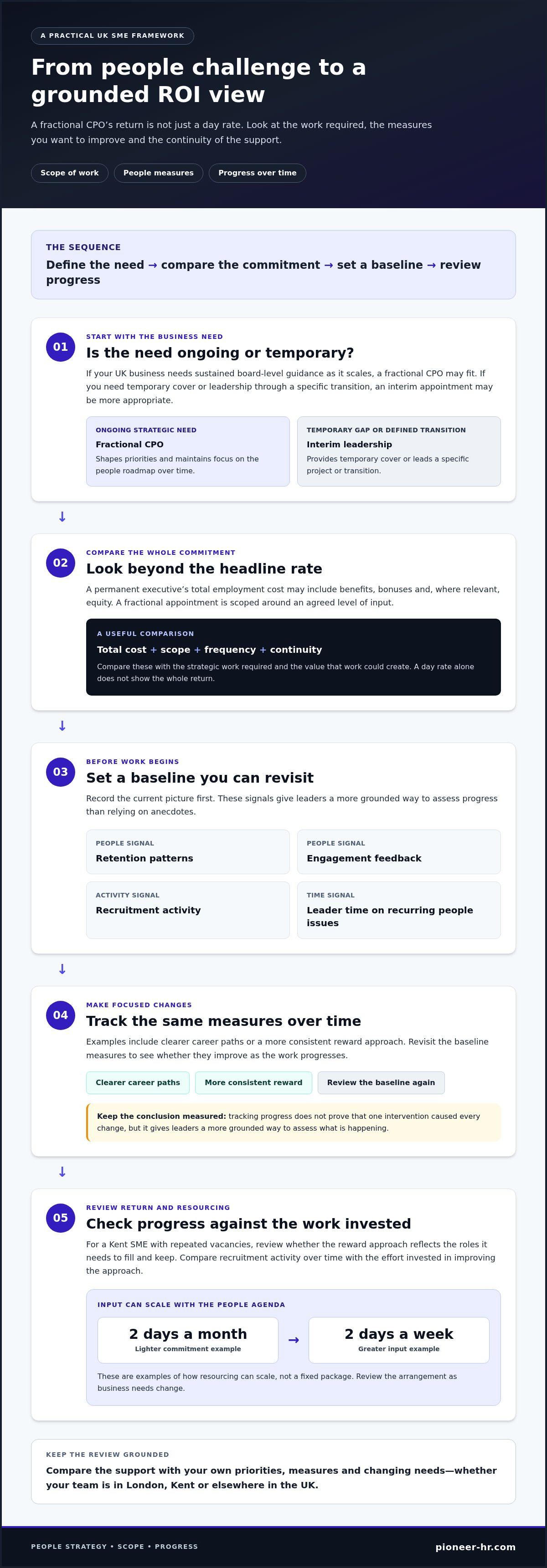
A fractional appointment is typically ongoing and strategic, while an interim CHRO is usually brought in temporarily to fill a leadership gap or deliver a defined project. An ongoing relationship allows a fractional leader to build knowledge of the organisation’s decisions, people priorities and culture over time, without the commitment of a full-time executive hire.
Start with the need you’re addressing. If your UK business requires sustained board-level guidance as it scales, a fractional CPO may be a good fit. If you need temporary cover or leadership through a specific transition, an interim appointment may be more appropriate. Pioneer HR’s Fractional CPO service is led by Sarah-Jane (SJ), who brings more than 30 years of experience, alongside insight into UK salary benchmarking and reward strategy.
Fractional vs. Full-Time: Comparing the ROI for UK Scale-Ups
Comparing a fractional CPO with a full-time hire means looking beyond the headline salary. A permanent executive’s total employment cost may also include benefits, bonuses and, where relevant, equity. A fractional appointment is usually scoped around an agreed level of input, giving the business access to senior leadership without taking on a full-time role. Compare the total cost with the strategic work required and the value that work could create.
A day rate can help with budgeting, but it doesn’t show the whole return. In London and across the UK, consider the scope, frequency and continuity of the engagement alongside the rate. A fractional leader can give a business access to senior-level guidance without the cost of a full-time executive appointment. Assess whether the role provides the perspective and support your managers need.
The Financial Case for Fractional Leadership
To assess return on investment, establish a baseline before work begins. Review retention patterns, engagement feedback, recruitment activity and the time leaders spend responding to recurring people issues. Then track whether focused changes, such as clearer career paths or a more consistent reward approach, improve those measures. This won’t prove that one intervention caused every change, but it gives leaders a more grounded way to assess progress than relying on anecdotes.
For example, a Kent SME that struggles to retain experienced staff might review whether its reward approach reflects the roles it needs to fill and keep. If a clearer, more coherent strategy helps reduce repeated vacancies, leaders can compare recruitment activity over time with the effort invested in the improvement. Explore reward strategy support as one way to address that challenge.
Strategic Flexibility and Scalability
The fractional model can be shaped around the organisation’s priorities. A business might begin with a lighter commitment, such as two days a month, then increase the input to two days a week as its people agenda expands. These figures are examples of how resourcing can scale, not a fixed package. Review the arrangement as business needs change so strategic leadership stays aligned with the work ahead.
An external fractional leader can also offer an objective view in board discussions, helping surface trade-offs that may be harder to raise within established internal dynamics. Their value isn’t simply faster access to advice: ongoing involvement lets them understand decisions and follow through as priorities evolve. For a scale-up, compare the cost of that continuity with the time and business impact of unresolved people challenges, then assess the return against your own goals.
Core Deliverables: What a Fractional CPO Actually Does
A Fractional CPO turns business priorities into a practical people plan, then helps leaders put it into action. For a UK scale-up, that might mean mapping the capabilities needed for the next stage of growth, clarifying responsibilities or planning an organisational restructure. The work connects board-level decisions with the experience of managers and employees, rather than treating HR as a collection of separate processes.
A fractional chief people officer can also strengthen an existing HR function. This may include coaching an HR Manager through complex decisions, helping them present recommendations to senior leaders and supporting the team to prioritise its work. The aim is to build clearer direction and stronger internal capability, not simply deliver a list of recommendations.
Reward Strategy and Pay Transparency
Reward decisions affect whether employees see a credible relationship between their responsibilities, contribution and pay. Salary benchmarking gives leaders a clearer view of how roles compare with the relevant UK market, including the distinct pressures of attracting talent in London. It can inform a wider reward strategy, while a consistent job grading framework helps explain how roles differ and how progression may work as the organisation grows. Clear communication about pay decisions can support trust. Avoid making promises the organisation’s approach cannot sustain.
Salary benchmarking can provide a foundation for evidence-informed reward decisions. A structured job grading framework can bring consistency to role evaluation, while PPC benchmarking can support consideration of competitive packages for London talent.
Culture, Engagement and Retention
Culture needs to remain understandable as a company adds teams, locations and layers of management. A CPO can help leaders identify which behaviours and principles should stay consistent, while adapting how they’re put into practice across UK-wide hybrid teams. During a founder-led transition, this can help preserve what employees value while establishing clearer decision-making and accountability beyond the founders.
Engagement surveys are useful when they lead to visible follow-through. A CPO can help shape questions around practical issues, such as communication, management support or confidence in career development, then work with leaders to agree actions and review progress. Results can inform retention priorities, but should be considered alongside conversations and organisational context rather than treated as a complete explanation on their own.
Signs Your Business is Ready for a Fractional Chief People Officer
There isn’t a single employee count that automatically means a business needs a CPO. The often-mentioned “50-employee wall” is better understood as a change in complexity: informal ways of working may become harder to manage as teams grow, and routine HR processes alone may no longer give leaders the strategic visibility they need.
Look for accumulating people debt: inconsistent policies between teams, unclear pay decisions, recurring leadership friction or key decisions that depend too heavily on one person. CEO burnout around people matters is another signal. If the chief executive spends substantial time resolving team issues, managing performance concerns or untangling unclear responsibilities, it may be time to bring in senior people leadership.
Preparing for Investment or Exit
Investment or a potential strategic exit can put greater focus on how clearly a business understands its people and organisation. A Fractional CPO can help leaders organise people data, clarify role structures and identify gaps in documentation, making information easier to review during due diligence. They can also help the leadership team assess whether its people practices need attention against current UK requirements. One review alone does not guarantee compliance.
Investors also look for a leadership team with clear responsibilities and the ability to deliver the organisation’s plans. A CPO can help define decision-making, strengthen management capability and make workforce priorities more coherent. Starting this work before a transaction process becomes urgent gives leaders time to consider improvements rather than rushing them.
The Skills Gap in Your Current HR Team
Your HR Manager may be highly capable in operational delivery while having limited opportunity to develop board-level strategy. That’s not a failure: the roles call for different experience and focus. A Fractional CPO can mentor internal HR colleagues, help them frame recommendations for senior leaders and connect day-to-day priorities with longer-term organisational needs.
This can also bridge retained HR support and executive leadership. Ongoing HR support helps maintain operational continuity, while CPO-level input connects people priorities to business direction. A fractional chief people officer can help UK SMEs establish that link as they grow, including across teams in London, Kent and the wider UK.
If these signs feel familiar, consider how fractional CPO support could fit your growth plans.
The Pioneer HR Approach: Strategic Leadership for the UK
Effective people strategy starts with understanding the organisation, not arriving with a pre-set plan. Led by Sarah-Jane (SJ), Pioneer HR brings more than 30 years of experience working with SMEs and scale-ups across the UK, including London and Kent. Our Discovery First approach begins by understanding the business’s goals, culture, leadership priorities and reward challenges, then uses that picture to shape a focused people roadmap.
That work connects operational HR with board-level decision-making. A fractional chief people officer through Pioneer HR can help leaders weigh people implications alongside growth plans, organisational change and the capabilities the business needs next. We work collaboratively with the board and internal HR team to agree priorities, clarify decisions and support follow-through, drawing on knowledge of the UK salary landscape when reward is part of the brief.
There’s no one-size-fits-all first quarter, but a 90-day framework can help make the early work tangible. It’s a guide for setting priorities, not a promise that every initiative will be completed on a fixed schedule.
Your First 90 Days with a Pioneer HR CPO
Month one, understand and focus: Review current people processes, culture, reward priorities and business goals. Identify important risks and practical early actions, which might include salary benchmarking where pay decisions need a clearer evidence base.
Month two, agree the direction: Turn findings into a people roadmap. Align with board members, leaders and HR colleagues on outcomes, responsibilities and sequencing, so the plan reflects both organisational needs and available capacity.
Month three, begin delivery: Start agreed culture and reward initiatives, establish how progress will be reviewed, and support managers and HR colleagues as changes take shape. The pace and priorities depend on the organisation’s circumstances.
Learn more about our Fractional CPO service to see how this strategic partnership can work.
Why a Local UK Partner Matters
People decisions need to reflect the organisation’s actual labour market and operating context. Insight into London and Kent salary expectations can inform reward discussions, while a UK-grounded perspective helps leaders avoid applying assumptions designed for a different market, such as US-centric models. Employment law is a specialist area, so people-strategy work should not be confused with legal advice.
Local understanding also means recommendations can be shaped around the teams, leaders and business priorities involved. Whether the organisation works in one location or across hybrid teams throughout the UK, the focus remains practical: build a people roadmap that supports its objectives and can be carried forward by its leaders.
Build Your People Strategy for the Next Stage of Growth
Scaling well takes more than adding people. It means connecting board-level priorities with a practical people roadmap, grounding reward decisions in UK salary benchmarks and giving your HR team strategic support. A fractional chief people officer can provide that leadership to UK businesses without a full-time executive appointment.
Pioneer HR brings more than 30 years of HR leadership experience, specialist knowledge of UK salary benchmarking and experience supporting scale-ups in London and Kent. Together, we can explore the people challenges your business needs to address and shape an approach around your goals.
Book a consultation for a Fractional CPO with Pioneer HR and take a considered first step towards a people strategy that can grow with your organisation.
Frequently Asked Questions
What is the typical day rate for a fractional CPO in the UK?
There isn’t one standard UK day rate for a fractional CPO. Fees depend on the scope of work, the level of leadership required and how regularly the organisation needs support. Rather than comparing rates in isolation, define the outcomes you need, such as a people roadmap, reward review or board-level guidance, then assess the engagement against those priorities and your budget.
How many days per month does a fractional CPO usually work?
There’s no fixed monthly commitment that suits every business. The time required depends on the complexity of your people priorities, the size of your organisation and the support available internally. Some businesses need regular strategic input, while others need a more focused level of involvement. Agree the priorities and review the commitment as your UK business grows or its needs change.
Can a fractional CPO manage my existing HR team?
Yes. A fractional CPO can provide strategic direction and mentorship to an existing HR team. They can connect operational work to business priorities, support an HR Manager with complex decisions and strengthen how recommendations are presented to the board. Whether the CPO also takes on direct line-management responsibilities depends on the agreed scope. The aim is to develop internal capability while bringing senior leadership to the people agenda.
Is a fractional CPO different from an HR Consultant?
Yes. An HR consultant is often engaged to advise on a specific issue or defined piece of work. A fractional CPO provides ongoing senior leadership, helping shape the people strategy and keep it aligned with business goals. The role connects individual HR projects to a wider roadmap and supports leaders as priorities evolve. The distinction is about the breadth and continuity of strategic responsibility.
How do I know if I need a CPO or just a better HR Manager?
Consider whether your main need is stronger operational delivery or strategic leadership. If HR processes need consistent attention, developing or adding HR management capacity may be the priority. If leaders need help with organisation-wide planning, reward strategy, leadership capability or board-level people decisions, a CPO may fill that gap. A fractional chief people officer in the UK can also mentor an HR Manager while guiding the broader strategy.
What industries do fractional CPOs typically work in?
Fractional CPOs can work across a range of sectors, as people leadership is relevant wherever organisations need to align workforce decisions with business goals. Priorities vary: a growing technology company may be addressing organisational design, while another UK SME may be reviewing reward or leadership capability. Pioneer HR supports employers across sectors, tailoring its strategic people support to each organisation’s context and objectives.
How long does a fractional CPO engagement usually last?
Engagement length depends on the business need and whether the priority is ongoing strategic leadership or a defined period of support. Some organisations work with a fractional CPO over time as their people roadmap develops; others focus on a particular phase of growth or change. Set clear objectives at the outset and review progress together so the arrangement remains aligned with your organisation’s priorities.
Does a fractional CPO help with recruitment?
A fractional CPO can connect recruitment needs to workforce planning, role design and the organisation’s wider growth plans. They can help leaders clarify which capabilities are needed and how roles fit into the structure, as well as consider whether reward is aligned with the UK talent market. This is strategic guidance rather than recruitment agency provision, with the scope shaped around the organisation’s priorities and internal resources.



Comments