
Reviewing HR Policies for UK Compliance in 2026: The Employer’s Essential Guide
Updated: Jun 23
Could your 2025 staff handbook be the very thing that triggers a costly tribunal claim in 2026? With the launch of the Fair Work Agency on April 7, 2026, and the doubling of redundancy protective awards to 180 days, the margin for error has never been thinner. We understand that reviewing hr policies for uk compliance feels overwhelming right now, especially as you juggle day-one rights for sick pay and paternity leave alongside your daily operations in Kent or Sussex. It's a lot to process, and the fear of getting it wrong is a weight many business owners are carrying.
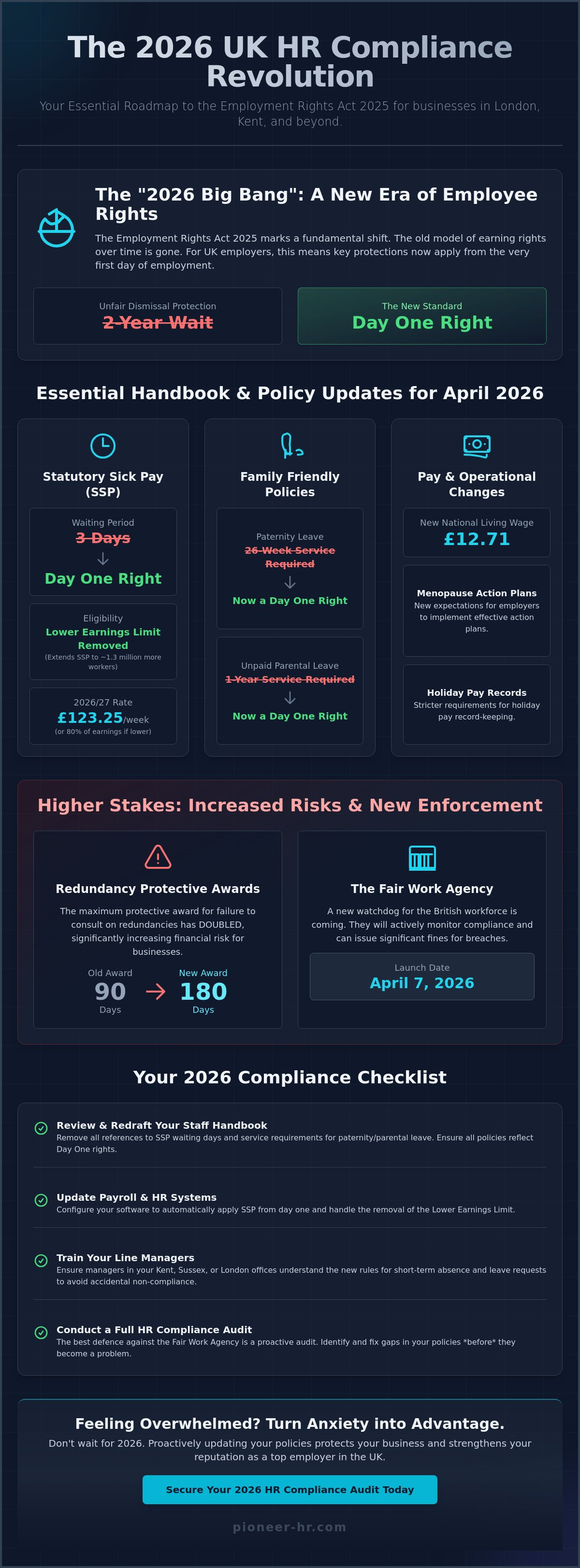
We're here to help you turn that anxiety into a strategic advantage. You'll learn how to master the 2026 legislative shifts with a practical roadmap for updating your staff handbook to meet the Employment Rights Act 2025. We'll explore the new £12.71 National Living Wage, the removal of the SSP Lower Earnings Limit, and a clear timeline to ensure your business stays protected while remaining an employer of choice. From day-one Statutory Sick Pay at £123.25 to the new expectations for menopause action plans, we've broken down exactly what you need to do to stay ahead of the curve.
Table of Contents
The 2026 UK HR Compliance Roadmap: Navigating the Employment Rights Act
Essential Policy Updates for April 2026: Sick Pay and Day-One Rights
Redundancy and Industrial Relations: Managing Higher Risks in 2026
Operational Compliance: Holiday Pay, Menopause, and Reporting
Beyond Compliance: Turning 2026 Law Changes into a Strategic Advantage
The 2026 UK HR Compliance Roadmap: Navigating the Employment Rights Act
The 2026 'Big Bang' isn't just a catchy phrase for HR professionals; it marks the full implementation of the Employment Rights Act 2025. This legislation fundamentally rewrites the rules of engagement in the British workplace. We're seeing a move away from the traditional model where rights were earned through tenure. Instead, we're entering an era of immediate, day-one protections. When we talk about reviewing hr policies for uk compliance, we're really talking about a complete strategic repositioning of your business to meet these new standards. It's a complete overhaul of the contract between you and your team.
For SMEs across Kent and the Southeast, the stakes are particularly high. We operate in a region where talent competition is fierce. If your handbook feels outdated or fails to reflect these new rights, you aren't just risking a tribunal claim; you're risking your reputation as a modern employer. It's about building trust from the very first hour an employee joins your team. Ensuring your documentation is ready for 2026 is the only way to stay competitive in the local market.
Why 2026 is a Milestone Year for UK Employers
The Fair Work Agency: Enforcement and Support
Launching on April 7, 2026, the Fair Work Agency will become the new watchdog for the British workforce. This body won't just sit on the sidelines; it has the remit to monitor compliance across the country actively. While their initial approach might focus on support and guidance, they possess the real power to issue significant fines for persistent breaches. We believe that a comprehensive HR Audit is the most effective first step for any leadership team. It's the only way to ensure your documentation is robust before the agency begins its inspections. It's also essential when reviewing hr policies for uk compliance to ensure no gaps remain between your written word and your daily practices.
Essential Policy Updates for April 2026: Sick Pay and Day-One Rights
The transition to April 2026 requires more than a simple acknowledgement of new rules. It demands a precise redrafting of your core employment documents. When reviewing hr policies for uk compliance, the most immediate pressure point is the transformation of Statutory Sick Pay (SSP). Effective April 6, 2026, the three-day waiting period is officially abolished. This means SSP becomes a "Day One" right for every member of your team. Additionally, the Lower Earnings Limit has been removed, bringing approximately 1.3 million part-time and gig-economy workers into the statutory safety net for the first time.
Rewriting Your Sickness and Absence Policy
Your current handbook likely contains phrases like "SSP is paid from the fourth qualifying day of absence." This must be replaced with clear, definitive language stating that "SSP is payable from the first day of incapacity for work." For Sussex-based managers, this creates a new administrative rhythm. You'll need to track short-term absences with greater precision, as even a single day of sickness now triggers a payment obligation. For lower earners, remember that the 2026/27 statutory rate is £123.25 per week, but the payment is calculated as the lower of that rate or 80% of their average weekly earnings. We recommend updating your payroll triggers immediately to ensure your software doesn't default to the old three-day rule. If you're feeling the administrative weight of these changes, our retained HR support can help you streamline these workflows.
Modernising Family Leave Clauses
Family leave is also undergoing a significant shift. Paternity leave and unpaid parental leave are no longer rewards for long service; they are now day-one rights. The previous 26-week and one-year service requirements have been scrapped. This change is a powerful tool in Kent recruitment cycles, where offering these protections from the start can help you secure top-tier talent. You should also integrate the new Bereaved Partner’s Paternity Leave into your handbook. This is a sensitive, mandatory right that requires an empathy-led approach in your policy wording. Clear Acas guidance on the Employment Rights Act suggests that these updates are not optional. They're essential for protecting your business against tribunal risks. By reviewing hr policies for uk compliance now, you ensure your team feels supported during their most challenging moments, which builds long-term loyalty that goes far beyond simple legal adherence.
Redundancy and Industrial Relations: Managing Higher Risks in 2026
While the focus on individual day-one rights is understandable, the collective landscape of the British workplace is where the most significant financial risks now lie. When reviewing hr policies for uk compliance, we find that many leadership teams overlook the massive shift in redundancy penalties. The Employment Rights Act 2025 has effectively doubled the stakes for consultation failures. If your business undergoes a restructuring process and fails to meet its collective consultation obligations, the maximum protective award has increased from 90 to 180 days' pay per employee. For a mid-sized firm, this single oversight could lead to a catastrophic financial liability.
Industrial relations are also entering a more active phase. The barriers for trade union recognition have been lowered, and the ballot process for UK workplaces is now significantly simpler. We're seeing a trend where unions can more easily initiate industrial action, particularly in the public sector, but the ripple effects will be felt across all industries. You can find more detail on how these changes will be monitored in the official Fair Work Agency factsheet, which outlines the agency's new enforcement powers regarding industrial standards.
The Cost of Getting Redundancy Wrong in 2026
The penalty for poor consultation hasn't just increased; it's become a primary target for enforcement. For London firms where operational costs are already high, a 180-day award per worker can be the difference between survival and insolvency. Strategic planning is no longer a luxury. It's a requirement. We often find that bringing in Fractional CPO leadership during the early stages of a restructure is the most effective way to ensure every legal milestone is met. Early consultation isn't just about avoiding fines; it's about maintaining the trust of the staff who remain with you after the process is complete.
Strengthening Harassment and Whistleblowing Policies
Whistleblowing protections have also been expanded, specifically regarding reports of sexual harassment. From April 2026, employers must demonstrate they've taken "all reasonable steps" to prevent harassment before it occurs. This is a shift from a reactive to a proactive duty. In Sussex workplaces, this means creating a culture where reporting is safe and taken seriously. You'll need to maintain meticulous records of harassment prevention training and policy reviews. It's a vital part of reviewing hr policies for uk compliance to ensure your whistleblowing channels are not only present but actively promoted and trusted by your team. If you're unsure where to start, an HR Audit can help identify gaps in your current reporting culture.
Operational Compliance: Holiday Pay, Menopause, and Reporting
Compliance in 2026 isn't just about the policies you have in place; it's about the evidence you can produce under pressure. When we work with partners on reviewing hr policies for uk compliance, we're seeing a massive shift toward administrative transparency. It's no longer enough to simply "do the right thing" in your day-to-day operations. You have to prove it through meticulous record-keeping that spans years, not just months. This operational side of HR is where the new Fair Work Agency will focus its initial scrutiny.
The 6-Year Rule for Holiday Pay Documentation
For a Kent-based SME, the new mandatory 6-year retention rule for holiday pay evidence is a significant operational hurdle. "Adequate records" now means maintaining a clear, unbroken audit trail of every hour worked, every holiday request approved, and exactly how the 12.07% calculation was applied to irregular hours or part-year workers. If you're still relying on paper files or fragmented spreadsheets, 2026 is the year to move toward a unified digital audit trail. The Fair Work Agency has the power to look back at years of data, and historical holiday pay claims under this new enforcement regime could easily cripple a business that hasn't kept its house in order.
Gender Pay and Menopause: Moving Toward Best Practice
The 2026 legislative landscape also places a heavy emphasis on transparency regarding gender and health. Larger employers with over 250 staff are now required to publish detailed Action Plans alongside their gender pay gap figures. This moves the conversation from what the numbers are to what you're actually doing to fix them. We strongly believe that smaller businesses in Hove or London should adopt these action plans voluntarily. It's a powerful way to attract top-tier talent who value workplace equity. We recommend using salary benchmarking to ensure your reward strategy is both competitive and compliant with modern pay equity standards.
Menopause support is another area where best practice is becoming the expected standard. While mandatory action plans for menopause are currently focused on larger organisations, they're expected to become universal by 2027. Adopting a menopause policy now shows a level of empathy and foresight that sets you apart as a supportive employer. It's an essential part of reviewing hr policies for uk compliance to ensure your team feels supported through every life stage, which directly impacts your long-term retention rates.
Finally, don't overlook the new rules regarding trade union access. Unions now have a legal right to access workplaces for recruitment purposes. Your managers need clear guidance on how to facilitate this access without disrupting operations. It's a delicate balance to strike, but having a clear policy in your handbook prevents confusion and potential friction during these visits.
If your current documentation feels like a collection of "best guesses" rather than a robust shield, our retained HR support can help you build a compliant, digital-first policy framework.
Beyond Compliance: Turning 2026 Law Changes into a Strategic Advantage
We believe that the most successful organisations in 2026 won't view these legislative shifts as a mere checklist. Instead, they'll see them as a rare opportunity to redefine their relationship with their people. When reviewing hr policies for uk compliance, we encourage you to look past the legal minimums and consider how these changes can strengthen your culture. A handbook that clearly communicates day-one rights is a powerful statement of intent. It tells your team that their security and well-being are priorities from the very first hour they join your business. This transparency builds a level of trust that is difficult for competitors to replicate.
From Legal Burden to Employer Brand
In the competitive London and Kent job markets, the psychological contract between employer and employee has evolved. Candidates are no longer willing to wait two years for basic protections or security. By embracing day-one rights for sick pay and family leave, you're positioning your business as a progressive, secure place to work. Our founder, SJ, has spent 30 years helping businesses turn these kinds of legal shifts into significant cultural wins. We've seen first-hand that when employees feel protected, their engagement and productivity naturally rise. Your updated handbook isn't just a legal shield; it's a core part of your employer brand that helps you win the war for talent.
Managing the Bottom Line with Smart Benchmarking
We recognise that these changes come with a financial cost that must be managed carefully. The adjustments to Statutory Sick Pay alone are estimated to increase employer costs by roughly £15 more per employee annually. To manage this without damaging your margins, a holistic look at your Reward Strategy is essential. This is where reviewing hr policies for uk compliance meets financial planning. We recommend using Pay Benchmarking to ensure your total compensation package is balanced and sustainable. By understanding exactly where you sit in the Sussex market, you can offset rising statutory costs with a more efficient, data-driven pay structure.
Engagement and retention are your best defences against rising operational costs. High turnover is far more expensive than the new SSP rates or paternity leave entitlements. Through our retained HR support, we help you keep your policies evergreen and effective. We ensure that as the law continues to evolve, your documentation remains both compliant and strategically aligned with your growth goals. If you're ready to move beyond simple box-ticking and turn 2026 into a year of strategic growth, our team is here to guide your policy review process and secure your business for the future.
Securing Your Future Workforce for 2026 and Beyond
The 2026 legislative landscape marks a significant transition for every UK business owner. We've explored how day-one rights for sick pay and paternity leave are no longer just concepts but operational requirements that demand immediate attention. We've also highlighted the increased financial stakes in redundancy consultation, where awards have now doubled. It's clear that reviewing hr policies for uk compliance isn't just about avoiding the Fair Work Agency's fines; it's about building a resilient, attractive employer brand in Kent and London.
With over 30 years of HR expertise led by Sarah-Jane (SJ), we provide the strategic CPO-level guidance that UK SMEs need to navigate these complexities. We specialise in creating bespoke policy updates that reflect your unique culture while ensuring total legal protection. You don't have to face these changes alone. Let's work together to turn these new regulations into a foundation for your future growth. We're ready to help you lead with confidence and clarity.
Ensure your business is 2026-ready with our expert HR Retainer support
Frequently Asked Questions
What are the most urgent HR policy updates for April 2026?
The most urgent updates involve Statutory Sick Pay (SSP) and family leave eligibility. You must remove the three-day waiting period for SSP and the qualifying service periods for paternity and parental leave. These become day-one rights on April 6, 2026. Failing to update these in your staff handbook could lead to immediate tribunal risks under the new enforcement regime. It's a critical time to ensure your documentation accurately reflects these fundamental shifts in employee rights.
How does the Employment Rights Act 2025 affect small businesses in Kent and Sussex?
Small businesses in Kent and Sussex will see a direct increase in operational costs and administrative responsibility. The changes to SSP alone are estimated to cost employers roughly £15 more per employee each year. With unfair dismissal protections also shifting, the process of reviewing hr policies for uk compliance becomes a vital safeguard against day-one claims from new hires. We've found that local SMEs are prioritising these updates to maintain their reputation as stable, supportive employers in a competitive market.
Can I still have a waiting period for Statutory Sick Pay in 2026?
No, you cannot have a waiting period for Statutory Sick Pay starting from April 6, 2026. SSP is now a day-one right, meaning it's payable from the very first day of an employee's incapacity. The removal of the Lower Earnings Limit also means that all employees are eligible regardless of their weekly earnings. For lower earners, you must calculate the payment as the lower of the statutory £123.25 rate or 80% of their average weekly earnings.
What is the Fair Work Agency and can they fine my London business?
The Fair Work Agency is a new enforcement body launching on April 7, 2026, to monitor workplace standards across the UK. They have the power to inspect your London business and issue fines for non-compliance with employment rights. Their goal is to ensure that the standards set out in the Employment Rights Act 2025 are being met consistently across all sectors. Proactive compliance is the only way to ensure your business stays off their radar during their initial inspection cycles.
Do I need to update my paternity leave policy for new starters immediately?
Yes, you must update your paternity leave policy immediately to reflect day-one eligibility. The previous 26-week service requirement has been abolished as of April 2026. You should also ensure your policy includes the new Bereaved Partner’s Paternity Leave to ensure your team feels supported during sensitive times while remaining legally compliant. Clear communication of these rights during your recruitment process can also help you attract higher-quality candidates who value workplace security and empathy.
What happens if I do not keep holiday pay records for 6 years?
Failing to keep holiday pay records for the mandatory 6-year period leaves your business vulnerable to historical claims and enforcement action. The Fair Work Agency can request these digital or paper audit trails during an inspection. Without them, you'll find it nearly impossible to defend against claims of underpayment or incorrect 12.07% calculations for irregular workers. Meticulous record-keeping is now a core requirement for any business that wants to avoid costly legal disputes and financial penalties.
How do the 2026 trade union changes affect non-unionised workplaces?
Even in non-unionised workplaces, unions now have a legal right to access your premises for recruitment purposes. The ballot process for formal recognition has also been simplified, making it easier for employees to organise. It's essential that your managers understand how to facilitate these requests without disrupting your daily operations or breaching new access rules. Having a clear, neutral policy in place helps prevent confusion and potential friction if a union representative requests access to your site.
Is menopause support now a mandatory HR policy for all UK employers?
Menopause support isn't yet a mandatory policy for all, but employers with 250 or more staff must now publish Menopause Action Plans. While smaller firms aren't legally required to do this in 2026, it's expected to become mandatory in 2027. Adopting these plans early is a great way to support the one in three women in the UK workforce currently experiencing menopause symptoms. We believe that proactive support in this area is a key differentiator for employers who want to retain experienced talent.



Comments