
How to Improve Staff Morale: 2026 UK Employer Guide
- Pioneer HR
- 4 hours ago
- 12 min read
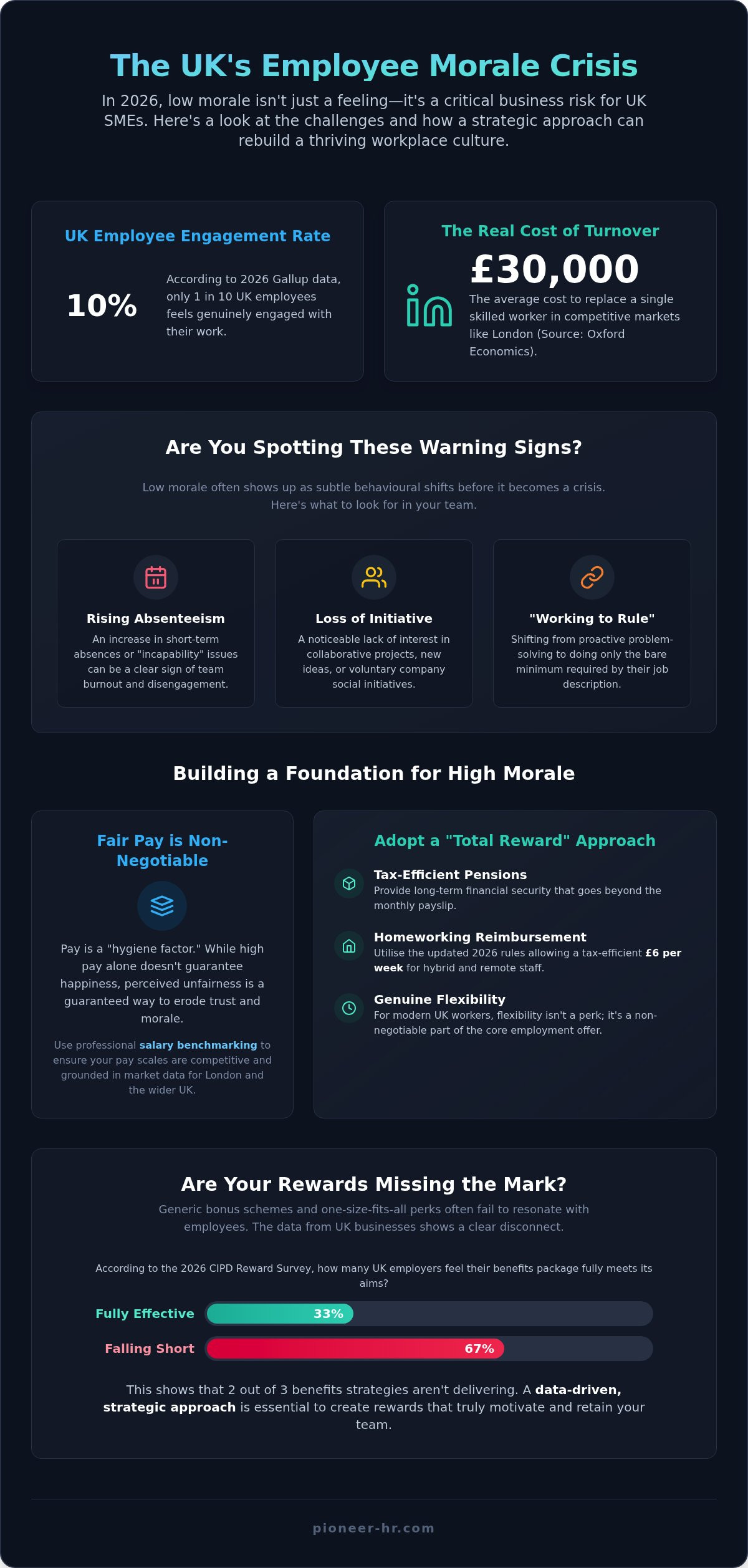
Did you know that only 10% of UK employees are genuinely engaged at work according to the latest 2026 Gallup data? In competitive markets like London or across the hybrid workspaces of Kent and Sussex, this disengagement often translates into a £30,000 replacement cost for every skilled worker you lose. We understand the pressure of trying to build a resilient culture when budget constraints make blanket pay rises feel impossible.
We believe that morale isn't just a soft HR metric; it's a strategic output of a well-designed employee recognition and reward strategy. In this guide, we'll show you how to transform your workplace culture and boost productivity through frameworks tailored specifically for UK SMEs. We'll explore how to navigate the 2026 tax landscape, including trivial benefits and the updated homeworking reimbursement rules, to create a clear roadmap for long-term cultural change.
Table of Contents
What is Staff Morale and Why is it Declining in 2026?
To understand how to lead effectively, we first need to define what employee morale is in a modern context. It isn't just about whether your team is smiling at their desks; it represents the collective outlook, attitude, and confidence that employees bring to their roles every day. We view it as the invisible glue that holds a company's goals and its people together. Staff morale is the heartbeat of business productivity and retention.
As we move through 2026, UK businesses are facing a perfect storm of challenges that have put this heartbeat under strain. The initial novelty of flexible working has, for many, turned into hybrid work fatigue. Employees in Kent and Sussex are reporting feelings of isolation, while UK economic shifts have made people more cautious and sensitive to their value within an organisation. We've noticed that many SMEs struggle because they confuse surface-level perks with structural morale. While a pizza lunch is a kind gesture, it doesn't provide the long-term cultural security or professional recognition that a formal employee recognition and reward strategy offers.
The Real Cost of Low Morale for UK SMEs
In competitive markets like London, the cost of ignoring a dip in spirit is staggering. According to Oxford Economics, the average cost to replace a single skilled worker is approximately £30,000. When morale drops, turnover rises, and your recruitment budget takes a direct hit. Beyond the numbers, low morale damages your brand reputation in local business communities. It also fuels the "Quiet Quitting" trend we're seeing across the UK, where talented individuals don't leave their jobs, but they do stop giving their best effort because they feel undervalued or disconnected from the company's mission—a challenge that Kaika AI helps solve by aligning individual purpose with organisational goals.
Identifying the Warning Signs in Your Workplace
Recognising the decline before it becomes a crisis is a hallmark of great leadership. We recommend managers look for specific behavioural shifts in their teams:
A rise in short-term absenteeism or "incapability" issues that suggest burnout.
A sudden lack of interest in collaborative projects or voluntary social initiatives.
A transition from proactive problem-solving to "working to rule," where employees do only the bare minimum required by their contracts.
If these signs are present, it's often a clear indicator that your current employee recognition and reward strategy isn't hitting the mark. We find that a strategic refresh, perhaps starting with a reward strategy audit, is usually the first step toward turning the tide and rebuilding a culture of genuine engagement.
The Foundation of Morale: Linking Pay and Reward to Engagement
We often see businesses attempting to boost morale with social events or office perks while overlooking the most fundamental element: fair compensation. In HR terms, pay is a hygiene factor. This means that while high pay alone won't guarantee long-term happiness, any perception of unfairness in your pay structure is a guaranteed way to erode trust. If your base salary isn't right, even the most creative employee recognition and reward strategy will feel like a hollow gesture to your team.
The psychological impact of perceived unfairness is profound. When an employee feels their hard work isn't reflected in their bank account, it creates a sense of resentment that's difficult to reverse. We advocate for a "Total Reward" approach that looks beyond the monthly payslip. This includes tax-efficient pensions, the 2026 homeworking reimbursement of £6 per week, and the kind of flexibility that modern UK workers now view as a non-negotiable. When people feel financially secure and fairly treated, they have the mental capacity to engage more deeply with your company's mission.
Why Salary Benchmarking is a Morale Booster
Data is your most powerful tool for eliminating the narrative of favouritism. By using professional salary benchmarking services uk, you can ensure your pay scales are grounded in reality rather than guesswork. It's vital to compare your rates against London weights and wider UK standards to remain competitive in a tight labour market. For a deeper look at how to navigate these shifts, our Salary Benchmarking UK guide provides the strategic context you need to lead these conversations with confidence.
Designing a Reward Strategy That Actually Works
A generic bonus scheme often fails because it lacks personal relevance. According to the 2026 CIPD Reward Survey, only 33% of UK employers feel their benefits package fully meets its aims. We find that working with a reward consultancy helps align your incentives with your specific company values. Whether you're utilising the £50 tax-free Trivial Benefit allowance for spontaneous thanks or granting EMI options, where the limit has doubled to £6 million in 2026, your strategy must be intentional. Adopting a structured staff recognition framework ensures that every contribution is seen and valued, creating a culture where people truly want to stay.
If you're unsure where your current pay scales sit compared to the market, we can help you find clarity with a bespoke benchmarking report.
Leadership Excellence: How Managers Influence Team Spirit
We've all heard the old adage that people don't leave companies; they leave bosses. In 2026, this sentiment is more relevant than ever as the UK labour market remains incredibly competitive. High-quality leadership is the lens through which your team experiences your organisation's values. You can have a gold-standard employee recognition and reward strategy on paper, but if your managers lack the emotional intelligence to implement it with sincerity, the strategic impact is lost. Authentic leadership isn't just a soft skill; it's a commercial necessity.
We often see inconsistent management styles create invisible walls within a business. Perhaps your London-based team feels the fast-paced pressure of the city, while your offices in Kent or Sussex operate with a different cultural rhythm. Without a unified leadership approach, these regional differences can turn into silos, leading to a fragmented culture where morale varies wildly between departments. This is why we view a Fractional Chief People Officer as a strategic investment. They provide the high-level oversight needed to harmonise your leadership team and ensure every manager is pulling in the same direction.
Training Managers for the 2026 Hybrid World
Leadership in a hybrid world requires a deliberate shift in focus. One of the biggest risks we see is proximity bias, where managers subconsciously favour the employees they see in person over those working remotely. To combat this, we help managers move their 1-on-1 meetings away from simple status updates. Instead, we coach them to use this time for career development and empathetic listening. Leadership coaching isn't just a luxury for the executive suite; it's a vital tool for middle managers who are navigating the complexities of modern team dynamics. It helps them build the resilience needed to support their teams through periods of change.
The Role of the Fractional CPO in Cultural Change
Sometimes, a culture becomes stagnant or even toxic, and internal teams are too close to the problem to see the solution. A Fractional CPO acts as a strategic bridge. They can implement anonymous employee engagement surveys to capture the honest feedback your team might be too hesitant to share directly. By building a long-term People Strategy that isn't tied to a single executive's tenure, you ensure that your culture remains stable and supportive. This high-level HR leadership allows you to reset the narrative and build a workplace where people feel genuinely seen and heard.
7 Practical Ways to Improve Staff Morale in Your UK Business
While a robust employee recognition and reward strategy provides the structural framework, morale is often built in the small, daily interactions between a business and its people. Moving from high-level strategy to practical action requires a focus on trust and visibility. We've identified seven actionable steps that UK SMEs can implement to see a tangible shift in team spirit and engagement.
First, we recommend prioritising work-life harmony over the traditional concept of balance. Harmony acknowledges that work and life are integrated; it's about providing the flexibility for a parent in Kent to attend a school play or a commuter in London to avoid the peak-time rush. When you trust your team to manage their own time, they're more likely to repay that trust with higher productivity. Second, implement transparent communication. Sharing the "why" behind business decisions, especially during economic shifts, reduces anxiety and makes employees feel like partners rather than just resources.
Third, invest in professional development. Showing an employee a clear future within your company is one of the strongest retention tools available. Fourth, don't wait for annual reviews to recognise success. Celebrating small wins publicly creates a dopamine hit that reinforces positive behaviours. Whether it's a shout-out in a team meeting or a quick note of thanks, visibility matters. Public recognition in UK teams is a powerful, cost-effective way to boost confidence and belonging; if you want to provide tangible rewards like custom apparel or stationery, you can visit The CEO Creative.
Local and Cultural Nuances for UK Employers
Fifth, support mental health through comprehensive Employee Assistance Programmes (EAPs). In the wake of hybrid work fatigue, having professional support just a phone call away is invaluable. Sixth, consider offering volunteering days. We find that teams in Kent and Sussex find great meaning in giving back to their local communities, which strengthens their bond with the company. Finally, ensure diversity and inclusion are core pillars of your culture. A workplace where everyone feels they belong is naturally a high-morale workplace.
Creating a Feedback Loop That Actually Closes
A common pitfall is "survey fatigue," where employees stop sharing feedback because they don't see anything changing. To avoid this, we advocate for Stay Interviews. Instead of waiting for an Exit Interview to find out why someone is unhappy, ask your best people why they stay and what would make their experience better. Encouraging peer-to-peer recognition programs also helps build organic morale, as it empowers the team to value each other's contributions without waiting for a manager's approval. This decentralised approach ensures that your employee recognition and reward strategy feels authentic and lived, rather than just a top-down mandate.
If you're ready to see how your team really feels, our retained HR support can help you implement these engagement tools effectively.
The Strategic Path Forward: Auditing Your Morale Health
We've explored the essential building blocks of a healthy workplace culture, from the psychological foundations of fair pay to the complexities of hybrid leadership. However, it's vital to remember that morale isn't a one-time project you can tick off a list. It's an ongoing process that requires constant attention, especially as market conditions in London and the South East continue to shift. A successful employee recognition and reward strategy is never static; it must evolve alongside your business and your people to remain effective.
One of the most valuable tools for maintaining this momentum is an external HR Audit. It's often difficult for internal teams to spot cultural blind spots because they're so close to the daily operations. We've seen how an objective review can uncover hidden frustrations within teams in Kent or Sussex that managers might have missed. By identifying these issues early, you can prevent them from turning into the kind of high turnover that impacts your bottom line. We believe that starting with data is the only way to build a strategy that truly resonates.
Why Outsourced HR is the Secret to SME Morale
For many UK SMEs, the burden of administrative HR can distract managers from their most important task: leading people. When you utilise retained HR support, you're essentially providing a safety net for your leadership team. We take care of the compliance and paperwork, ensuring your business stays aligned with the latest UK employment laws. This provides employees with a sense of security while freeing up your managers to focus on engagement and professional development. With over 30 years of industry experience, we've handled the most complex engagement challenges, allowing us to provide the strategic perspective your business needs to thrive.
Next Steps for Hove and UK Business Leaders
If you're ready to move from guessing to executing, the next step is a clear-eyed review of your current framework. We invite you to book a discovery call for a morale health check. Based in Hove, we provide personal support to businesses across Brighton and the wider UK, acting as a strategic partner in your growth. We often suggest beginning with a review of your current salary benchmarking. Ensuring your foundation is solid is the first step toward a more productive, engaged, and loyal workforce. Let's work together to build an employee recognition and reward strategy that doesn't just look good on paper but delivers real results for your team.
Ready to transform your workplace culture? Contact us today to discuss how our strategic HR support can help you boost morale and reduce turnover.
Building a Resilient Culture for the Long Term
Transforming staff morale is a journey that starts with a commitment to fairness and ends with a thriving, productive workforce. We've seen that while financial rewards are the baseline, true engagement comes from feeling seen, heard, and valued within a supportive leadership framework. Whether you're managing a hybrid team in Kent, navigating the high-pressure talent market of London, or expanding into international financial districts where premium facilities like Enterprise Hub set the standard for professional environments, your success depends on a cohesive employee recognition and reward strategy that aligns with your specific values.
With over 30 years of strategic HR experience, we specialise in helping UK SMEs build these frameworks from the ground up. From detailed salary benchmarking to high-level cultural audits, we provide the tailored support you need to reduce turnover and drive performance. You don't have to tackle these cultural shifts in isolation. We're here to act as your strategic partner, ensuring your people strategy is as robust as your business plan.
Book a consultation with Pioneer HR to boost your team’s morale today and take the first step toward a more engaged future. We look forward to helping you build a workplace where your team can truly excel.
Frequently Asked Questions
How long does it take to see an improvement in staff morale?
It usually takes between three to six months to see a measurable shift in team spirit. While quick wins like a public thank you provide an immediate dopamine boost, deep cultural change requires consistent application. We find that employees need to see that new initiatives are permanent fixtures rather than temporary fixes before they truly re-engage with the business and trust the new direction.
Can I improve morale without giving everyone a massive pay rise?
Yes, you can absolutely boost morale by focusing on non-monetary elements like autonomy, flexible working, and professional development. While pay must be fair to avoid resentment, a well-structured employee recognition and reward strategy often prioritises "Total Reward." This includes things like tax-free trivial benefits or extra holiday days, which often hold more emotional value for your team than a small salary increase.
What are the most common causes of low employee morale in the UK?
Lack of career progression and poor communication are the most frequent culprits we see in UK SMEs. When employees feel they're in a dead-end role or don't understand the company’s long-term direction, their confidence naturally drops. In competitive hubs like London, a perceived lack of fairness compared to industry standards also quickly erodes the bond between an employer and their staff.
How do I measure staff morale effectively in a hybrid team?
Pulse surveys and "Stay Interviews" are the most effective ways to track sentiment in a distributed workforce. Don't rely on annual reviews; instead, use short, monthly check-ins to catch issues before they escalate. It's also vital for managers in Kent or Sussex offices to have regular, non-operational video calls with remote staff to maintain a sense of belonging and ensure everyone feels visible.
Is a pizza party or social event ever enough to fix morale issues?
Social events are great for team bonding, but they won't fix structural morale issues like burnout or unfair pay. If the foundation of your culture is fractured, a pizza party can actually feel patronising to a team that feels undervalued. These events should be the "cherry on top" of a solid employee recognition and reward strategy, not a substitute for it.
What role does an Employee Assistance Programme (EAP) play in morale?
An EAP acts as a vital safety net by providing confidential support for mental health, financial stress, or personal legal issues. In the current UK economic climate, showing that you care about your team's well-being outside of their specific job duties—for instance, by encouraging personal transformation through services like Paramount Shift—builds immense loyalty. It signals that you value them as individuals, which is a significant driver of long-term morale and psychological safety.
How can a Fractional CPO help a small business with only 20 employees?
A Fractional CPO provides small businesses with the high-level expertise of a veteran HR Director without the full-time salary cost. For a team of 20, they can help you build scalable systems, mentor your managers, and design a long-term people strategy. This ensures you avoid common growth pitfalls and maintain a high-performance culture as you expand your headcount and complexity.
What is the difference between employee engagement and staff morale?
Morale is how employees feel about their work and the company, whereas engagement is how they act on those feelings. You can have a team with high morale who are happy but not particularly productive. True success happens when high morale is channelled into engagement, where employees are emotionally committed to achieving the company's goals and driving the business forward with proactive effort.


Comments