
Restructuring and Redundancy Support for London Employers
A role continuing does not automatically prevent an employee from being made redundant. But if the same work carries on under another person or simply a new job title, the dismissal may be unfair. Restructuring and redundancy support in London can help employers assess whether roles are genuinely changing and plan a fair process. Look beyond job titles to the work that will remain.
It is understandable to focus on who may leave and how quickly a restructure can be completed. Careful planning also means explaining the business reasons, consulting affected employees and considering whether suitable alternative roles are available.
This article covers selection criteria, consultation, notice periods and alternative work. It also explains how to turn commercial objectives into a practical restructuring plan, with clear implementation steps and sensitive communication.
Table of Contents
Do I have to work my redundancy notice period?
In the UK, employees generally work their redundancy notice unless the employer agrees to early departure with payment in lieu of notice or places them on garden leave. Employees are also entitled to notice pay for the applicable notice period. Statutory redundancy pay generally requires at least two years of continuous service, according to UK Government. The amount depends on the applicable statutory calculation, while contractual terms may provide an enhanced package.
Consultation is separate from giving notice. Tell affected employees about the proposal early enough for them to ask questions and make representations. Discuss the reasons for the change, their selection, ways to avoid redundancy and any suitable alternative employment. Record the points raised and respond meaningfully before making a final decision.
For collective redundancies, employers consult appropriate employee representatives about the reasons, proposed dismissal numbers and measures to avoid dismissals. Representatives may include a trade union or an elected staff committee, depending on the workplace. Identify who represents affected employees, share relevant information and allow genuine discussion before finalising decisions. Collective consultation does not replace individual consultation.
Individual meetings give each employee a chance to explain their circumstances and challenge information relevant to their selection. Explain how the selection process works, consider representations and communicate the outcome clearly. A fair process should also offer an opportunity to appeal, so employees can raise concerns about the decision or how the criteria were applied.
Redundancy pay and notice pay are separate. Notice pay covers the employee’s notice entitlement; redundancy pay is a separate payment for eligible employees. An enhanced redundancy package may be offered under a settlement agreement, which usually requires the employee to obtain legal advice and waive employment claims. Explain the payment calculation and any enhanced terms in writing.
During notice, an employee generally continues working unless the employer agrees otherwise or places them on garden leave. If payment in lieu applies, the employer pays instead of requiring the employee to work through the notice period. For London employers, clear records of consultation, selection, pay and appeal decisions help show how each step was handled.
Fair and consistent selection criteria
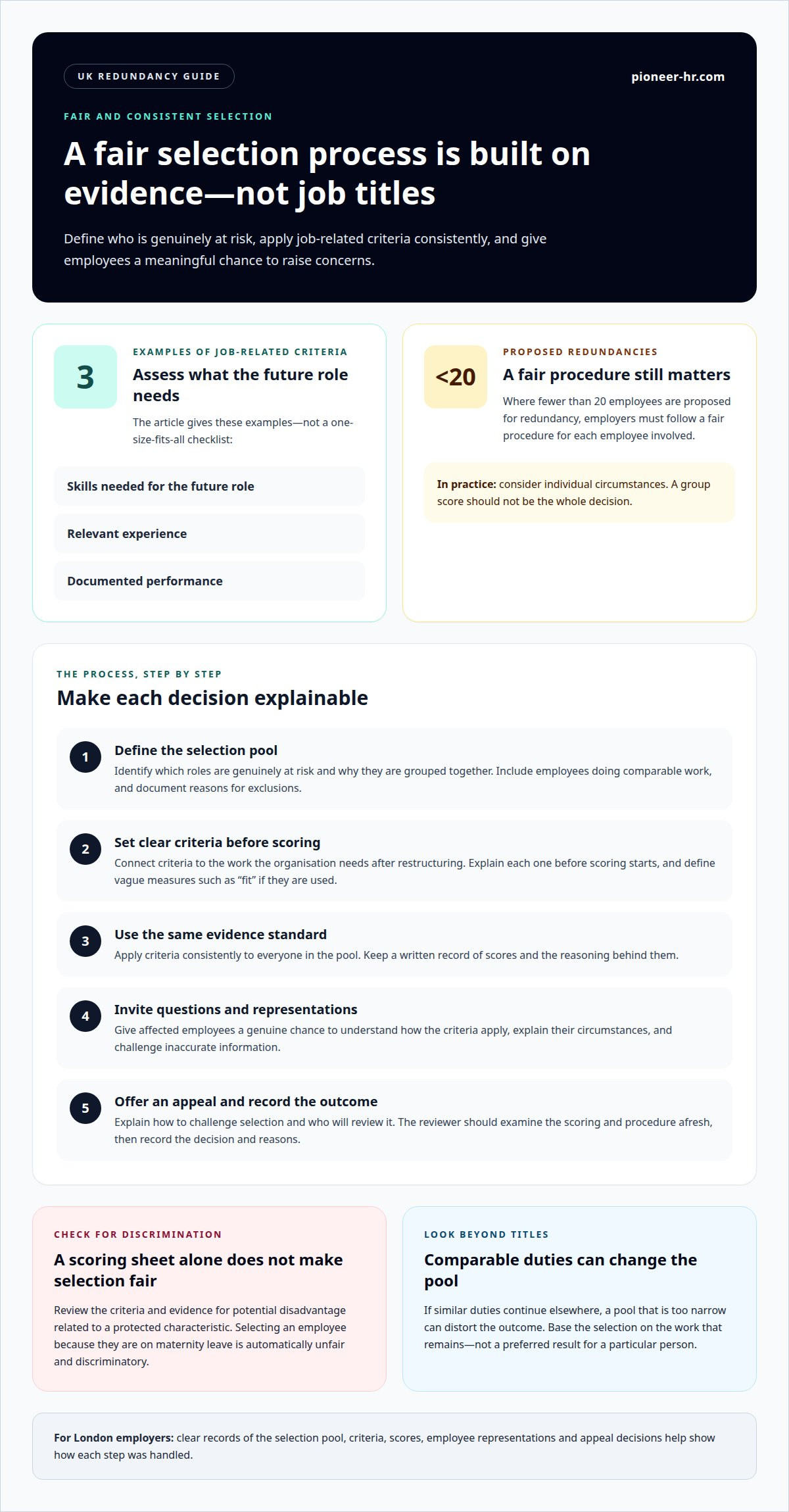
Start by defining the selection pool: which roles are genuinely at risk, and why are they grouped together? Include employees doing comparable work, and document the reasons for any exclusions. A pool that is too narrow can distort the outcome, especially when similar duties continue elsewhere. Criteria should reflect the work the organisation needs after restructuring, not a preferred outcome for a particular person.
Choose objective, job-related criteria and apply them consistently to everyone in the pool. Relevant examples might include skills needed for the future role, experience and documented performance. Explain each criterion before scoring begins, use the same evidence standards for each employee, and keep a written record of scores and reasoning. Avoid vague measures such as “fit” unless they are clearly defined and connected to the role.
Review criteria for potential discrimination before using them. Take care not to disadvantage employees because of a protected characteristic. Selecting an employee because they are on maternity leave is automatically unfair and discriminatory. A consistent scoring sheet alone does not make a process fair if the criteria or evidence create that disadvantage.
For proposed redundancies involving fewer than 20 employees, employers must follow a fair procedure for each employee involved. This means considering individual circumstances rather than treating a group score as the whole decision. A competitive process should give affected employees a genuine opportunity to understand how the criteria apply and raise concerns about inaccurate information.
Build an appeal into the process. Tell each employee how to challenge their selection, who will review it and how they can present relevant evidence. The reviewer should examine the scoring and procedure afresh, including whether comparable roles were pooled fairly. Record the appeal outcome and reasons. Clear documentation can help address concerns before they become claims.
Where managers lack experience designing a fair process, specialist HR input can help test the pool, criteria and scoring before decisions are final. Keep settlement discussions separate from selection decisions: an agreement should not replace a genuine, consistently applied process.
Suitable alternative employment
Before confirming redundancy, identify suitable alternative roles across the organisation and explain them clearly to affected employees. Compare each vacancy’s duties, skills, location, pay and contractual terms with the employee’s current role. A different job title does not necessarily mean the role is unsuitable if its responsibilities and conditions are comparable. A clear written description helps the employee assess the offer and respond.
Employees on maternity leave have first refusal on suitable alternative roles before other employees. Apply this priority when matching vacancies, rather than relying only on a general competitive process. Also consider alternatives to redundancy, including changes to working arrangements where appropriate. If a role involves changed employment terms, explain the proposed changes and discuss them with the employee before implementation.
Restructuring can create employment law risks if changes affect contractual rights or bypass a fair process. The TUPE Regulations protect employment rights when changes arise from a business sale, merger, outsourcing or insourcing. An employee who believes a dismissal was unfair may bring a claim to an employment tribunal. Reviewing contracts and documenting decisions helps identify issues before changes take effect.
Practical support matters too. Employers should give affected staff time off to seek new work or training. A defined transition plan can clarify who arranges training, what time is available and how internal vacancies are shared. For example, an employee moving into a revised role may need training for new responsibilities before taking them on.
There is no automatic grant for every London business restructuring. Government funding depends on the scheme’s purpose and eligibility, and does not replace consultation or employment obligations. Employees seeking free redundancy advice can use ACAS guidance on fair procedures and redundancy processes. Trade union representatives can also support employees during workplace consultation.
Restructuring strategy and implementation
A sound restructuring starts with the commercial situation, not a predetermined list of dismissals. Define the objective first: cost reduction, improved operational or tax efficiency, or preparation for a sale or acquisition. Then map the activities, roles and capabilities the future organisation needs. For employers planning restructuring and redundancy support in London, the people plan should follow from those objectives. For example, a plan to combine teams should explain how work will be covered after roles change.
Turn the objective into a delivery plan before announcing proposed changes. Identify affected teams, decision-makers, consultation arrangements, suitable vacancies and the sequence of communications. Consider voluntary redundancy as one possible measure, alongside changes that could avoid compulsory dismissals. Set out how proposals will be assessed, who owns each action and how employee feedback may affect the design.
Implementation needs clear responsibilities. Give managers consistent information before they speak with employees, while HR records decisions and tracks outstanding questions. Explain the business rationale in plain language, describe what is proposed rather than presenting it as final, and update staff when consultation changes the plan. Sensitive conversations matter because uncertainty can affect trust and day-to-day operations.
Bring specialist employment advice into the process from the outset if the change could reduce headcount, alter roles or lead to dismissal. HR specialists can help coordinate the people plan; solicitors or lawyers can advise on legal interpretation and specific employment risks. This distinction helps decision-makers understand which issues concern implementation and which require legal advice. Record the advice considered and the resulting decisions.
Before launch, test whether the proposed structure meets its stated objective. Check that responsibilities have owners, essential work remains covered and employees understand the next steps. A thoughtful reward strategy can also help align pay principles with the organisation’s future structure. Employers considering restructuring and redundancy support in London should connect commercial rationale, people impact and delivery in one plan, then adapt it as consultation informs decisions.
Pioneer HR: Retained HR Support
Pioneer HR provides Retained HR Support for employers planning organisational change and managing its impact on people. The team can help structure the HR work around a proposed restructure, from assessing workforce needs to coordinating communications and implementation. This support can be useful when internal teams need ongoing HR input alongside commercial decision-making.
Where changes affect roles or reward, Salary Benchmarking and Reward Strategy can inform decisions about pay and the future structure. For organisations seeking senior people leadership during a transition, a Fractional Chief People Officer can provide strategic input. The right support depends on your organisation’s needs and the scope of the change.
Contact Pioneer HR to discuss the people challenges involved in your restructuring plans.
Carry the people plan into the next phase
A restructure continues after the new structure is announced. As teams take on changed responsibilities, keep ownership clear and establish a practical way to raise issues. For example, managers should know where to direct questions about role boundaries, workloads and handovers. This helps turn the proposed design into a workable day-to-day operation.
Use the organisation’s original objectives as a reference point during implementation. Consider whether responsibilities are flowing as intended, whether teams understand how work is allocated and whether unexpected gaps are emerging. If the new structure creates friction, address it early and explain what will happen next. A considered review helps keep the transition connected to its business purpose.
For London employers, effective restructuring and redundancy support should connect people decisions with the organisation’s future direction. If you’d like to discuss how to approach the next stage of your plans, contact Pioneer HR for support. With a clear plan and considered communication, you can move forward with confidence.
Frequently Asked Questions
Can you be made redundant if your job still exists?
Yes, if the employer has a genuine redundancy situation, such as needing fewer employees to do that work. However, if your actual role continues unchanged and someone else performs it, or it has simply been renamed, the dismissal may be unfair. A new title alone does not show that the underlying role has disappeared. The employer should explain how the future role differs.
Can you be made redundant on maternity leave?
Yes, a genuine redundancy can affect someone on maternity leave, but selecting them because they took maternity leave is automatically unfair and discriminatory. If a suitable alternative vacancy exists, an employee on maternity leave has priority for that role over other employees. The employer should consider them for an appropriate vacancy rather than treating their absence as a reason to exclude them.
Do you need to sign anything if made redundant?
You do not have to sign a settlement agreement in every redundancy. If an enhanced package is offered through one, employees are usually required to obtain legal advice and sign the agreement, which waives claims in the Employment Tribunal. Read the terms carefully before agreeing, including the payment offered and the claims being waived. A settlement agreement is distinct from simply receiving notice of dismissal.
What is voluntary redundancy?
Voluntary redundancy is when an employer invites employees to apply to leave under a redundancy programme, rather than selecting every departure compulsorily. The employer considers applications against its operational needs and the terms of the offer. Applying doesn’t itself mean acceptance: the employer may need to retain particular skills or maintain service coverage. Employers should explain the proposal and how applications will be assessed.
What restructuring and redundancy support services are available to businesses in London?
London employers can use HR support to plan workforce changes, coordinate employee processes and consider how roles and reward arrangements fit the future organisation. Pioneer HR provides Retained HR Support, Salary Benchmarking, Reward Strategy and Fractional Chief People Officer support. Salary benchmarking can inform pay decisions for redesigned roles, while strategic HR input can connect the restructure’s commercial aims with its impact on people.
Which London consultants advise on business restructuring and workforce redundancy?
Pioneer HR provides HR consultancy support to UK employers handling workforce change, redundancies and organisational redesign. Its Retained HR Support can provide practical HR input as a business plans and implements changes, while a Fractional Chief People Officer can contribute strategic people leadership. Employers seeking restructuring and redundancy support in London can consider which level of HR involvement best fits their organisation’s needs.



Comments