
HR audit checklist for reviewing records, hiring, pay and benefits
An HR audit shouldn’t be a one-off paperwork exercise. A practical HR audit checklist helps you assess whether employee records, recruitment, training, pay and benefits are organised and consistent. For most UK organisations, an annual audit provides a regular opportunity to identify gaps and plan improvements.
Compliance is an important starting point, but a useful review also examines how people processes work day to day. This guide explains what an HR audit covers, which records and processes to review, and how to assess recruitment, onboarding, training, compensation and benefits.
It also explains how often to carry out a full audit and when a focused review may help, such as after a restructure or a move to hybrid working. Wherever your organisation is based in the UK, a clear, proportionate process can turn findings into practical next steps.
Table of Contents
Employee records and documentation
Begin with a records inventory covering current employees, former employees and contractors. For each employment file, review the written statement of particulars, contract, role changes, leave records, performance notes and relevant training documentation. The Employment Rights Act 1996, as amended, requires employees to receive a written statement of particulars on or before their first day of work.
An HR audit should cover the Employment Rights Act 1996, as amended, and UK GDPR, alongside applicable equality and health and safety requirements. Compare current HR policies with actual workplace practice, then record gaps, owners and corrective actions as clear findings.
For health and safety, equality and workplace policies, review the written procedures, training records, incident reports and how managers apply them. Check whether staff can access current policies and whether documented performance or disciplinary processes are applied consistently. The Information Commissioner's Office states UK GDPR data-protection breaches can result in fines of up to 4% of global annual turnover or £17.5 million, whichever is higher.
Reconcile headcount. Compare the staff list with contracts, starters, leavers and contractors so reporting reflects who works for the organisation.
Review classification. Confirm each record identifies the person’s employment status and working arrangements, then investigate inconsistencies between documented terms and day-to-day practice.
Check pay and benefits records. Match recorded salary, hours, overtime and benefits to contractual terms, approved changes and the organisation’s reward policies.
Assess employee relations and performance. Review appraisals, complaints, grievances, disciplinary records and wellbeing actions for consistent documentation and appropriate follow-up.
Keep sensitive records access-controlled and collect only information needed for a defined HR purpose. An effective HR audit checklist connects each finding to its source document and a practical next step, such as updating an outdated policy or completing an incomplete file. This makes follow-up measurable without treating documentation as a substitute for fair, consistent management.
Recruitment, onboarding and training
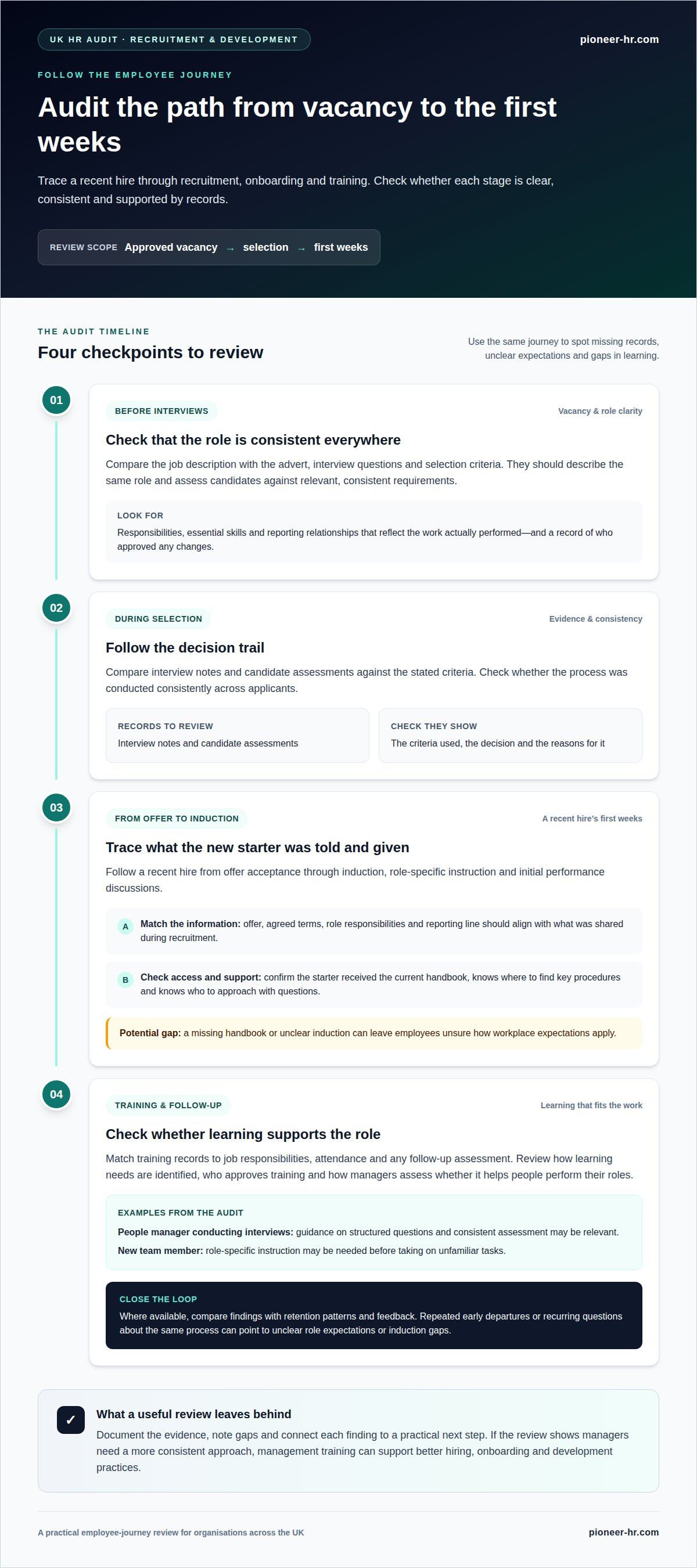
Review recruitment as a connected process, from the approved vacancy to the new starter’s first weeks. Compare the job description with the advert, interview questions and selection criteria. They should describe the same role and assess candidates against relevant, consistent requirements. Record decisions and reasons so the organisation can explain how appointments were made.
Next, trace a recent hire through onboarding. Check that the offer, agreed terms, role responsibilities and reporting line match the information provided during recruitment. Confirm that each new starter receives the current handbook, knows where to find key procedures and understands who to approach with questions. A missing handbook or unclear induction can leave employees unsure how workplace expectations apply.
Review job descriptions. Check that responsibilities, essential skills and reporting relationships reflect the work actually performed, then record who approved changes.
Assess selection records. Compare interview notes and candidate assessments against the stated criteria, looking for consistent conduct across applicants.
Map onboarding steps. Follow a new employee’s journey from offer acceptance through induction, role-specific instruction and initial performance discussions.
Examine training evidence. Match training records to job responsibilities, attendance and any follow-up assessment, then identify skills needing further development.
Training should relate to the work, not simply be marked as complete. For example, a manager who conducts interviews may need guidance on structured questions and consistent assessment. A new team member may need role-specific instruction before taking on unfamiliar tasks. Review how learning needs are identified, who approves training and how managers assess whether it helps employees perform their roles.
Finally, compare recruitment and onboarding findings with retention patterns and feedback, where available. Repeated early departures or recurring questions about the same process can point to unclear role expectations or gaps in induction. If audit findings show managers need a more consistent approach, management training for people managers can support better hiring, onboarding and development practices.
Compensation, overtime and benefits
Compare payroll records with employment terms, approved pay changes and recorded working hours. If a worker’s contracted hours change, for example, check that the new arrangement appears consistently in payroll and relevant employment records. Investigate differences between hours worked, overtime submitted and amounts paid, then record the cause and follow-up action.
Compare roles with similar responsibilities across the compensation structure. Review job scope, grade, salary decisions and progression criteria to identify unexplained differences or outdated arrangements. Clear records of how pay decisions are made help managers apply a consistent approach to hiring, promotion and pay reviews. Salary benchmarking can provide useful context when assessing whether pay remains aligned with the roles the organisation needs to fill.
Reconcile pay records. Match payroll outputs against approved salary changes, working hours, overtime and deductions, and investigate discrepancies.
Review overtime processes. Check how additional hours are recorded, approved and reflected in pay, including how managers handle corrections.
Assess benefits administration. Compare eligibility rules, enrolment records and employee communications with the benefits offered, noting where records or explanations differ.
Examine the reward structure. Review how pay, progression and benefits relate to role responsibilities and documented decision-making.
Benefits can support recruitment and retention when employees understand what is available and how to access it. Check whether communications explain eligibility, enrolment steps and changes consistently and in a timely way. For instance, compare the information given to a new starter with current benefits documents and the records used to administer their choices.
A regular HR audit brings these details together, helping leaders distinguish isolated payroll errors from wider process gaps. Findings can inform policy updates, manager guidance and workforce planning. They also help determine which issues need prompt correction and which call for a broader review of compensation or benefits design.
Audit frequency and spot checks
Set an annual full HR audit as the baseline for reviewing compliance, documentation and core people programmes. Choose a quieter period when HR and leadership have capacity to examine findings and act on them. Reviewing at the beginning or end of the year can also help teams assess progress and plan improvements.
A calendar date alone isn’t enough. Schedule an additional review after rapid headcount growth, a move to hybrid working, a restructure or a significant change in employment law. These events can affect recruitment, reporting lines, policies and employee records. A focused check can help HR identify processes that no longer reflect how the organisation operates.
Use spot checks between full audits to examine a specific risk or process. For example, sample recent recruitment files to see whether selection records follow the same procedure, or review a department’s records after a management change. Record the sample, issue, action owner and follow-up. This creates a traceable process without repeating a full review.
Choose a clear trigger. Link each spot check to a change, recurring query or finding that needs closer attention.
Review the relevant evidence. Compare the affected records and process documents with current practice.
Assign follow-up. Give each finding an owner and a practical action, then record its completion.
Escalate patterns. If a focused check reveals wider gaps across recruitment or another function, include them in the next full audit.
Keep workplace safety inspections on a separate, visible schedule: the checklist recommends conducting one at least once every 12 months. This complements, rather than replaces, an HR audit. Clear timing helps the HR function and each department understand which review is due and what records it covers.
If you need a structured review across people processes, arrange an HR Audit with Pioneer HR to assess current practices and prioritise findings.
Pioneer HR: HR Audit
Pioneer HR’s HR Audit provides a structured review when an annual assessment, organisational change or recurring issue calls for a closer look at people processes. It covers areas such as employee records, recruitment, training, compensation and benefits, helping you understand where practices are consistent and where attention may be needed.
An HR Audit can be useful when your internal team needs an independent perspective or when findings should inform wider people planning. If the review highlights an ongoing need, Retained HR Services can provide practical HR guidance. Salary Benchmarking and Reward and Benefits Review may also help when findings raise questions about pay positioning or reward design.
Turn audit findings into a people plan
The value of an HR review depends on what happens next. Use the findings to agree which improvements matter most, who will lead each action and how progress will be reviewed. An HR audit checklist is most useful when it informs decisions about capability, leadership and the employee experience, rather than becoming a record of past gaps.
Some actions may call for ongoing HR guidance; others may require a closer look at pay positioning or reward design. Pioneer HR offers Retained HR Services, Salary Benchmarking and Reward and Benefits Review to help organisations address these priorities. The right next step depends on which findings matter most to your people plan.
If you’re ready to discuss how to turn your review into practical priorities, contact Pioneer HR for HR audit support. A clear plan can help your organisation move forward with purpose.
Frequently Asked Questions
What is an HR audit?
An HR audit is a structured review of how an organisation manages its people processes and related records. It tests whether documented procedures match day-to-day practice and helps leaders set priorities for improvement. For example, a review might compare how teams handle the same approval process and identify where responsibilities or guidance need clarification.
Can I use this checklist for a multi-state company?
This checklist is written for UK employers, so it is not sufficient on its own for an organisation operating across US states. A multi-state US business may need to account for differing federal, state and local requirements. Define a separate scope for each country or jurisdiction, distinguishing shared company processes from location-specific rules. A UK-focused review can still inform consistent internal processes.
What should an HR audit checklist template include?
A useful template makes each review easy to follow and track. Include the audit area, the question being tested, the evidence examined, the reviewer and the review date. Add fields for the finding, its priority, an action owner and a target completion point. For example, a finding about an outdated approval process should show who will revise it and how completion will be recorded.
What are the biggest risks of skipping an HR audit?
Without a planned review, inconsistent practices can go unnoticed and small process gaps may become harder to resolve. Managers may handle similar situations differently, while leaders lack a clear view of recurring issues. Repeated confusion over who approves role changes, for example, can affect employee records, reporting and decision-making. An audit helps identify patterns for follow-up.
What is the difference between an internal and external HR audit?
An internal audit is conducted by people within the organisation, such as HR colleagues or another team reviewing a process. An external audit involves an independent reviewer who brings a separate perspective and can question established practices. Either approach needs a defined scope, access to relevant evidence and a clear record of findings. The choice depends on internal capacity and the review’s purpose.
What should an HR audit checklist include?
Include the areas in scope, the evidence needed for each check and a consistent way to record findings. The checklist should identify review responsibilities, explain how issues will be prioritised and provide space to track actions through completion. Tailor it to the organisation’s structure and current priorities so the review examines relevant processes rather than becoming a generic paperwork exercise.



Comments