
Organisational Development Consultant for UK SMEs
Organisational development consultant UK searches often come from leaders looking to make change work in practice. An organisational development consultant helps leaders and teams understand how an organisation works, involve people in change, strengthen culture and capability, and build resilience.
Change needs to deliver practical improvements while recognising the people who keep an organisation running. A thoughtful, iterative approach helps teams understand challenges, agree priorities and turn plans into everyday practice.
This article explains what organisational development consulting involves, how a consultant works with an organisation, and what to consider when deciding whether support fits your business. It also explores how leadership, culture and employee insight can contribute to change that people understand and can sustain.
Table of Contents
Collaborative and iterative change processes
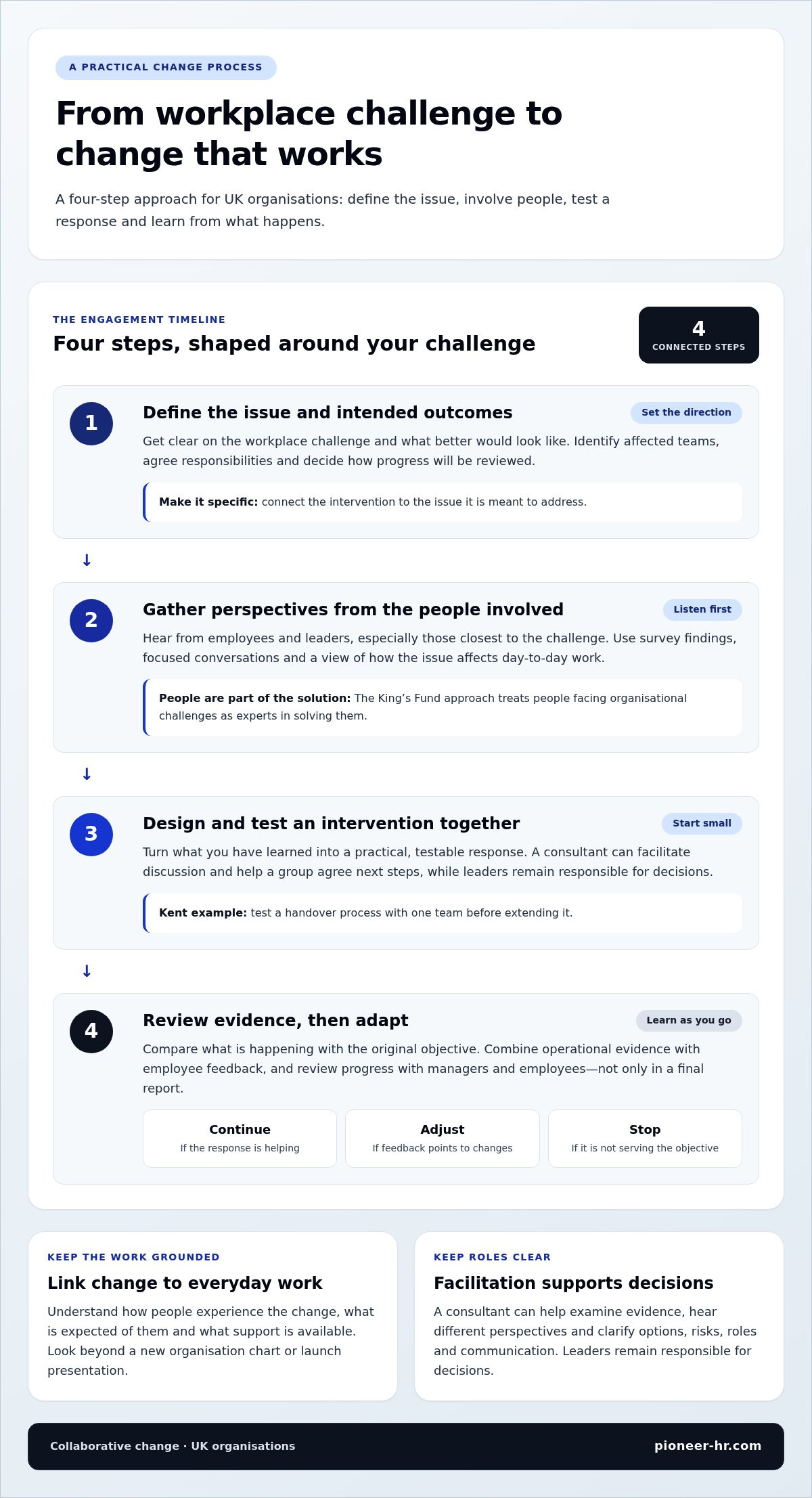
For UK SMEs, change is more workable when employees help define problems and test solutions. The King’s Fund’s approach treats people facing organisational challenges as experts in solving them.
Collaborative Change Processes
Leaders and staff can map the change, identify affected teams and agree how to measure success. A consultant can facilitate the process. A useful cycle is to listen, choose a priority, trial a response, review feedback and adapt. For example, a Kent firm could test a handover process with one team before extending it. This ties decisions to daily work and makes learning part of implementation.
Behavioural Change and Human Dynamics
People are more likely to change their behaviour when they understand why change is happening, what is expected and what support is available. A restructure can unsettle established roles, so facilitated conversations can surface concerns before they turn into workarounds. A consultant can examine decision-making habits, trust between managers and teams, and informal influence. Look for attention to these dynamics, not just a new organisation chart or launch presentation. They shape how change is experienced and adopted.
Change Facilitation and Advice
Facilitation gives a group a structured way to examine evidence, hear different perspectives and agree next steps. Advice can clarify options, risks, roles and communication, while leaders remain responsible for decisions. In a workshop, a consultant might help managers turn employee feedback into a small, testable action and agree when to review it. This can help when discussion stalls or teams interpret priorities differently.
Consulting Services and Engagement Steps
Organisational development consulting in the UK can cover diagnosis, team and leadership development, culture, facilitated change and capability building. The work should reflect the organisation’s challenge, not follow a fixed package. An engagement might involve four steps: define the issue and intended outcomes; gather perspectives; design and test interventions together; then review evidence and adapt. For example, employee survey findings can inform focused conversations and practical actions. Agreeing roles and measures for review early helps link each intervention to its purpose.
Organisational culture, capability and shared values
Culture shows up in everyday decisions, such as how a manager responds to missed deadlines or disagreement. A consultant can compare these behaviours with stated values and identify where leadership practice, team expectations and business priorities diverge. That can help an SME decide whether it needs clearer decision-making, stronger collaboration or new management capability. Shared values matter when employees can connect them to specific actions, not just words on a wall.
Organisational development consultants focus on how people, culture and systems interact. Management consultants often address business performance or operating models, while HR consultants typically focus on people processes and workforce matters. The fields can overlap: changing team responsibilities, for example, may require operational analysis, HR input and culture work.
UK consultants may bring relevant study, professional development or practical experience in organisation design, facilitation, coaching and people management. No single qualification replaces evidence of handling comparable challenges. Ask how a consultant would build capability, involve employees and adapt their approach to your organisation.
There’s no single fee for an organisational development engagement. The price depends on the case and is given after a quote request; scope, duration, consultant involvement and the work required shape the cost.
Risks include misdiagnosing the problem, overlooking employee concerns or leaving managers without the skills to sustain change. Reduce these risks by agreeing outcomes, responsibilities and review points before work begins. For example, check whether a culture initiative includes support for managers and a way to assess progress.
UK consultancies work across different sectors, including businesses, charities and public services. The King’s Fund’s organisational development approach treats people facing organisational challenges as experts in solving them. For an SME, consider whether a consultancy understands its operating context and can adapt its methods to its people, priorities and resources.
To build capability, connect shared values with practical development: identify the required behaviours, give managers opportunities to practise them, then review how they affect team decisions. Management training can help when managers need structured development; organisational development can address broader patterns across teams and systems. Understanding the difference helps match support to the underlying challenge.
Evaluating impact and adapting interventions
Organisational development consulting can help UK organisations clarify accountability, improve coordination and strengthen managers’ ability to lead change. These benefits are easier to assess when each intervention relates to a defined workplace issue and agreed evidence of progress.
Start with a baseline: record how the issue affects work before introducing a response. If handovers regularly leave tasks unclear, for example, map where information is lost and ask the employees who manage those handovers. Choose indicators that reflect the problem, such as fewer unresolved queries or clearer ownership. Combine operational evidence with employee feedback, since a process can appear efficient while remaining difficult to use.
Review progress through planned conversations with managers and employees, not only in a final report. A new meeting structure, for instance, might improve decision clarity but add administration. Compare feedback from affected teams with the original objective, then decide whether to continue, adjust or stop the intervention. Recording the reasoning gives leaders a practical account of what changed and why.
A useful evaluation cycle has four steps:
Set the outcome: describe the workplace change sought, such as clearer decision rights between teams.
Select evidence: choose relevant observations, employee feedback or existing operational information.
Review together: discuss findings with the people affected, including managers responsible for implementation.
Adapt the response: refine responsibilities, communication or support when evidence reveals a barrier.
If employees understand a new process but managers apply it differently, the issue may be inconsistent guidance rather than resistance. A focused coaching conversation or revised manager briefing could address the gap. Evaluation should also consider whether the organisation can sustain the change without ongoing external facilitation. Clear ownership, shared learning and regular review help embed useful practices into everyday work and keep an intervention connected to business priorities.
Organisational agility and resilience
For a UK SME, agility means adjusting priorities without losing sight of customers, employees or essential work. Resilience means maintaining important operations while responding to disruption. An organisational development consultant can help leaders examine whether decision-making, responsibilities and communication support both. For example, a growing London business might find that every customer issue waits for one director’s approval.
That bottleneck is a practical reason to review decision rights, not simply ask people to work faster. Map the decisions that regularly stall, identify who has the information to act, then clarify which choices teams can make independently. A useful arrangement gives employees clear boundaries and a route to escalate unusual cases. Leaders can then assess whether decisions move smoothly without weakening accountability.
To build adaptability into everyday operations, an SME can:
Identify a pressure point, such as a key task depending on one person.
Map the skills and knowledge needed to keep that task moving.
Develop backup capability through shared documentation, coaching or structured handovers.
Review the arrangement after a change in workload, roles or customer needs.
These steps connect workforce capability with continuity. If a small finance team relies on one employee to explain a monthly process, documenting the workflow and supporting peer learning can spread essential knowledge. The aim is not to make everyone interchangeable, but to reduce avoidable dependency and help employees understand how their work connects.
Agility also depends on how leaders respond to new information. A change in customer demand, for instance, may require revised team priorities. Managers need to explain what has changed, hear operational concerns and decide what should pause. An organisational development consultant can facilitate this discussion and help leaders align responsibilities with the new direction.
Resilience grows when a business learns from disruption rather than simply returning to old routines. Reviewing what slowed decisions, where communication broke down and which skills proved essential gives leaders specific improvements to carry forward. These findings can inform future planning, team development and organisational design.
Pioneer HR: Retained HR Support
Pioneer HR provides Retained HR Services for SMEs that need ongoing, practical people support alongside organisational change. This can help when leaders need consistent HR guidance as roles, responsibilities or workforce priorities evolve. For longer-term people strategy, a Fractional Chief People Officer can provide strategic leadership; Salary Benchmarking and Reward and Benefits Review can help address questions about pay and reward.
The right focus depends on the organisation’s priorities, whether that means supporting managers, reviewing reward or building a more coherent people approach. Contact Pioneer HR to discuss your organisation’s needs.
Make your next people decision count
Choose one organisational challenge that matters now and define what a useful change would look like for the people affected. This gives leaders a practical starting point, whether the priority is improving collaboration, clarifying responsibilities or helping managers lead through change. Keep the first step proportionate to your organisation, then use what you learn to guide the next decision.
An organisational development consultant in the UK can help connect people practices with business priorities. If your next step also involves ongoing HR guidance or reward decisions, Pioneer HR provides Retained HR Services, Salary Benchmarking and Reward and Benefits Review. The right support depends on the challenge you want to address and the outcomes your organisation is working towards.
Contact Pioneer HR to discuss your needs. A clear conversation can help you consider a practical way forward, with your people and priorities at the centre.
Frequently Asked Questions
What does an organisational development consultant do in the UK?
An organisational development consultant helps an organisation improve how its people, structures and ways of working support its goals. For a UK SME, that might mean helping teams adapt after a restructure, clarifying responsibilities as the business grows or strengthening managers’ ability to lead. The work can include diagnosis, facilitated discussions, leadership development and practical recommendations shaped around the organisation’s needs.
How to find and choose an organisational development consultant in the UK?
Start by defining the issue you need help with, such as unclear roles, low engagement or inconsistent management practice. Then look for support that matches the need and explains its approach in practical terms. Pioneer HR provides organisational development alongside HR and people support, so SMEs can discuss how organisational priorities connect with workforce needs and decide on a relevant way forward.
Which UK organisational development consultancies serve businesses, charities and the public sector?
The King’s Fund is noted for an organisational development approach that treats people facing organisational challenges as experts in solving them. UK consultancies work across businesses, charities and public services.


Comments