
Employee engagement strategies: ways to improve communication
Communication is central to employee engagement: it shapes whether people understand their work, feel heard and can contribute effectively. Practical employee engagement strategies begin with clear information and regular, two-way conversations, not occasional announcements or surveys.
It’s understandable that engagement can feel difficult to improve when teams have different needs, work across locations or don’t always hear the same messages. For employers in London, Kent and across the UK, the useful starting point is to understand what employee engagement means in practice: how connected people feel to their roles, colleagues and organisation.
This article explains how communication and access to workplace information affect engagement, and how it can relate to productivity, retention and profitability. It also covers practical ways to listen to employees, share updates, recognise contributions and act on feedback, helping you build an approach suited to your organisation rather than relying on generic initiatives.
Table of Contents
1. What Is Employee Engagement, and How Do You Improve It?
Employee engagement describes how connected people feel to their work, colleagues and organisation. The 2009 MacLeod Review found more than 50 definitions, so a useful workplace definition focuses on motivation, commitment and willingness to contribute. Engagement grows through everyday experiences, including clear expectations, meaningful conversations and recognition that reflects actual contributions.
Recognition works best when it is timely and specific. A manager might thank someone for resolving a customer issue, explaining how their actions helped the team. Gallup estimates that 80% of workers who received meaningful feedback in the past week are more engaged. Peer appreciation can also make recognition part of routine work, while incentives should reinforce useful outcomes rather than activity for its own sake.
How can organisations measure employee engagement? Draw on several sources, including employee surveys, one-to-one conversations and workplace indicators such as productivity, retention and absence. Compare results over time, then explain what has changed and what action will follow. Satisfaction scores alone rarely reveal why people feel engaged or disconnected.
How can managers improve employee engagement in hybrid and remote teams? Schedule regular check-ins, share decisions through accessible channels and include remote colleagues in meetings and informal discussions. For example, circulate meeting notes and invite each team member to raise an obstacle, so location does not determine whose voice is heard.
What role do career development and training play in employee engagement? They show employees how they can build skills and progress, connecting daily work with a longer-term future. Managers can discuss career interests during development conversations, then agree on a practical learning opportunity and how to apply it.
What are low-cost employee engagement ideas for small businesses? Give specific thanks, encourage peer recognition and hold brief listening conversations. A team could share a weekly achievement and an improvement idea, then report back on the suggestion chosen. These actions make employee voice visible and help leaders spot concerns before they affect team outcomes.
Communication and access to workplace information
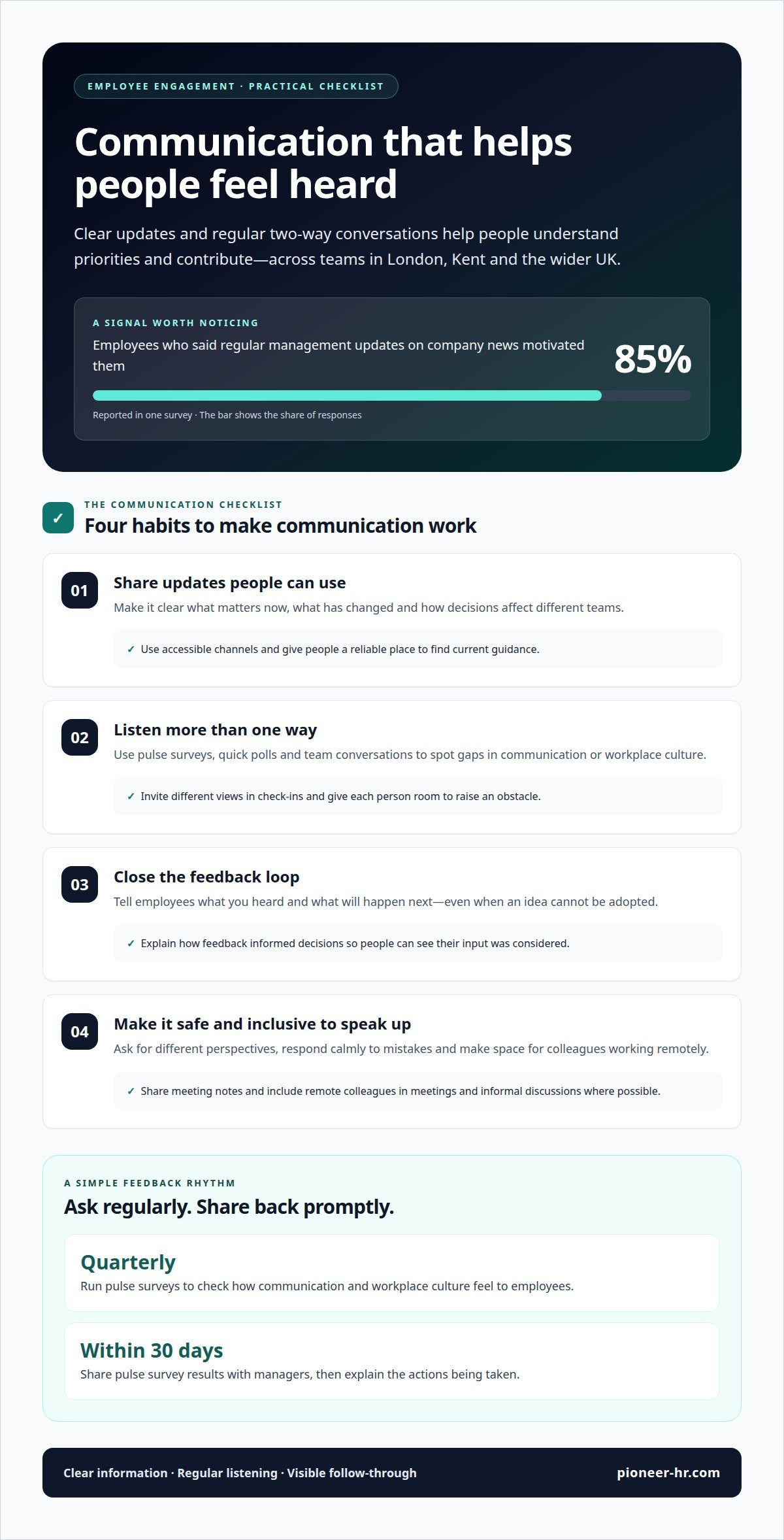
Clear workplace communication helps employees understand priorities, decisions and how their work contributes to success. In one survey, 85% of employees said regular management updates on company news motivated them. Share information through accessible channels, explain what decisions mean for different teams, and give employees a reliable place to find current guidance.
Listening matters as much as broadcasting. Use pulse surveys, quick polls and team conversations to identify gaps in communication or workplace culture. Run pulse surveys quarterly and share results with managers within 30 days of each cycle. Then explain the actions being taken, even when an idea cannot be adopted; closing that loop helps people see that speaking up leads to consideration.
Psychological safety grows when employees can raise concerns without being dismissed. Managers can encourage it by asking for different views, responding calmly to mistakes and explaining how feedback informs decisions. After a project review, for example, invite each team member to identify an obstacle and suggest a change for the next piece of work.
Connection also shapes culture. Workers with close friends at work are more likely to report belonging, with 80% reporting this, and 86% report satisfaction with work. Create opportunities for colleagues to collaborate and connect, without making socialising compulsory. In hybrid teams across London, Kent and the wider UK, include remote colleagues in meetings and informal discussions where possible.
A positive workplace culture also supports work-life balance and mental wellbeing. Managers can discuss workload, clarify priorities and consider practical arrangements such as flexible hours or hybrid working where suitable. Treat these as ongoing initiatives, not one-off actions: review them in team conversations and adapt them when responsibilities or working patterns change.
3. Productivity, retention and profitability
Employee engagement can influence operational outcomes, although results vary by sector and role. Highly engaged employees are associated with 14% higher productivity in production records and evaluations, and 18% higher productivity in sales. The same group is associated with 23% higher profitability. Treat these figures as relationships, not guaranteed gains; leaders should measure relevant outcomes alongside employee feedback.
Retention patterns also differ by organisation. In high-turnover organisations, defined as having more than 40% annualised turnover, highly engaged employees are associated with 21% less turnover. In low-turnover organisations, with 40% or lower annualised turnover, the association is 51% less turnover. Compare turnover across teams and roles to spot where management practices or career opportunities may need attention.
Stay interviews can help leaders understand commitment before an employee decides to leave. Ask what makes work worthwhile, what creates friction and which change would improve their experience. Keep the conversation open, agree practical actions and follow up. This matters because 52% of voluntarily departing employees said their manager or organisation could have done something to prevent their departure.
Onboarding can shape early confidence and connection. Employees with a positive onboarding experience are 18 times more committed to their employer, while those with exceptional experiences are 2.6 times more likely to be extremely satisfied with their workplace. Set clear expectations, assign a supportive colleague and schedule check-ins during the first months. These practices help new starters raise questions and understand how their work contributes.
Career development is another retention factor. A Conference Board survey found that 58% of employees are likely to leave if they lack opportunities to develop their skills. Leaders can discuss career aims, agree relevant learning and revisit progress in regular conversations. Track whether these actions relate to changes in retention, productivity and feedback, rather than treating one measure as proof of success. This gives organisations a clearer view of where commitment is strengthening and which practices need adjustment.
4. Benefits of employee engagement
Engaged employees can support outcomes beyond individual performance. They’re associated with 10% higher customer loyalty or engagement, 70% higher wellbeing, measured as net thriving employees, and 78% less absenteeism. These measures help leaders consider how workplace experience may affect both customer relationships and day-to-day operations.
Other reported associations include 63% fewer safety incidents, 32% fewer quality defects and 28% less shrinkage, measured as theft. These figures aren’t a forecast for an individual organisation. They show why managers can assess engagement alongside relevant operational measures, such as quality, attendance and safety, rather than relying on one satisfaction score.
Employees feel more able to contribute when their work has meaning and they have appropriate autonomy. Employees are 12% more likely to report being happy with their job when they have freedom and autonomy at work. Managers can support this by clarifying the outcome required, then giving workers room to decide how to achieve it. Regular communication helps keep that freedom aligned with team priorities.
Competitive pay and benefits matter because employees consider whether their contribution is recognised fairly. Review pay in relation to role responsibilities and explain how reward decisions are made. In London, Kent and across the UK, clear communication about reward can help employees understand their overall package, while meaningful recognition acknowledges contributions that pay alone cannot.
Use a practical review: select relevant measures, gather employee feedback and discuss results with managers. 96% of engaged employees trust management, highlighting the connection between engagement and confidence in leadership. To explore how engagement can be assessed in your organisation, discuss an employee engagement review.
Pioneer HR: Employee Engagement Surveys
Pioneer HR provides Employee Engagement Surveys to help organisations understand how employees experience their work and workplace. A survey can be useful when conversations reveal concerns, communication feels inconsistent or leaders need a clearer picture before setting priorities.
Survey findings can reveal themes in employee feedback and inform practical action. Their value depends on what happens next: share relevant findings, decide which issues to address and communicate progress. If pay or recognition emerges as a concern, Pioneer HR’s Reward Strategy service can help shape a considered response.
If you’re ready to explore how employee feedback could inform your organisation’s next steps, contact Pioneer HR.
Make engagement part of how work gets done
Lasting progress comes from treating engagement as an ongoing management practice, not a campaign with a fixed end date. Choose a priority employees have raised, agree who will lead the response and communicate what will change. Revisit the issue in team conversations and use employee feedback to shape the next step. This keeps employee engagement strategies connected to the realities of work across your organisation.
When concerns involve reward, career progression or day-to-day people management, the right support depends on the issue. Pioneer HR offers Reward Strategy, Salary Benchmarking and Retained HR Services to help employers address these areas within a wider people approach. The aim is to make thoughtful decisions that fit your organisation and its employees.
Ready to discuss a practical next step for your team? Contact Pioneer HR to discuss engagement. A clear conversation can help you decide where to begin and how to move forward with confidence.
Frequently Asked Questions
What Is Employee Engagement, and How Do You Improve It?
Employee engagement describes how invested people feel in their work and how connected they are to the organisation’s purpose. Improve it by identifying what helps or hinders employees in their specific roles. A team facing unclear handovers, for example, may benefit from agreed responsibilities and a shared process, while another may need more autonomy or development opportunities.
What are effective employee engagement strategies?
Effective employee engagement strategies respond to employees’ actual needs rather than relying on a standard programme. Start by identifying a workplace issue, such as unclear priorities, then agree on an action with the people affected. A project team might set shared weekly priorities and review what changed at the end of the week. Keep the approach practical, consistent and relevant to different roles.
How do recognition and rewards affect employee engagement?
Recognition shows employees that their contribution matters, while rewards make appreciation tangible. A manager might acknowledge someone’s careful mentoring in a team meeting, then ensure reward decisions follow clear, consistently applied criteria. Recognition should be sincere and specific. If rewards seem arbitrary or favour only visible work, they may undermine confidence instead of strengthening it.
How can employee feedback and surveys improve engagement?
Feedback and surveys can reveal concerns employees may not raise in routine meetings. Ask focused questions about a defined topic, such as access to tools or clarity about responsibilities. Share the emerging themes, protect individual responses where appropriate and explain the next action. If a survey highlights inconsistent handovers, managers can agree on a common process and review whether it addresses the concern.
How can employers improve wellbeing and work-life balance to boost engagement?
Employers can support wellbeing by examining how work is organised, not just by offering standalone activities. Review workload peaks, meeting patterns and expectations for availability. A team might protect focus time, clarify cover arrangements during leave or discuss flexible working needs individually. These steps can help employees manage responsibilities while maintaining clear expectations about work and team outcomes.
How can organisations build an employee engagement strategy step by step?
Build the approach in a clear sequence: define the issue, gather employee input, choose a focused action, assign responsibility and review progress. If new starters struggle to understand team processes, for example, involve recent starters in improving induction materials. Set a review point, consider what employees say has changed and adapt the action if the original problem remains.



Comments