
Performance management systems: goals and feedback explained
A performance process should do more than record a rating once a year. Performance management systems connect employees’ goals with organisational priorities, then use regular feedback to guide progress and development. The aim is to make expectations clearer and support better performance, not simply to complete an annual form.
Annual reviews can still play a role, but they work best as part of an ongoing conversation between managers and employees. This article explains what performance management systems do, how individual objectives can support wider business goals, and what continuous feedback looks like in practice. It also explores how organisations in London, Kent and across the UK can bring goal-setting, regular check-ins and formal reviews together.
Table of Contents
What is a performance management system?
Performance management systems connect expectations, employee performance and development through an ongoing process. They help employees understand their priorities and give managers a structure for reviewing progress, offering support and identifying where work or wider business processes could improve.
Coaching and employee improvement plans
Coaching and improvement plans turn performance discussions into agreed development actions. A manager might help an employee strengthen a skill, clarify expectations and review progress through regular conversations. This gives the employee a practical route to improve, while helping the organisation identify suitable learning opportunities and build capability over time.
Motivation, retention and job satisfaction
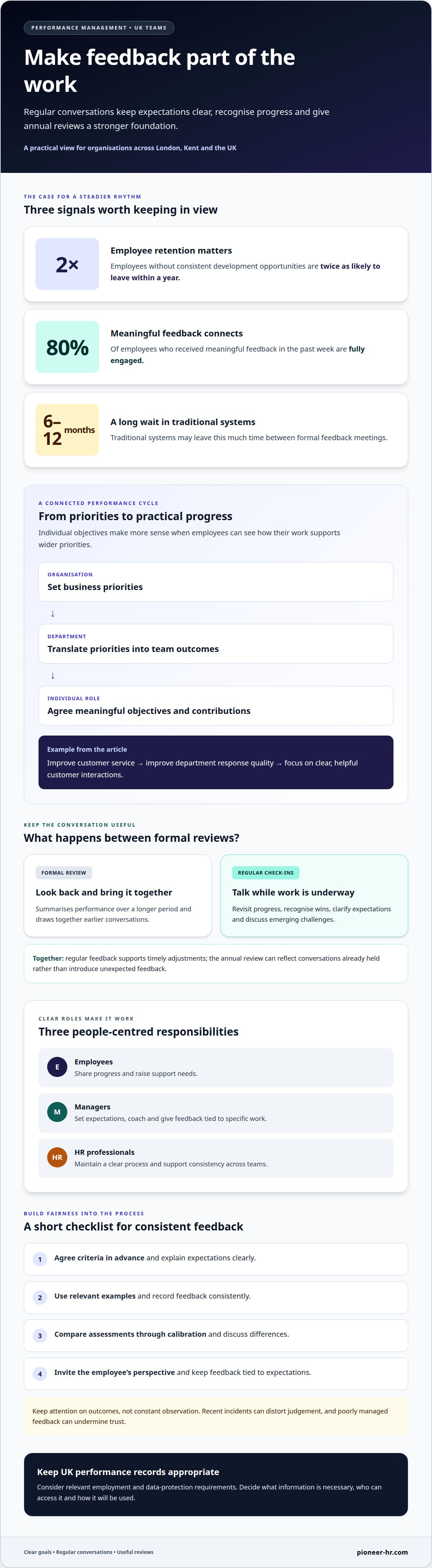
Development-focused conversations can support motivation by making progress and future opportunities visible. Employees without consistent development opportunities are twice as likely to leave within a year. Discussing strengths, challenges and career interests helps managers understand what support an employee values, rather than reducing job satisfaction to a rating.
Employee, manager and HR responsibilities
Employees share progress and raise support needs; managers set expectations, coach and give feedback. HR professionals help maintain a clear process and support consistency across teams. When everyone understands their responsibilities, performance reviews can reflect both individual contributions and organisational priorities.
Goal communication and meaningful feedback
Managers should explain how employee goals connect with team priorities, then give feedback tied to specific work. For example, feedback on a completed project can recognise a strength and identify a practical next step. 80% of employees who received meaningful feedback in the past week are fully engaged.
In the UK, organisations should handle performance records appropriately and consider relevant employment and data-protection requirements. Decide what information is necessary, who can access it and how it will be used.
For UK organisations, the cost of performance management systems depends on the system’s scope and features; costs are provided after a quote request.
Some performance management systems use software with goal-setting, performance reviews, 360-degree feedback, OKR tracking, analytics and customisable workflows. These features help organise objectives, feedback and review information.
Moving from annual reviews to continuous feedback
Continuous feedback adds regular conversations to formal reviews, allowing employees to discuss progress while work is underway. A clear structure makes expectations easier to revisit and helps managers respond to changing priorities.
Continuous feedback and annual reviews
An annual review summarises performance over a longer period; continuous feedback addresses progress throughout the year. Traditional systems may leave 6 to 12 months between formal feedback meetings, so employees might wait to learn that an expectation was unclear. Regular check-ins make it easier to adjust objectives, recognise progress and discuss emerging challenges. The annual review can then bring together earlier conversations rather than introduce unexpected feedback.
Consistency, transparency and calibration
Consistency means applying clear criteria across similar roles; calibration helps managers compare assessments and resolve differences. Explain each expectation and use relevant examples, such as agreed project outcomes, to make feedback transparent. Bias can distort a judgement when a recent incident outweighs a longer record, while excessive monitoring can shift attention from outcomes to constant observation. Poorly managed feedback can also undermine trust, so managers should explain the evidence and invite the employee’s perspective.
To implement an effective process, agree criteria in advance and record feedback consistently. Review how managers apply the criteria, then discuss differences through calibration. These steps support a fairer structure without treating every role as identical.
Peer-to-peer and multi-source feedback
Peer-to-peer feedback draws on colleagues’ observations, while 360-degree feedback gathers perspectives from people around an employee, including peers and direct reports. A 180-degree approach generally focuses on feedback from the employee and their manager. Each perspective can show how someone’s ability affects teamwork, but feedback needs to relate to clear expectations. A specific example of collaboration offers more useful insight than an unsupported personal judgement.
Implementing a performance management system
Implementation means establishing a repeatable process for objectives, conversations, reviews and follow-up. Define expectations and decide how often managers and employees will check progress. Explain the process, guide managers and capture feedback in a consistent format. Include an annual review alongside regular check-ins, rather than expecting either method to work alone. Review how the process operates and adjust it when feedback or objectives reveal gaps.
Objective setting and aligning individual goals with organisational goals
Aligned objectives connect organisational priorities with department plans and each employee’s responsibilities. A clear performance management cycle turns those priorities into action and makes progress easier to assess.
Objectives across business, department and role levels
Objectives should flow from business priorities to department outcomes, then to role-specific contributions. For example, a business target to improve customer service could inform a department objective for response quality, while an employee focuses on clear, helpful customer interactions. This helps each person understand how their work contributes. Involving relevant departments in planning can also improve transparency and accountability.
Aligning goals with strategic objectives
Strategic alignment means linking employee objectives to the organisation’s wider direction, rather than treating targets as isolated tasks. Employees are 3.6 times more engaged when they have a voice in setting goals and connecting them with company initiatives. Managers can invite employees to shape relevant objectives, then explain how progress supports business priorities. Recognition can reinforce contributions that advance those priorities.
Organisational objectives and SMART goals
Organisational performance objectives set out the outcomes a business wants to achieve; SMART goals make those outcomes specific, measurable, achievable, relevant and time-bound. For example, an OKR key result could be to increase website traffic by 25% over the next quarter. Managers can assess whether each target is realistic, inform employees how success will be measured, and review progress during the performance management cycle.
To evaluate the return on investment of performance management software, compare agreed outcomes before and after implementation with the system’s costs. Consider whether it improves goal visibility, review completion, feedback consistency or the time spent coordinating assessments. Set measures before implementation and assess them consistently. The useful indicators depend on the organisation’s objectives and how the software is used.
Definition and purpose of performance management systems
Performance management systems bring together processes for setting employee goals, reviewing progress and deciding what support should follow. Their purpose is to connect individual contributions with organisational priorities, not simply to produce an appraisal rating. Since there is no single fixed definition, each organisation should clarify its intended outcomes, responsibilities and review criteria before establishing a process.
A well-defined approach can help managers identify development needs, recognise effective work and track whether objectives are being met. It can also make expectations more visible across teams. However, poorly designed performance management systems can become rigid or focus too narrowly on measurable targets. Employees may then prioritise a score over the quality or wider value of their work.
Possible organisational aims include improving productivity, quality, service levels or employee motivation. These aims should guide what the organisation measures and how it reviews results. 44% of employers say their performance management programme meets its objective of driving organisational performance, while 31% say it meets its employee-development objective. Considering both outcomes helps leaders assess whether the process serves the organisation and its employees.
Software can bring objectives, reviews, feedback and progress records together, but it cannot define good performance on its own. Managers need relevant criteria and a shared understanding of how to apply them. For example, a customer-service objective might consider both completed work and its quality. Clear processes help managers interpret information consistently and revisit employee goals when priorities change.
Development conversations can also help employees see ways to build skills and progress in their roles, supporting retention. Define the process’s purpose, select relevant measures, explain expectations and review whether the results support the intended outcomes. Discuss how to strengthen your performance management approach.
Performance management objectives may include improving productivity, quality and service levels, or employee motivation, with the potential to increase profits. Businesses should track, report and analyse key performance indicators on an ongoing basis, using the findings to assess whether measures remain aligned with intended outcomes and to guide adjustments where needed.
Pioneer HR: Management Training
Pioneer HR provides Management Training to help managers lead performance conversations with greater clarity and consistency. It can be a useful next step when managers need to set expectations, give constructive feedback or support employee development as part of a wider performance process.
Training can help managers practise turning broad organisational priorities into clear role expectations, discussing progress and agreeing practical next steps. This supports more thoughtful performance reviews, where employees understand the feedback and how it relates to their work. If your organisation is reviewing how managers handle these conversations, contact Pioneer HR to discuss Management Training.
Keep performance conversations moving forward
A performance approach should stay relevant as your organisation’s priorities and roles evolve. Review whether expectations still reflect valuable contributions and whether managers feel confident applying them consistently. This keeps performance management systems connected to how work develops, rather than letting the process become an administrative exercise.
It can also be useful to consider how performance practices connect with wider people decisions. Pioneer HR offers Retained HR Support, Salary Benchmarking and Reward Strategy, which can contribute to a more joined-up approach to supporting employees and organisational priorities.
If you’re considering how to develop your organisation’s approach, contact Pioneer HR to discuss a practical next step. Thoughtful, consistent conversations can help create a clearer foundation for progress.
Frequently Asked Questions
How can data be used to improve performance?
Performance management systems can use reliable data to reveal patterns that may be hard to spot in individual conversations. For example, a team’s project records might show repeated delays at the same handover point. Managers can investigate the cause, then decide whether clearer responsibilities, adjusted processes or targeted training would help. Interpret figures alongside relevant context, since data alone rarely explains why an outcome occurred.
What is a performance management system and how does it work?
Performance management is an organised way to review work, recognise progress and decide what action could support better outcomes. Systems might bring together project results, employee reflections and manager observations. For example, if a team member consistently resolves customer issues well but struggles with a particular task, the discussion can identify strengths and a focused development priority without reducing their contribution to one score.
How should organisations set goals and measure employee performance?
Choose measures that reflect the purpose of the work, then explain what evidence will inform an assessment. A service team, for instance, could consider completed requests alongside quality checks and customer feedback. Involve relevant stakeholders when selecting measures, and use consistent data sources. Comparing results with the organisation’s previous performance can add context and help leaders decide whether objectives remain useful.



Comments