
Managing Sickness Absence and UK Law: A Guide for Employers in 2026
Updated: Jun 17
Could your organization in London or Kent withstand the operational shift if every minor illness triggered immediate financial obligations from the very first hour? With the total number of working days lost to sickness hitting an estimated 148.8 million last year, the stakes for getting your policy right have never been higher. Mastering managing sickness absence uk law is no longer just a checkbox for your HR audit; it's a fundamental requirement for maintaining a stable, productive team in 2026.
We understand that the recent overhaul of Statutory Sick Pay (SSP) rules, including the abolition of waiting days and the new £123.25 weekly rate, can feel overwhelming for many employers. You want to support your people through genuine illness without letting absence rates erode your company culture or bottom line. In this guide, we'll provide a clear framework for staying compliant with the latest legislative updates. You'll learn how to handle the removal of the Lower Earnings Limit and discover how proactive management training can help you reduce absence rates while keeping morale high.
Key Takeaways
Understand the major 2026 shift to "Day One" Statutory Sick Pay and how the removal of the Lower Earnings Limit impacts your payroll and compliance.
Learn to distinguish between capability and conduct issues to ensure your strategy for managing sickness absence uk law is both fair and legally robust.
Identify your obligations under the Equality Act 2010 regarding long-term illness and how to implement reasonable adjustments that support your staff.
Gain a clear, step-by-step framework for conducting professional absence review meetings that prioritize both empathy and objective data.
Discover how strategic HR support can transform your absence management from a reactive burden into a proactive component of your organizational development.
Table of Contents
Navigating the 2026 Legal Framework for Sickness Absence
The legal framework for employers has shifted significantly following the full implementation of the Employment Rights Act 2025 updates. By mid-2026, the "Day One" revolution isn't just a headline; it's a daily operational reality for businesses from the City of London to the industrial hubs of Kent. Effectively managing sickness absence uk law now requires a deeper understanding of how these legislative layers interact. While the Employment Rights Act 1996 remains the foundation, the recent removal of waiting days has fundamentally changed the financial rhythm of short-term absence management.
Statutory Sick Pay (SSP) in 2026: The New Rules
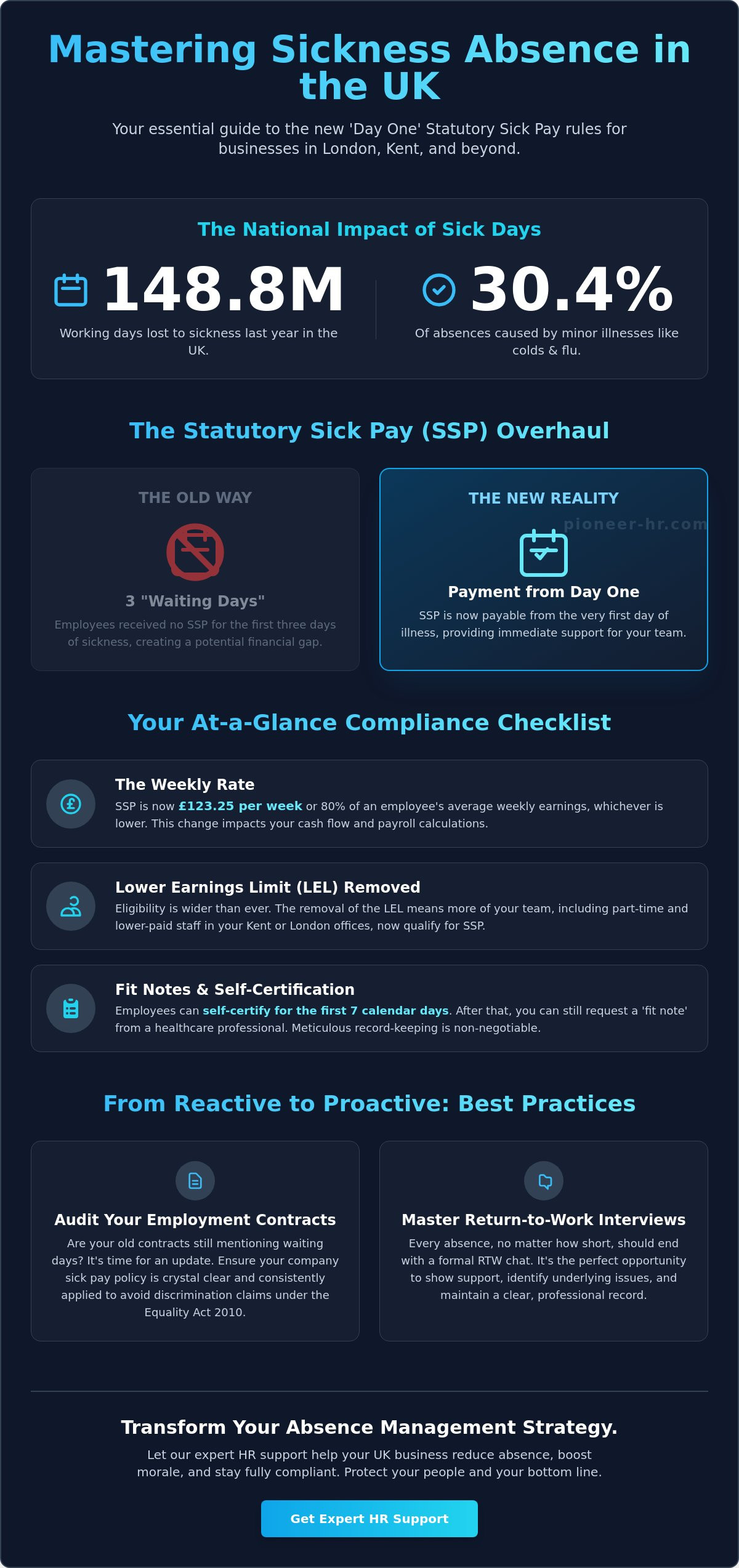
For the 2026/27 tax year, the weekly rate of Statutory Sick Pay is £123.25, or 80% of the employee's average weekly earnings, whichever is lower. This isn't just a rate hike. The real change lies in the abolition of the three "waiting days." Since April 6, 2026, employees are entitled to SSP from their very first day of illness. We've seen that for many SMEs in Kent, this immediate entitlement creates a new pressure on weekly cash flow. Additionally, the removal of the Lower Earnings Limit means even your part-time or lower-paid staff are now fully within the scope of the Statutory Sick Pay (SSP) rules. You still have the right to ask for a "fit note" after seven calendar days of self-certification; however, managing sickness absence uk law effectively in 2026 means your record-keeping must be sharper than ever to track these day-one payments accurately.
Contractual vs. Statutory: Which One Wins?
With these statutory changes, your existing employment contracts might be working against you. Many older contracts in Sussex and London firms were written with the three-day waiting period in mind. If your current reward strategy includes enhanced company sick pay, you must ensure the interaction between your private scheme and the new SSP rules is crystal clear. Relying on "discretionary" sick pay is increasingly risky in 2026. If you apply discretion inconsistently, you open the door to claims under the Equality Act 2010, particularly if an employee has a long-term condition that qualifies as a disability. We often recommend a thorough HR audit to align your contracts with these 2026 realities, ensuring you stay generous enough to retain talent without compromising your business's financial sustainability.
Managing Frequent Short-Term Absence: Capability vs. Conduct
Frequent short-term absences often pose a greater challenge to business continuity than a single long-term case. Whether you're running a boutique agency in London or a logistics hub in Kent, the unpredictability of "odd days off" disrupts workflows and damages team morale. This is where the psychological contract comes into play. When one employee is frequently absent, the remaining team members often feel the strain of an increased workload, which can lead to resentment and a dip in overall productivity. In 2025, minor illnesses like colds and flu accounted for 30.4% of all absences, proving that short-term issues remain the primary driver of lost time.
In the context of managing sickness absence uk law, you must distinguish between conduct and capability. Conduct issues arise when you suspect an employee is being dishonest about their illness. Capability, however, applies when the employee is genuinely unwell but their frequent absence makes it impossible for them to fulfill their role. Navigating a capability dismissal is a delicate process. You need a clear paper trail to prove that you've acted reasonably and explored all supportive avenues before reaching a final decision. Relying on retained HR support ensures that your managers have the expert guidance needed to handle these sensitive cases without triggering a tribunal claim.
The Role of Return-to-Work (RTW) Interviews
A casual "how are you?" in the breakroom doesn't constitute a proper audit trail. Every period of absence, no matter how short, should trigger a formal RTW interview. We recommend focusing on three essential questions: Are you fully fit to perform your duties? Is there an underlying cause for this absence we should be aware of? Is there any specific support we can provide to help you stay at work? These meetings help you identify trends, such as musculoskeletal issues or mental health struggles, which were significant factors in the 148.8 million working days lost across the UK in 2025.
Trigger Points and Fair Warnings
Transparency is your best defense against litigation. You should establish clear "trigger points" that prompt an formal absence review. While the Bradford Factor remains a popular weighting tool in 2026, it shouldn't be used in isolation or without human context. Consistency is vital; if a manager in your Sussex office ignores a trigger that a London manager enforces, you risk a claim of unfair treatment. Establishing these thresholds ensures that managing sickness absence uk law remains a structured, objective process rather than a series of reactive, emotional decisions. Warnings must be proportionate and should always be accompanied by an offer of support or a discussion about potential workplace adjustments.
Long-Term Sickness: Balancing Empathy with the Equality Act 2010
While frequent short-term absences are disruptive, long-term sickness presents the most significant legal risks for employers. When an absence extends beyond a few weeks, your focus must shift from simple attendance tracking to the nuances of the Equality Act 2010. Managing sickness absence uk law in this context requires you to understand if an employee’s condition meets the legal definition of a disability. It isn't just about visible conditions; mental health struggles and chronic musculoskeletal issues often qualify if they have a substantial, long-term impact on daily life. If you aren't sure where the line is, we recommend commissioning an Occupational Health report to get a professional medical perspective before making any major decisions.
The "Permanent Incapacity" hurdle is a common point of confusion. There’s no magic number of weeks after which you can legally terminate employment. Instead, a tribunal will look at whether you’ve acted reasonably. Have you consulted with the employee? Have you sought medical advice? Most importantly, have you considered every possible reasonable adjustment? If you're struggling with these high-level strategic decisions, our Fractional Chief People Officer services can help you navigate these complexities with a focus on both compliance and compassion.
Reasonable Adjustments in Practice
The duty to make adjustments is proactive. For a London-based corporate office, an adjustment like a permanent shift to remote work or expensive ergonomic equipment might be considered "reasonable" due to their resources. However, for a small SME in Kent, the same request might be disproportionately disruptive or costly. You must document every adjustment you consider. If you decide an adjustment is unreasonable, you need a clear, objective record of why. This documentation is your primary defense against a discrimination claim; it proves you didn't just ignore the request but evaluated it fairly against your business needs.
Maintaining Contact Without Harassment
We see many managers fall into the "out of sight, out of mind" trap, but silence can be just as damaging as harassment. The golden rule is to agree on a communication schedule early on. Whether it's a fortnightly phone call or a monthly email, regular contact keeps the employee connected to the workplace culture. It also helps you manage the impact on the rest of the team. When a role is left empty for months, your other staff in Sussex or London may feel the burn of "absence fatigue." Keeping the lines of communication open allows you to plan for a phased return or temporary cover more effectively—perhaps by engaging a specialized agency like Operational Chef Consultant for interim support—protecting your wider team’s engagement.
Step-by-Step: Conducting an Effective Absence Review Meeting
Conducting a formal review is often the most nerve-wracking part of the process for managers. Whether you're based in a quiet office in Kent or a fast-paced firm in Brighton or Hove, the quality of this conversation dictates the outcome of the case. Effective managing sickness absence uk law starts long before you sit down. You must gather all relevant data, including return-to-work forms, fit notes, and any previous meeting notes. This isn't about building a case against someone; it's about having a clear, objective foundation for a supportive and professional discussion. We believe that preparation is the bridge between a stressful confrontation and a strategic resolution.
One non-negotiable legal requirement is the employee's right to be accompanied by a colleague or trade union representative. Failing to offer this right in your invitation letter can compromise the entire process if the case ever reaches a tribunal. Once the meeting concludes, your follow-up is your most important document. The 'minutes' or summary of the meeting serve as your primary legal audit trail. They should accurately reflect the support you've offered, the employee's explanations, and the agreed next steps. Without these records, even the most well-intended meeting is vulnerable to challenge.
The Meeting Agenda: A Manager’s Script
Open the conversation with a supportive tone. Instead of jumping straight into the statistics, ask how they're feeling and if there's anything the business can do to help. You can address the impact on the business without sounding cold by explaining how their absence affects project timelines or peer workloads in your London office. The goal is to agree on an action plan with specific, measurable outcomes. This might include a phased return or a temporary change in duties, with a clear date set for a follow-up review. This structured approach ensures the employee feels heard while maintaining professional standards.
Handling Difficult Reactions
It's common for employees to feel defensive or emotional during these sessions. If someone becomes too distressed, it's perfectly acceptable to pause the meeting and offer them a moment to compose themselves. In some cases, the meeting itself can be cited as a source of stress, leading to further absence. This is a critical moment where you might need to pause and seek retained HR support to ensure you're following a fair and reasonable process. If you feel your team leaders are struggling with these conversations, our specialized Management Training can provide them with the tactical skills and confidence to lead these meetings effectively while staying within the boundaries of the law.
How Pioneer HR Protects Your Business and Your People
Managing the complexities of managing sickness absence uk law shouldn't feel like a solo journey through a legal maze. For many SMEs in Brighton, Hove, and across the UK, the instinct is to call an employment lawyer the moment a case gets complicated. While legal advice has its place, it's often a reactive, expensive "cure" rather than a proactive "prevention." This is where the strategic value of a Fractional CPO becomes evident. We don't just tell you what the law says; we help you build the systems that ensure you stay on the right side of it while maintaining a high-performance culture.
Our approach is grounded in the belief that absence management is an extension of your wider Reward Strategy. If your team feels undervalued or if your pay structures are misaligned with the market, disengagement often manifests as increased sickness absence. By conducting a tailored HR audit for your business in Kent or London, we identify these hidden triggers. We help you move beyond the "day one" SSP administrative burden and focus on creating a workplace where people actually want to show up and contribute. We look at the data.
Strategic Absence Reduction
Moving from reactive "firefighting" to a proactive wellbeing culture requires a shift in mindset. We analyze your internal metrics to see if "disengagement absence" is a factor in your organization. Often, the solution isn't a stricter policy but a better understanding of how your team perceives their value. This is why we emphasize the importance of Salary Benchmarking UK: A Strategic Guide for Employers in 2026. When employees feel they're paid fairly and their rewards are structured strategically, their commitment to the business naturally increases. This leads to a measurable reduction in short-term absence rates.
Your Dedicated HR Partner
The 2025 legislative changes brought a lot of noise and confusion to the market. Having a partner who understands the nuances of managing sickness absence uk law provides more than just compliance; it provides peace of mind. We act as an extension of your team, providing the steady hand needed to navigate sensitive return-to-work meetings and complex disability adjustments. We take the stress out of the process. This allows you to focus on growing your business while we ensure your people are supported and your risks are mitigated. Ready to get your absence management back on track? Contact Pioneer HR today to discuss how our retained support can protect your organization and your employees.
Build a Resilient and Compliant Workforce for the Future
The landscape of UK employment has fundamentally changed with the 2026 SSP reforms. Successfully managing sickness absence uk law requires more than just knowing the new £123.25 weekly rate; it demands a shift toward proactive, documented support. Whether you're navigating a complex disability case in London or setting up trigger points for a team in Kent, your approach must be both legally robust and human-centered. By focusing on clear communication and consistent return-to-work procedures, you protect your culture and your bottom line.
You don't have to manage these legislative shifts alone. With over 30 years of HR expertise, we specialize in helping SMEs maintain full compliance while reducing absence rates through strategic organizational development. Our fixed-cost monthly support ensures you have a dedicated partner to handle the stress of policy audits and difficult meetings. Secure your business with expert Retained HR Support from Pioneer HR and turn your absence management into a strategic advantage. We're ready to help your business thrive with confidence and clarity.
Frequently Asked Questions
Can I legally dismiss an employee for frequent short-term sickness in 2026?
Yes, you can dismiss an employee for frequent absence, but it must be handled as a capability issue rather than a disciplinary one. You need to demonstrate that you've followed a fair process, including formal meetings, clear warnings, and an exploration of any underlying health issues. For businesses in London or Kent, the key is showing that the level of absence is unsustainable for your operations and that you've offered all reasonable support before taking final action.
What are the new Statutory Sick Pay (SSP) rules following the 2025 Act?
As of April 6, 2026, the most significant change is that SSP is now a day one right. The previous three day waiting period has been abolished, meaning employees are entitled to pay from their first day of illness. The weekly rate for the 2026/27 tax year is £123.25. Additionally, the Lower Earnings Limit has been removed, so all employees qualify for SSP regardless of their weekly earnings level.
How do I handle a Fit Note that says an employee may be fit for work?
This status means the employee could return if specific adjustments are made. You should meet with them to discuss the doctor's suggestions, such as amended duties, altered hours, or a phased return. If your business can't accommodate these changes, the employee should be treated as not fit for work and continue their leave. Documenting these discussions is vital for managing sickness absence uk law compliance and protecting your business from future claims.
What is considered a reasonable adjustment for a mental health condition?
Reasonable adjustments for mental health often involve flexibility rather than physical equipment. This might include a phased return to work, temporary part-time hours, or allowing them to work from home to avoid a stressful commute into Central London. Since mental health conditions accounted for 8.9% of UK absences in 2025, proactive support like adjusted deadlines or regular check-ins can help an employee stay productive while they recover.
Can I contact an employee while they are off on long-term sick leave?
Yes, you have a right and a duty to maintain reasonable contact with absent staff. The goal is to check on their wellbeing and keep them updated on workplace news so they don't feel isolated or forgotten. We recommend agreeing on the frequency and method of contact early in the absence. This prevents the employee from feeling harassed while ensuring they remain connected to your company culture and the team.
What happens if an employee's sickness absence is caused by work-related stress?
You must treat work-related stress with extra caution as it carries a higher risk of personal injury or constructive dismissal claims. Start by conducting a stress risk assessment to identify specific triggers like workload, bullying, or interpersonal conflict. Addressing the root cause through management training or organizational development is often more effective than simply waiting for the employee to return. You have a legal duty to provide a safe working environment.
Do I have to pay SSP to an employee who is only off for one day?
Yes, you must pay SSP for a single day of absence under the rules that came into effect on April 6, 2026. The removal of waiting days means that every qualifying day of sickness is now a payable day. While this increases the administrative burden for payroll teams in Kent and Sussex, it's a non-negotiable legal requirement for all UK employers. You must track these one day absences accurately to ensure your payroll remains compliant.
What is the difference between a capability procedure and a disciplinary procedure?
The core difference lies in whether the employee can't or won't do the work. A capability procedure is used when an employee is genuinely ill and unable to meet attendance standards despite your support. A disciplinary procedure is reserved for conduct issues, such as when you have evidence that an employee is faking an illness or failing to follow notification rules. managing sickness absence uk law effectively requires using the correct framework to avoid expensive unfair dismissal claims at a tribunal.



Comments