
How to Measure Employee Engagement and Act on What You Learn
A survey only measures engagement well when people can answer honestly and see that their feedback will lead to action. To understand how to measure employee engagement, prepare clear, anonymous questions, pilot them before launch and plan how you’ll respond to the findings. An annual survey typically contains 30 to 50 questions, while a comprehensive survey should take employees about 10 minutes to complete.
It’s easy to focus on the questionnaire, but measuring employee engagement is useful only when it gives you a credible picture of employees’ experiences and informs practical decisions. Explain why you’re asking for feedback and how you’ll share what you learn.
This guide covers how to prepare a survey, choose complementary ways to gather insight, communicate results and turn patterns into focused action. It also considers related organisational measures, such as retention and absence, so you can interpret survey findings in context rather than treating one score as the whole story.
Table of Contents
What should you do before measuring employee engagement?
Set a clear purpose before choosing questions, so the feedback can inform useful decisions. Use an annual engagement survey as a company-wide baseline, then add pulse surveys when you need to track a specific issue.
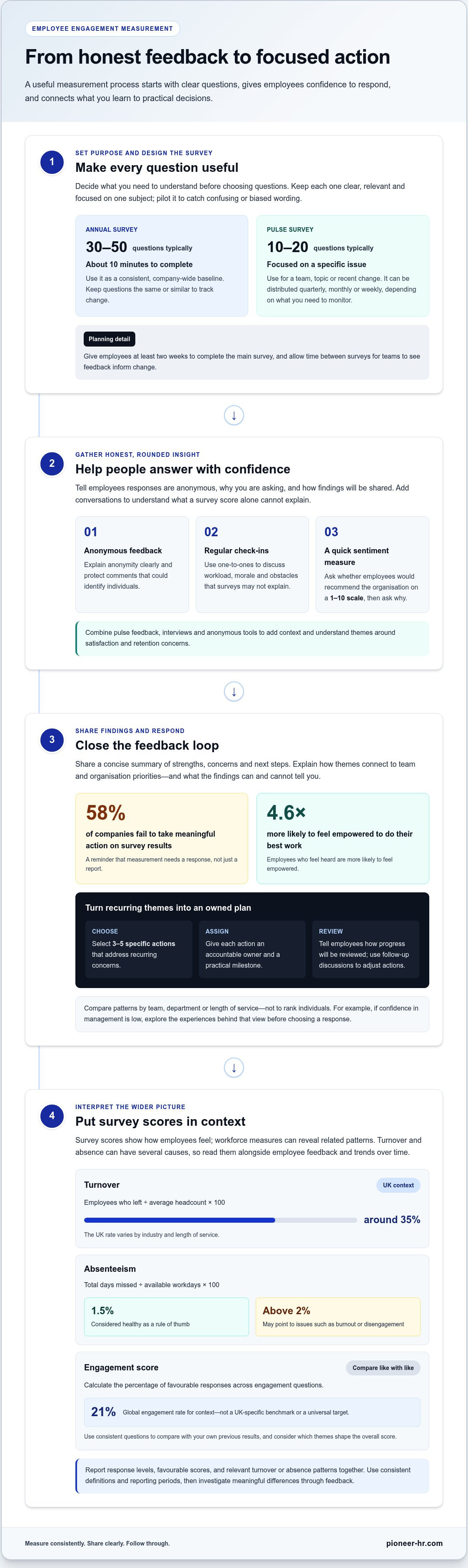
Select Questions and Avoid Survey FatigueChoose questions that connect directly to your goals, such as satisfaction with management, workload or development. An annual survey typically contains 30 to 50 questions and takes about 10 minutes to complete. Keep each question clear, relevant and focused on one subject, so employees can answer without guessing what you mean. Pilot the survey first to catch confusing or biased wording. Avoid repeating questions that won’t inform action, as excessive surveys can reduce response and effort.
Set a Measurement FrequencySet an annual survey as your consistent company-wide measure, keeping questions the same or similar to identify changes over time. Use pulse surveys to explore a specific focus area, team or recent company change. They’re typically 10-20 questions and can be distributed quarterly, monthly or weekly, depending on what you need to monitor. Give employees at least two weeks to complete the main survey. Leave enough time between surveys for teams to see feedback inform change.
Use Ongoing Check-Ins and Anonymous FeedbackTell employees clearly that survey responses are anonymous, and explain how findings will be shared. Add regular one-to-one check-ins to discuss workload, morale and obstacles that a survey may not explain. For a quick sentiment measure, ask whether employees would recommend the organisation on a 1-10 scale. Ask why they chose that score, then use their explanations to identify themes. Anonymous tools, pulse feedback and interviews can add context, while helping you understand retention concerns and satisfaction.
Communicating results and taking action
Close the feedback loop by sharing what employees said, what the organisation learned and what happens next. Communication is part of measurement: employees need to see how their input informs decisions.
Communicate the ResultsShare a concise summary of strengths, concerns and next steps with employees. Explain which engagement themes matter to team and organisation priorities, without publishing comments that could identify individuals. Knowing how to measure employee engagement also means explaining what findings can and can’t tell you. Avoid presenting a score without context; employees should understand who will respond and how progress will be shared. 58% of companies fail to take meaningful action on survey results.
Review Trends and Employee FeedbackCompare results by team, department or length of service to spot patterns rather than rank individuals. Teams deciding how to measure employee engagement over time should compare consistent measures, then gather context through conversations or focused follow-up feedback. If a team reports low confidence in management, ask what experiences shape that view before choosing a response. Employees who feel heard are 4.6 times more likely to feel empowered to do their best work.
Turn Findings Into Action PlansSelect 3-5 specific actions that address recurring concerns, and assign an accountable owner to each. Agree a practical milestone and explain to employees how progress will be reviewed. For example, if feedback points to workload pressure, managers could review priorities with teams and report back on changes. Avoid promising fixes before understanding the issue. Use follow-up discussions to assess whether actions are helping, then adjust plans when new feedback or workplace trends point elsewhere.
Other organisational metrics for measuring engagement
Survey scores show how employees feel, while organisational metrics can reveal related patterns. Consider both carefully: turnover or absence may have several causes, so interpret them alongside employee feedback.
Track Turnover and AbsenteeismCalculate turnover by dividing employees who left by average headcount, then multiplying by 100. The UK rate is around 35%, though it varies by industry and length of service. Calculate absenteeism by dividing total days missed by available workdays, then multiplying by 100. A 1.5% absence rate is considered healthy as a rule of thumb; a rate above 2% may point to issues such as burnout or disengagement. Check trends over time, not one isolated result.
Calculate and Compare Engagement ScoresEmployee engagement reflects employees’ connection with their work and organisation; measure it through survey responses and related workforce metrics. Calculate an engagement score as the percentage of favourable responses across engagement questions. A global engagement rate of 21% offers context, but it isn’t a UK-specific benchmark or a universal target. Compare your score with your own previous results, using consistent questions, and consider which themes shape the overall result.
Report Metrics Across Teams and DemographicsBreak down results by department, team and demographic to see where employee experiences differ. Report response levels, favourable scores and relevant turnover or absence patterns together, giving managers context rather than a single headline. Use consistent definitions and reporting periods for each group. Check that comparisons reveal a meaningful pattern, then investigate through feedback before deciding whether targeted action could improve engagement.
Why organisations measure employee engagement
Use an employee engagement survey to connect employees’ experiences with decisions about culture, leadership and business priorities. Measurement matters when it helps leaders understand what supports people’s ability to contribute, and where a change in strategy may be needed.
Identify what helps people do their best work. Ask about purpose, support, workload and development, then use responses to understand what strengthens or limits employees’ ability to contribute. Gallup reported that 23% of employees were engaged in 2023, a reminder that leaders shouldn’t assume people feel connected to their work. Use regular measurement to track your organisation’s own patterns rather than relying on a broad figure as a local target.
Connect employee experience with organisational outcomes. Compare survey themes with measures such as retention, productivity and absenteeism. If employees report unclear priorities, for example, managers can explore whether teams also experience duplicated effort or missed handovers. These connections help leaders decide which workplace issues deserve attention, without assuming that one metric explains performance or turnover.
Make culture and leadership decisions more specific. Use department-level feedback to see whether an issue affects the whole organisation or particular teams. A pattern of low confidence in communication, for example, may call for clearer updates from leaders, while concerns limited to one area may need a local response. This gives your strategy a clearer basis than anecdotal feedback alone.
Assess whether action is changing the experience. Set a baseline, agree what improvement would look like, then use regular follow-up measures to review progress. Use the findings to inform the business case for taking engagement seriously, while grounding decisions in your organisation’s own evidence, priorities and culture.
Pioneer HR: Retained HR Support
Pioneer HR’s Employee Engagement Surveys and Retained HR Services can help organisations connect employee feedback with practical people priorities. This support is useful when you need to design a measurement approach, interpret findings or develop a considered response to recurring themes. If results raise questions about pay or recognition, Salary Benchmarking and Reward and Benefits Review can also inform your review.
If your organisation needs senior people leadership to shape the wider approach, a Fractional Chief People Officer may be relevant. The right next step depends on the challenge you’re addressing, whether that’s gathering insight, understanding patterns or aligning action with organisational priorities. Contact Pioneer HR to discuss how its support could fit your organisation’s needs.
Make employee insight part of everyday decisions
Make listening a continuing management practice, not a task that ends when survey results arrive. Choose one employee concern to explore, invite managers to discuss it with their teams, and agree how you’ll recognise progress. This keeps attention on the experiences behind the numbers and gives employees a meaningful role in shaping improvements.
Knowing how to measure employee engagement is most useful when leaders connect the findings to considered people decisions. Pioneer HR offers Employee Engagement Surveys, Retained HR Services, Salary Benchmarking and Reward and Benefits Review to help organisations understand employee feedback and consider people priorities. The right support can help you move from measurement to a focused response that fits your organisation.
Talk to Pioneer HR about engagement and explore a thoughtful next step for your team. Consistent listening can help build a workplace where employees’ perspectives inform decisions and action.
Frequently Asked Questions
Are pulse surveys sufficient?
Pulse surveys are useful for monitoring a specific concern, but rarely provide full context on their own. For example, a short survey can show whether communication improved after a restructure, while interviews can explain what employees experienced. Combine pulse results with a broader annual measure and regular conversations to understand organisation-wide patterns. Give each method a clear purpose, and avoid repeatedly asking employees for feedback without responding.
Can exit interviews provide engagement feedback?
Yes. Exit interviews can reveal what influenced someone’s decision to leave, including management, workload, development or workplace culture. Ask consistent, open questions, such as what might have encouraged them to stay, and look for recurring themes across departures. Treat these insights as one perspective: departing employees may have different experiences from those who remain, so compare their feedback with current employees’ views.
Which employee engagement survey questions should employers ask?
Ask clear questions about employees’ day-to-day experience: whether they understand priorities, receive useful feedback, have the resources to do their work and see opportunities to develop. Include an open-response prompt, such as “What one change would improve your working day?” Avoid double questions that combine separate issues, because an employee may feel supported by their manager but unclear about expectations.
What are the best methods for measuring employee engagement beyond surveys?
Use structured one-to-one check-ins, stay interviews, exit interviews and performance conversations to explore experiences in more depth. Focus groups can help teams discuss shared themes, though some employees may hold back in front of colleagues. Manager assessments and 360-degree feedback can add insight into leadership behaviours. Choose methods that suit the question, and compare qualitative feedback with operational patterns rather than treating one conversation as representative.
Which employee engagement metrics should UK employers track?
Alongside survey results, monitor retention, turnover, absence, overtime, training participation, promotion patterns and benefit uptake. These measures can help identify where employee experience needs closer attention. For example, low participation in a development programme could prompt managers to explore access, relevance or workload barriers. Interpret metrics together across consistent periods, because a single measure rarely explains why employees feel engaged or disconnected.
How can employers protect employee anonymity and comply with UK GDPR when measuring engagement?
Explain what feedback will be collected, why it’s needed, who can access it and how long it will be kept. Collect only information relevant to the survey’s purpose, restrict access to appropriate staff and avoid reporting comments that could identify someone. Take particular care with small teams, since details such as a role or incident can reveal identity even without names. Set clear handling procedures before inviting responses.



Comments