
How to design fair bonus and incentive plans in the UK
A bonus plan can reward the wrong behaviour when it measures only individual results. Effective bonus and incentive plan design in the UK links rewards to outcomes employees can influence while recognising the wider team’s contribution.
That balance matters: clear individual measures can recognise accountability, while shared goals encourage collaboration. An annual incentive plan connects performance to a cash reward over a 12-month period, so employees need to understand what is measured, how results affect payouts and how the plan supports the organisation’s priorities.
A fair scheme does not have to treat every role identically. It should set transparent, achievable measures that fit each role and how the work is done, while recognising creative problem-solving rather than rewarding volume alone.
This guide explains how annual incentives work, how to combine individual, team and company measures, and how to set targets and payouts that support performance and creativity. It also covers practical design choices to make a scheme clear, financially sustainable and aligned with your UK organisation’s goals.
Table of Contents
What is an Annual Incentive Plan?
Design the plan around its purpose, measurement period and eligible roles. For UK organisations, compare cash rewards with longer-term awards before deciding on the structure.
Distinguish Incentive Plans from Traditional BonusesDefine whether the reward is a planned incentive or a traditional bonus. An annual incentive plan links performance to a cash reward over a 12-month period, with transparent measures and payout rules. A traditional bonus may be less formulaic, so set out whether it depends on company results, individual contribution or management discretion. Keep commission separate where it rewards specific sales activity, and explain how each payment reflects effort.
Compare Short- and Long-Term IncentivesMatch the incentive period to the result employees can influence. Short-term plans commonly assess performance over one year; long-term incentive plans typically reward performance over 3-5 years. Cash awards suit annual objectives, while share or option plans can connect value to longer-term organisational outcomes. UK employee or director share and option awards may be employment-related securities under the Income Tax (Earnings and Pensions) Act 2003, according to The National Archives.Compare current and replacement plans using the same performance scenarios. Record changes to eligibility, measures and award timing, then show how outcomes differ by role. Tailor targets to responsibilities and working context, including differences between London-based and other UK teams. Phantom awards track share value without granting shares; hybrid plans combine cash and equity-based elements.
Review Tax, Employment, and Design RisksSet out cash bonuses and share-based awards separately in plan documents. Explain that payroll deductions affect take-home cash awards, while share and option awards need their own tax and National Insurance assessment. For employment terms, state whether a bonus is discretionary or contractual, and document eligibility, performance criteria and payment conditions so employees understand the rules.Review outcomes across comparable roles and groups before launch. Inconsistent access, unclear discretion or unexplained award differences can undermine fairness and raise discrimination or equal pay concerns. Apply consistent criteria, document exceptions and explain how decisions are made. Clear records also help when comparing the existing plan with its replacement.
How do you balance individual and team bonuses?
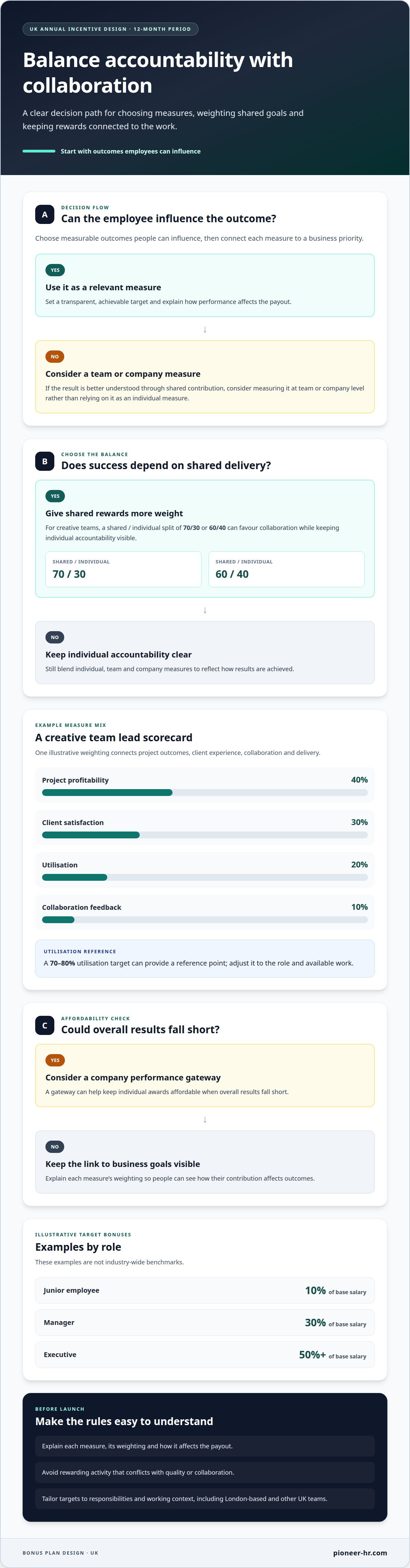
Strong bonus and incentive plan design in the UK recognises individual contribution without undermining collaboration. Choose measurable outcomes employees can influence, then assess how each metric supports business goals.
Choose Individual, Team, and Company MeasuresBlend company, team and individual measures to reflect how results are achieved. A company performance gateway can help ensure individual awards remain affordable when overall results fall short. For creative teams, a 70/30 or 60/40 split can favour shared rewards while retaining individual accountability. Explain each measure’s weighting so employees can see how their contribution affects outcomes.
Link Metrics to Business GoalsConnect each metric to a specific business priority, such as revenue growth, project profitability or client satisfaction. Avoid rewarding activity that conflicts with quality or collaboration. For a creative agency, one example weights team project profitability at 40%, client satisfaction at 30%, collaboration feedback at 10% and utilisation at 20%. A 70-80% utilisation target can provide a reference point, but should reflect the role and available work.
Select Performance Share StructuresUse performance share plans when awards should depend on company results over time; consider growth shares when the aim is to reward value growth above an agreed threshold. These differ from cash bonuses because their value depends on the plan’s terms and business performance. Set out the relevant metrics and explain how employees benefit from meeting them. Do not treat equity awards as interchangeable with commission or annual cash incentives.
Set Vesting and Performance ConditionsSpecify what must happen before an award vests, including performance conditions, timing and treatment of leavers. A UK long-term incentive plan may combine vesting over 4 years with a one-year cliff. Explain how sickness, parental leave and departures affect eligibility and awards in the written scheme. Set a consistent process for performance disputes, with evidence, decision-making responsibility and a route to review. Reviewing bonus and incentive plan design in the UK against these cases can help keep decisions consistent and fair.
How do you structure bonuses to nurture creativity?
Set a clear link between creative contribution, measurable targets and potential reward. Illustrative target bonuses include 10% of base salary for a junior employee, 30% for a manager, and 50% or more for an executive; these are examples, not industry-wide benchmarks.
Define Measures and Award LimitsChoose measures that value outcomes as well as delivery. A creative team lead plan could weight project profitability at 40%, client satisfaction at 30%, collaboration feedback at 10% and utilisation at 20%. Set a maximum award and a threshold below which no payment applies. Explain how each measure is assessed, so employees can see what earns a reward and what limits the payout.
Set Realistic, Stretching TargetsUse recent performance and role responsibilities to set targets that require effort without making achievement implausible. For example, a project target might pair an agreed quality measure with completion within 10% of budget. Check whether employees can influence each target during the measurement period. If changing client priorities or resource constraints determine the result, adjust the measure rather than penalising creative judgement.
Weight Targets and MeasuresAllocate weightings according to business priorities, and make the total equal 100%. A 40% profitability measure should influence earnings more than a 10% collaboration measure, while both can recognise distinct contributions. Avoid giving every activity equal weight by default. Test how different results affect awards, including strong teamwork alongside weaker individual outcomes, before explaining the final structure to employees.
Map Targets to Payout CurvesShow how performance translates into payment at threshold, target and maximum. One example curve pays 50% of the target award at 80% performance, 100% at target, and 150% at 120% performance, with no payout below 80%. Explain whether results between points are interpolated and how a maximum award applies. Review the curve annually, so targets and earnings remain aligned with the work employees can influence.
Bonus plan design
Effective bonus and incentive plan design in the UK begins with a clear purpose, a sustainable funding basis and rules employees can understand. Use this practical sequence to shape a scheme around the behaviours and business outcomes that matter.
Set the purpose and funding basis. Decide whether the plan should motivate revenue growth, quality, collaboration or another priority. For a creative agency with £500,000 revenue and £300,000 in direct team costs, gross profit is £200,000. Allocating 10% of that amount creates a £20,000 annual bonus pool. This connects potential rewards to business performance.
Choose a period that fits the work. Annual awards can suit goals whose results take time to emerge, while sales incentives are often paid monthly or quarterly. Match the measurement period to how long employees can influence results. Consider whether shorter cycles support changing priorities or risk encouraging short-term decisions.
Test affordability before launch. Model outcomes below, at and above target, including different combinations of company, team and individual performance. If historic data is incomplete, agree assumptions and show their effects. Modelling compares scenarios; actual costs depend on performance, eligibility and final plan rules.
Make the rules understandable. Explain eligibility, measures, calculations, payment timing and conditions in plain language. Employees should be able to see how achievement affects potential earnings. Avoid distributing pots through managers without clear criteria, as this can feel like retrospective recognition rather than an incentive. Clear communication is central to bonus and incentive plan design in the UK.
Review results after each cycle. Compare actual awards with modelled outcomes and assess whether the scheme encouraged the intended behaviour. If revenue goals were met but quality weakened, revisit the measures or their weightings. Employee feedback can reveal confusing rules and perceived unfairness, helping improve future bonus and incentive plan design in the UK.
For support aligning reward with business priorities, explore a tailored reward strategy.
Pioneer HR
Pioneer HR helps UK employers connect bonus decisions with wider people and business priorities. If you’re reviewing whether measures feel fair, whether awards fit different roles, or how a new scheme aligns with pay, its Reward Strategy support can help shape a coherent approach. Salary Benchmarking can inform decisions about reward levels, while Retained HR Support and Fractional Chief People Officer support can help organisations address broader people priorities. These options may be useful when an existing plan needs a fresh review or a new approach needs to fit your organisation’s structure. Contact Pioneer HR to discuss your bonus and incentive plan.
Make your next reward decision count
A bonus scheme also signals what your organisation values. As roles, priorities and employee expectations change, review the plan rather than treating it as a fixed formula. Thoughtful bonus and incentive plan design in the UK can keep rewards relevant to employees’ work and the outcomes the organisation needs.
If you are considering what to change, Pioneer HR can connect reward decisions with your wider people strategy. Its Reward Strategy, Salary Benchmarking and Retained HR Support help employers consider how incentive plans relate to pay, roles and ongoing HR priorities. The right starting point depends on the challenge, whether you are reviewing existing arrangements or shaping a more coherent approach.
Contact Pioneer HR to discuss your bonus plans and take a considered next step.
Frequently Asked Questions
What is a Bonus Plan?
A bonus plan explains how an employer may award additional pay for defined results or contributions. It can use company, team or individual outcomes, or combine them. For example, an employer might link an award to delivery quality as well as financial performance. The written rules should explain eligibility, how results are assessed and how decisions are communicated.
What is the purpose of a bonus scheme?
A bonus scheme aims to focus attention on priorities the organisation values, such as sustainable growth, service quality or cooperation between teams. It can also recognise contributions that base pay does not distinguish. Make the purpose specific: if collaboration matters, include a way to recognise it rather than rewarding individual output alone. This helps employees understand why the scheme exists.
Do bonuses motivate employees?
Bonuses can support motivation when employees see the scheme as fair and understand how their actions affect the outcome. A reward is less effective if targets seem beyond an employee’s control or decisions appear inconsistent. Consider how different roles experience the scheme, and invite feedback after a payment cycle. Use that feedback to assess whether the reward encourages the intended behaviours.
How often should you review and pay out bonuses?
Review the plan at least at the end of each measurement cycle, and set payment timing to match how quickly results can be assessed. Bonus plans are commonly paid quarterly or annually, though some organisations pay monthly. Reviews can happen separately from payments: check whether measures remain relevant, calculations are clear and outcomes support the scheme’s original purpose.
What types of bonus and incentive plans are common for UK employers?
UK employers may use individual, team or company bonuses, sales commission, profit-sharing arrangements and longer-term share-based incentives. The right form depends on the behaviour being rewarded and how long employees need to influence results. A sales role might use commission tied to sales outcomes, while a wider team scheme could recognise shared organisational performance. Some employers combine approaches across roles.
How should UK employers set bonus targets, metrics and payout levels?
Start with business priorities, then choose a small number of measurable outcomes employees can influence. Define how each metric is calculated, where its data comes from and what happens when performance falls between target levels. Test sample scenarios, including results that differ across measures, before setting payout levels. Clear definitions help employees understand how the scheme distinguishes achievement from activity.



Comments